Every maintenance failure in a hotel starts the same way: someone knew something and told the wrong person, or told the right person too late, or told nobody at all. The overnight engineer noticed the chiller was running warm. He mentioned it to the outgoing supervisor verbally. The supervisor forgot to write it in the logbook. The incoming team found out when a guest called at 8am from a room that had been warm all night. The front desk manager found out when a review went live at 9am. The general manager found out at the 10am briefing. Four hours, four communication failures, one preventable guest incident. Now multiply that across three shifts a day, 365 days a year. Hotels that have not structured their maintenance communication workflows spend an average of 62% of their maintenance budget reactively — more than double the 31% benchmark for properties with connected operations platforms. Oxmaint connects every maintenance event — from first report to verified resolution — in a single workflow where every team member sees what they need to see, instantly. Hotels using Oxmaint resolve issues 82% faster, cut overtime by 34%, and reduce guest complaints attributable to maintenance failures by 61%. If your property still runs on radio calls, paper handovers, and WhatsApp chains, book a demo and we will map exactly where your communication chain breaks — or start a free trial and see the workflow live on your property today.
Poor Maintenance Communication Costs Full-Service Hotels $420K–$1.1M Per Year
The financial impact of fragmented maintenance communication is not visible in a single incident. It accumulates invisibly across thousands of micro-failures — missed handovers, re-routed radio calls, duplicated work orders, delayed completions — until it defines a property's operational baseline. The gap between what maintenance teams know and what they communicate is where budget disappears.
6 Communication Failures That Break Hotel Maintenance Operations
These are structural workflow failures — not technology problems — that emerge when maintenance communication relies on radios, paper, and verbal handovers. Each one is independently costly. Together, they define the pattern that determines how much a property spends reactively versus preventively. Book a demo and we will identify which of these are active at your property right now.
Verbal Handovers Miss Critical Items
Shift briefings are rushed, undocumented, and dependent on memory. Items not explicitly spoken are not actioned. A fault logged at 2am becomes a guest complaint at 8am because it was never said out loud.
Radio Routing Reaches the Wrong Person
Radio calls broadcast to everyone but land with whoever answers first — who may be in the wrong zone, unqualified, or mid-task. The right technician gets it 20–40 minutes later after re-routing. The guest is still waiting.
Parallel Reporting Creates Duplicate Work Orders
Guest calls front desk about a broken shower. Front desk calls engineering. Housekeeping reports it separately. Two technicians respond independently. One wasted a full trip. 68% of hotels experience regular duplicate dispatch.
Supervisors Blind to Real-Time Task Progress
With no visibility, supervisors either interrupt technicians constantly for status updates or assume completion and release rooms early. Both failure modes generate guest incidents and unnecessary overtime.
Completion Never Reaches Other Departments
Engineering fixes a room and marks it complete — but housekeeping is not notified, so the room stays blocked. Front desk cannot assign it. A 20-minute repair generates a 90-minute room blockage because no one communicated the close.
No Data to Break Repeat Failure Cycles
When maintenance lives in radios and paper, there is no performance record. Which asset causes the most calls? Which floor has the worst repeat rate? Without a digital communication layer, every failure is a surprise.
From Issue Reported to Verified Resolution — One Connected Workflow
Oxmaint replaces every manual communication step in the maintenance cycle with a structured, trackable digital workflow. The same cycle that currently takes hotels an average of 4.2 hours completes in 47 minutes. Start a free trial to activate this workflow on your property today.
Issue Reported — Any Channel, Any Device
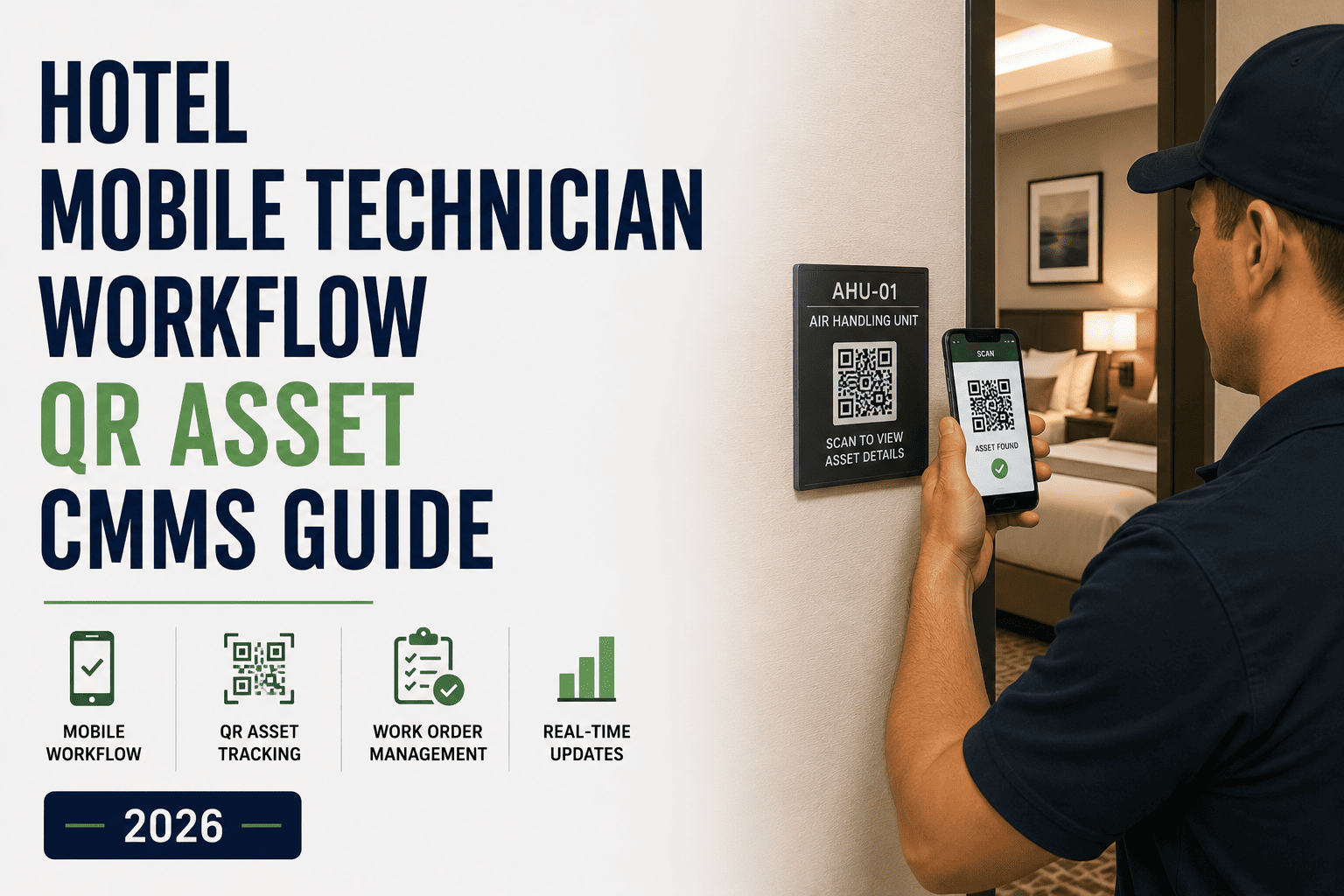
Any team member logs the issue from any device using a form that captures asset tag, location, priority level, and photo evidence. QR codes on equipment allow scan-to-report in under 30 seconds. No paper. No phone calls. Logged and in the system instantly.
AI Routes to the Right Technician Instantly
Oxmaint's AI evaluates asset type, location zone, fault category, and technician availability to assign the work order to the correct person immediately. No manual dispatch. No radio chain. The technician receives a push notification with full context — asset history, prior faults, likely parts needed — before they reach the location.
Live Status Visible to All Stakeholders in Real Time
As the technician accepts, travels to, and works on the task, status updates propagate instantly to all relevant parties — supervisor sees task progress, front desk sees room blocked or cleared, housekeeping sees when to re-enter. Escalation fires automatically if any SLA window is missed. Zero status calls required.
Completion Triggers Automated Downstream Actions
Task marked complete triggers automatic notifications to housekeeping if room clearance is needed, updates room management status, logs resolution time and parts used, and closes the associated logbook entry. Repair notes and photos attach to the asset's permanent record. Every downstream communication happens automatically.
What Changes for Each Role When Communication Is Unified
Each role in your hotel's maintenance ecosystem experiences a distinct elimination of friction when communication moves to a single digital platform. Here is the precise before-and-after for the four roles that matter most.
Replace Radio Chains and Paper Handovers With a Platform That Routes, Tracks, and Closes Every Maintenance Event Automatically
Hotels on Oxmaint resolve issues 82% faster, cut overtime by 34%, and eliminate the cross-department communication gaps that generate guest complaints and reactive repair spend. No rip-and-replace. Live within days. Trusted across 300+ properties in six regions.
Measured Outcomes After 12 Months on Oxmaint
Aggregated from full-service hotel properties across six regions. Figures represent median outcomes at 12 months post-implementation versus same-period baseline.
Frequently Asked Questions
Does Oxmaint replace our existing radio communication system?
How does Oxmaint handle urgent and emergency maintenance requests?
Can Oxmaint integrate with our PMS to create tasks from guest requests automatically?
What performance reporting does Oxmaint provide for maintenance communication?
Maintenance Communication That Works Like Your Hotel Operations Deserve
From boutique independents to branded portfolio operators — Oxmaint gives every maintenance team a structured digital workflow that routes every task faster, keeps every department informed in real time, and builds the operational data record that drives continuous improvement.