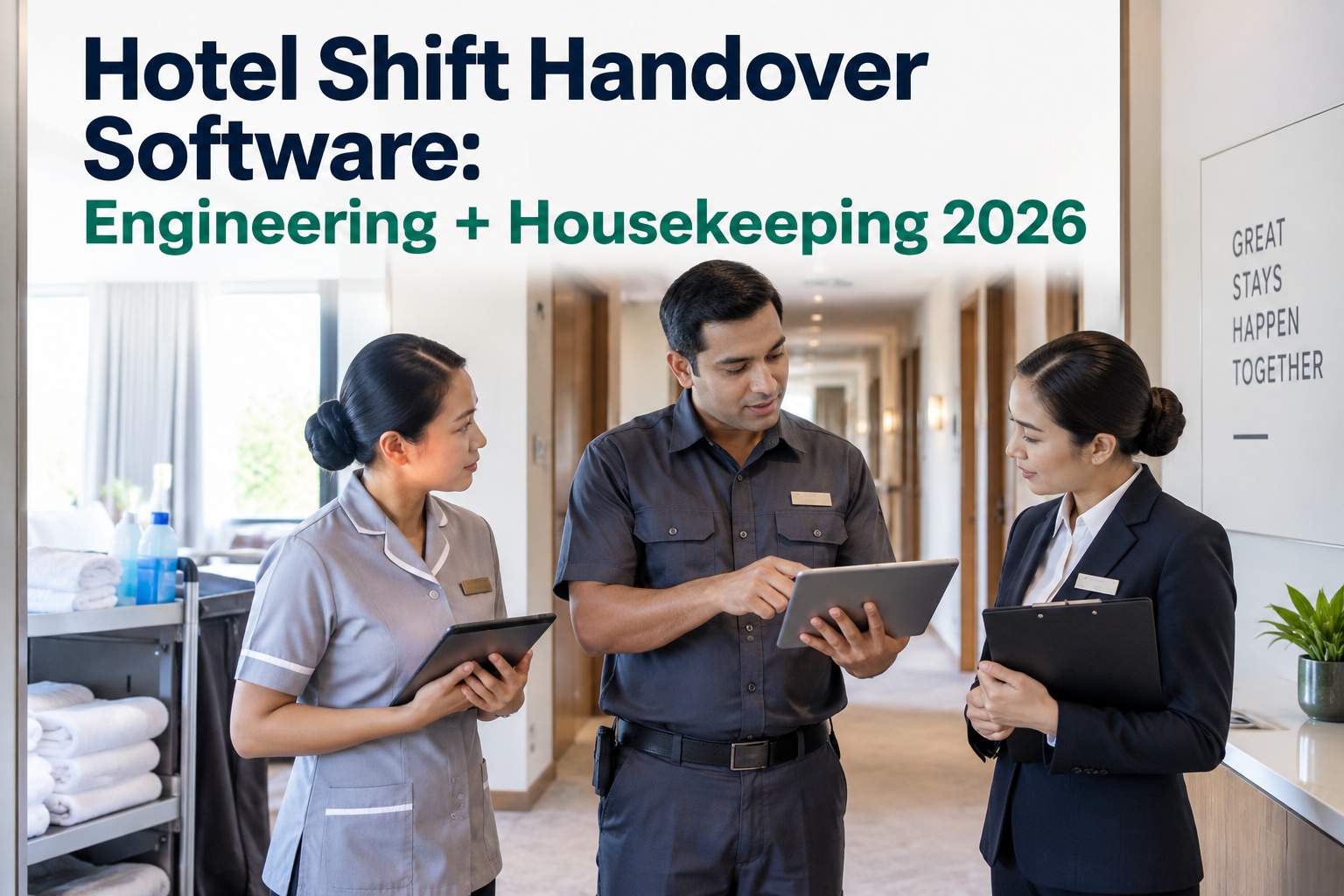
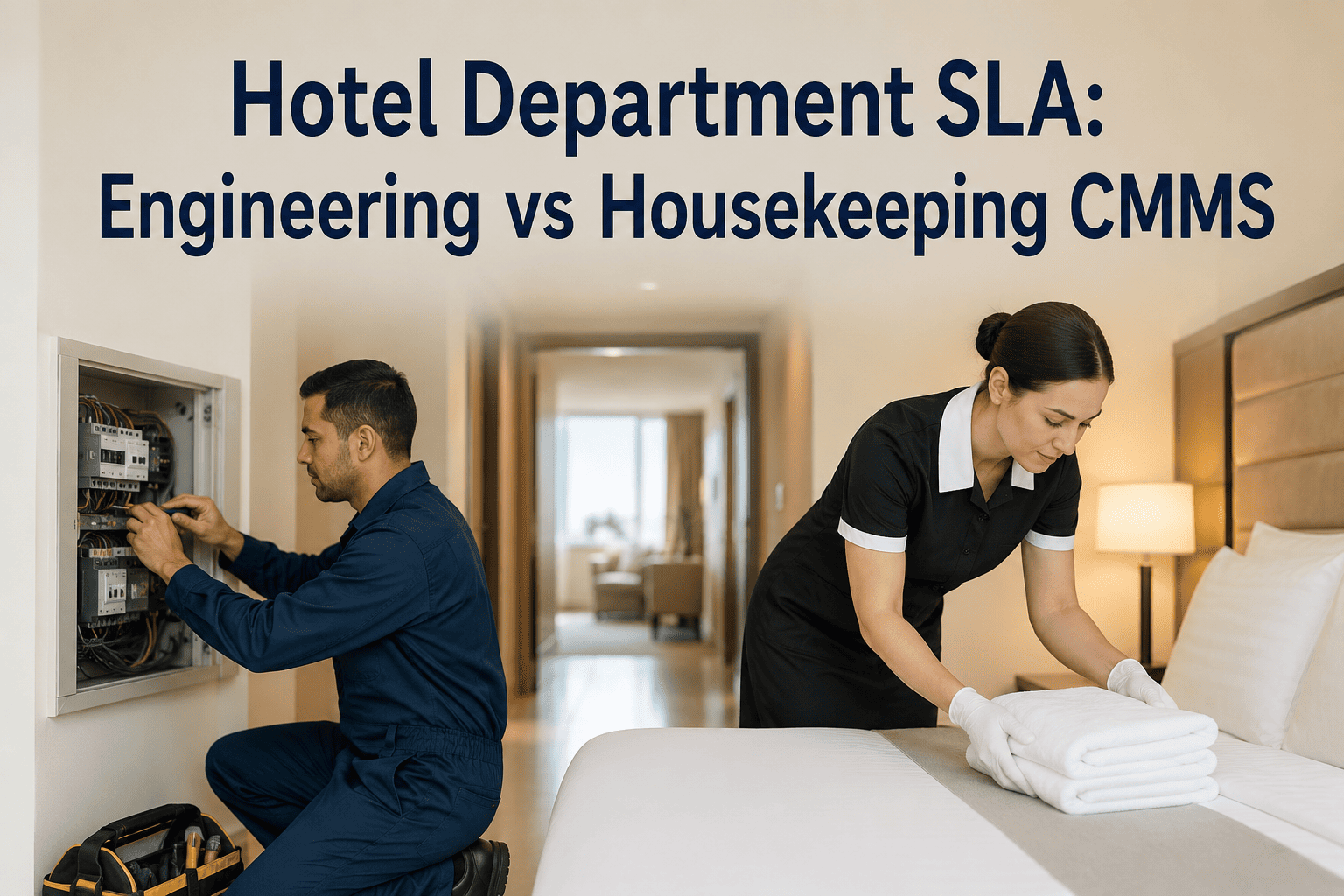
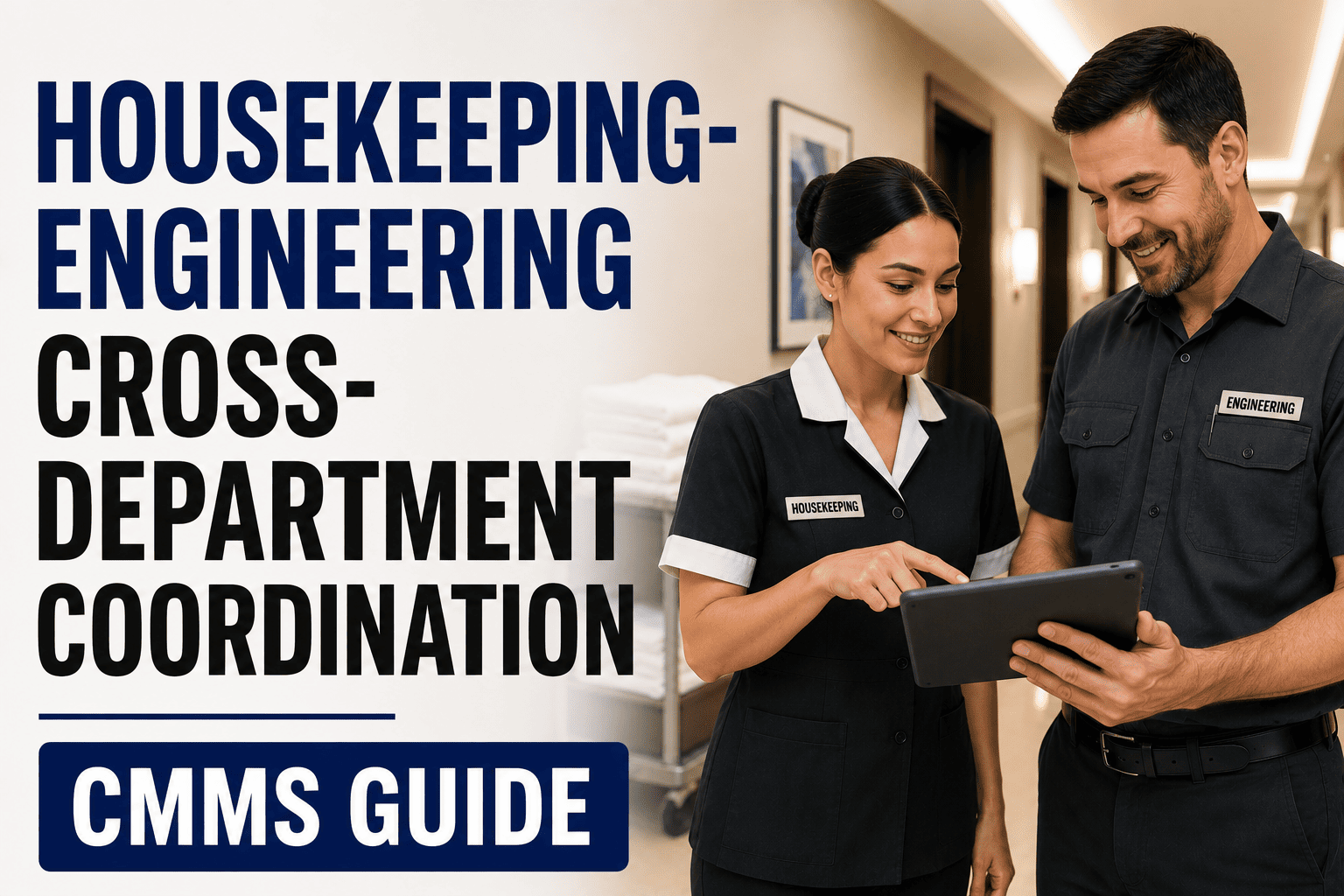
A housekeeper spots a leaking pipe under the bathroom vanity in Room 318. She radios the front desk. The front desk leaves a note for engineering. Engineering starts their shift, finds the note three hours later, and logs the repair — but by then the guest has already checked out and left a 2-star review. This is not an isolated failure. It is the default operating model for 71% of hotels. Digital coordination between housekeeping and engineering eliminates this chain of broken handoffs — replacing radio calls, paper logs, and verbal shift briefings with instant reporting, real-time status tracking, and automatic escalation when response time thresholds are exceeded. Want to see how Oxmaint connects housekeeping and engineering into one live workflow? Start a free trial — no implementation fees, no long onboarding.
Blog · Workforce & Technology · Housekeeping & Engineering · P2
Hotel Housekeeping and Engineering Coordination: Breaking Down Communication Silos
Every hotel room is inspected by housekeeping before engineering ever sets foot in it. That makes housekeeping the earliest detection layer for maintenance issues — leaks, broken fixtures, HVAC faults, damaged furnishings. But in most hotels, the path from housekeeping observation to engineering response runs through radio calls, verbal handoffs, and shift notes that disappear overnight. The result is delayed repairs, repeat complaints, and preventive maintenance that never happens because nobody logged the early warning. Book a 30-minute demo to see live cross-department coordination in Oxmaint.
The Coordination Cost Gap
71%
Hotels still routing housekeeping-to-engineering requests via radio, paper, or verbal handoff
3.4 hrs
Average delay from housekeeping report to engineering response in manual systems
38%
Maintenance issues first detected by housekeeping — not guests or engineering
22 min
Average engineering response time with a digital coordination platform
4.8x
Higher repair cost when a housekeeping-detected issue is not acted on within 24 hours
Definition
What Is Housekeeping-Engineering Coordination — And Why Most Hotels Get It Wrong
Housekeeping-engineering coordination is the operational system that governs how maintenance issues discovered during room servicing are reported, routed, prioritized, assigned, tracked, and confirmed resolved. It covers every touchpoint between the two departments: from a room attendant flagging a non-functional thermostat, to the engineering technician receiving the job, completing the repair, and notifying housekeeping that the room is cleared for guest occupancy.
The problem is structural. Housekeeping and engineering operate on different schedules, different communication channels, and different accountability systems. Housekeeping moves room by room on a defined rotation — speed is the metric. Engineering responds to requests as they arrive — priority and technical complexity are the metrics. Without a shared digital layer connecting these two workflows, every handoff is a gap. Issues fall through. Rooms go back into inventory with unresolved defects. Guests check in to problems that housekeeping reported three days ago and engineering never received. The downstream cost is real: 43% of hotel maintenance complaints are for issues that were previously reported but not resolved before the next guest checked in. Curious how digital coordination changes this for your property? Book a demo with Oxmaint and see the full workflow.
71%
Manual Handoff Hotels
Radio, verbal, or paper-based routing between housekeeping and engineering
43%
Repeat-Entry Complaints
Maintenance issues reported by housekeeping but unresolved before next guest arrival
3.4 hrs
Average Response Delay
Manual routing delay from housekeeping issue report to engineering action
$180
Cost Per Lost Room Night
Average revenue lost per room removed from inventory for unresolved maintenance
Key Framework
The 8 Breakdown Points Between Housekeeping Observation and Engineering Resolution
Most coordination failures are not caused by a single gap — they are caused by a chain of small failures across eight handoff points. Fixing one or two is not enough. Digital coordination must cover the full chain. Want to see what that looks like in practice? Start a free trial in Oxmaint and map your own workflow.
01
Issue Detection
Room attendant identifies a defect during servicing — leaking fixture, HVAC fault, damaged furniture, broken lock. Detection is reliable. What happens next is not.
02
Issue Reporting
In manual systems, the attendant radios the supervisor or writes on a log sheet. 29% of issues are never formally reported because the reporting process is too slow relative to the room rotation pace.
03
Supervisor Triage
The housekeeping supervisor decides whether to escalate to engineering or defer. Without priority logic, this is a judgment call — often made in 10 seconds between rooms. High-value defects get treated the same as cosmetic ones.
04
Engineering Notification
The handoff from housekeeping to engineering is the highest-risk gap. Radio calls are not logged. Paper notes get lost. Verbal briefings are forgotten. 34% of inter-department handoffs never reach the intended technician.
05
Work Assignment
The engineering supervisor assigns the job to a technician. Without a digital work queue, assignment is first-come-first-served — not priority-based. Urgent safety repairs can sit behind cosmetic tasks for hours.
06
Repair Execution
Technician completes the repair. Without mobile documentation, there is no record of what was done, what parts were used, or how long it took. The room history is blank. Future technicians have no reference.
07
Housekeeping Notification
Engineering marks the room cleared for re-entry. In manual systems, this is another radio call or note — another chance for the message to not arrive. Rooms sit out of inventory while housekeeping waits for clearance they never received.
08
Room Reinstatement
Room returns to available inventory in the PMS. Without a digital confirmation loop, rooms can remain blocked for hours after repairs are complete — costing an average of $180 per room night in lost revenue.
Industry Pain Points
Why Coordination Silos Between Housekeeping and Engineering Keep Costing Hotels
The silos are not created by unwilling teams. They are created by systems that were not designed for cross-department coordination. These are the six failure patterns that appear in almost every hotel operating on manual handoffs. See how Oxmaint resolves each of these — sign up free and explore the platform.
!
No Shared Visibility
Housekeeping has no visibility into engineering's current workload. Engineering has no visibility into which rooms are priority-clean. Both teams make decisions in isolation — creating scheduling conflicts, room blocks, and duplicated effort.
!
Radio-Only Reporting
Radio communication creates zero record. When a housekeeper radios in a defect, there is no timestamp, no room number logged, no issue category, and no accountability trail. Disputes about what was reported and when are unresolvable.
!
Shift Transition Loss
The shift change is the single most dangerous moment for issue tracking. Verbal briefings between outgoing and incoming supervisors miss 34% of open items. The incoming team starts blind — repeating work or abandoning it entirely.
!
No Priority Logic
A leaking pipe and a burned-out lightbulb enter the same queue with the same urgency. Engineering works sequentially — not by impact. A water damage risk sits behind a cosmetic fix because nobody prioritized the queue.
!
Blocked Room Delays
Rooms stay out of available inventory long after engineering finishes the repair — because the clearance message never reached housekeeping. Hotels lose an average of 1.8 room nights per week to delayed reinstatement on a 200-room property.
!
No Pattern Detection
HVAC issues are reported in Room 412 on 9 separate occasions over 6 months. No one connects the data because there is no data. The hotel keeps patching instead of replacing — spending $3,600 on a unit that should have been replaced for $2,200.
How Oxmaint Solves It
One Platform. Both Departments. Zero Lost Handoffs.
Oxmaint connects housekeeping and engineering into a single live workflow — where every issue reported is automatically routed, timestamped, prioritized, assigned, completed with documentation, and confirmed back to the reporting team. Book a 30-minute demo to see the full coordination workflow live.
Mobile Reporting
Instant Issue Submission from the Room
Room attendants submit defects directly in the Oxmaint mobile app — selecting room number, issue category, urgency level, and optional photo. Submission takes under 20 seconds and does not interrupt the room rotation. Report capture rate increases from 61% to 97% vs. radio-based systems.
Auto-Routing
Automatic Engineering Assignment
Every housekeeping-submitted issue is instantly routed to engineering as a work order — with room number, issue type, priority level, and submission timestamp. The engineering technician receives a mobile push notification in under 10 seconds. No radio call, no note, no intermediary.
Priority Engine
Smart Priority Based on Impact
Safety issues (leaks, electrical, fire safety) are automatically escalated to P1. Comfort issues (HVAC, plumbing) for occupied or imminent check-in rooms are elevated ahead of vacant-room cosmetic repairs. The system enforces priority logic — no manual triage required.
Live Status Board
Shared Real-Time Work Order Dashboard
Both departments see the same live dashboard — housekeeping supervisors can see which rooms have open engineering jobs, what the current status is, and when clearance is expected. Engineering sees the housekeeping room priority sequence. Scheduling conflicts drop by 61% within the first 30 days.
Photo Completion
Verified Repair with Mobile Documentation
Technicians log completion with before-and-after photos, parts used, time spent, and notes — all within the mobile app. The work order is only marked complete after documentation is uploaded. Supervisors can verify remotely. Room history is automatically updated with every repair record.
Auto-Clearance
Instant Housekeeping Notification on Completion
When engineering marks a repair complete, the housekeeping supervisor receives an instant mobile notification — room number, issue resolved, ready for final inspection and return to inventory. Average time from repair completion to room reinstatement drops from 47 minutes to 6 minutes.
Shift Continuity
Digital Shift Handoff — Zero Lost Issues
Pattern Analytics
Repeat Issue Detection by Room and System
Oxmaint flags rooms and systems with recurring issues — surfacing patterns that justify replacement rather than repeat repair. Properties using pattern analytics reduce repeat maintenance calls by 54% and cut total reactive repair spend by 31% within 6 months.
Before vs. After
Manual Coordination vs. Oxmaint Digital Cross-Department Workflow
| Coordination Metric |
Manual / Radio-Based System |
Oxmaint Digital Coordination |
| Issue Reporting Method |
Radio call or paper log — no digital record |
Mobile submission with photo, category, and timestamp in under 20 seconds |
| Engineering Notification Time |
3.4 hour average from report to action |
Under 10 seconds — automatic push notification to assigned technician |
| Issue Capture Rate |
61% of reported defects reach engineering |
97% capture rate — every submission creates a tracked work order |
| Shift Handoff Loss Rate |
34% of open items lost between shifts |
0% — full open-item list carries over digitally with status and history |
| Room Reinstatement Speed |
47 minutes average from repair to inventory |
6 minutes — automatic clearance notification to housekeeping on completion |
| Repair Documentation |
No record — verbal or radio confirmation only |
Before/after photos, parts used, time spent, technician signature — all mobile |
| Priority Assignment |
Sequential FIFO — no urgency logic |
Auto-prioritized by safety category, occupancy status, and check-in urgency |
| Repeat Issue Detection |
None — no data aggregation across jobs |
Auto-flagged by room, system, and issue type — replacement vs. repair decisions supported by data |
Based on operational data from hotel properties using digital cross-department coordination vs. manual handoff systems. Compare your current performance — book a demo with Oxmaint.
ROI & Results
The Measurable Impact of Digital Housekeeping-Engineering Coordination
The financial case for eliminating coordination silos between housekeeping and engineering is not marginal. Every metric — response time, room availability, repair cost, repeat complaints — improves materially when both departments share a live workflow. Ready to measure these results at your property? Start a free trial in Oxmaint.
97%
Issue Capture Rate
Up from 61% with radio-based reporting — more issues logged, fewer defects reaching guests
87%
Faster Room Reinstatement
From 47 minutes to 6 minutes average — cleared rooms return to inventory faster
54%
Fewer Repeat Repair Calls
Pattern analytics surface repeat-issue rooms — fix root cause once instead of repeatedly
$36K
Annual Savings (200-Room Hotel)
Reduced blocked rooms, fewer repeat repairs, lower reactive maintenance spend, and faster room turns
"
Before Oxmaint, our housekeeping team was submitting maintenance issues by radio and writing on a paper log at the end of the shift. Engineering would pick it up the next morning. Rooms were sitting out of inventory for 4 to 6 hours after a repair was finished because nobody communicated the clearance back to housekeeping. In the first month with Oxmaint, our average room reinstatement time dropped from 52 minutes to 8 minutes. We recovered 23 room nights that month that we previously would have lost. That is real revenue — not a metric on a dashboard.
Director of Rooms · 280-Room Full-Service Hotel, Western Canada
Frequently Asked Questions
Housekeeping-Engineering Coordination FAQs
How does Oxmaint handle issue submission for housekeeping staff who may not be tech-savvy?
Oxmaint's mobile app is designed for operational staff, not tech users. The issue submission flow for housekeeping is three taps: select the room number, select the issue category from a visual menu, and optionally add a photo. There are no text fields required for standard submissions. The interface uses large tap targets, plain language category labels, and requires no training beyond a 10-minute onboarding walkthrough. Properties report full housekeeping staff adoption within the first week. For room attendants with limited smartphone experience, QR codes can be placed in each room — the attendant scans the code and the room number is pre-populated automatically.
See the submission flow yourself — start a free trial in Oxmaint.
Can engineering technicians close work orders and notify housekeeping from their mobile device in the field?
Yes — this is the core of the coordination loop. When a technician completes a repair, they close the work order in the Oxmaint mobile app by uploading a completion photo, logging parts used, and confirming resolution. The system immediately sends an automatic notification to the housekeeping supervisor — displaying the room number, the issue resolved, and a clearance status for room re-entry. The housekeeping team does not need to wait for engineering to radio in or walk over. The notification arrives in under 5 seconds from work order closure. This single step accounts for the 87% improvement in room reinstatement speed that properties see in the first 30 days.
Book a demo to see the complete mobile workflow from report to clearance.
How does Oxmaint prevent high-priority maintenance issues from being delayed in the engineering queue?
Oxmaint's priority engine classifies every incoming work order at submission — automatically, based on the issue category selected by the housekeeper. Safety categories (water leak, electrical fault, fire equipment, structural) are classified P1 and trigger immediate escalation to the engineering supervisor in addition to the standard technician notification. Comfort categories (HVAC, plumbing noise, broken fixture) for rooms with same-day check-ins are elevated to P2 and move ahead of P3 cosmetic items in the queue. If a P1 or P2 item is not acknowledged within a configurable time threshold (default 15 minutes), the system auto-escalates to the next supervisor level. No manual triage is required — the priority logic is enforced by the system, not by individual judgment calls.
Configure your own priority rules — start a free trial in Oxmaint.
Does Oxmaint integrate with our Property Management System so room status updates in real time?
Oxmaint is built to connect with the hotel's PMS, enabling real-time room status synchronization. When engineering marks a room cleared in Oxmaint, the status update can flow directly into the PMS — returning the room to available inventory without manual intervention from the front desk. The integration also enables check-in priority identification: rooms with imminent arrivals are automatically flagged in Oxmaint's work order queue, so engineering knows which rooms to prioritize regardless of the order issues were reported. For hotels where full PMS integration is not immediately available, Oxmaint provides a live room status board accessible by the front desk via browser — providing the same operational visibility without requiring a full system integration.
Book a demo to discuss your specific PMS and integration options.
Work Order Management · Mobile CMMS · Free to Start
Stop Losing Rooms, Revenue, and Reviews to Coordination Gaps Between Housekeeping and Engineering.
Mobile issue reporting from the room. Automatic work order routing to engineering. Smart priority logic based on impact and check-in urgency. Photo-verified completion. Instant housekeeping clearance notification. Shared live dashboard for both departments. Digital shift handoff with zero data loss. Every issue tracked from detection to resolution — starting with the phones your team already carries.