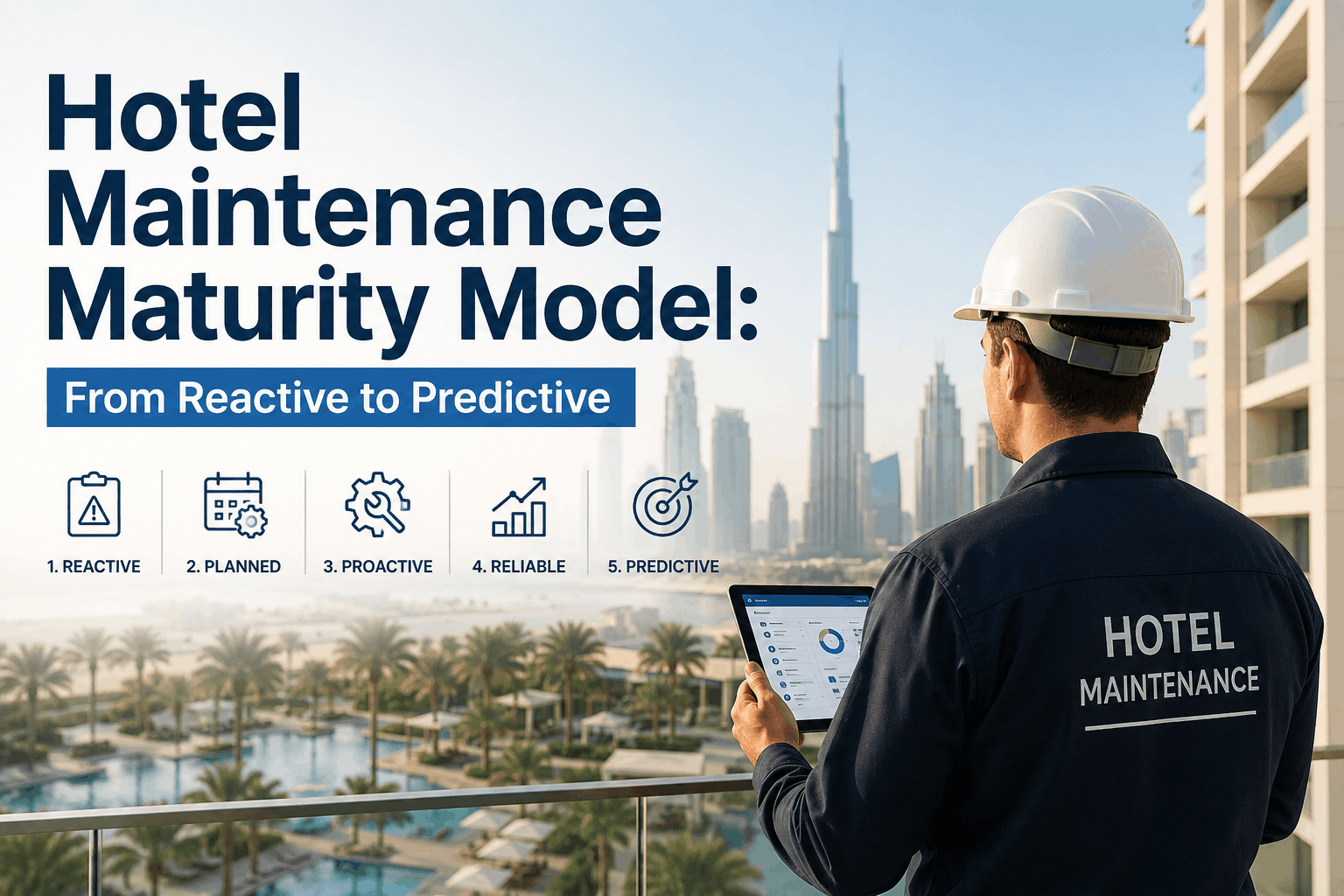
Hotel Maintenance Maturity Model: From Reactive to Predictive
By Alex Jordan on June 19, 2026
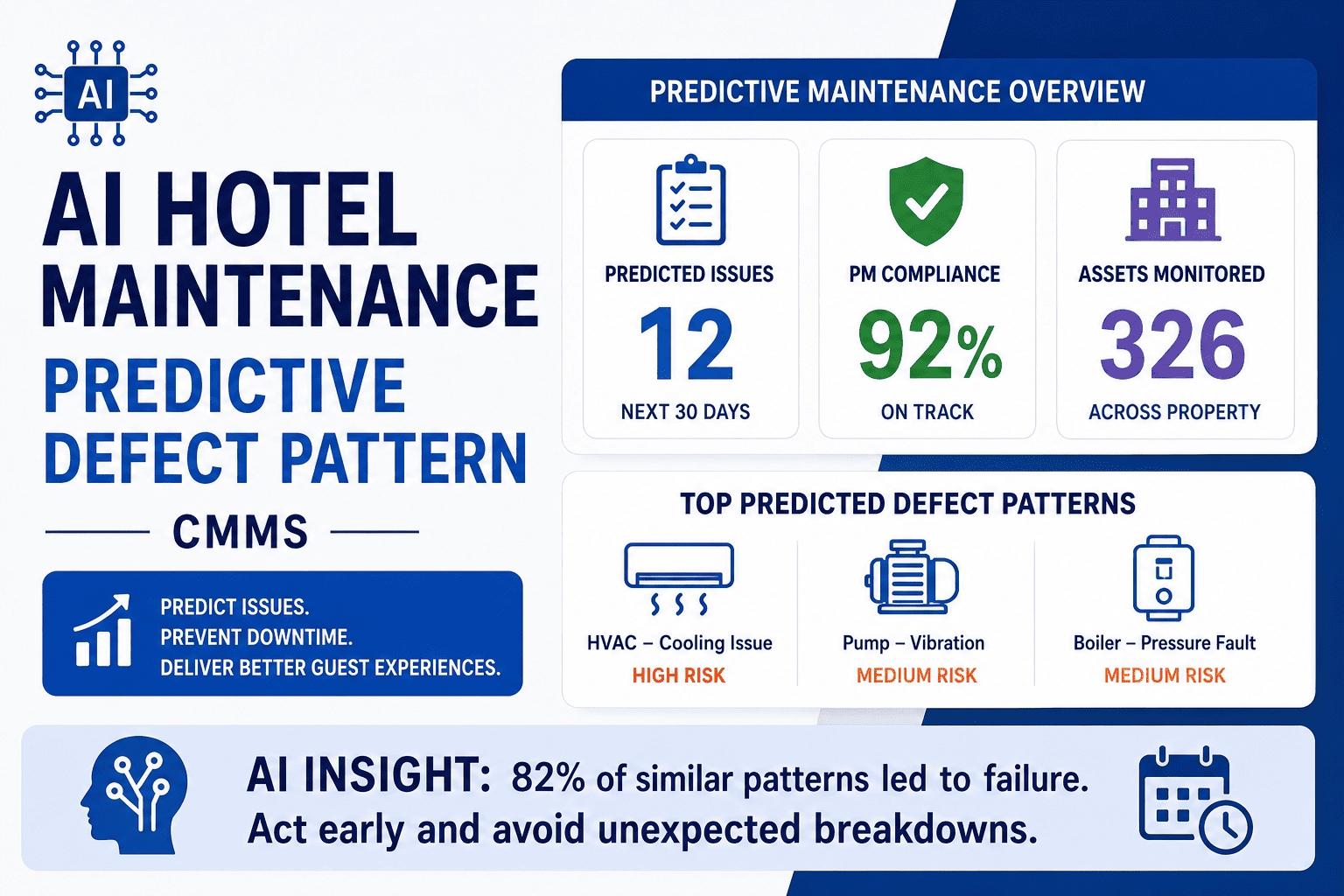
Every hotel maintenance department follows a predictable evolution — from chaotic, reactive fire-fighting to proactive, data-driven optimization. The difference between a hotel that experiences constant guest complaints about broken amenities and one that consistently delivers flawless operational experiences is not luck — it's maturity. The Maintenance Maturity Model provides a framework for assessing your hotel's current maintenance practices and charting a clear path toward predictive maintenance excellence. Start a free trial with Oxmaint to assess your current maturity level, or book a demo to see how hotels use Oxmaint to advance their maintenance maturity.
HOTEL MAINTENANCE · DIGITAL TRANSFORMATION · MATURITY MODEL · 2026
Hotel Maintenance Maturity Model: From Reactive to Predictive
Assess your hotel's maintenance maturity across five stages — reactive, preventive, condition-based, predictive, and autonomous — with a clear roadmap for advancing to world-class maintenance performance.
85%Of hotels operate at reactive or preventive maturity levels
40–60%Reduction in guest complaints when advancing to predictive maturity
2–3 yearsTimeframe to progress from reactive to predictive maintenance
25–50%Maintenance cost savings from higher maturity levels
Why Maintenance Maturity Matters in Hospitality
In the hospitality industry, maintenance is not just about keeping equipment running — it's about protecting guest experience, brand reputation, and revenue. A hotel at reactive maturity might fix a broken air conditioner after a guest complains. A hotel at predictive maturity prevents that failure entirely, eliminating the guest complaint and the negative online review that would follow. Start a free trial or book a demo to see how Oxmaint's maintenance module supports maturity advancement.
Guest Experience
Reputation
Every maintenance failure is a guest experience failure. Higher maturity levels mean fewer failures, fewer complaints, and better online reviews.
Revenue Protection
Financial
Equipment failures lead to room outages, event disruptions, and guest compensation. Predictive maintenance protects your revenue stream.
Operational Efficiency
Cost
Reactive maintenance costs 3–5x more than planned maintenance. Higher maturity levels dramatically reduce emergency labor and parts costs.
The Five Stages of Hotel Maintenance Maturity
The Maintenance Maturity Model defines five progressive stages that hotels typically follow. Each stage represents a distinct level of capability, data usage, and organizational culture. Understanding your current stage is the first step toward advancement. Oxmaint's maturity assessment module provides a structured evaluation of your current practices.
Stage 1: Reactive
Fix When Broken
? Equipment is repaired only after failure occurs
? No formal maintenance schedule or planning system
? No historical data on failures or maintenance costs
? Maintenance costs are 3–5x higher than planned maintenance
Stage 2: Preventive
Scheduled Maintenance
? Routine maintenance on fixed schedules (monthly, quarterly)
? Inspections and preventive tasks documented
?️ Some planned work, but still significant reactive work
? Basic CMMS adopted for work order management
? Limited data analysis — mostly compliance checking
Stage 3: Condition-Based
Monitor and Act
? Equipment condition is actively monitored with sensors
? Maintenance decisions based on actual equipment condition
? Maintenance schedules adjusted based on condition data
? Historical data used to identify failure patterns
? Proactive work now exceeds reactive work
Stage 4: Predictive
Anticipate Failures
? Predictive models identify failures before they occur
? Advanced analytics used for failure prediction
? Maintenance scheduled based on predictive insights
? Continuous learning from data improves prediction accuracy
? Reactive work reduced to <10% of total maintenance
Stage 5: Autonomous & World-Class
Self-Optimizing Maintenance
? AI-driven maintenance optimization
? Self-learning systems that continuously improve
? Fully integrated with operations and finance
? Zero unplanned downtime for critical assets
? Maintenance is a strategic business driver
? Benchmarking against world-class standards
Maturity Assessment Framework — Where Does Your Hotel Stand?
To advance your maintenance maturity, you must first understand your current position. The maturity assessment framework below evaluates hotels across five key dimensions. Oxmaint's maturity assessment tool automatically scores your hotel across these dimensions and provides a customized improvement roadmap.
Maintenance Maturity Assessment — Five Dimensions
Score your hotel from 1 (Reactive) to 5 (World-Class) on each dimension
1
Work Order Management
Reactive (1): No structured process. Preventive (3): Basic CMMS with work orders. Predictive (5): Automated, data-driven work prioritization and scheduling.
2
Data & Analytics
Reactive (1): No data collected. Preventive (3): Basic failure history. Predictive (5): Advanced analytics for failure prediction and optimization.
3
Planning & Scheduling
Reactive (1): No planning. Preventive (3): Fixed schedule maintenance. Predictive (5): Dynamic scheduling based on condition and prediction.
4
Technology Adoption
Reactive (1): No technology. Preventive (3): Basic CMMS. Predictive (5): IoT sensors, AI analytics, and fully integrated systems.
The Roadmap — Advancing from Reactive to Predictive
Progressing through maintenance maturity stages requires a structured approach. The roadmap below outlines the key initiatives, technology enablers, and organizational changes needed at each transition. Book a demo to see how Oxmaint provides the technology foundation for each stage of the journey.
Reactive → Preventive
Foundation
3–6 months
Implement a CMMS. Create equipment inventory. Define preventive maintenance schedules. Train team on work order management. Establish maintenance history.
Preventive → Condition-Based
Monitor
6–12 months
Install IoT sensors on critical equipment. Implement condition monitoring. Use data to adjust maintenance intervals. Train on condition-based decision making.
Condition-Based → Predictive
Predict
12–18 months
Deploy predictive analytics models. Implement machine learning for failure prediction. Automate work order creation from predictions. Validate and refine models.
Predictive → Autonomous
Optimize
18–24+ months
Implement self-optimizing maintenance systems. Integrate maintenance with operations and finance. Establish continuous improvement culture. Benchmark against world-class.
"
When I joined this 600-room convention hotel, we were at Stage 1 — completely reactive. We had no CMMS, no preventive maintenance schedule, and the engineering team was constantly responding to emergencies. We started with Oxmaint to build our preventive maintenance program, then added IoT sensors for our HVAC and chiller systems. Within 18 months, we had progressed to Stage 3. Guest complaints about temperature issues dropped 72%, and maintenance overtime costs decreased 45%. We're now working toward predictive maintenance for our critical event spaces.
Director of Engineering — 600-room Convention Hotel, US West Coast
Benefits of Higher Maturity Levels — The Business Case
Advancing through maintenance maturity stages delivers measurable business benefits. The table below summarizes the typical improvements achieved at each maturity level. Oxmaint's ROI calculator projects the specific benefits for your hotel.
Metric
Reactive
Preventive
Condition-Based
Predictive
Reactive Work %
85–95%
40–60%
15–30%
<10%
Maintenance Cost
High
Medium
Low
Lowest
Guest Complaints
High
Medium
Low
Very Low
Equipment Life
Short
Medium
Long
Longest
Overtime Cost
High
Medium
Low
Lowest
Frequently Asked Questions — Hotel Maintenance Maturity
What is the hotel maintenance maturity model?
The hotel maintenance maturity model is a framework that defines five progressive stages of maintenance capability — Reactive, Preventive, Condition-Based, Predictive, and Autonomous. Each stage represents increasing levels of data usage, planning sophistication, and organizational culture. The model helps hotels assess their current practices and chart a path toward world-class maintenance performance. Start a free trial to assess your current maturity level.
What stage are most hotels at?
Most hotels operate at Stage 1 (Reactive) or Stage 2 (Preventive). Approximately 85% of hotels have not yet reached condition-based maintenance maturity. This represents a significant opportunity — hotels that advance to higher maturity levels gain competitive advantage through better guest experiences and lower operating costs. Book a demo to see how advanced hotels differentiate themselves.
How long does it take to advance from reactive to predictive?
The typical timeframe to progress from reactive to predictive maintenance is 2–3 years. This includes implementing a CMMS (3–6 months), building a preventive maintenance program (6–12 months), adding condition monitoring (6–12 months), and deploying predictive analytics (12–18 months). The timeline depends on organizational commitment, resources, and technology adoption. Oxmaint provides the technology foundation for each stage.
How does a CMMS help advance maintenance maturity?
A CMMS like Oxmaint is the technology foundation for advancing maintenance maturity. It provides: (1) Work order management for systematic tracking, (2) Preventive maintenance scheduling, (3) Historical data collection for analysis, (4) IoT and sensor integration for condition monitoring, (5) Analytics and reporting for predictive insights, and (6) Integration with other systems for autonomous operation. Start a free trial to see how Oxmaint supports each maturity stage.
Assess Your Hotel's Maintenance Maturity — Start Your Advancement Journey.
Oxmaint's maintenance maturity assessment provides a clear picture of your current practices and a customized roadmap to advance to the next level. Free to start.