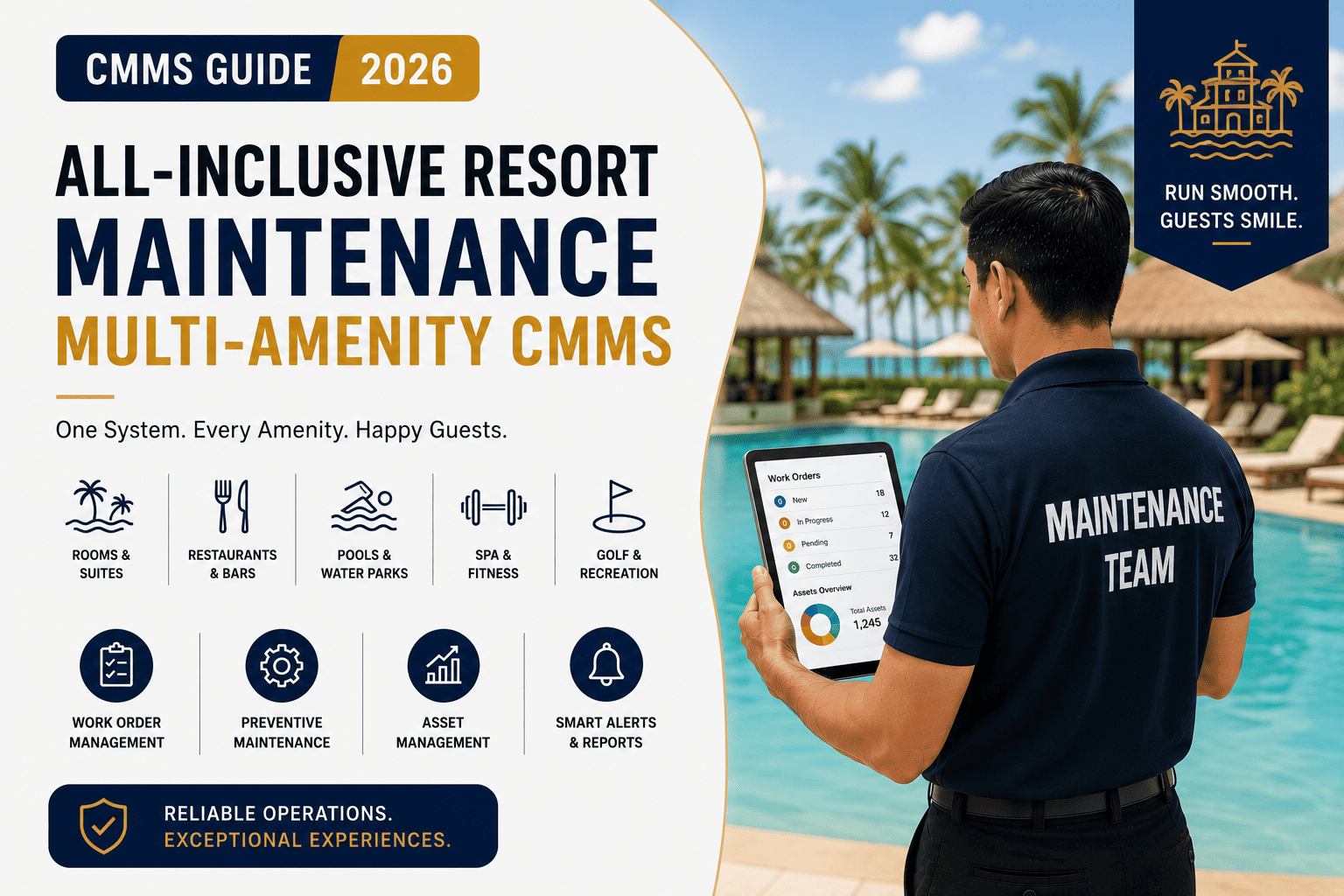
Resort properties operate in a different maintenance universe than traditional hotels. A downtown business hotel maintains guest rooms, an HVAC system, and a fitness center. A resort property manages all of that plus swimming pools, water features, spas, golf courses, marinas, water parks, equestrian facilities, ski lifts, beach operations, tennis complexes, outdoor event venues, and miles of landscaped grounds — each with its own regulatory requirements, seasonal rhythms, specialized equipment, and guest-safety implications. The maintenance failure that closes a pool or sidelines a golf course doesn't just inconvenience guests; it removes the primary reason they chose your property. Resort maintenance is, at its core, an amenity protection strategy. Get it right and every amenity delivers the experience guests paid a premium for. Get it wrong and the cascading failures that follow affect occupancy, reviews, and revenue in ways that take seasons to recover from. This guide addresses the real operational complexity of multi-amenity resort maintenance — the challenges, the frameworks, and the technology that brings it all together. If you're ready to see how a purpose-built CMMS handles resort-scale operations, sign up for OxMaint and experience it firsthand.
Why Resort Maintenance Is Fundamentally Different
Traditional hotel maintenance programs are built around rooms, HVAC, plumbing, and common areas. The maintenance team is relatively small, the asset list is manageable, and most systems follow predictable service intervals. Resort maintenance breaks every one of those assumptions. You're managing dozens of distinct facility types, each requiring specialized technical knowledge, dedicated chemical programs, regulatory compliance, and skilled labor that differs from one amenity to the next. The pool technician and the golf course superintendent don't share skills, tools, or service schedules.
The complexity compounds further because resort amenities don't operate in isolation. A water park pump failure affects pool chemistry across multiple attractions. A spa boiler going down takes out heated pools, treatment rooms, and steam facilities simultaneously. Golf course irrigation issues ripple into landscape watering and surface water management. When maintenance failures cascade across interconnected systems, the guest experience impact multiplies rapidly. Building a maintenance program that accounts for these interdependencies requires a fundamentally different approach than standard hotel maintenance management — one that centralizes visibility across every amenity while preserving the specialist workflows each discipline requires. Book a demo to see how OxMaint unifies resort maintenance across every amenity type.
The Multi-Amenity Maintenance Matrix
Every resort amenity category carries its own maintenance requirements, regulatory framework, inspection cadence, and seasonal considerations. Understanding the full scope of what your maintenance program must cover is the first step toward building a program that doesn't leave critical gaps. Here is what a comprehensive multi-amenity resort maintenance program looks like across the core amenity categories.
Aquatics and Pool Maintenance: The Highest-Stakes Amenity
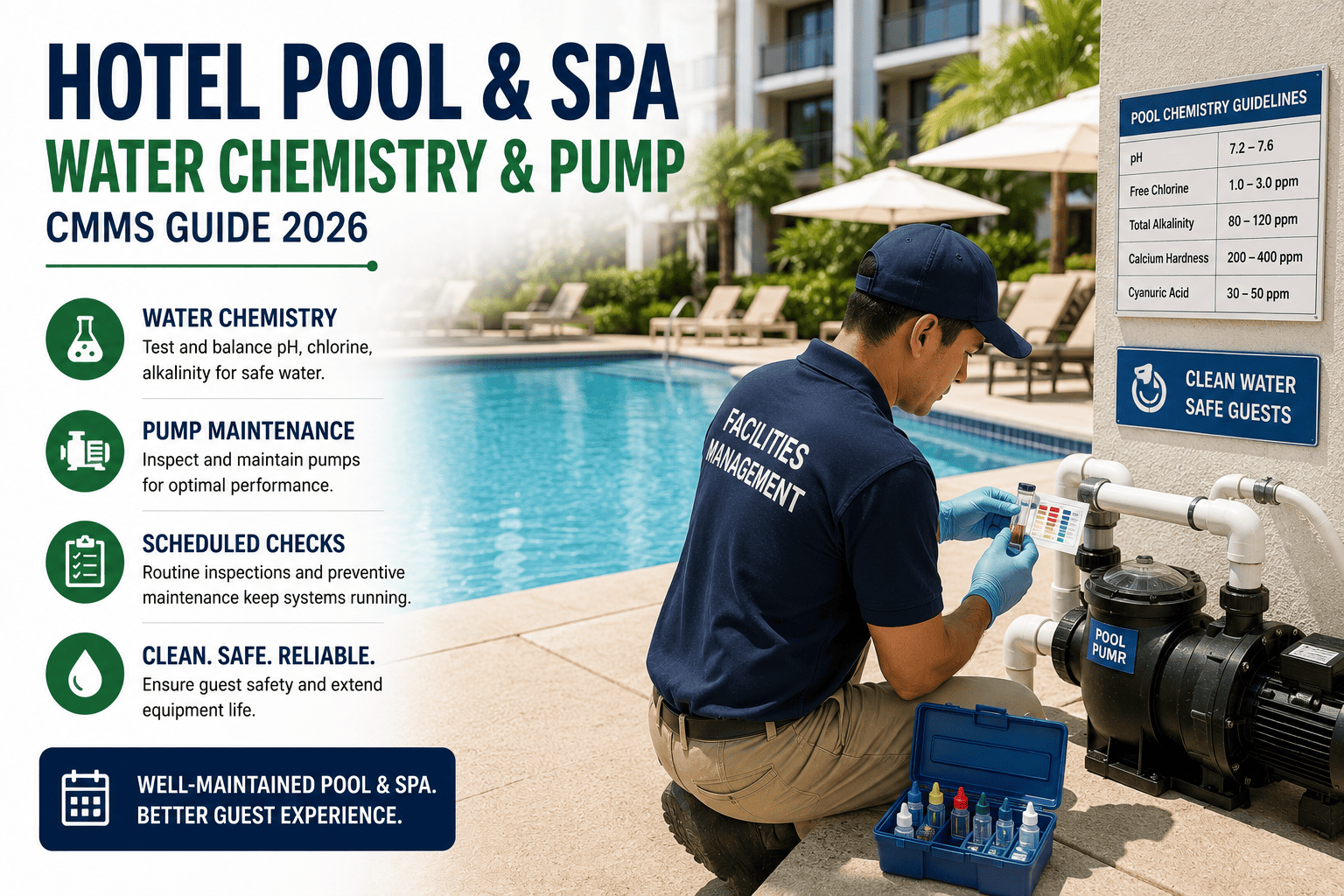
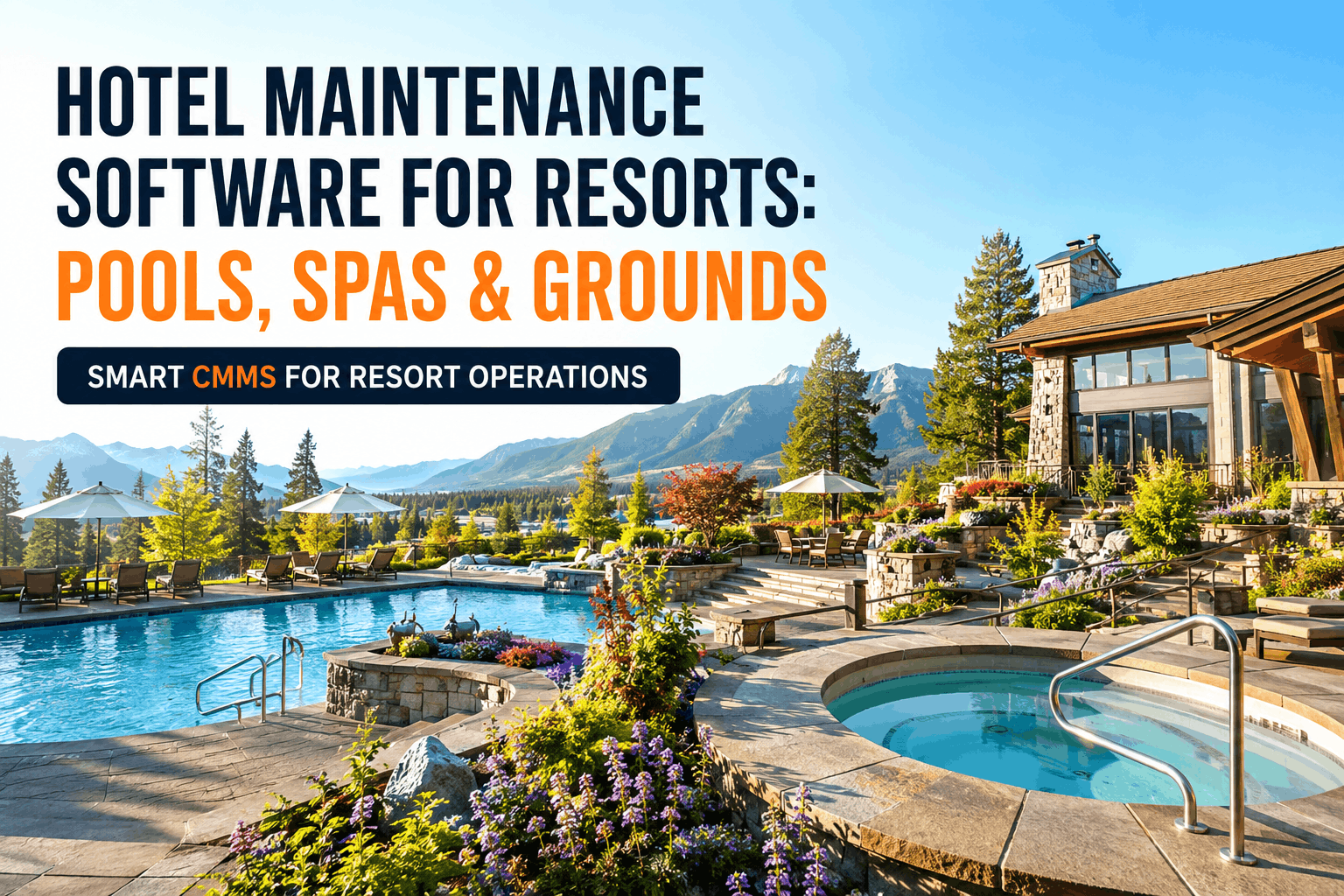
Of all resort amenities, pool and aquatics facilities carry the greatest combination of guest safety risk, regulatory exposure, and operational visibility. A closed pool is immediately visible to every guest on property. The chemistry failures, equipment breakdowns, and documentation gaps that lead to closures are entirely preventable with a disciplined maintenance program — but preventing them requires systems that traditional spreadsheet-based tracking simply cannot support at resort scale.
Spa and Wellness Facility Maintenance: Precision in a High-Expectation Environment
Spa guests arrive expecting a seamless sensory experience. The ambient temperature, the humidity, the lighting, the sound — and yes, the functionality of every hydrotherapy feature and treatment room piece of equipment — all contribute to an experience they have paid significantly for. Maintenance failures in spa environments are often invisible until the moment they become impossible to ignore: a malfunctioning steam room, a cold plunge pool that isn't cold, a facial steam device that misfires. The standard for maintenance precision in a spa facility is higher than almost anywhere else on a resort property.
OxMaint allows spa engineering teams to build dedicated PM schedules for every piece of spa equipment with per-device maintenance histories, warranty tracking, and mobile-accessible checklists for daily operational inspections. Sign up to start building your spa maintenance program.
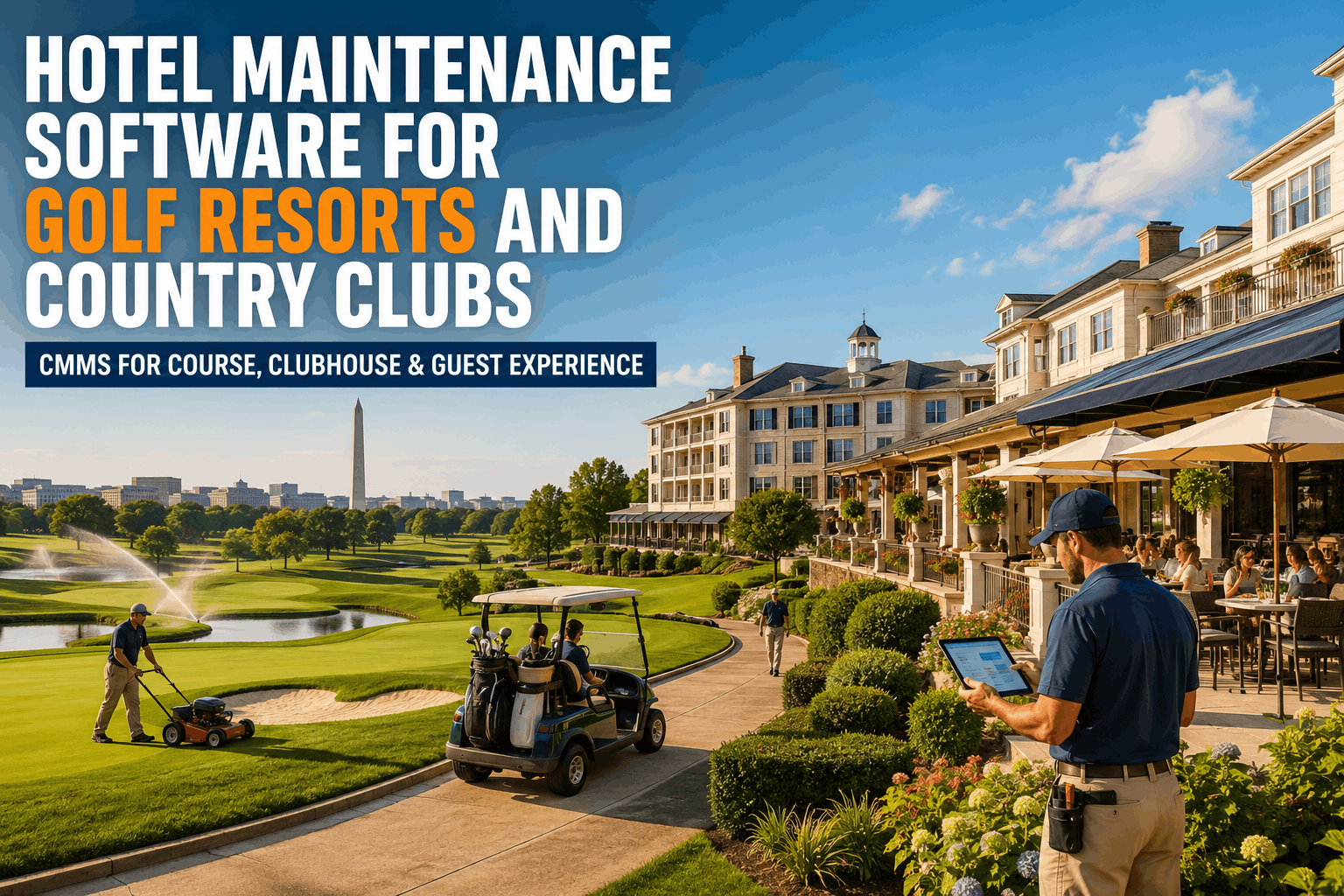
Golf Course Maintenance: Managing an Agronomic Operation Within a Hospitality Business
A golf course is fundamentally different from every other resort amenity because it is a living system. The turf, the soil biology, the microclimate, and the seasonal agronomic calendar drive maintenance decisions in ways that equipment service schedules alone cannot capture. Golf course maintenance sits at the intersection of agronomy, irrigation engineering, equipment management, and hospitality standards — and the superintendent who manages it typically operates with more autonomy and more complexity than any other department head on property.
A full 18-hole golf course operates an equipment fleet that rivals a mid-size construction company. Greens mowers, fairway mowers, rough mowers, bunker rakes, top-dressers, aerators, sprayers, utility vehicles, and a cart fleet of 80 to 150 vehicles all require structured maintenance programs. Reel mower blade grinding intervals, hydraulic system service, battery maintenance for electric carts, and engine service schedules must all be tracked simultaneously.
A modern golf course irrigation system is a sophisticated automated network of hundreds or thousands of heads, controlled by a central computer that adjusts run times based on ET data and soil sensors. The central controller, pump station, distribution mains, lateral lines, valve boxes, and individual heads all require inspection and service on separate schedules. Seasonal winterization is a multi-day, multi-technician operation with a precise sequence that must be documented for insurance and warranty purposes.
Cart paths, bridges, tee markers, yardage markers, bunker edging, drainage structures, and safety netting are all resort assets that require periodic inspection and maintenance. Course infrastructure failures — a washed-out cart path, a structurally compromised footbridge, damaged drainage that creates standing water — directly affect playability and guest safety. Regular inspection rounds with digital checklists ensure nothing is missed during routine walkthroughs.
Marina and Waterfront Maintenance: Managing in a Corrosive Environment
Marine environments are categorically harder on infrastructure than any other resort setting. Saltwater corrosion, tidal stress, UV degradation, biofouling, and the mechanical wear of constant wave action all accelerate equipment and infrastructure deterioration at rates that land-based maintenance programs aren't calibrated for. A marina maintenance program that applies standard hotel maintenance intervals to waterfront assets will consistently find itself behind the deterioration curve, reacting to failures rather than preventing them.
One Platform for Every Amenity on Your Resort Property
OxMaint gives resort engineering teams a single system to manage pools, spas, golf equipment, marina assets, grounds, and all supporting infrastructure. No more disconnected spreadsheets across departments.
Building a Resort Maintenance Program from the Ground Up
Most resort maintenance programs evolve organically — a work order system here, a spreadsheet there, an amenity-specific log book for the spa, a golf course software package that doesn't talk to anything else. The result is a fragmented maintenance operation where the Chief Engineer has no single view of what's due, what's overdue, what failed last quarter, or how much each amenity is costing to maintain. Building a cohesive program requires a structured approach that starts with the asset inventory and builds outward from there.
Build a Complete Asset Register
Every maintainable asset on the property — every pump, every generator, every piece of spa equipment, every golf mower, every dock section — needs a record in your system before you can maintain it properly. For a full-service resort this typically means 2,000 to 10,000 individual asset records. Include make, model, serial number, install date, warranty expiry, vendor contact, and location. This asset register is the foundation everything else is built on. Sign up for OxMaint to start building your resort asset register today.
Define Maintenance Schedules by Asset Category
Assign preventive maintenance schedules to every asset category. Pool pump motors get quarterly lubrication and annual winding inspection. Golf mowing equipment gets blade service every 40 hours of operation. Spa steam generators get monthly descaling. The schedules should come from manufacturer recommendations, industry standards from ASHRAE, PHCC, and GCSAA, and the operational experience of your department heads.
Assign Ownership Across Departments
Resort maintenance is always multi-departmental. The engineering team owns building systems. Golf course maintenance owns turf equipment and irrigation. Spa operations often has its own technicians. The marina may run semi-independently. Your maintenance platform needs role-based access that gives each department visibility into their own assets while giving the Chief Engineer a unified view across all departments. Ownership without accountability creates gaps; accountability without visibility creates frustration.
Build Seasonal Workflows
Resort operations are defined by seasonality. The tasks required to open an outdoor water park in May are fundamentally different from the tasks required to winterize it in October, and both involve dozens of sequenced steps across multiple systems. Digital seasonal checklists tied to work orders ensure the opening and closing of every amenity is executed completely and documented for compliance purposes. Missed steps during winterization cause spring opening failures. Book a demo to see how OxMaint handles seasonal workflows.
Implement Inspection Programs Across All Amenities
Beyond scheduled maintenance, resort amenities need regular inspection rounds to catch emerging issues before they become failures. Daily pool inspections, weekly equipment walkarounds, monthly structural checks on docks and course infrastructure, and quarterly deep inspections of critical systems like boilers and chillers. Mobile inspection checklists completed by technicians in the field generate automatic work orders for any deficiency identified, creating a closed loop between observation and resolution.
Establish KPIs and a Reporting Cadence
What gets measured gets managed. Resort maintenance KPIs should include PM completion rate by amenity, mean time to repair for guest-impacting failures, maintenance cost per amenity per quarter, equipment uptime rate for critical systems, and compliance documentation completion rates. Monthly reporting to ownership and quarterly deep-dive reviews with department heads keep the program continuously improving rather than drifting into reactive mode.
Seasonal Operations: The Make-or-Break Moments
Resort operations are more seasonal than almost any other hospitality category. Full-service destination resorts may operate year-round, but the amenity mix, staffing levels, and maintenance intensity shift dramatically between peak and off-peak periods. Managing these transitions well — opening every amenity on time and in perfect condition, closing every system properly before the off-season — is one of the clearest indicators of maintenance program maturity at a resort property.
Compliance and Safety Across Resort Amenities
Resort properties are among the most heavily regulated hospitality businesses precisely because of the range of activities and safety risks involved. Every amenity category carries its own regulatory framework, and the documentation requirements across all of them simultaneously can overwhelm a maintenance team that manages compliance manually. Understanding what you're accountable for — and proving it with documented records — is as important as the maintenance work itself.
Managing compliance documentation across all of these regulatory categories simultaneously is one of the strongest arguments for a centralized CMMS platform at a resort property. When every inspection record, certification, work order, and chemical log lives in a single system, compliance audits become a reporting exercise rather than a document-hunting crisis. Sign up for OxMaint to start centralizing your resort compliance documentation today.
What Makes OxMaint the Right Choice for Resort Maintenance
Most CMMS platforms are designed for single-facility industrial or commercial applications. Resort properties need something different: a platform that manages dozens of distinct amenity types, supports multiple departments with different workflows and asset categories, handles seasonal operational rhythms, and provides a unified view of the entire property without forcing every department into the same rigid workflow model.
Resort Maintenance Does Not Have to Be This Hard.
OxMaint gives resort engineering teams one place to manage every amenity, every asset, every inspection, and every compliance record. Deploy in days. See results in weeks. Free to start.
Frequently Asked Questions
These questions come from resort Chief Engineers, facility managers, and operations directors evaluating maintenance programs for multi-amenity properties. For questions specific to your property, book a demo with an OxMaint hospitality specialist.
How is resort maintenance management different from standard hotel maintenance?
Standard hotel maintenance programs are built around guest rooms, building systems, and limited common areas. Resort maintenance extends into fundamentally different technical domains: aquatics chemistry and equipment, golf course agronomy and irrigation, marine infrastructure, spa thermal systems, water park structures, and outdoor recreation facilities. Each domain requires different technical expertise, different inspection cadences, different regulatory compliance, and often different tools. The central challenge of resort maintenance management is unifying all of these domains under a cohesive program without losing the specialist workflow each requires.
What is the biggest maintenance risk for a resort property?
Amenity closure during peak season is the highest-impact maintenance failure a resort can experience. Unlike a hotel room going out of service, a closed pool, unavailable spa, or grounded watercraft fleet affects every guest on property simultaneously and directly undermines the reason guests chose the resort. The maintenance risks that lead to these closures — deferred preventive maintenance, poor chemical documentation, undetected equipment deterioration — are entirely preventable with a disciplined PM program. Sign up for OxMaint to build the preventive program that keeps your amenities open.
How many staff does a full-service resort maintenance team typically require?
A full-service destination resort with pools, spa, golf, marina, and extensive grounds typically requires 30 to 80 maintenance personnel across all departments, not including the golf course crew which is often separately staffed at 10 to 25 people depending on course size and quality level. The engineering department alone for a 400-room resort with significant amenities might run 15 to 25 technicians across all trades. Effective CMMS implementation reduces the administrative burden on each person and allows the same team to manage more assets more reliably.
Can OxMaint manage both building systems and amenity-specific equipment in one platform?
Yes. OxMaint's asset management architecture is category-agnostic, meaning you can build asset records, maintenance schedules, and inspection templates for any type of equipment regardless of asset class. A resort can manage chillers and boilers alongside pool pump rooms, spa steam generators, golf reel mowers, and marina fuel dispensers all within a single platform. Work orders, PM schedules, and compliance documentation are unified at the property level while each department maintains its own view of its specific assets.
How should resort maintenance programs handle the transition between peak and off-season?
Seasonal transitions are among the highest-risk periods in resort maintenance because they involve large numbers of tasks executed under time pressure, often with partially reduced staffing. The best approach is to build seasonal opening and closing checklists as structured work order templates assigned to specific technicians with deadline tracking. Each step should require a completion sign-off and optional photo documentation. This turns what is often an informal process into an auditable workflow, and the completion record from each season informs improvements for the next. Book a demo to see OxMaint's seasonal workflow templates.
What compliance documentation do resort pools and aquatics facilities require?
Regulatory requirements vary by jurisdiction but typically include daily chemical test logs with timestamps and technician identification, equipment inspection records for pumps, filters, and safety devices, drain cover compliance documentation under the Virginia Graeme Baker Act, incident reports for any injury or closure, and health department permit copies. In many states, these records must be retained for two to five years and be immediately available for health department inspection. Digital logs in a CMMS are significantly more defensible than handwritten records in the event of a regulatory audit or guest injury litigation.
How do you manage golf course maintenance within a broader resort maintenance program?
Golf course maintenance has traditionally operated as a completely separate department from the resort engineering team, with its own software, its own budget, and its own reporting structure. The most effective resort programs integrate golf course equipment maintenance and irrigation infrastructure into the same CMMS platform used by the engineering team, while preserving the golf course superintendent's autonomy over agronomic scheduling and course setup. This gives ownership and the Chief Engineer cross-department visibility into equipment costs and maintenance compliance without disrupting the specialized workflows the golf team depends on.
What maintenance frequency is required for resort spa and thermal facilities?
Daily operational checks should cover temperature calibration, water chemistry in hydrotherapy pools, steam function in thermal rooms, and equipment operational status. Weekly tasks include jet nozzle inspection, filter cleaning in hydrotherapy systems, and surface cleaning of heated stonework and heated loungers. Monthly tasks include steam generator descaling in hard-water areas, HVAC filter replacement, and treatment equipment mechanism inspection. Quarterly and annual tasks include boiler certification, refrigeration system service, and comprehensive equipment deep service per manufacturer specifications. Sign up for OxMaint to access spa maintenance schedule templates.
How can a CMMS help with resort maintenance cost control?
A CMMS delivers cost control at multiple levels in a resort operation. At the asset level, complete maintenance histories reveal which pieces of equipment are approaching the end of their cost-effective service life, informing capital replacement planning. At the amenity level, cost-per-amenity reporting identifies which facilities are disproportionately expensive to maintain. At the program level, PM completion tracking shows whether preventive work is being done before breakdowns occur, directly impacting the ratio of planned to reactive maintenance spend. Resorts that shift from reactive to proactive maintenance typically reduce total maintenance costs by 20 to 30 percent within two years.
What should resort maintenance managers look for when selecting a CMMS?
Resort-specific evaluation criteria should include support for multiple asset categories and maintenance workflow types within a single platform, multi-department access controls with property-wide reporting, mobile-first design for technicians working across large outdoor properties, seasonal workflow templates, compliance documentation generation for aquatics and other regulated amenities, and integration capabilities with specialized systems like golf course irrigation controllers. Equally important is the vendor's implementation support — resort CMMS deployments involve significantly more data complexity than single-facility industrial implementations. Book a demo with OxMaint to evaluate fit for your specific property.