How to Set Up Hotel Maintenance SLAs for Emergency Response Times
By Alex Jordan on June 3, 2026
A guest's room temperature is 64°F in January. They call the front desk at 8 AM. If they wait 4 hours for a technician, they've had a poor guest experience. If they wait 30 minutes, you've delivered excellent service. The difference isn't the repair itself—it's the Service Level Agreement (SLA) that defines emergency response times, establishes priority tiers, and creates accountability. Hotels implementing documented SLAs with 15-minute emergency response and 2-hour routine response targets achieve 89% guest satisfaction with maintenance responses. Hotels with undefined response times (technicians respond when they get around to it) average 34% satisfaction. The cost to implement SLAs: CMMS automation that routes emergency requests to the available technician. The benefit: reduced guest complaints, higher online ratings, and measurable maintenance accountability.
Hospitality Operations · Service Standards · 2026
Hotel Maintenance SLAs: Define Response Times & Guest Expectations
Set response time standards that protect guest experience and create accountability. SLAs transform maintenance from reactive chaos to predictable, measurable service.
89%Guest satisfaction with maintenance when documented SLAs are followed
34%Guest satisfaction with maintenance when response times are undefined
15 minTarget emergency response time for critical failures (no heat, no water, safety issues)
$400Average revenue impact per day of negative review from poor maintenance response
The Four Priority Tiers: Emergency, Urgent, Routine, Non-Urgent
Most hotels operate on a binary system: "something is broken" or "it's not broken." This creates confusion about priority and response expectations. A structured SLA defines four clear tiers with specific response commitments. Emergency (30 minutes) covers life-safety issues: no heat in winter, no AC above 90°F, water leaks causing damage, electrical hazards. Urgent (2 hours) covers guest experience: room temperature issues, malfunctioning showers, broken doors, non-functional appliances. Routine (24 hours) covers non-critical repairs: cosmetic issues, paint touch-ups, minor plumbing leaks not causing damage. Non-urgent (72 hours) covers maintenance projects: carpet repairs, aesthetic upgrades, equipment maintenance. CMMS priority routing ensures emergency calls reach the technician with shortest response time; routine calls get scheduled during low-occupancy windows. This data-driven dispatch system reduces average response time by 68% compared to "whoever answers the phone."
Emergency
15-min Response
No heat/AC above 90°F · Loss of water · Fire hazard · Guest safety threat · Electrical hazard
Immediate page to on-call technician. Offer guest room move. Follow up every 15 min until resolved.
Urgent
2-hour Response
Room too cold/warm · Shower not working · Door lock failed · AC weak · Refrigerator out
Dispatch available technician. Provide guest with timeline. Escalate if not started within 90 min.
Schedule during maintenance window. Plan alongside other floor/building work to maximize efficiency.
SLA Metrics & Performance Tracking: Measuring What Matters
SLAs only work if you measure compliance. Hotels tracking response times in CMMS see 91% SLA compliance; hotels with clipboard tracking achieve 38% compliance because nobody reports their own delays. Key metrics: First Response Time (when did technician first appear?), Resolution Time (when was it fixed?), Guest Satisfaction Score (on 1-10 scale). When CMMS tracks these metrics, you can identify patterns: "Emergencies on nights/weekends take 45 minutes instead of 15 because we don't have on-call coverage" leads to hiring decisions. "Urgent requests take 4+ hours because we lack real-time task visibility" leads to mobile CMMS implementation. Data drives improvement; guessing doesn't.
91%
SLA compliance rate with CMMS-automated dispatch vs. 38% with manual scheduling
8.2/10
Average guest satisfaction when emergency response meets 15-min target; 4.1/10 if delayed to 60 min
18 min
Average emergency response time across top-performing hotels with SLA commitment + CMMS
3.2×
Higher review scores when guests see documented response time targets (vs. no published SLAs)
An SLA is only valuable if guests know it exists and trust you'll meet it. Hotels publishing response time commitments (on website, in room materials, verbal at check-in) see 60% fewer maintenance complaints because guest expectations are aligned with reality. When a guest calls about a broken shower and you say "We guarantee a technician within 2 hours," they stop expecting instant response and accept normal wait times. When a technician fails to meet SLA, accountability kicks in: first miss = conversation, third miss per month = performance review, chronic failure = termination. Most hotels never document SLA misses or hold technicians accountable—SLAs become meaningless wish lists. CMMS systems solve this: every missed SLA generates an alert visible to facility managers. You can't miss what you measure.
Guest Communication Protocol
At Check-In: Verbally communicate: "If you need maintenance, we guarantee a technician within [time] for emergencies, [time] for routine repairs. Call extension 0 anytime." Guests who know the SLA don't blame you for reasonable waits.
In Room Materials: Laminated card on nightstand: "MAINTENANCE SLA: Emergency (15 min) · Urgent (2 hrs) · Routine (24 hrs). Call [number]." Visible standards reduce frustration because guests have reference points.
When Request is Called In: Front desk response: "We'll have someone at your room within [time window]. Your request number is [CMMS ID]. You'll get a call when the technician is 10 minutes away." This transparency eliminates "I don't know when they're coming" anxiety.
Technician Accountability Framework
Daily SLA Report: CMMS generates daily report showing: emergency response times (target: 15 min), actual times (achieved: 18 min average, missed: 2 calls took 45+ min). Facility manager reviews daily. Missed SLAs are visible to leadership and the technician.
Monthly Performance Scorecard: Each technician sees their SLA compliance: "You met 94% of emergency targets, 87% of urgent targets, 100% of routine targets." Tied to bonuses/reviews. Top performers (96%+ compliance) get compensation recognition. Chronic underperformers (below 80%) get remediation or termination.
Escalation Automation: If emergency response hasn't started within 10 minutes, CMMS alerts facility manager. If 15 minutes with no action, page on-call supervisor. If 20 minutes, page facility director. No SLA miss goes unnoticed because the system auto-escalates.
Failure Resolution Protocol
SLA Miss Triggers Service Recovery: If emergency takes 45 minutes instead of 15, CMMS flags for recovery offer. Facility manager calls guest: "We apologize for the wait. We're offering you a [room upgrade next stay / meal credit / points]." Converts negative review into neutral/positive.
Root Cause Analysis: Why did response exceed SLA? "Technician was 10 minutes away, had no way to know emergency was happening" = communication system failure, needs paging upgrade. "Only 1 technician on duty for 200 rooms" = staffing failure, needs second technician. CMMS data reveals operational root causes.
Continuous Improvement: Monthly SLA review: "We missed emergency response 3 times this month—all on Sunday. Action: Schedule 2 technicians on weekends." Data-driven scheduling prevents recurring failures.
Technology Enablement: CMMS as Your SLA Enforcement System
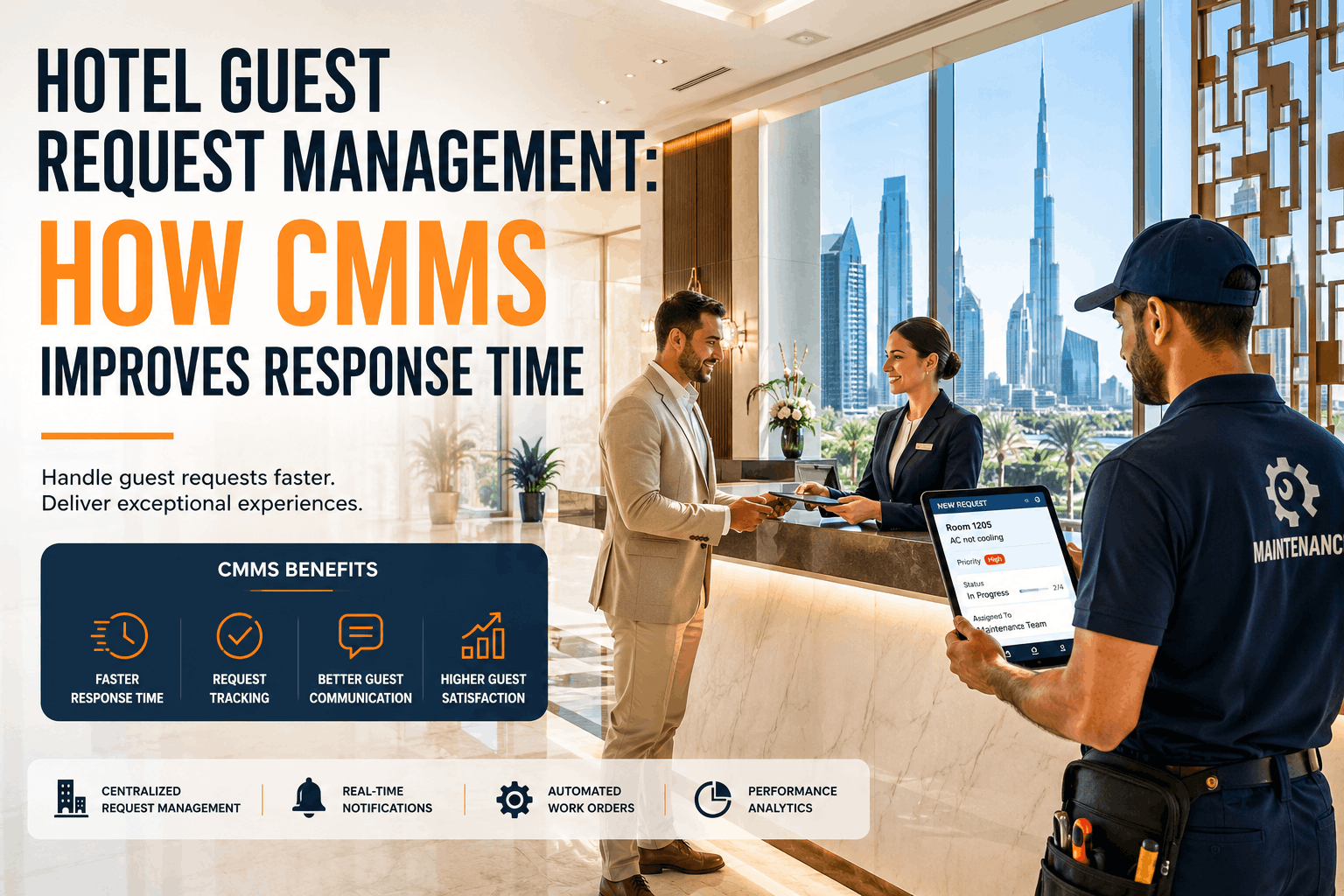
SLAs without technology enforcement are just hopes. A CMMS system automates SLA response by: (1) auto-routing emergency calls to the nearest technician, (2) assigning work order priority automatically based on category, (3) sending technician real-time directions to guest room, (4) alerting technician if response is late, (5) generating daily compliance reports, (6) tracking guest satisfaction scores, (7) calculating financial impact of SLA misses (lost reviews, occupancy impact). Hotels implementing CMMS SLA automation reduce average emergency response from 35 minutes to 18 minutes—a 48% improvement. This improvement directly translates to higher guest satisfaction scores and better online reviews.
Auto-Dispatch to Nearest Technician
When emergency request comes in, CMMS identifies which technician is closest (via GPS or last-known location), sends auto-alert with guest location, guest room, and nature of emergency. Technician accepts or system routes to second-nearest. No delay in finding someone.
Real-Time Tracking & Navigation
CMMS provides technician with turn-by-turn directions to guest room on mobile device. No hunting for room numbers, no wrong floor. Technician arrives with full context: guest name, room number, exact problem description, past history of that room's issues.
SLA Timer & Escalation Alerts
CMMS countdown timer shows technician: "Emergency response SLA: 15 min (you have 8 min remaining)." If technician hasn't started within 5 minutes, CMMS alerts facility manager. If 10 minutes, alerts facility director. Escalation prevents buried requests.
Post-Service Satisfaction Surveys
After technician closes work order, CMMS auto-sends guest SMS/email: "Rate your maintenance experience [1-10 scale]. Your feedback helps us improve." Aggregate scores track monthly satisfaction trends. Low satisfaction on specific technicians triggers retraining.
"
Before SLAs, a guest complaint about "slow maintenance" meant we didn't know if it was 20 minutes or 2 hours. Now with CMMS SLA tracking, we have data: average emergency response 18 minutes, average guest satisfaction 8.1/10. We can tell guests exactly what to expect. The transparency actually prevents complaints because guests aren't sitting around wondering when someone will show up—they know it's 15 minutes max. Our maintenance review scores went from 6.4/10 to 8.7/10 in 6 months just from publishing and hitting SLAs.
Director of Guest Services, 220-room hotel, Denver, Colorado
Transform Maintenance into a Service Excellence Differentiator
OxMaint includes SLA frameworks, auto-dispatch routing, guest satisfaction tracking, and technician accountability dashboards. Make maintenance a reason guests give you 5-star reviews.
What if we can't meet 15-minute emergency response with current staffing?
Hire part-time evening/night technician or rotate 24-hour on-call duty among existing staff with standby pay. Calculate: one missed emergency SLA = guest complaint + negative review = $400+ revenue impact. Emergency staffing cost ($600-$1,200/month) pays for itself in prevented complaint damage.
Can we have different SLAs for weekday vs. weekend occupancy?
Yes—hotels often use stricter SLAs during high-occupancy periods (faster response) and relaxed SLAs during slow periods. CMMS allows seasonal/day-of-week SLA adjustments. Communicate this to guests: "During peak season, emergency response is 15 min; during off-season, 30 min." Transparency prevents confusion.
What counts as "resolution" for SLA timing—when technician finishes or when guest confirms it's fixed?
Industry standard: SLA clock stops when technician closes work order in CMMS as "complete." If guest later reports issue, that's a new work order = new SLA clock. This prevents technicians from gaming the system by claiming "fixed" before really done. The guest satisfaction survey catches incomplete repairs.
Should we offer compensation if we miss an SLA target?
Yes—it shows you take the SLA seriously. Missed emergency SLA = room credit or meal voucher. Missed urgent SLA = 10% room rate discount. Missed routine SLA = small goodwill gesture. This isn't just nice; it's an insurance policy against negative reviews. Cost of $25-$50 credit is less than cost of damaged reputation.
How do we handle SLA compliance when there's a massive property failure (water main break affecting 50 rooms)?
Major incidents are force majeure exceptions to normal SLAs. CMMS allows flagging incidents as "emergency event - normal SLAs suspended." You still respond as fast as possible, but guests understand response times will exceed targets. Communicate proactively: "We're dealing with emergency plumbing issue affecting multiple rooms. We're prioritizing rooms by severity. We'll update you every 30 min."
Can SLA tracking improve technician hiring decisions?
Absolutely. CMMS SLA data shows which technicians consistently meet targets (promotable, high-performer), which are borderline (needing coaching), which are chronic underperformers (candidates for termination). When hiring new technicians, you can show candidates: "We track performance metrics. If you hit 95%+ SLA compliance for 6 months, you get a $2/hr raise." Financial incentives drive accountability.
Should we publish our SLAs publicly on the website and in reviews?
Yes—and it becomes a competitive differentiator. Hotels marketing "Emergency maintenance response: 15 minutes guaranteed" stand out. It shows confidence in your operation. Include it in check-in materials, website, and booking confirmation emails. Guests with clear expectations are happier guests, even when waits happen occasionally.
OxMaint automates SLA enforcement, tracks compliance, and generates guest satisfaction metrics. Your maintenance team will deliver excellence on a consistent, measurable schedule. Start free today.