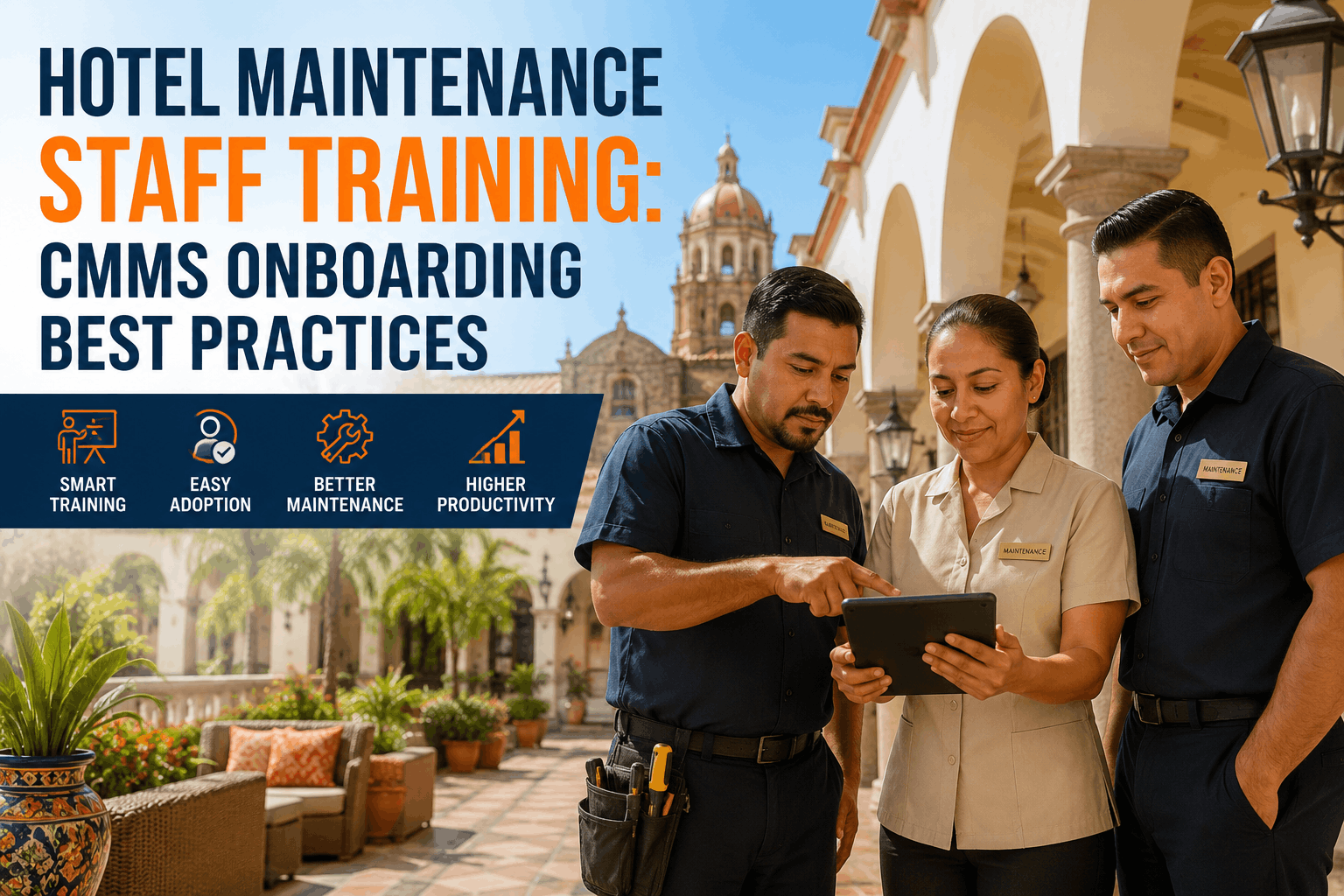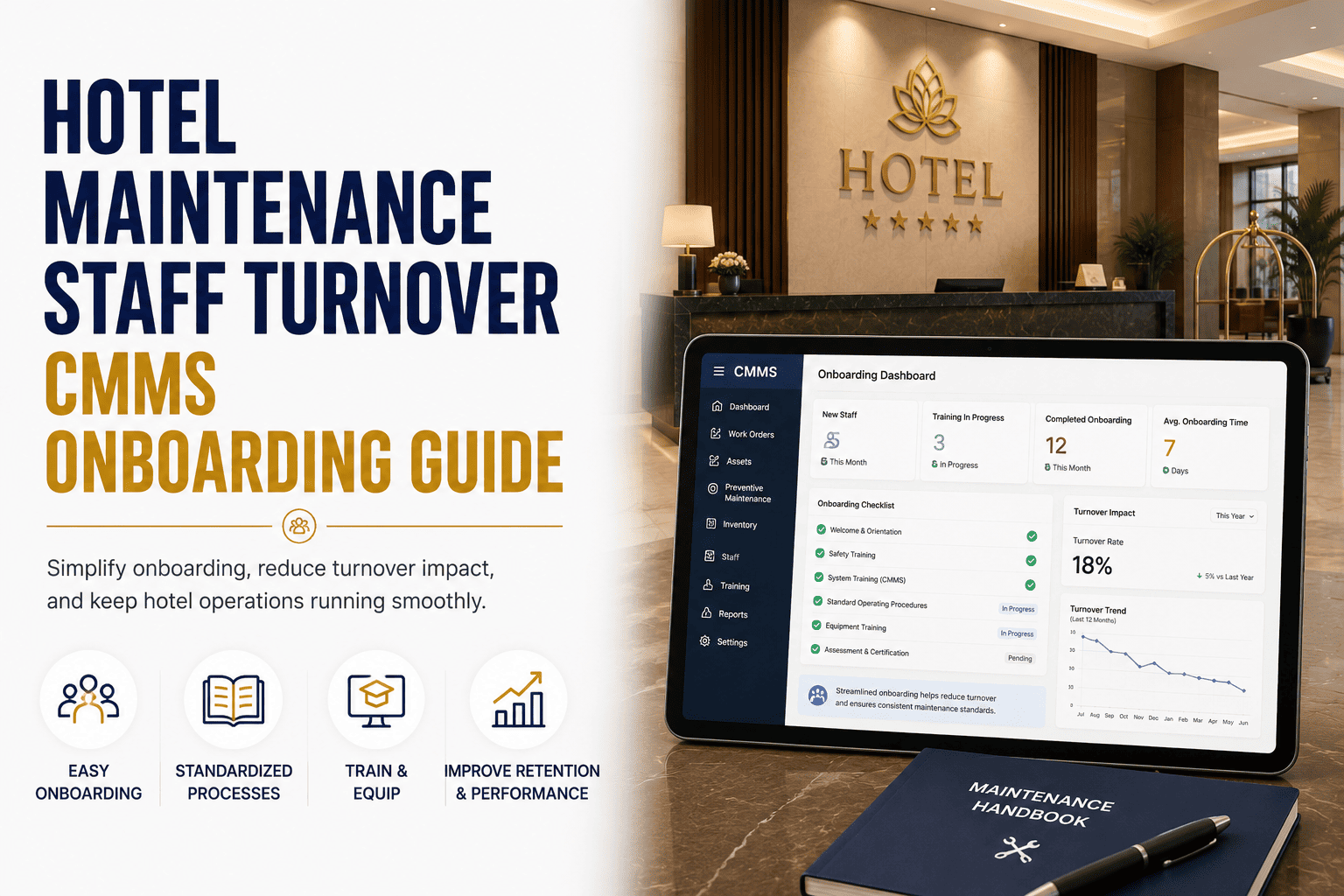
Hotel maintenance teams face some of the highest technician turnover in hospitality — often exceeding 70% annually — and every departure walks out the door with undocumented knowledge of boiler sequencing, guest-room HVAC quirks, and preventive-maintenance cadences. When a replacement engineer arrives and the CMMS is treated as a passive log rather than an onboarding engine, you lose roughly three months of productive output while they reverse-engineer your property. A structured CMMS onboarding program collapses that ramp-up to 30 days by front-loading digital SOPs, standardized PM templates, and asset histories into the system the new hire touches on day one. Start Free Trial to turn your maintenance platform into the knowledge-transfer layer your hotel actually needs.
Can a new maintenance engineer reach full productivity in 30 days instead of 90?
When hotel maintenance turnover runs 60–80% annually, every unguided hire burns three months of lost output. A CMMS-first onboarding program captures institutional knowledge before it walks out the door — and gets new technicians self-sufficient by Day 30.
What staff turnover actually costs your maintenance operation
Hospitality maintenance turnover consistently ranks among the highest of any skilled-trade segment, and the cost compounds when onboarding is ad-hoc.
Consider a 220-room full-service hotel running a four-person maintenance team. At a 73% annual turnover rate, expect roughly three technician departures per year. Each replacement costs $4,200 in recruiting, background checks, and uniform/training overhead — plus an estimated $11,500 in lost productivity during the 90-day ramp. That is $47,100 per year in avoidable cost, before counting the guest-complaint impact of delayed room turns and repeated HVAC callbacks. A CMMS onboarding program that cuts ramp time to 30 days recovers roughly $23,000 of that loss annually.
A 30-day CMMS onboarding timeline for hotel maintenance engineers
Instead of shadowing for a quarter and hoping knowledge sticks, sequence the first 30 days around the CMMS as the single source of truth.
CMMS Foundations & Asset Familiarization
New engineer logs into the CMMS on Day 1, completes a guided asset-hierarchy walkthrough (rooms, MEP plant, pool, kitchen, laundry), and reads the top-10 digital SOPs tied to highest-frequency work orders. Goal: navigate the system without asking where anything is.
Guided PM Execution
Technician executes preventive-maintenance tasks assigned through the CMMS — filter changes, PTAC coil cleaning, generator weekly checks — each task carrying a digital checklist, expected time, parts list, and safety lockout steps. Supervisor reviews completion quality inside the system.
Reactive Work Orders & Knowledge Base
Engineer begins picking up guest-room reactive tickets. Every work order in the CMMS links to a digital SOP, prior repair history, and the asset's failure pattern. The knowledge base — not a departing veteran — answers "how did we fix this last time?"
Independent Operation & Audit
Technician runs a full shift independently, closing work orders with photos, parts consumed, and root-cause notes logged in the CMMS. Supervisor audits a random 10% sample for completeness. Passing the audit = full productivity achieved.
How the CMMS captures knowledge before it walks out the door
The CMMS is not a logging tool — it is the hotel's maintenance memory. Four mechanisms make it the primary onboarding asset.
Digital SOPs attached to every asset
Each asset — from rooftop unit AHU-3 to dishwasher DW-K1 — carries step-by-step digital SOPs with photos, torque specs, and safety steps. A new hire reads the same procedure the departing tech followed, eliminating tribal variation.
Standardized PM templates
Preventive-maintenance schedules are templated by asset class, not hand-built per technician. A new engineer inherits the same 30/60/90-day PM cadence with checklists, parts, and labor estimates already populated.
Complete work-order history
Every prior repair — parts used, downtime, root cause, who fixed it — sits on the asset record. The new hire does not need to ask "what keeps failing on RTU-2?"; the CMMS answers in two clicks.
Root-cause & failure-pattern logging
Structured root-cause fields force technicians to record why a failure occurred, not just what was replaced. Over time this builds a failure-pattern database that lets new hires diagnose faster than veterans relying on memory.
Calculating the payback of CMMS-driven onboarding
The financial case is straightforward: shorter ramp + fewer repeat failures + lower turnover cost = measurable annual savings.
| Onboarding Approach | Ramp to Full Productivity | Knowledge Retained on Departure | Est. Annual Cost (4-person team) |
|---|---|---|---|
| Shadowing only (no CMMS structure) | 90 days | ~20% | $47,100 |
| CMMS log + paper SOPs | 60 days | ~45% | $31,400 |
| Structured CMMS onboarding program | 30 days | ~85% | $15,700 |
| Full digital SOP + PM template + audit | 21 days | ~92% | $11,000 |
What hotels see after implementing structured CMMS onboarding
Properties that treat the CMMS as the onboarding layer — not just a work-order log — report measurable shifts within the first quarter.
"Before OxMaint, a new maintenance tech took three months before we could trust them on a solo shift. With digital SOPs and PM templates tied to every asset, our last two hires were closing guest tickets independently by Day 24. The knowledge doesn't leave when someone quits — it lives in the system."
Turn your CMMS into the onboarding engine your hotel needs
Digital SOPs, standardized PMs, and asset histories — ready for your next hire on Day 1.
CMMS onboarding for hotel maintenance turnover
How fast can a new maintenance technician become productive on a CMMS?
With a structured onboarding program — digital SOPs attached to assets, templated PMs, and a guided 30-day timeline — most new hotel maintenance engineers reach independent shift coverage in 30 days rather than the industry-typical 90. The key is making the CMMS the first thing they touch on Day 1, not an afterthought to shadowing. You can Start Free Trial to build that timeline before your next hire starts.
What makes hotel maintenance turnover so much worse than other industries?
Hospitality maintenance combines shift work, wage pressure, and broad asset diversity (HVAC, kitchen, pool, laundry, MEP) with historically thin documentation. When knowledge lives in a veteran's head and that veteran leaves, the replacement starts from near-zero. A CMMS with complete work-order history and digital SOPs breaks that cycle by retaining knowledge in the system.
How do digital SOPs reduce the knowledge gap when a technician quits?
Digital SOPs capture the exact steps, photos, parts, torque specs, and safety procedures a departing technician followed — attached permanently to the asset record. The next hire reads the same procedure instead of relying on verbal handoff. Over time, root-cause logging builds a failure-pattern database that lets new engineers diagnose faster than memory alone.
Can a small hotel justify a CMMS just for onboarding?
Yes — even a 100-room property with two maintenance staff loses an estimated $15,000–$20,000 per year to turnover ramp and repeat failures. A CMMS that cuts ramp from 90 to 30 days and reduces repeat work orders by 40% typically pays back in under four months. Book a walkthrough at calendly.com/oxmaintapp/30min to see the math for your property.
What should a hotel CMMS onboarding program include?
At minimum: a guided asset-hierarchy walkthrough in Week 1, templated PM execution with digital checklists in Week 2, reactive work orders linked to SOPs and failure history in Week 3, and an independent-shift audit in Week 4. Every task the new hire touches should live inside the CMMS so completion quality, parts usage, and root cause are captured from day one.
Stop losing three months of productivity on every hire
Build your 30-day CMMS onboarding program today — digital SOPs, PM templates, and asset histories included.
Free 14-day trial · No credit card