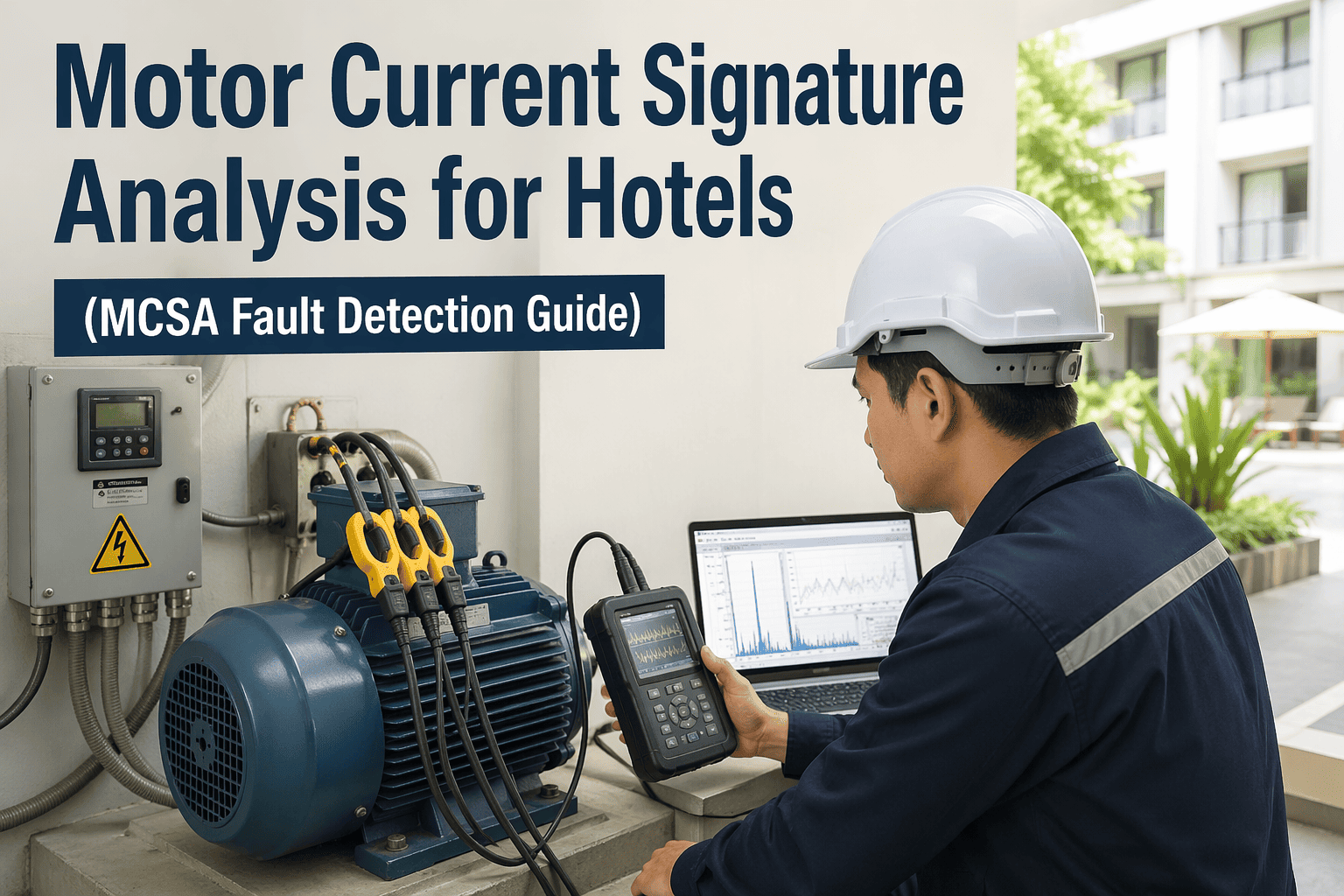
Motor Current Signature Analysis for Hotels (MCSA Fault Detection Guide)
By Mark Strong on April 22, 2026
A hotel's chilled water pump motor fails on a Friday night in August — peak occupancy, 96% rooms sold. The bearing had been degrading for four months. The vibration signature wasn't strong enough to trigger a standard vibration sensor alert, and no one had scheduled a physical inspection. But the motor's electrical current had been telling the story the whole time — a faint sideband frequency at precisely 47.3 Hz, climbing 0.8 dB per week. Motor Current Signature Analysis would have detected that bearing defect frequency 90 to 120 days before failure, without a single technician touching the motor. No sensor mount. No vibration accelerometer. Just a clamp-on current transformer at the control panel — and the physics of how a failing bearing changes the load on a spinning motor. That's what MCSA delivers: non-invasive, continuously running, electrically-sourced fault detection that catches what vibration sensors miss and catches it earlier. Start a free Oxmaint trial to connect MCSA diagnostics to automated maintenance workflows for your hotel motors.
90–180
days
Earlier fault detection vs. vibration analysis alone
60–70%
Reduction in unplanned motor failures with MCSA + CMMS
Zero
Physical sensors required on the motor itself
35–45%
Lower motor maintenance costs within 12 months
40%
Of all induction motor failures originate in bearings — MCSA's primary target
What MCSA Is — and Why It's Different from Vibration Monitoring
Motor Current Signature Analysis monitors the stator current waveform of an operating induction motor to detect both mechanical and electrical faults — without stopping the motor or mounting any sensors on it. Every fault changes the motor's load, and every load change leaves a measurable imprint on the electrical current it draws. MCSA uses Fast Fourier Transform (FFT) analysis to decompose that current signal into frequency components, revealing fault-specific sideband frequencies that appear months before physical failure.
MCSA vs. Vibration Analysis: Detection Timeline Comparison
Motor Current Signature Analysis
Detection Method
Electrical current spectrum analysis at control panel
Sensor Installation
Clamp-on CT at panel — no motor access required
Bearing fault detection lead time
90–180 days before failure
Winding fault detection
Direct — electrical faults show immediately in current spectrum
Hard-to-reach motors
Submerged pumps, sealed housings — monitored remotely from panel
Rotor bar fault detection
Best method available — first bar crack detectable
Cost per monitoring point
Lower — CT sensors cheaper than accelerometers
Vibration Analysis
Detection Method
Accelerometer on bearing housing measures mechanical vibration
Sensor Installation
Physical mount on motor bearing housing required
Bearing fault detection lead time
30–60 days before failure (mechanical symptoms develop later)
Winding fault detection
Indirect — electrical faults must create vibration to be detected
Hard-to-reach motors
Challenging — physical access needed for sensor mounting
Rotor bar fault detection
Poor — 2-3 bars must fracture before vibration signature detectable
Cost per monitoring point
Higher — accelerometers + mounting hardware + access labour
MCSA and vibration analysis are complementary, not competing. MCSA detects earlier; vibration confirms mechanical severity. Combined programs deliver the most comprehensive motor health picture.
The Six Faults MCSA Detects in Hotel Motors
Each fault type produces a mathematically predictable sideband frequency pattern in the motor's current spectrum. The presence and amplitude of these sidebands tell maintenance teams not just that something is wrong — but specifically what is failing and how fast it is progressing.
01
Bearing Fault
Fault frequency pattern
f₁ ± n·f_bearing (BPFI, BPFO, BSF, FTF)
Bearing raceway defects, ball spalling, and cage damage all modulate motor load at specific bearing defect frequencies. MCSA detects these 90–120 days before the mechanical vibration becomes measurable.
Chilled water pumps, cooling tower fan motors, AHU supply fans, condenser pumps
02
Broken Rotor Bar
Fault frequency pattern
f₁ ± 2s·f₁ (where s = slip frequency)
MCSA is the gold standard for rotor bar fault detection — it catches the first cracked bar while vibration methods require 2–3 fractured bars before a detectable signature develops. Lab duty cycles make this a common hotel motor failure mode.
High-duty-cycle motors: domestic hot water circulation, boiler feed pumps, laundry equipment
03
Stator Winding Fault
Fault frequency pattern
Odd harmonics (3f₁, 5f₁, 7f₁) + phase imbalance
Insulation breakdown between winding turns creates inter-turn short circuits visible as harmonic distortion and current imbalance across phases. Detected months before catastrophic winding failure and motor rewind.
Any induction motor — particularly those in high-temperature environments: boiler room, kitchen exhaust
04
Air Gap Eccentricity
Fault frequency pattern
f₁ ± n·f_r (static); sidebands modulated by rotor speed (dynamic)
Non-uniform air gap between rotor and stator — caused by bent shaft, bearing wear, or mounting frame distortion. Static eccentricity indicates frame issues; dynamic eccentricity confirms bearing degradation.
Large motors subject to mechanical stress: cooling tower fan motors, elevator machine room motors
05
Shaft Misalignment
Fault frequency pattern
1× and 2× rotational frequency sidebands around f₁
Angular and parallel coupling misalignment creates periodic load variations that modulate stator current. MCSA provides definitive misalignment diagnosis without coupling disassembly — critical for pump-motor sets.
All pump-motor coupled sets: chilled water, condenser, domestic hot water, fire pump
06
Load-Side Mechanical Fault
Fault frequency pattern
n × vane passing frequency (f_vp = RPM/60 × blades)
Pump impeller cavitation, vane deterioration, and fan blade damage all create torque oscillations at specific frequencies in the stator current. MCSA diagnoses driven equipment faults without accessing the pump or fan housing.
Hotel Motors That Benefit Most from MCSA Monitoring
MCSA prioritization for hotels follows the same logic as any predictive maintenance program: monitor assets where early detection delivers the highest value relative to failure consequence. The matrix below maps hotel motor assets to their failure impact, MCSA detection advantage, and deployment priority.
Motor Asset
Failure Consequence
MCSA Advantage
Detection Lead Time
Priority
Chilled Water Pump Motors
Full HVAC failure — guest comfort event across all floors
Monitors submerged or inaccessible bearing housings from panel
90–120 days
P1
Cooling Tower Fan Motors
Condenser water temperature rise — chiller efficiency drop 15–25%
Detects bearing and blade imbalance via load-torque frequency analysis
Detects impeller cavitation and winding degradation in high-heat zones
60–90 days
P2
Kitchen Exhaust Fan Motors
Hood failure — fire code violation, kitchen shutdown
Grease-contaminated housing makes physical sensor mounting impractical — MCSA ideal
30–60 days
P2
Condenser Water Pumps
Chiller shutdown — $40K–$100K emergency repair
Shaft misalignment and bearing faults detected before coupling damage spreads
90–120 days
P1
MCSA in Practice: From Current Signal to CMMS Work Order
MCSA's value is only realized when the detection output connects to a maintenance action. A motor health score sitting in a diagnostics dashboard without triggering a work order is just another alarm nobody acts on. Oxmaint closes that loop — mapping MCSA fault patterns directly to asset records and generating condition-based work orders before a technician notices anything is wrong. Book a demo to see MCSA-driven work orders in a live hotel maintenance environment.
MCSA Signal-to-Work-Order Pipeline
CT Sensor
Clamp-on current transformer at the motor's control panel MCC captures three-phase current waveform continuously — no motor access, no shutdown
FFT Analysis
Fast Fourier Transform converts time-domain current signal into frequency spectrum — fault-specific sidebands isolated and compared against motor's baseline signature
Fault Classification
AI compares spectrum against known fault signatures — classifies fault type (bearing, rotor, winding, misalignment), estimates severity level and trajectory
Health Score
Each motor receives an aggregate health score (0–100) combining MCSA, vibration trend, thermal data, and runtime hours. Scores below 70 trigger PM review; below 50 generate urgent work orders
Oxmaint Work Order
Auto-generated work order with fault type, severity level, recommended repair action, optimal scheduling window, and complete asset history pre-attached — technician acts, not investigates
Frequently Asked Questions
Can MCSA monitor motors that aren't accessible — submerged pumps, sealed housings?
This is one of MCSA's primary advantages over vibration analysis. Because monitoring happens at the control panel via a clamp-on current transformer — not on the motor itself — submerged pumps, motors in sealed enclosures, motors in hazardous or confined spaces, and equipment on high shelves or behind structural obstructions can all be monitored without physical access. For hotel domestic hot water recirculation pumps, grease-environment kitchen motors, and cooling tower motors at height, MCSA is often the only practical continuous monitoring option.
How does MCSA establish a motor's "healthy" baseline?
During the first 7–14 days of monitoring, the system captures multiple current spectrum readings across varying load conditions and builds a statistical baseline of the motor's normal signature — the frequency amplitudes that represent healthy operation at different loads. All subsequent readings are compared against this baseline. Deviation from baseline, not just absolute threshold exceedance, is what triggers alerts. This is why MCSA catches developing faults that fixed-threshold systems miss: the fault shows as change from normal, not change beyond a generic limit.
Does MCSA work on variable speed drive (VFD) controlled motors?
VFD-controlled motors require additional signal processing because the drive modifies the current waveform — standard FFT analysis produces misleading results without accounting for the carrier frequency and switching harmonics introduced by the VFD. Modern MCSA systems designed for hotel HVAC applications include VFD-aware filtering algorithms that separate drive-generated harmonics from genuine fault signatures. Most chilled water pump motors and fan motors in hotels with BMS control operate on VFDs, so verifying VFD compatibility is essential when selecting an MCSA platform.
What's the difference between MCSA and a simple current amp draw monitoring?
Current amp draw monitoring tracks only total RMS current — useful for detecting gross overloads or open phases but incapable of identifying the specific fault types MCSA detects. MCSA performs spectral analysis of the full current waveform, resolving individual frequency components at millihertz resolution. A bearing fault with a defect frequency of 47 Hz produces a sideband at 47 ± 50 Hz that is invisible to amp monitoring but clearly detectable in the frequency spectrum. It's the difference between reading a total sound level and hearing a specific note in an orchestra.
Should MCSA replace vibration analysis or complement it?
Complement, not replace. MCSA detects faults earlier and covers motor types where physical sensor mounting is impractical. Vibration analysis provides more precise mechanical severity assessment once a fault is known to exist. Best practice for hotel critical motors — chilled water pumps, cooling tower fans — is to deploy MCSA as the continuous early-warning layer and use periodic vibration readings to confirm severity and schedule the repair window. Oxmaint manages both data streams in a single asset record, correlating MCSA health scores with vibration trend readings for the most complete motor health picture.
Hotel Predictive Motor Maintenance
Stop Replacing Motors on Schedules.
Replace Them When They Actually Need It.
MCSA tells you what's failing and when. Oxmaint turns that signal into a scheduled work order before any guest is impacted — automatically, 24 hours a day, across every motor in your plant room.