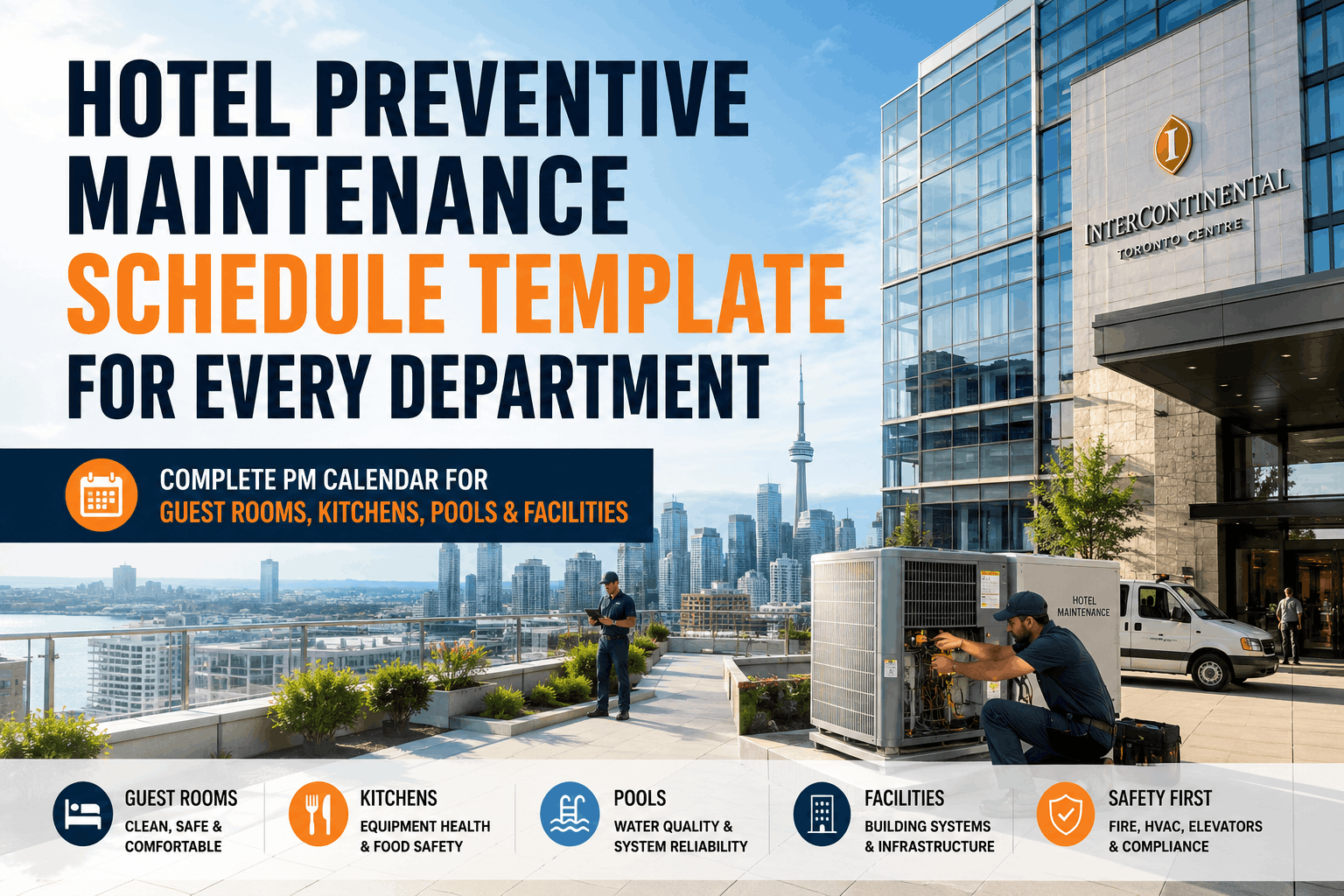
Hotel Preventive Maintenance Schedule Template for Every Department

By Alex Jordan on June 25, 2026

hotel-preventive-maintenance-schedule-template-for-every-department

Your CMMS already contains the data that could optimize your preventive maintenance schedule — but the challenge is that 73% of hotels lack a structured, department-by-department PM schedule that catches issues before guests notice them. A flickering light, a rattling air conditioning unit, or a slow drain signals something more damaging than a minor fault: it signals a property that cannot be trusted [citation:1]. The guest room that generates three maintenance complaints in a single stay is not random — it is a pattern sitting in your maintenance data right now, invisible because nobody has built the scheduling framework that surfaces it. Oxmaint's preventive maintenance module turns your asset inventory into a department-specific scheduling engine — automatically generating PM work orders by frequency, tracking completion rates, and flagging overdue tasks before they become guest complaints. The data is already yours, and building a comprehensive PM schedule takes minutes, not months. If your hotel is still managing preventive maintenance through spreadsheets and memory instead of a structured schedule, start a free trial or book a demo to see how Oxmaint automates PM scheduling across every department.

HOTEL PREVENTIVE MAINTENANCE · PM SCHEDULE · DEPARTMENT TEMPLATE · 2026

Hotel Preventive Maintenance Schedule Template for Every Department

Download a complete PM schedule template for guest rooms, kitchens, pools, and facilities — a department-by-department preventive maintenance calendar for hospitality operations.

73%Of hotels lack a structured department-by-department PM schedule
15%Efficiency loss from clogged HVAC filters — reduced by regular PM
40-60%Cost reduction from preventive vs. reactive maintenance
5-7 yearsMattress replacement cycle — tracked through PM scheduling

Why Preventive Maintenance Scheduling Matters — The Guest Experience Impact

Research consistently shows that the physical environment ranks among the top drivers of satisfaction—or dissatisfaction. A flickering light, a rattling air conditioning unit, or a slow drain signals something more damaging than a minor fault: it signals a property that cannot be trusted [citation:1]. Preventive maintenance gives teams a way to catch those problems before guests have a chance to notice them [citation:2].

For hotel maintenance teams, a PM schedule provides five essential benefits: guest satisfaction by fixing issues before guests notice them; safety compliance by ensuring fire alarms, elevators, and emergency exits meet code; cost control by preventing major breakdowns in HVAC, plumbing, or laundry systems; operational consistency by standardizing inspections across shifts and staff; and asset longevity by extending the life of high-use equipment [citation:3]. A structured schedule protects both guest experience and asset value [citation:1]. Start a free trial or book a demo to see how Oxmaint automates department-specific PM scheduling.

Guest Satisfaction
Revenue
Catch issues before guests notice — flickering lights, HVAC rattles, slow drains are all preventable through regular PM scheduling.
Cost Control
Financial
Preventive maintenance costs 40-60% less than reactive repairs. A structured schedule eliminates emergency premiums and guest compensation.
Asset Longevity
Capital
HVAC units, mattresses, and kitchen equipment last 15-40% longer with scheduled PM. Extend asset life and defer capital replacement.

Guest Room Preventive Maintenance Schedule

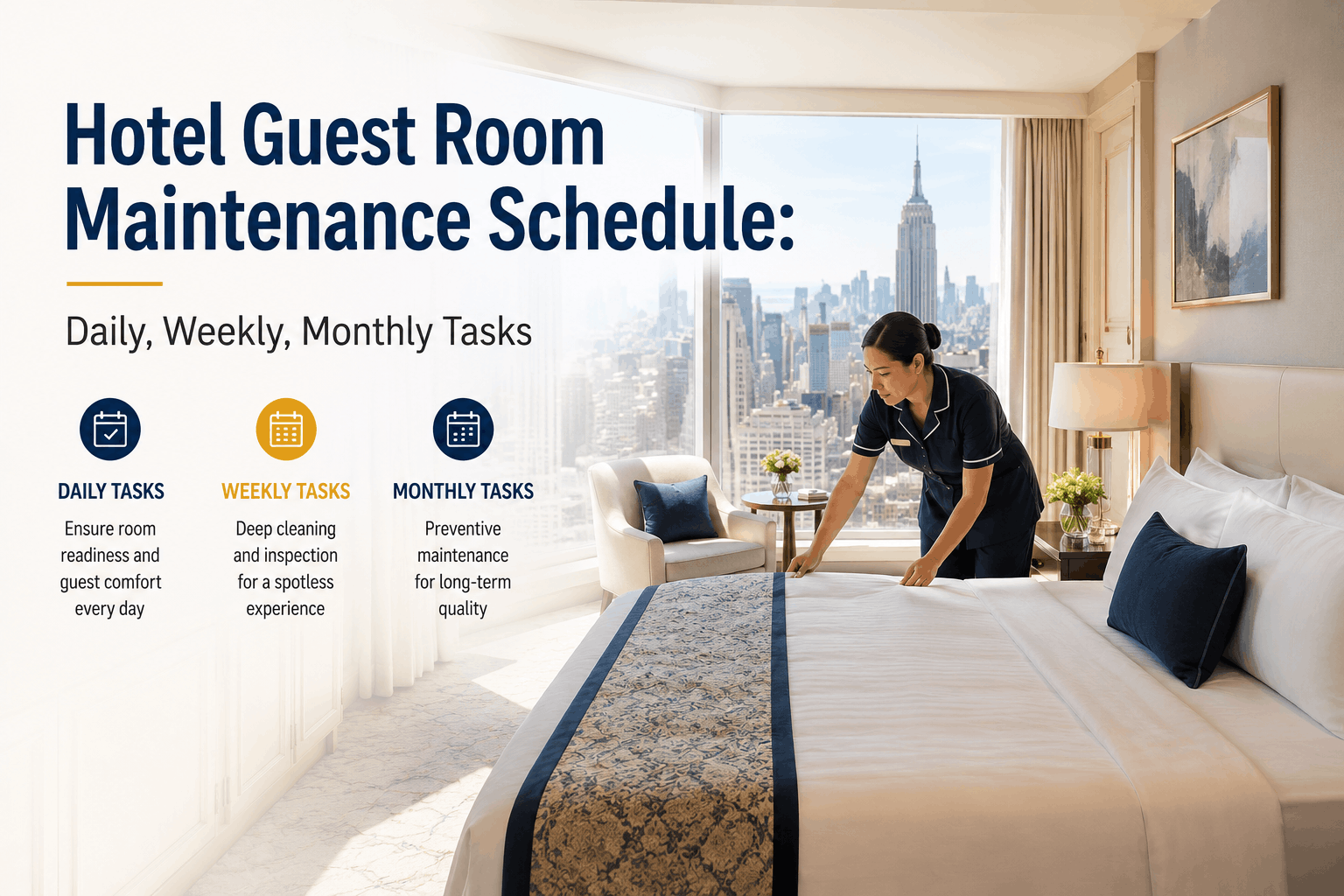
Guest rooms are the highest-impact area for preventive maintenance because they are the primary guest touchpoint and the most common source of complaints. A thermostat that won't respond or a malfunctioning electrical device can easily become a one-star review [citation:1]. Hotel rooms contain the highest concentration of mechanical, electrical, plumbing, and safety components — and even small failures can directly impact guest satisfaction and online reviews [citation:4].

Pre-Arrival Guest Room Checks
Every Stay
✓ Test all light switches — replace burnt bulbs, check for flickering
✓ Check faucets for leaks, test water pressure and temperature
✓ Test toilet flush and check for leaks at base
✓ Test HVAC heating and cooling modes, verify temperature accuracy
✓ Test keycard access, deadbolt, and night latch function
✓ Test TV power, input, and remote batteries
✓ Verify Wi-Fi connectivity, test all outlets
✓ Test smoke detector function and indicator light [citation:1]
Monthly Guest Room Tasks
Every 30 Days
✓ Inspect HVAC vents for dust — replace filters (clogged filters reduce efficiency by 15%)
✓ Rotate mattresses and inspect for stains or damage [citation:1]
✓ Check window seals for drafts, test blind and curtain operation
✓ Inspect paint, walls, and ceilings for scuffs, stains, or damage
✓ Test telephone dial tone and all function buttons [citation:1]
Quarterly Guest Room Tasks
Every 3 Months
✓ Clean light fixtures and lampshades, check wiring connections
✓ Inspect faucet aerators, descale fixtures, replace worn washers
✓ Deep clean shower/tub, reseal grout lines as needed
✓ Inspect toilet internal components, replace flappers as needed
✓ Clean HVAC exhaust fan blades, test operation [citation:1]
✓ Lubricate door hinges and lock mechanisms
Annual Guest Room Tasks
Every 12 Months
✓ Deep clean or replace mattresses (typically every 5-7 years) [citation:1]
✓ Inspect weatherstripping on windows and doors, replace worn seals
✓ Full paint condition audit (full repaint every 3-5 years)
✓ Full furniture condition audit — schedule replacement items
✓ Comprehensive guest room condition assessment [citation:4]

Common Areas and Shared Facilities — PM Schedule

Shared areas see the most foot traffic and shape first impressions. A flickering lobby light or a broken treadmill won't generate an urgent work order the way a guest-room complaint does. But it does quietly erode the perception of quality [citation:1]. Common areas also carry a higher compliance burden than guest rooms, with elevators, pools, emergency lighting, and accessibility features all subject to regulatory inspection and certification requirements [citation:1].

Frequency Area Key Tasks
Daily Lobby · Elevators · Pool · Stairwells · Restrooms Inspect lobby furniture; clean elevator interiors; test pool chemical levels (pH, chlorine, alkalinity); check stairwells for blocked exits; clean public restrooms [citation:1]
Weekly Lighting · Pool Equipment · Fitness Center · Parking Replace burnt bulbs; inspect pool pumps and filters for leaks; inspect fitness equipment for wear; check parking areas for cracks or trip hazards [citation:1]
Monthly Elevators · Emergency Lighting · Signage · ADA Features Test elevator door sensors and safety operation; test emergency lighting battery backup (30-second test); check signage for damage; test ADA ramps and handrails [citation:1]
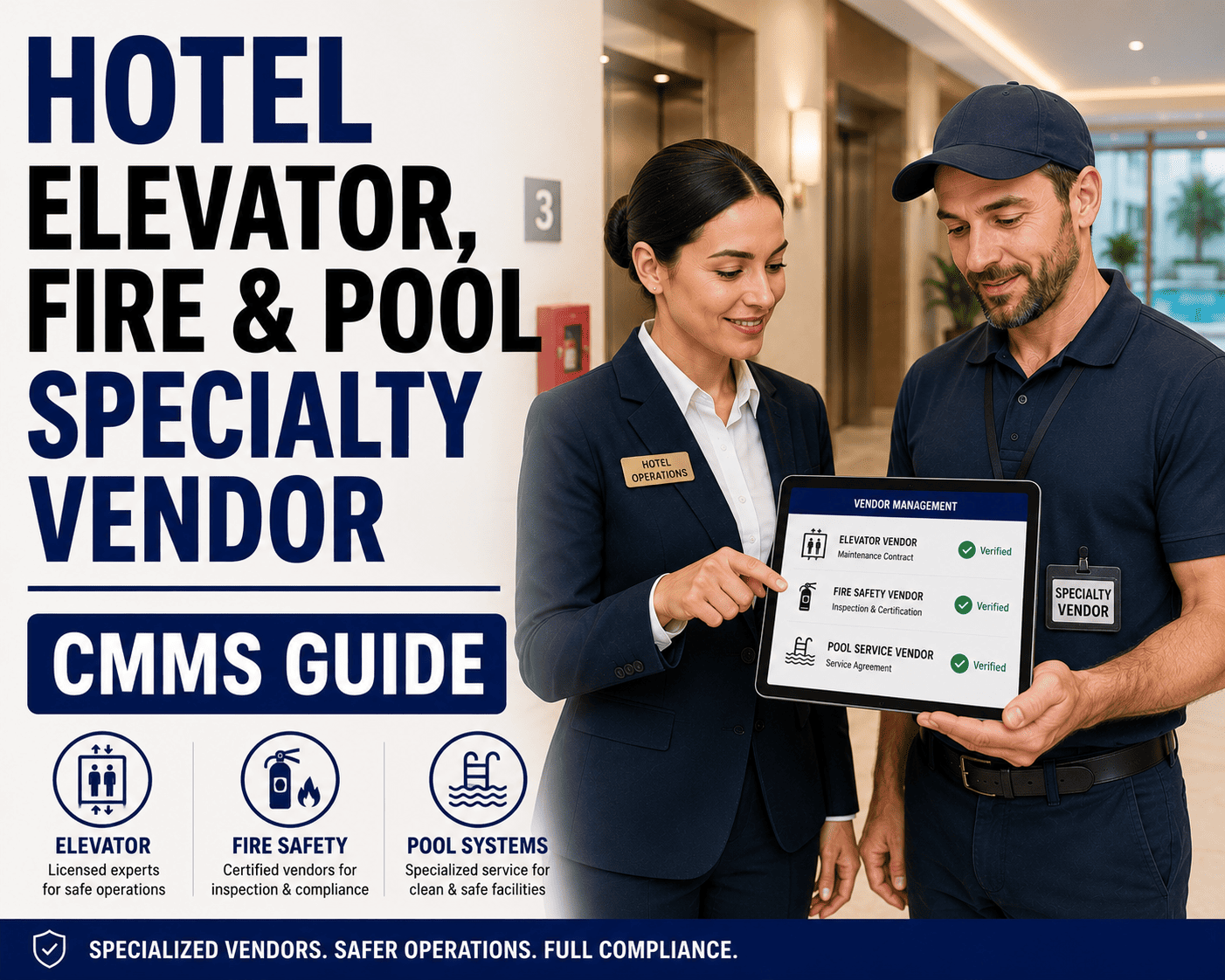
Quarterly Lobby · Elevators · Pool · Fitness Equipment Deep clean lobby upholstery; elevator cable and pulley inspection by licensed contractor; drain, clean, and refill pool; lubricate fitness equipment moving parts [citation:1]

HVAC, Plumbing, and Electrical Systems — Critical Infrastructure PM

Nearly every aspect of guest comfort depends on building systems. Guests don't register HVAC, plumbing, or electrical when they're working, but when they fail, the impact is immediate, property-wide, and unpleasant [citation:2]. These building systems underpin every aspect of guest comfort. When they fail, the impact is immediate and property-wide [citation:1].

Building Systems PM Schedule
HVAC · Plumbing · Electrical — Critical Infrastructure
HV
HVAC Systems
Monthly: Filter changes (clogged filters reduce efficiency by 15%) [citation:1]. Quarterly: Coil cleaning to maintain airflow and heat transfer, thermostat calibration, condensate drain clearing to prevent water damage and mold [citation:2]. Annual: Refrigerant checks to catch slow leaks before compressors fail [citation:2].
PL
Plumbing Systems
Monthly: Inspect guest room plumbing fixtures to prevent mid-stay complaints [citation:3]. Quarterly: Flush water heaters and check water pressure [citation:3]. Annual: Inspect and service boilers and furnaces; flush water heaters; check water pressure [citation:3].
EL
Electrical Systems
Monthly: Test emergency lighting battery backup (30-second test) [citation:1]. Quarterly: Inspect wiring, tighten outlet connections, test GFCI outlets [citation:1]. Annual: Test emergency lighting and backup power systems [citation:3].

Back-of-House and Health & Safety Systems

Kitchens, laundry rooms, loading docks, storage areas, and mechanical rooms sit outside the guest experience but run a significant portion of it. Failures here create service delays guests feel directly, even when they never see the source [citation:2]. These spaces also carry compliance burdens: commercial kitchen equipment, exhaust systems, and laundry infrastructure are all subject to health code requirements [citation:2].

Kitchen Equipment
Monthly
Commercial kitchen servicing
Hood systems, walk-in coolers, and cooking lines [citation:2]. Clean kitchen exhaust hoods and grease traps quarterly [citation:3].
Fire Safety Systems
Quarterly
Sprinkler and extinguisher checks
Fire sprinkler inspections per NFPA 25 schedules; smoke and CO detector testing in guestrooms and common areas [citation:2]. Fire extinguisher inspection and recharge cycles tracked by location [citation:2].
Laundry Equipment
Monthly
Lint traps and bearing inspections
Lint trap cleaning, bearing inspections, and water-hose replacement [citation:2]. Check ice machines, refrigerators, and freezers weekly [citation:3].
Backup Generators
Monthly
Generator testing
Load tests and annual full-load verification [citation:2]. Confirm backup generators are tested monthly for storm readiness [citation:3].

Pool, Spa, and Recreation Facilities — Compliance-Focused PM

Pools and spas operate under the highest regulatory scrutiny of any amenity. Health departments inspect water chemistry daily. A single out-of-range pH or chlorine reading can trigger immediate closure, mandatory retesting, and public notice [citation:1]. Pool maintenance requires daily testing and regular equipment servicing to ensure guest safety and regulatory compliance.

Frequency Area Key Tasks
Daily Pool · Spa/Hot Tub Test pH, chlorine, and alkalinity — log results per health code [citation:1]; test spa chemical levels and temperature [citation:1]
Weekly Pool Equipment · Spa Filters Inspect pumps, filters, and heaters for leaks or unusual noise [citation:1]; clean spa filters and inspect jets [citation:1]
Monthly Pool Systems Verify pool pumps, filters, and chemical levels [citation:3]; service chillers and cooling towers [citation:3]
Quarterly Pool Drain, clean, and refill pool (schedule during low occupancy) [citation:1]; deep clean pool surfaces

Seasonal Preventive Maintenance — Preparing for Peak Demand

Seasonal scheduling helps hotel teams balance guest expectations with maintenance demands. With a CMMS, you can auto-schedule spring HVAC cleanings, summer generator tests, fall fire system checks, and winter deep cleans — keeping your hotel ahead of breakdowns and complaints [citation:3].

Season Focus Areas Key Tasks
Spring HVAC · Cooling Systems Deep clean HVAC coils and replace filters [citation:3]; service chillers and cooling towers [citation:3]; check irrigation systems for leaks [citation:3]
Summer Pool · Generators · High-Traffic Test pool systems and chemical balance [citation:3]; confirm backup generators [citation:3]; review carpets, flooring, and furniture after summer traffic [citation:3]
Fall Heating · Fire Systems Inspect and service boilers and furnaces [citation:3]; inspect and test heating controls [citation:3]; inspect fire alarms, extinguishers, and emergency exits [citation:3]
Winter Envelope · Plumbing · Deep Cleaning Check windows, doors, and weatherstripping for drafts [citation:3]; inspect plumbing and insulate pipes [citation:3]; schedule deep cleans and non-urgent repairs during lower occupancy [citation:3]
"

Our preventive maintenance was reactive for years. We had the checklists, but we never had a system to schedule tasks across departments and track completion. The shift to a structured PM schedule meant we stopped waiting for complaints. We caught HVAC filter clogs before guests noticed temperature issues, identified bathroom leaks before they became water damage claims, and extended the life of our kitchen equipment by 30%. The schedule paid for itself in the first 6 months.

Director of Engineering — 350-room Full-Service Hotel, US Southwest

Frequently Asked Questions — Hotel Preventive Maintenance Scheduling

How often should guest rooms be inspected for preventive maintenance?
Guest rooms require multiple inspection frequencies: pre-arrival inspections (every stay) to catch issues before guests arrive [citation:1]; monthly inspections for HVAC vents, filters, mattresses, and window seals [citation:1]; quarterly inspections for light fixtures, plumbing, and door hardware [citation:1]; and annual inspections for deep cleaning, repainting, and full condition audits [citation:1]. Mattresses typically require replacement every 5-7 years [citation:1]. Start a free trial to automate guest room PM scheduling.
What HVAC tasks should be included in the PM schedule?
HVAC PM tasks should be scheduled by frequency: monthly filter changes (clogged filters reduce efficiency by 15%) [citation:1]; quarterly coil cleaning to maintain airflow and heat transfer, thermostat calibration, and condensate drain clearing [citation:2]; annual refrigerant checks to catch slow leaks before compressors fail [citation:2]; and seasonal deep cleaning of HVAC coils and replacement of filters before peak cooling/heating seasons [citation:3]. Book a demo to see HVAC PM scheduling in action.
How do I implement a preventive maintenance schedule across departments?
Implementing a department-specific PM schedule requires four steps: (1) Create a complete asset inventory by department — guest rooms, common areas, HVAC, kitchen, pool, safety systems [citation:1], (2) Define PM frequencies by asset type — pre-arrival, daily, weekly, monthly, quarterly, annual [citation:1], (3) Use a CMMS to generate work orders automatically at scheduled intervals [citation:3], and (4) Track completion rates and adjust schedules based on failure data. Use Oxmaint's PM module to automate the entire process.
What is the ROI of a structured preventive maintenance schedule?
The ROI of a structured PM schedule is significant across three categories: (1) Cost reduction — preventive maintenance costs 40-60% less than reactive repairs, eliminating emergency premiums and guest compensation, (2) Asset life extension — HVAC units, kitchen equipment, and mattresses last 15-40% longer with scheduled PM, deferring capital replacement, and (3) Guest satisfaction — catching issues before guests notice improves review scores and repeat bookings. Most hotels see PM program payback within 6-12 months. Start free to calculate your potential ROI.

Stop Reacting — Start Scheduling. Deploy Department-Specific PM Today.

Oxmaint's preventive maintenance module generates department-specific work orders automatically — guest rooms, kitchens, pools, HVAC, and safety systems all on schedule. Free to start.
Share This Story, Choose Your Platform!