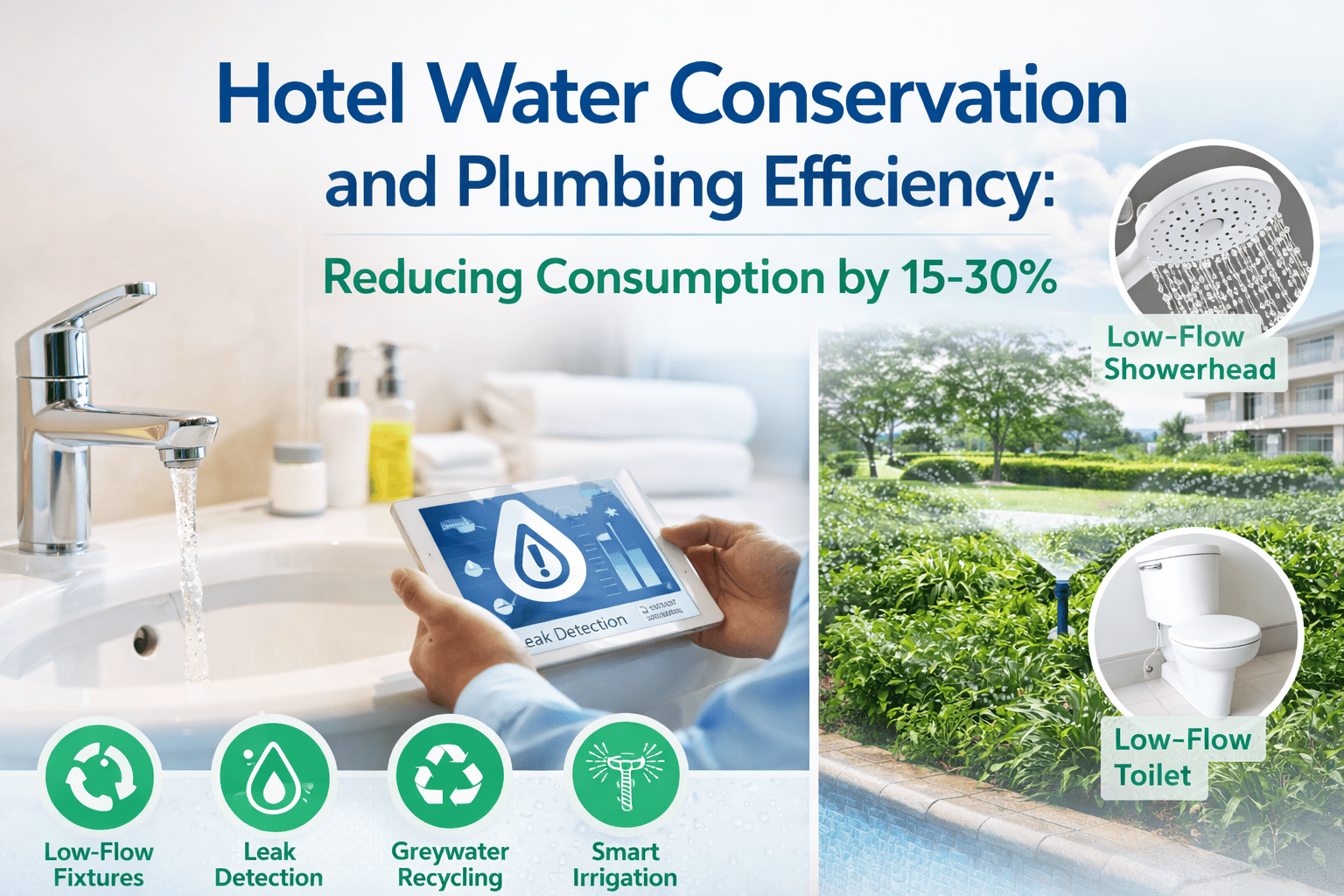
A 250-room hotel in Miami was spending $186,000 per year on water — and the general manager assumed it was simply the cost of running a full-service property. When a water audit revealed that 31% of that spend was tied to undetected leaks, inefficient laundry cycles, and cooling tower blowdown waste, the assumption collapsed. Three months after deploying IoT leak detection and smart monitoring, the property had eliminated $58,000 in annual water waste. The fix wasn't a renovation. It was visibility. Sign up free to see how OxMaint's water monitoring tools work for hospitality properties.
40%
Water Cost Reduction Achievable
$1,800
Avg. Water Cost per Room per Year
30%
Of Hotel Water Lost to Leaks
6 mo
Typical Payback Period
Where Hotels Actually Lose Water — and Money
Most hotel water waste is invisible at the billing level. Monthly utility statements show total consumption — not where the gallons went or whether they served any guest. Before any conservation strategy can work, the sources of waste need to be mapped. Book a demo to see how OxMaint's conservation analytics identify waste sources across your property.
Guest Rooms (showers, toilets, faucets)
Food and Beverage / Kitchen
Pools, Spas, and Landscaping
Undetected Leaks and System Losses
The leak category above is not a fixed allocation — it overlaps across all systems. Properties without IoT monitoring routinely underestimate this figure by 2x or more.
The Case for IoT Leak Detection: Finding What Meters Miss
Traditional water audits are point-in-time snapshots. A technician reads meters, estimates flow rates, and produces a report that reflects conditions on the day of the audit — not at 2 AM on a Tuesday when a guest room supply line starts weeping behind the wall. IoT-based leak detection solves this by monitoring flow continuously, flagging anomalies in real time, and alerting maintenance before damage compounds. Sign up free to connect your first monitored zone.
Traditional Water Audit
Point-in-time snapshot — misses intermittent leaks
Requires technician visit — expensive and infrequent
No alert capability — leaks found weeks later on the bill
No zone-level visibility — can't isolate which area is wasting
Report delivered weeks after assessment
No trend data — each audit starts from zero
OxMaint IoT Monitoring
Continuous 24/7 monitoring — catches leaks within minutes
No technician needed for detection — sensors do the work
Instant alerts to maintenance staff when anomaly detected
Zone-level sub-metering isolates waste to floor, system, or fixture
Real-time dashboard — current consumption visible always
Historical trend data drives predictive conservation decisions
5 Proven Water Conservation Strategies for Hotels
01
Sub-Meter by Zone and System
Identify 20 to 30% waste hidden in billing totals
A single master meter tells you how much water entered the property. Sub-meters tell you where it went. Install sub-meters on guest room floors, laundry, kitchen, cooling towers, and pool systems. The first 30 days of sub-meter data typically reveals which system is the primary waste driver — and it is rarely the one staff would guess.
OxMaint connects sub-meter data into a single conservation analytics dashboard, showing consumption by zone with baseline comparisons updated daily.
02
Deploy Flow Anomaly Detection on Key Lines
Catch leaks in minutes, not months
Flow anomaly detection compares real-time flow rates against expected baselines for the time of day and occupancy level. A guest room supply line showing flow at 3 AM in an unoccupied room is an immediate alert — not a line item on next month's bill. IoT sensors on main supply lines, riser valves, and irrigation systems cover the highest-risk leak points first.
OxMaint's IoT Leak Detection Alerts trigger work orders automatically when flow anomalies exceed defined thresholds — routing the right technician to the right location within minutes.
03
Optimize Cooling Tower Cycles of Concentration
Recover 15 to 25% of cooling system water waste
Cooling towers are the largest single water consumer in hotels with central HVAC — and most operate at suboptimal cycles of concentration, blowing down more water than chemistry requires. Monitoring conductivity and adjusting blowdown frequency to water quality data (not a fixed timer) reduces cooling tower water consumption by 15 to 25% in most properties.
OxMaint tracks cooling tower conductivity readings against PM schedules, alerting engineers when blowdown frequency should be adjusted based on actual water quality trend data.
04
Implement Greywater Reuse for Laundry and Landscaping
Reduce fresh water draw by 20 to 35% for eligible uses
Greywater from guest showers and bathroom sinks can be filtered and reused for laundry pre-rinse cycles and landscape irrigation in jurisdictions where permitted. Properties with greywater systems report 20 to 35% reduction in fresh water consumption for these end uses. The capital cost has dropped significantly as prefabricated treatment systems have entered the market.
OxMaint monitors greywater system flow rates, filter performance, and pump health — ensuring treatment system uptime and tracking water reuse volumes for sustainability reporting.
05
Run Linen and Towel Programs with Data, Not Assumptions
Cut laundry water use by 10 to 20% through occupancy-linked scheduling
Linen reuse programs save water only if participation rates are tracked and laundry schedules are adjusted accordingly. Properties that link laundry load scheduling to occupancy data and actual linen collection volumes — rather than running standard cycles regardless of room turnover — report 10 to 20% reduction in laundry water use without guest satisfaction impact.
OxMaint connects housekeeping records and laundry equipment runtime data into conservation analytics, showing actual water consumption per occupied room night over rolling periods.
Ready to Find Out Where Your Hotel Is Losing Water?
OxMaint's water monitoring and leak detection platform gives hotel engineering teams real-time visibility into every major water system — so waste is found in minutes, not on the next utility bill.
Hotel Water Audit Checklist: 12 Points to Inspect First
Guest Rooms and Plumbing
Toilet flapper condition — running toilets waste 200 gallons per day per fixture; check all guest room and public restroom toilets
Showerhead flow rate — measure GPM against WaterSense standard of 2.0 GPM; replace any fixtures above 2.5 GPM
Faucet aerator condition — clogged aerators force guests to run longer; clean or replace on a defined schedule
Supply line pressure by floor — excessive line pressure above 80 PSI increases leak risk and fixture wear rate
Mechanical and Utility Systems
Cooling tower conductivity — verify blowdown is triggered by water quality data, not a fixed interval timer
Boiler blowdown frequency — review against actual conductivity readings; over-blowdown is common and correctable
Pool and spa backwash cycles — verify filter backwash is triggered by pressure differential, not a daily schedule
Steam trap integrity — failed steam traps are a major hidden water loss source in hotels with steam heat or laundry
Monitoring and Metering
Sub-meter coverage map — confirm that laundry, kitchen, cooling, and guest floors each have dedicated sub-metering
Overnight flow baseline — run a flow log from midnight to 5 AM; any significant flow in this window indicates a leak
Irrigation controller schedule — verify irrigation runs are timed to demand, weather-adjusted, and not defaulted to maximum
Alert threshold configuration — confirm that IoT sensors have active alert thresholds set for each monitored zone and system
Water Conservation ROI: What the Numbers Look Like
| Conservation Action |
Estimated Annual Saving |
Implementation Cost |
Payback Period |
| IoT Leak Detection System |
$18,000 to $42,000 |
$8,000 to $20,000 |
4 to 8 months |
| Sub-Meter Installation (5 zones) |
$12,000 to $28,000 |
$6,000 to $14,000 |
5 to 8 months |
| Cooling Tower Optimization |
$8,000 to $18,000 |
$2,000 to $5,000 |
2 to 4 months |
| WaterSense Fixture Retrofit (rooms) |
$14,000 to $22,000 |
$18,000 to $30,000 |
12 to 18 months |
| Greywater Reuse System |
$22,000 to $45,000 |
$40,000 to $90,000 |
18 to 30 months |
| Laundry Occupancy Scheduling |
$5,000 to $12,000 |
$0 to $2,000 |
0 to 3 months |
Combined implementation of IoT monitoring, sub-metering, and cooling tower optimization delivers an average 32% water cost reduction within 12 months at typical U.S. hotel utility rates.
OxMaint Water Monitoring Features for Hotels
Water conservation at a hotel property is a data problem — and OxMaint's monitoring platform provides the data layer that makes conservation decisions actionable rather than aspirational. Book a demo to walk through how each feature applies to your property's specific systems.
01
Real-Time Flow Monitoring
Continuous flow rate tracking across all sub-metered zones. Dashboard shows current consumption versus daily baseline by system — guest floors, laundry, kitchen, cooling, and pool — updated in real time.
02
Leak Detection Alerts
Automated alerts when flow rates exceed expected thresholds for the time of day and occupancy level. Work orders created and routed to maintenance staff within minutes of anomaly detection — not hours or days.
03
Conservation Analytics
Rolling trend reports showing water consumption per occupied room night, gallons per laundry pound, and cooling tower efficiency ratio. Benchmarks against similar properties and prior-period performance to identify drift before it becomes waste.
04
Overnight Flow Baseline Tracking
Automated overnight flow reports flag any zone showing unexpected consumption between midnight and 5 AM. This is the single most reliable method for early leak detection in hotel guest room supply systems.
05
PM Schedule Integration
Water-related PM tasks — cooling tower conductivity checks, steam trap inspections, irrigation controller reviews, filter replacements — managed in OxMaint with completion tracking and audit-ready documentation.
06
Sustainability Reporting
Automated water usage reports formatted for LEED documentation, ENERGY STAR certification, hotel brand sustainability scorecards, and management company ESG reporting — generated on demand, no manual data compilation.
Director of Engineering, 320-Room Full-Service Hotel
"We had been running water audits every two years and thinking we had reasonable visibility. The first 30 days on OxMaint's monitoring platform showed us three zones with consistent overnight flow we had never seen before. Two were slow toilet fill valve leaks. One was a cooling tower bypass valve that had been partially open for months. We recovered the investment in the first quarter."
Frequently Asked Questions
How much water does a typical hotel waste annually through undetected leaks?
Industry studies consistently estimate that hotels lose between 15 and 30 percent of total water consumption to undetected leaks and system inefficiencies. For a 250-room hotel consuming 30 million gallons annually, that represents 4.5 to 9 million gallons — or $54,000 to $108,000 at a $0.012 blended water and sewer rate. The wide range reflects how dramatically properties differ based on fixture age, maintenance frequency, and monitoring infrastructure.
Sign up free to establish your property's baseline and start identifying waste sources.
What IoT sensors are required to begin water monitoring in a hotel?
A minimal effective deployment starts with pulse-output flow meters on main supply risers and the three to five highest-consumption sub-systems — typically laundry, cooling tower makeup, kitchen, and guest floor supply mains. These connect to OxMaint via wireless or wired data loggers and provide the zone-level visibility needed to identify primary waste sources. The initial sensor investment for a 250-room property typically ranges from $4,000 to $12,000 depending on existing meter infrastructure. OxMaint's onboarding team assesses your current metering coverage and recommends the minimum sensor set for meaningful monitoring.
Book a demo to review your property's sensor needs.
How does OxMaint's leak detection differ from a building management system water alarm?
Traditional BMS water alarms trigger at catastrophic flow events — a burst pipe, a failed valve. OxMaint's anomaly detection identifies slow leaks and gradual waste by comparing real-time flow against expected baselines for the time of day, day of week, and occupancy level. A toilet fill valve running continuously at 0.3 gallons per minute will never trigger a BMS alarm — it will waste 130,000 gallons per year. OxMaint's baseline comparison catches that anomaly within the first overnight monitoring window and generates a maintenance alert before the waste compounds.
Can OxMaint water monitoring support hotel LEED or ENERGY STAR certification documentation?
Yes. OxMaint generates consumption reports formatted for LEED WE (Water Efficiency) prerequisite and credit documentation, ENERGY STAR certification benchmarking submissions, and hotel brand sustainability scorecard reporting. Reports include total consumption by period, consumption by end use category, gallons per occupied room night, and year-over-year comparison — all exportable in standard formats without manual data compilation. The documentation process that previously required 20 to 40 staff hours per certification cycle typically takes under two hours with OxMaint's automated reporting.
Sign up free to explore the sustainability reporting dashboard.
What is the typical water cost reduction achievable for a hotel implementing smart monitoring?
Properties implementing IoT leak detection and sub-meter monitoring report water cost reductions ranging from 20 to 40 percent within 12 months. The wide range reflects baseline conditions — properties with older plumbing infrastructure and no prior monitoring tend toward the high end, while well-maintained newer properties with existing BMS integration see results in the 20 to 25 percent range. Adding cooling tower optimization and laundry scheduling improvements consistently pushes total reduction above 30 percent.
Book a demo to receive a savings estimate based on your property's size, age, and current utility spend.
Your Hotel Is Likely Losing 15 to 30% of Its Water Right Now
OxMaint's water monitoring platform gives hotel engineering teams the real-time visibility, automated leak alerts, and conservation analytics needed to find and eliminate water waste — before it shows up on next month's utility bill. Most properties see measurable savings within the first 90 days.