Hotel Window and Door Maintenance: Sealing, Security, and Energy Loss Prevention
By Peter Parker on February 27, 2026
Engineering at a 310-room waterfront hotel received 34 complaints about "cold drafts," "noise from outside" or "the door is hard to open" during a single winter quarter — each one logged as a separate work order, dispatched to a separate technician, and resolved with a separate repair trip. When the chief engineer ran the numbers, the total labor cost across those 34 calls was $4,800. A systematic weatherstripping and door hardware inspection of all 310 rooms would have taken one technician three weeks at a cost of $2,200 — and would have prevented all 34 complaints before any guest experienced them. Sign up for Oxmaint and build a tracked window and door maintenance program across every room in your inventory — before winter, before the complaints and before the reactive repair costs compound.
Asset Management · Guest Experience & Rooms · P3
Hotel Window & Door Maintenance: Sealing, Security & Energy Loss Prevention
Complete inspection and maintenance checklists for hotel entry doors, sliding balcony doors, guestroom windows, and corridor fire doors — covering weatherstripping, hardware, closers, locks, and seal integrity across four functional inspection domains.
34%
of hotel guest comfort complaints involve drafts, noise, or temperature at windows and doors — all preventable with a weatherstrip inspection
$180
average annual energy cost increase per room from a single failed window perimeter seal in a cold-weather climate
2 min
inspection time per door to identify weatherstripping, latch, and closer issues before a guest reports them as a complaint
The Maintenance Gap Between Structural and Cosmetic Inspection
Guest room windows and doors occupy a unique maintenance gap: they are not tracked by building management systems, they do not generate fault codes, and they are not inspected during housekeeping turnovers. The only person who notices a drafty window is the guest sleeping next to it on a cold night. The only person who notices a door that requires significant force to open is the guest carrying luggage in both hands. Systematic inspection closes this gap before guests experience it. Oxmaint tracks every door and window as an individual asset — with inspection intervals, weatherstrip replacement dates, and hardware service history by room.
A failed window perimeter seal is not an emergency. It is a deferred maintenance item that accumulates incrementally — increasing HVAC load, increasing noise transmission, and reducing guest comfort — until it crosses a threshold that generates a complaint. The inspection cost is $0.80 per window. The complaint cost averages $180 in comp plus a review mention. The math is not complicated.
Key Insight
$180
annual energy cost increase per room from a single failed window perimeter seal
vs.
$0.80
cost to inspect the same window during a scheduled room PM cycle
The guest room entry door is the highest-use door in the property — opened and closed 8–15 times per occupied night across its service life. Door closer hydraulic fluid degrades, latch strike plates drift, weatherstripping compresses, and hinge pins loosen — all invisibly, all between inspection cycles that in many hotels happen never. An entry door that does not self-close and latch automatically is a fire-rated assembly failure and a security vulnerability simultaneously. Load the full door inspection program into Oxmaint free.
DetectsSelf-close failures creating fire-rated assembly code violations and security vulnerabilities that exist silently between guest staysWeatherstrip and bottom sweep failures causing draft and noise infiltration — responsible for the largest share of winter comfort complaints at any climate-zone property
Now in Oxmaint
Every door and window is a tracked asset. Every inspection is timestamped. Every replacement interval is scheduled automatically.
Set weatherstrip replacement intervals by door type. Schedule seasonal seal inspections before heating and cooling seasons. Track closer fluid replacement by service cycles per room. Load your first room door and window program free.
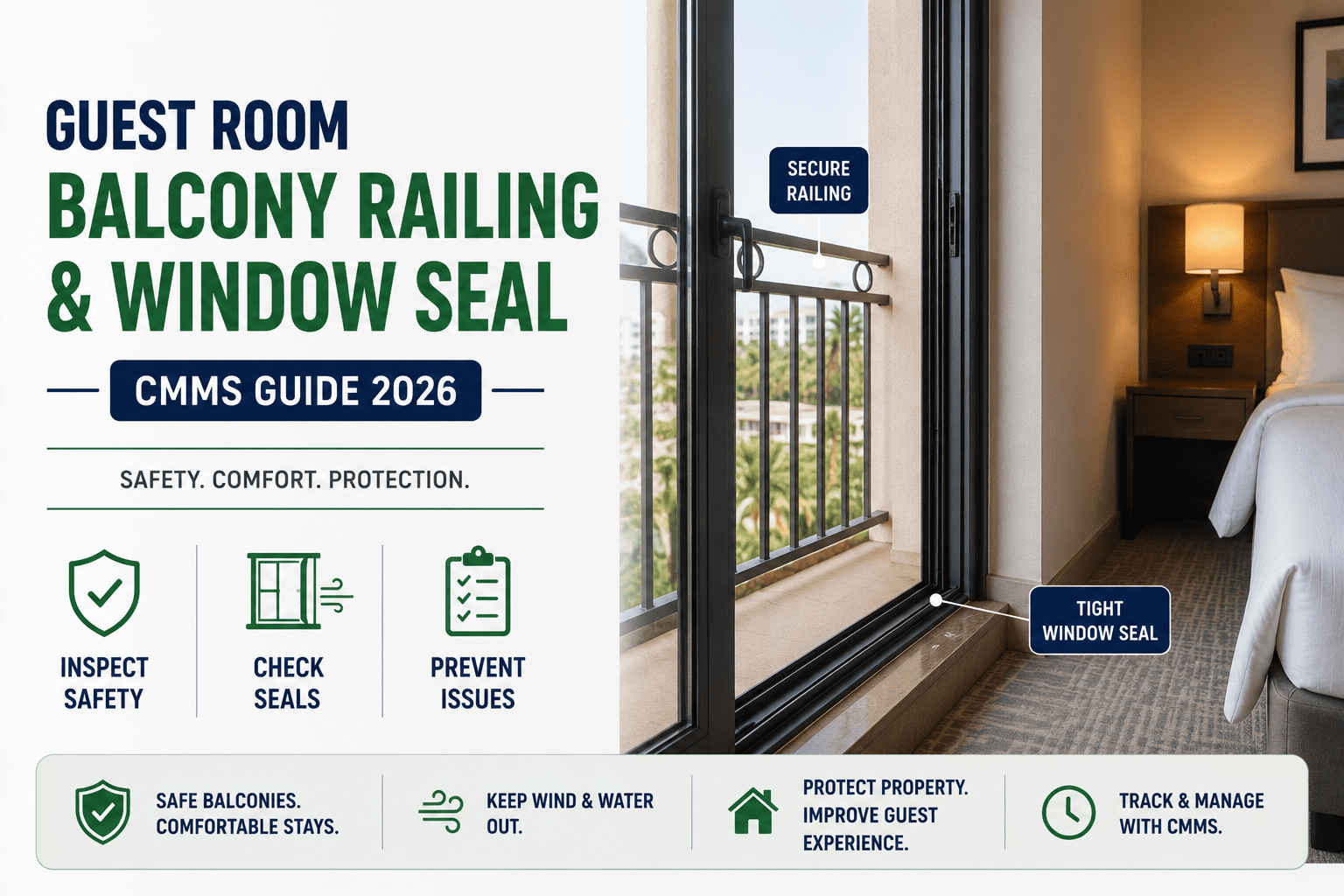
Balcony sliding doors are the largest source of both energy loss and security failures in hotel rooms with exterior access. A sliding door that does not fully seal at the latch perimeter is equivalent to a 3-inch round hole in the exterior wall for HVAC purposes. A latch that does not positively engage is a security failure. A balcony railing with any movement at post bases is a life-safety failure that requires immediate room closure.
DetectsMissing anti-lift pins on sliding doors — the primary forced-entry bypass method that defeats latch hardware while the door appears locked from insideRailing movement detectable only by applying physical force — a life-safety failure mode invisible to visual inspection and to every housekeeping turnover
Operable guest room windows create three distinct maintenance categories: energy performance (seal integrity determines HVAC load), sound performance (glass and frame seal determine noise transmission), and safety (ventilation limiters prevent falls from height). All three categories fail silently between inspection cycles. A window with a failed IGU (insulated glass unit) seal — visible as internal fogging between panes — is performing at 40–60% of its design insulation value while appearing structurally intact.
DetectsFailed IGU seals reducing window insulation by 30–60% — invisible from inside the room but detectable immediately by internal fogging inspectionDisconnected ventilation limiters — a fall-prevention code violation above the fourth floor that a previous guest may have deliberately bypassed
Fire-rated corridor doors and stairwell doors are life-safety assemblies — not just doors with closers. A fire door propped open, a fire door with a damaged intumescent strip, or a fire door with a closer adjusted too slowly to latch under positive pressure from a stairwell stack effect is a code violation that can be cited during a life-safety inspection and, in a fire event, can directly affect egress outcomes. Monthly fire door inspections are required under NFPA 80. Book a demo to see how Oxmaint schedules and documents NFPA 80 fire door inspections.
DetectsCloser speed failures that allow fire doors to miss the latch from slow-open positions — a NFPA 80 violation invisible without testing from multiple open positionsDamaged intumescent strips and missing fire door labels — both cited in AHJ life-safety inspections as violations requiring immediate corrective action
How Oxmaint Helps
How Oxmaint Manages Your Hotel Window and Door Program
Each Door and Window as a Named Asset
Every entry door, balcony slider and operable window in every room is a named asset in Oxmaint — with its own installation date, weatherstrip replacement history, closer service record, and inspection log. When Room 412's door generates its third closer adjustment request in 18 months, that pattern is visible in the asset record and drives a closer replacement decision rather than a fourth adjustment call.
Configure a September window seal inspection across all rooms on all floors. Oxmaint generates the task list, assigns it to the engineering team members by floor, tracks completion in real time, and reports the compliance percentage to the engineering director before heating season begins. No spreadsheet. No clipboard. No rooms missed because someone forgot which floor they left off on.
Monthly fire door inspection tasks are assigned automatically, completed via mobile with photo documentation of any deficiency, and stored in a searchable record that satisfies NFPA 80 documentation requirements. When an AHJ inspector requests the last 12 months of fire door inspection records, Oxmaint generates the complete log in under three minutes — with timestamps, inspector names, and deficiency photos attached.
When IGU seal inspections across 200 rooms generate data showing 38 units with internal fogging — all installed in the same property renovation cycle — Oxmaint surfaces that pattern in a single asset report. A batch replacement program covering all 38 units in a two-week window costs significantly less than 38 separate replacement events spread over three years of individual guest complaints. Data makes the batch program visible. See how the pattern detection works free.
Batch replacement planningAge cohort analysis
"
We ran a full building weatherstrip inspection across 220 rooms in October. Oxmaint assigned the rooms by floor to four technicians and tracked completions in real time. We found 67 rooms with failing door bottom sweeps and 41 rooms with window perimeter seal failures — all scheduled for replacement before Thanksgiving. That winter we had fewer draft complaints than any previous year on record. The inspection paid for itself in avoided comps in the first two weeks of cold weather.
How often should hotel guest room door weatherstripping be replaced?
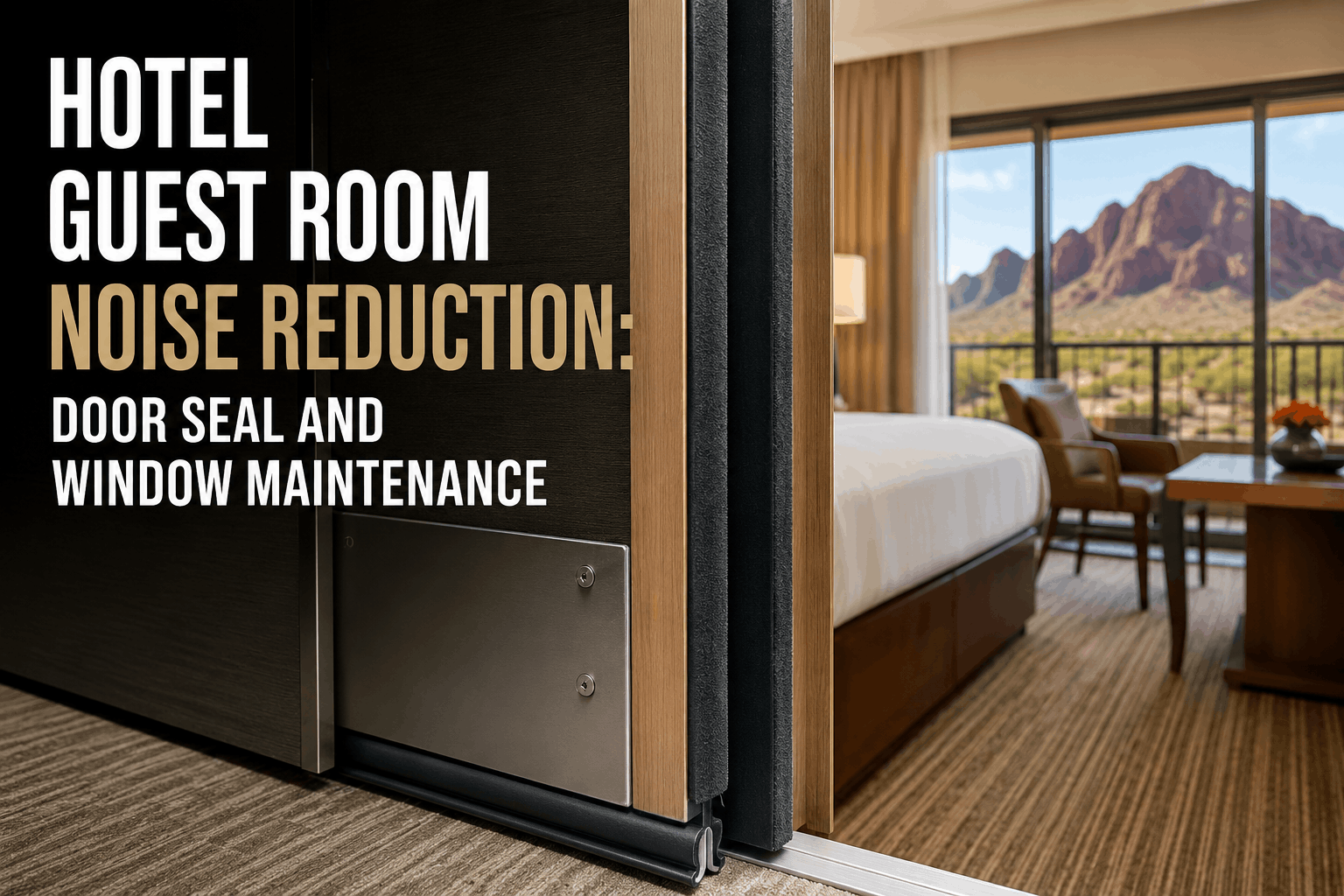
Hotel guest room entry door weatherstripping — including side jamb seals, top seal, and bottom door sweep — should be inspected quarterly and replaced on a schedule based on observed wear rather than a fixed interval. In high-use rooms (full-service hotels with 80%+ occupancy), expect bottom door sweeps to require replacement every 18–24 months. Side jamb and top seals typically last 3–5 years before compression reduces their effectiveness. The flashlight test (inspecting from inside a darkened room for visible light around the closed door perimeter) is the most reliable field test for seal integrity — any visible light means replacement is needed. Oxmaint tracks weatherstrip replacement dates by room automatically.
What is the NFPA 80 requirement for hotel fire door inspections?
NFPA 80 (Standard for Fire Doors and Other Opening Protectives) requires that fire doors in commercial buildings including hotels receive a visual inspection annually at minimum, with interim inspections recommended monthly. The inspection must verify: the door closes and latches from all open positions, no unauthorized hold-open devices are present, the door label is visible and legible, the intumescent strip and smoke seal are intact, and the door and frame show no physical damage that compromises the rated assembly. All inspections must be documented with the date, inspector name, and findings — records must be retained and available for AHJ review. Book a demo to see how Oxmaint generates NFPA 80 compliant fire door inspection records.
How do I identify a failed insulated glass unit (IGU) seal in a hotel window?
The primary indicator of a failed IGU seal is internal fogging, streaking, or condensation visible between the glass panes — on the interior surfaces of the glass that are enclosed within the unit and inaccessible to cleaning. In early-stage failures, the fogging may only appear during temperature differentials (cold exterior, warm interior) and clear as temperatures equalize. In advanced failures, mineral deposits from evaporated condensation appear as white streaking or clouding between the panes that does not clear. A failed IGU cannot be field-repaired — the unit must be replaced. Properties in cold climates should inspect all windows for IGU fogging in October, before heating season creates the temperature differential that makes early-stage failures visible.
What are the ADA requirements for hotel guestroom door hardware?
Under the 2010 ADA Standards for Accessible Design, guestroom door hardware in accessible rooms must be operable with one hand without tight grasping, pinching, or twisting of the wrist — which disqualifies round knobs in favor of lever handles. Door closers on accessible room entry doors must be adjusted so the door takes at least 5 seconds to close from 90 degrees to the latch position — a slower closing speed than the standard 5–7 seconds required for fire-rated doors, creating a potential conflict that must be resolved with a hold-open device tied to the fire alarm system. Pull forces on interior doors in accessible rooms must not exceed 5 lbs. Track ADA door hardware compliance by accessible room in Oxmaint.
Asset Management · Window & Door Program · Free to Start
Your Hotel Window and Door Program Starts in Oxmaint
Every door and window tracked as a named asset. Weatherstrip replacement scheduled by room and floor. NFPA 80 fire door inspections documented monthly. Seasonal seal sweeps completed before heating season — not after the first draft complaint of winter. Batch replacement programs planned from data, not from accumulated work orders.