Crestview Collection — a regional hospitality group operating seven full-service hotels across the Southeast United States — spent four years growing from two properties to seven while their maintenance operations grew in exactly the wrong direction: outward, not upward. Each property ran its own spreadsheet-based PM tracking, its own paper work order system, its own vendor contact list, and its own way of classifying and prioritizing maintenance tasks. The director of operations could not answer a basic question — "What is our total portfolio maintenance cost per available room this month?" — without spending half a day calling seven chief engineers, reconciling seven different formats, and producing a number she could not entirely trust. Compliance documentation was scattered across seven filing systems. Asset replacement decisions were being made by individual property engineers with no visibility into how sister properties were managing identical equipment. Emergency repair spend was running at 61% of the maintenance budget chain-wide because no one had the cross-portfolio visibility to identify the systemic patterns driving it. The expansion that was supposed to create operational scale had instead created seven separate maintenance silos, each operating in isolation, each developing its own drift from brand standards, and each requiring individual management attention that a three-person corporate operations team could not sustain. The decision to centralize was not driven by technology — it was driven by the realization that the group could not grow to twelve properties under the same operating model that was already straining at seven. Fourteen months after deploying OxMaint's centralized dashboard and CMMS platform across all seven properties — 3,200 rooms, 4,847 registered assets, 84 active engineering staff — the results were measurable: emergency repair share from 61% to 19% across the portfolio, PM completion rate from 41% to 96%, cross-property emergency repair cost from $487,000 to $142,000 per month, and the director of operations able to see every open work order, every asset health status, and every compliance gap across all seven properties from a single screen before her 8 a.m. coffee. OxMaint's centralized dashboard gave Crestview Collection the operational infrastructure their growth required — visibility and standardization at scale, without uniformity that eliminated local context.
Crestview Collection: How a 7-Property Hotel Group Centralized Maintenance Operations and Eliminated Portfolio Blindness
3,200 rooms across 7 properties. 4,847 assets. 14 months from scattered spreadsheets to a single centralized dashboard that every property, every engineer, and the entire corporate team operates from.
The Multi-Property Maintenance Problem Nobody Talks About
Every hospitality group experiences a version of what Crestview Collection faced. The first property runs manual systems. The second adopts the same manual systems. By property five or six, the corporate team is managing five or six slightly different versions of the same broken model — and the scale that was supposed to create efficiency has instead multiplied the original inefficiencies across every location. This is not a staffing problem. It is an architecture problem: without a shared platform, shared asset taxonomy, and shared performance visibility, multi-property maintenance cannot be managed — it can only be reacted to.
No Portfolio Visibility
Corporate leadership cannot answer real-time questions about portfolio maintenance status, open work orders, asset health, or compliance gaps without calling seven engineers and reconciling seven formats.
Inconsistent PM Standards
Each property develops its own PM frequency, asset classification, and documentation format. Identical equipment at two properties receives different maintenance intervals with no rationale beyond local habit.
Scattered Compliance Records
Insurance audits, brand standards inspections, and regulatory reviews require documentation from multiple file systems across multiple locations — a process that takes days and almost always surfaces gaps.
No Cross-Property Benchmarking
The best-performing property's maintenance practices have no mechanism to transfer to underperforming ones. Cost-per-room-maintained, MTTR, and PM completion rates are invisible across the portfolio.
The 5 Operational Gaps That Were Costing Crestview Collection Most
Before deployment, the OxMaint implementation team conducted a two-week operational assessment across all seven Crestview properties. Five gaps emerged consistently — and each had a measurable financial cost that the group had not previously been able to quantify because the data did not exist in a consolidated form. Book an operational assessment with our multi-property specialists to map your portfolio's version of these same gaps.
Emergency Repair Premium
61% of all maintenance work across the portfolio was reactive emergency response — billed at 3–5x planned maintenance rates. No property-level engineer had visibility into peer properties running the same assets more efficiently.
Manual Reporting Overhead
Corporate operations required weekly status calls from each property chief engineer. Consolidated reports were hand-built in spreadsheets every week — 18+ hours of management time that produced data 4–7 days stale on arrival.
PM Schedule Fragmentation
Seven separate PM spreadsheets with seven different formats, update frequencies, and completion tracking methods. Across the portfolio, only 41% of scheduled PM tasks were being completed on time — generating the emergency repair backlog that dominated engineering hours.
No Asset Lifecycle Visibility
4,847 assets across seven properties with no shared condition scoring, repair history, or replacement planning. Capital expenditure requests were based on age estimates and gut feel — not documented condition deterioration or cost-per-repair trending.
Compliance Documentation Fragmentation
Brand standards audits and insurance reviews required assembling documentation from seven separate systems. Three properties failed to produce complete elevator inspection records on demand. Two had gaps in fire safety compliance logs. None could produce a real-time compliance status report.
How OxMaint Built the Centralized Operation
The OxMaint centralized dashboard deployment at Crestview Collection used a phased rollout that started with the two highest-cost properties and expanded across the portfolio over 12 weeks — never taking any engineering team fully offline during the transition. The architecture was designed around a single principle: corporate visibility at the portfolio level, full operational autonomy at the property level. OxMaint's multi-property platform treats Portfolio → Property → Asset as a native data model, not an add-on — meaning cross-property benchmarking, portfolio-level KPIs, and consolidated compliance reporting were available from the first day of full deployment.
All 4,847 assets registered with standardized taxonomy across every property — shared asset categories, condition scoring methodology, and PM interval logic inherited from portfolio-level templates
Corporate engineering team creates master PM schedules once — deployed to all properties for each asset category, with property-level overrides available for site-specific equipment variants
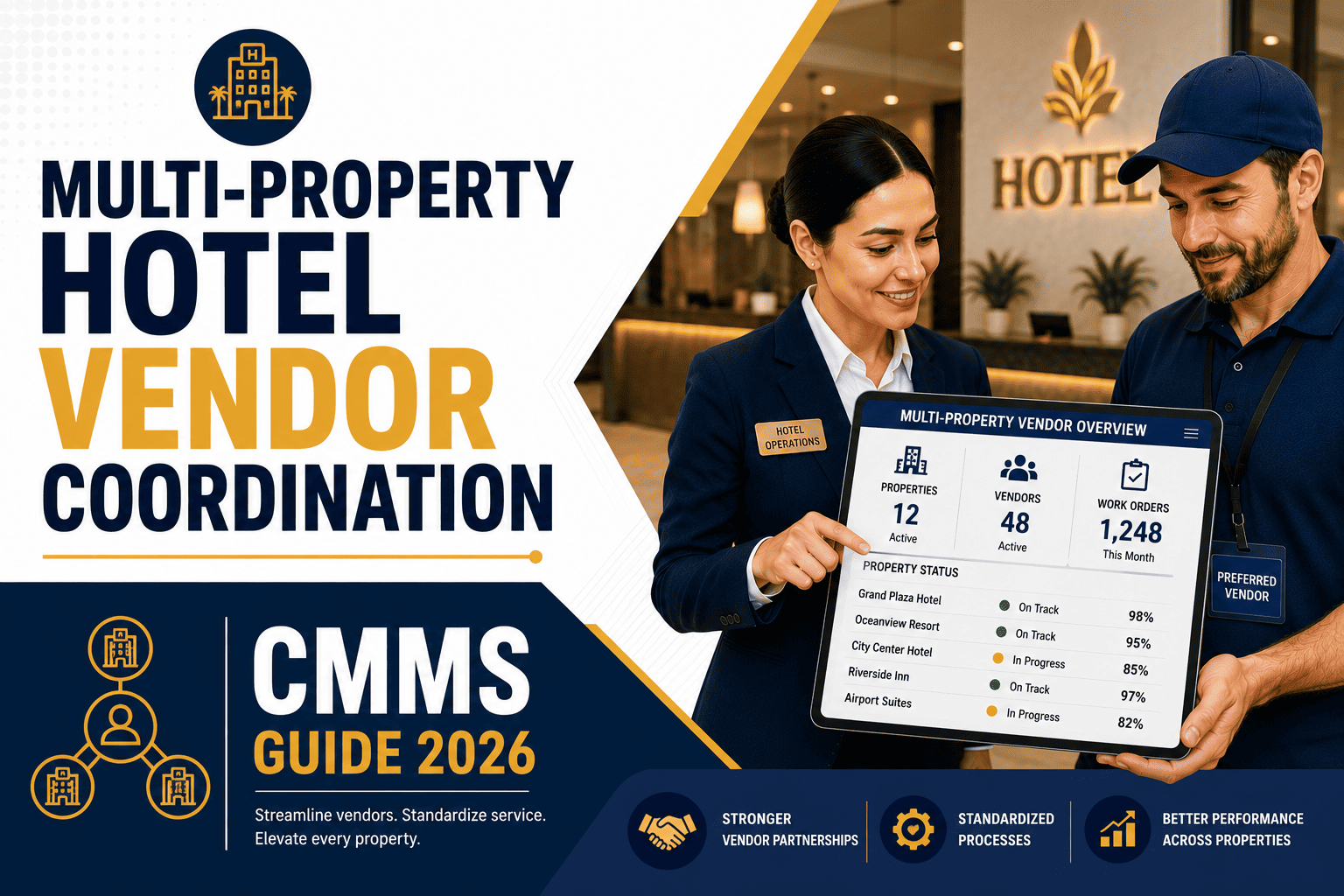
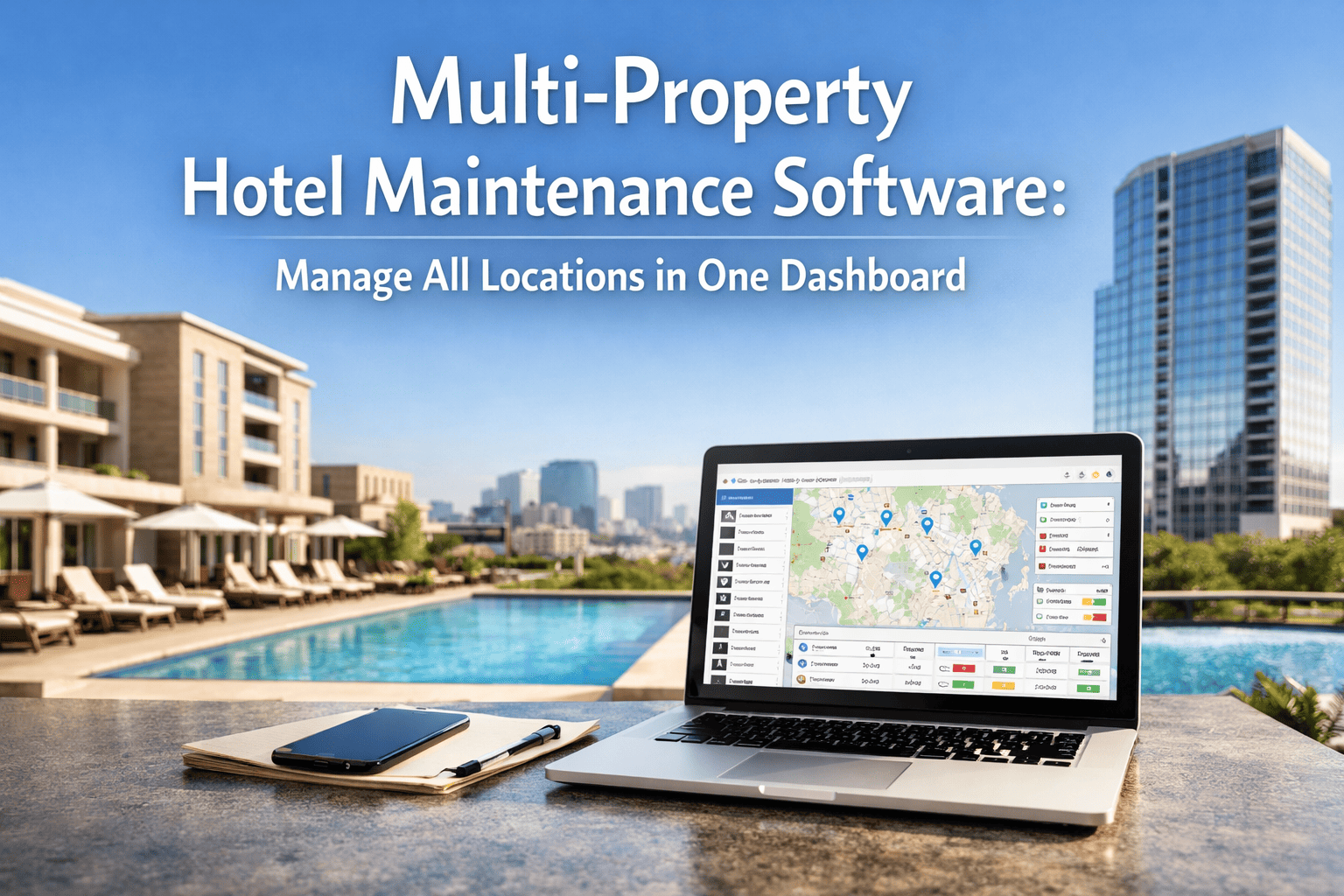
Corporate operations sees all 7 properties in real time — open work orders, PM completion rates, compliance gaps, asset health scores, and cost-per-property maintenance spend updated live
Automatic comparison of cost-per-room-maintained, MTTR, PM completion, and emergency repair share across all properties — best practices from top performers identified and deployable to underperformers in days
Portfolio Results After 14 Months
The metrics below compare the 6-month pre-deployment baseline across all seven properties against the 14-month post-deployment window. No staffing changes were made at any property. No capital equipment was replaced during this period. All improvement is attributable to centralization, standardization, and the operational visibility that the OxMaint dashboard provided to both property-level engineers and corporate operations leadership.
Seven Silos Became One Operation. The Same Team. The Same Properties. Better Results.
Crestview Collection did not add staff or replace equipment. They replaced the information architecture that was preventing their existing team from performing at portfolio scale. OxMaint's centralized dashboard is the difference between managing seven separate maintenance operations and managing one.
What the Centralized Dashboard Made Visible — Three Portfolio Discoveries
Every multi-property group that centralizes onto a shared platform discovers things about their portfolio that were invisible when each property operated independently. At Crestview Collection, three findings emerged within the first 90 days that drove immediate cross-portfolio operational decisions.
Property 3 Had a PM Completion Rate of 28% — No One at Corporate Knew
The portfolio average of 41% masked a 28% rate at the Savannah property, which had been operating without a functioning PM tracking system for nearly two years following a chief engineer transition. The Savannah property's emergency repair costs were running at 2.3x the portfolio average. In the pre-deployment reporting model, this was invisible because each property's numbers arrived as self-reported summaries with no standardized benchmark to compare against.
Within 30 days of the OxMaint centralized dashboard going live, the Savannah property's PM schedule was rebuilt from the portfolio master template, the emergency repair backlog was identified and scheduled, and three chronic repeat failures were routed to planned replacement rather than continued reactive repair. Within 60 days, Savannah's PM completion rate had risen from 28% to 78%. Within 90 days, it had reached portfolio standard — and emergency repair costs had fallen by 54%.
The Same Chiller Model Across Four Properties Had a 3x Cost-Per-Repair Gap
When the centralized asset registry was populated with identical chiller models across four properties, the dashboard immediately surfaced a 3x variation in maintenance cost per unit: two properties were spending $8,400/year per unit while two others were spending $24,700/year on the same equipment. The high-cost properties had been servicing the units on calendar intervals that bore no relationship to actual runtime. The low-cost properties had implemented runtime-based PM intervals aligned to OEM specifications.
The portfolio-level asset benchmarking made this pattern visible in the first weekly review meeting — a meeting that, before centralization, had been a phone call with no shared data. The runtime-based PM model from the low-cost properties was deployed across all four properties within 45 days, immediately putting the high-cost units onto the efficient maintenance path. Projected annual savings from this single data point: $97,200 across the four affected properties.
18 Hours Per Week of Corporate Management Time Was Being Spent Producing Data Nobody Was Acting On
The pre-deployment reporting model required each property chief engineer to spend 2–3 hours per week producing a maintenance status summary. Corporate operations spent an additional 4–6 hours per week consolidating those summaries into a portfolio report. By the time the report was produced, it was 4–7 days stale — and the decisions it was supposed to inform had already been made based on conversations and gut feel. The OxMaint live dashboard eliminated every hour of that workflow. The 18 hours per week previously consumed by reporting were recovered and redirected to operational execution. The data quality improved from a weekly lagging summary to a live view updated every time any work order was created or closed across all seven properties. The corporate operations team's first comment after going live: "We can finally see what's actually happening."
Year-One ROI: What Centralization Returned to Crestview Collection
The ROI summary below is built from documented outcomes over the 14-month post-deployment window, annualized. Every figure is cross-referenced between OxMaint's reporting dashboard and Crestview Collection's own operational accounting records. This is not a projection — it is a post-deployment measurement.
If You Cannot See Your Portfolio from One Screen, You Are Managing Properties — Not an Operation.
Crestview Collection's transformation was not about new equipment or new staff. It was about replacing the information architecture that was hiding the operational truth of their portfolio. OxMaint's centralized dashboard gives multi-property hotel groups the same visibility in one screen that previously required 18 hours of manual reporting every week — with live data, cross-property benchmarking, standardized compliance records, and asset lifecycle management built natively into the platform from day one.