Most hotel maintenance AI conversations assume a public cloud endpoint — sensor data routed outward, processed somewhere off-site, responses returned. For luxury hotel groups, casino resorts, government-contracted properties, and any hospitality operator bound by data residency regulations, that assumption is not acceptable. Guest records, operational telemetry, asset fault histories, and PMS-linked occupancy data cannot travel through multi-tenant cloud infrastructure without creating compliance exposure. On-premise AI for hotel maintenance solves this — running predictive maintenance intelligence, automated work order creation, and condition monitoring entirely within your own infrastructure perimeter. Start your free trial to see how Oxmaint deploys AI-powered maintenance inside your environment.
Full AI Maintenance Intelligence. Zero Data Leaving Your Perimeter.
Oxmaint's on-premise deployment runs work orders, predictive alerts, asset history, and condition monitoring on your own infrastructure — not a shared cloud endpoint. Data sovereignty preserved from day one.
Why Hotel Operations Require On-Premise AI — Not Just a Cloud Option
Cloud-first AI maintenance platforms work for many hotel operators. But a specific and growing category of hospitality operations cannot use them — and the reasons are operational and regulatory, not just philosophical.
Data Residency Regulations
GDPR (EU), PDPA (Thailand, Singapore), POPIA (South Africa), and national data localisation laws in markets like China, Russia, and India require guest and operational data to remain within specific geographic jurisdictions. Multi-tenant cloud AI routing data through US or EU servers creates automatic non-compliance for properties in regulated markets.
Guest Data Confidentiality
PMS-linked maintenance scheduling exposes room occupancy patterns, VIP guest movements, and security-sensitive access schedules. For luxury and casino hotel operators, allowing these data streams to leave the property network — even encrypted — creates unacceptable confidentiality risk for high-profile guests.
Latency-Critical Operations
On-premise AI processes sensor alerts and creates work orders in milliseconds — cloud-routed systems introduce 200–800ms round-trip latency. For hotels where HVAC fault detection triggers immediate room reassignment logic in the PMS, that latency gap is operationally unacceptable during peak check-in periods.
Connectivity-Independent Reliability
Cloud-dependent AI maintenance systems fail silently when internet connectivity drops — a common condition in remote resort locations, island properties, and venues with unstable uplinks. On-premise deployment ensures the full AI maintenance stack continues operating regardless of external network status.
Brand & Competitive Intelligence
Equipment maintenance patterns, PM frequencies, energy consumption profiles, and failure rate histories reveal operational intelligence about a hotel's infrastructure quality. For competing hotel groups sharing a cloud vendor's infrastructure, this data represents genuine competitive exposure even with encryption.
Franchise & Brand Compliance
Several luxury hotel management companies and franchise networks specify that operational technology data — including maintenance records and asset health data — must remain within brand-controlled infrastructure. On-premise deployment satisfies these requirements; public cloud deployments typically do not.
On-Premise vs Cloud AI Maintenance: What Hotel IT Leaders Need to Know
The choice is not binary — and the right architecture depends on the hotel's regulatory environment, network infrastructure, IT team capacity, and data sensitivity requirements. Here is how the two models compare on the dimensions that matter most for hospitality operations.
| Dimension |
Cloud AI Maintenance |
On-Premise AI Maintenance |
| Data residency |
Data transits and processes on vendor-controlled servers — jurisdiction varies by provider |
All data stays within your infrastructure perimeter — jurisdiction fully controlled |
| AI response latency |
200–800ms round-trip for real-time decisions — acceptable for most operations |
Under 10ms local inference — essential for PMS-integrated fault-response logic |
| Connectivity dependency |
Full functionality requires stable internet uplink — degraded or offline without it |
Full AI stack operates on local network — zero dependency on external connectivity |
| Regulatory compliance |
Complex for GDPR, PDPA, POPIA, and national data localisation mandates |
Inherently compliant with data residency laws — data never leaves jurisdiction |
| Integration depth |
API-based PMS and BMS integration — latency adds complexity for real-time workflows |
Direct database and socket-level BMS/PMS integration — synchronous and millisecond-fast |
| Infrastructure cost |
Lower initial cost — subscription-based, no hardware investment |
Higher upfront hardware cost — lower 3-year TCO for data-intensive operations (41% average reduction) |
| IT management overhead |
Vendor manages infrastructure, updates, and scaling — lower IT burden |
Requires local IT team or managed service for hardware and OS maintenance |
Oxmaint Deploys On-Premise, Hybrid, or Cloud — Your Architecture, Your Choice
Oxmaint's maintenance AI platform supports full on-premise deployment, private cloud, and hybrid architectures — with the same AI capabilities regardless of deployment model. No feature reduction for on-premise. No cloud-only capability gating. Book a demo to map the right deployment model for your property's requirements.
On-Premise AI Hotel Maintenance Architecture
A functioning on-premise AI maintenance deployment for a hotel property has five architectural components. Each layer has specific hardware and software requirements — and the order of deployment matters for data quality and AI accuracy.
Layer 1
Edge Data Collection
IoT sensors, BMS data points, and PLC outputs connect to local edge gateways — compact compute units installed in the plant room or main electrical room that aggregate sensor streams and pre-process data before it reaches the AI inference layer. All data stays on the property LAN. Nothing transmitted externally.
Hardware: Edge gateway (e.g., industrial mini-PC or ruggedised IoT hub) · Wired or wireless sensor network · BMS OPC-UA or Modbus connection
Layer 2
On-Premise AI Inference Server
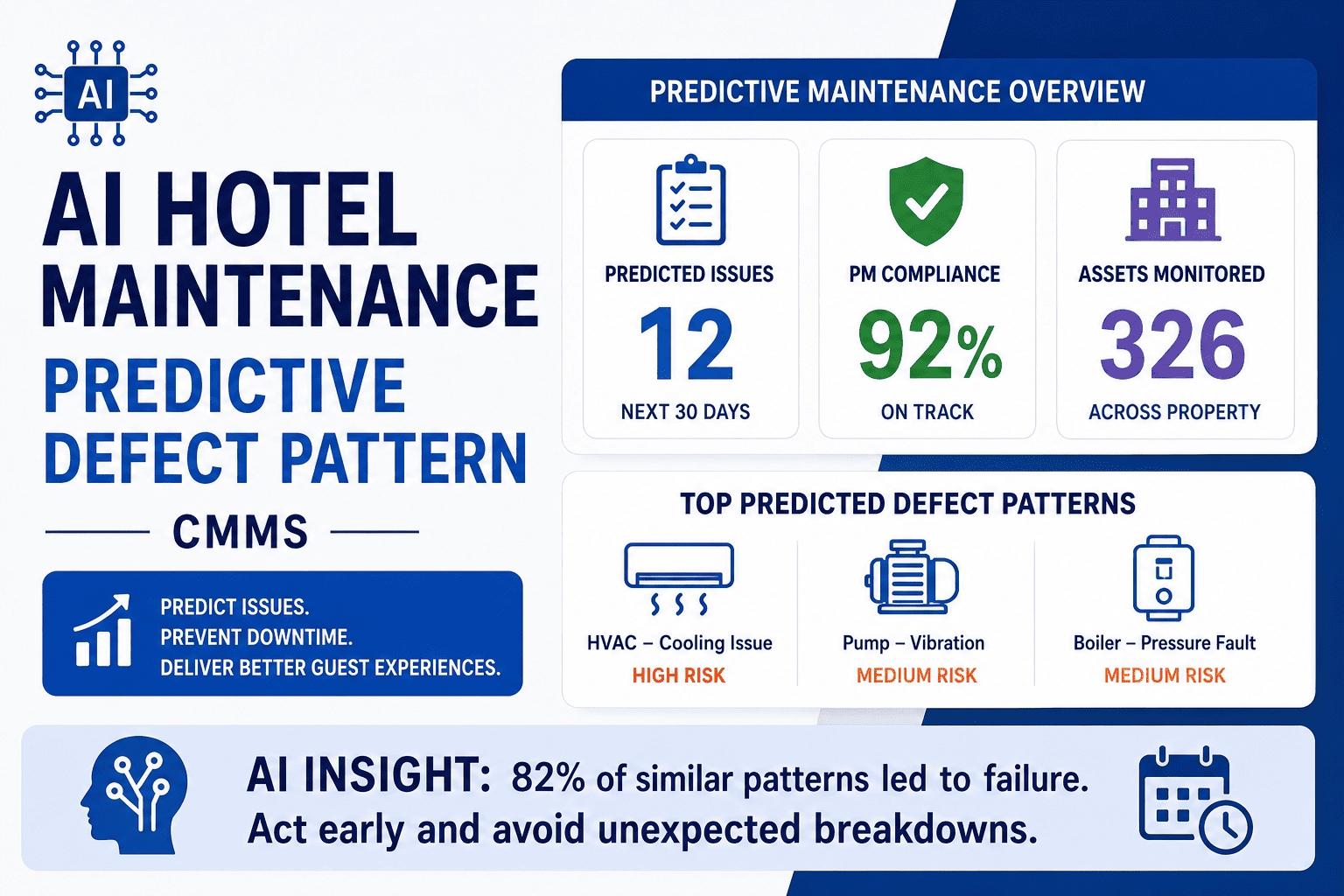
The AI engine runs on a local server — either dedicated hardware or a VM on the hotel's existing virtualisation infrastructure. This server runs the anomaly detection models, failure prediction algorithms, and work order generation logic entirely locally. No cloud API call is made for any maintenance decision.
Hardware: GPU-equipped server (recommended) or high-core-count CPU server · Local storage for model weights and operational data · Redundant power supply recommended for 24/7 operation
Layer 3
CMMS & Work Order Management
Oxmaint's CMMS runs on the same local server infrastructure — work order creation, PM scheduling, asset register, compliance documentation, and technician mobile app communication all operate on the property network. The AI inference layer writes directly to the CMMS database with no intermediate cloud hop.
Software: Oxmaint on-premise CMMS instance · Local SQL database for work order and asset records · Mobile app communicates via property Wi-Fi — no external data transit
Layer 4
PMS & BMS Integration
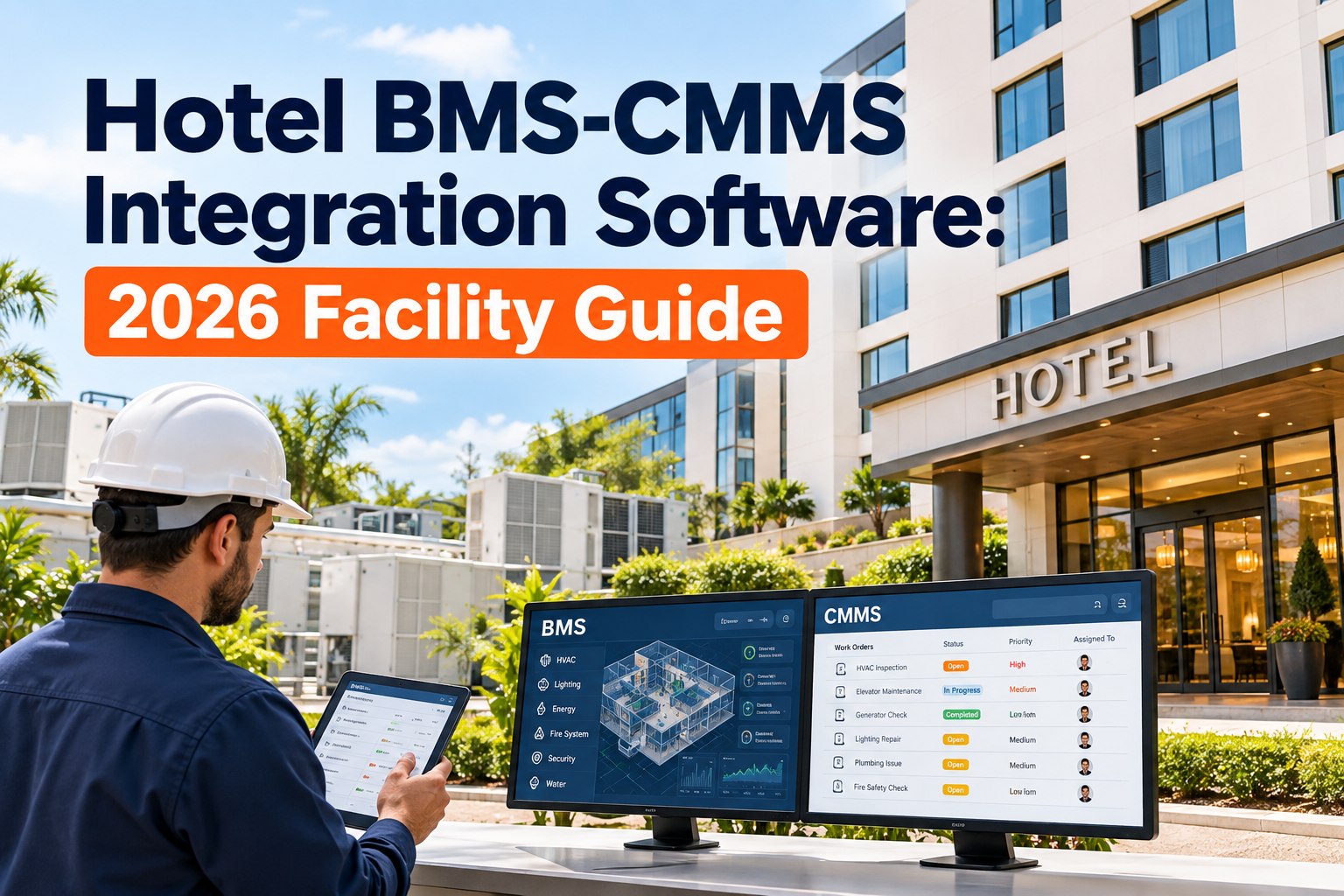
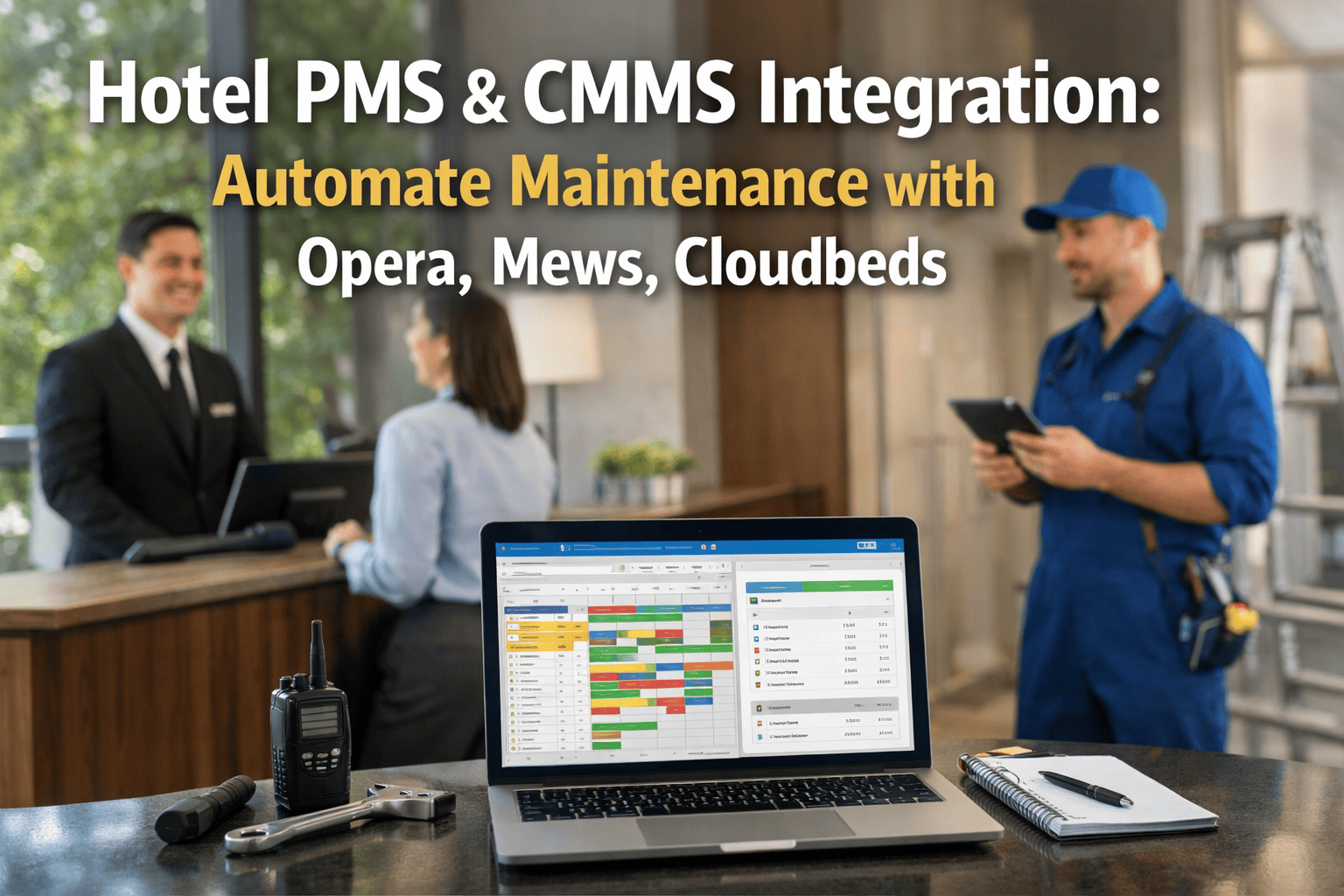
On-premise Oxmaint connects directly to the hotel's PMS and BMS via local API or database-level integration — enabling occupancy-aware maintenance scheduling, room status synchronisation, and energy management without any data leaving the property network. Room readiness sign-offs write directly to PMS room status.
Integration: Local REST API or direct DB connection to PMS (Opera, Mews, Cloudbeds) · BMS integration via OPC-UA, BACnet, or Modbus · All communication on property LAN
Layer 5
Optional: Selective Cloud Sync
For hotel groups that want portfolio-level reporting across multiple properties, Oxmaint's hybrid mode allows selective, encrypted synchronisation of anonymised KPI data to a controlled cloud endpoint — while keeping all raw sensor data, guest-linked records, and asset fault histories on-premise. The hotel operator defines exactly what leaves the perimeter.
Optional: Encrypted VPN tunnel to group-level analytics server · Anonymised KPI data only — no raw sensor streams or guest-linked records · Hotel operator controls sync scope and frequency
71%
of industrial enterprises in regulated sectors cite data sovereignty as their primary barrier to cloud AI adoption (Gartner, 2024)
41%
reduction in total cost of ownership over three years for organisations that shifted to on-premise AI-powered CMMS versus cloud alternatives
<10ms
AI inference latency on local server versus 200–800ms cloud round-trip — critical for PMS-integrated fault response workflows
Deployment Models: Which Architecture Fits Your Hotel Operation
On-premise is not one architecture — it is a spectrum. The right model depends on your IT team capacity, property network infrastructure, regulatory environment, and portfolio scale. Oxmaint supports all three deployment variants without feature restriction.
Model A
Full On-Premise (Air-Gapped Option)
Best for: Regulated markets, luxury/casino resorts, government-contracted properties
All AI inference, CMMS, and data storage on property servers
Zero external data transit — can operate fully air-gapped
Highest data sovereignty — meets all data residency requirements
Requires local IT capability for server management
Offline-resilient — full function with no internet connection
Model B
Private Cloud (Single-Tenant Hosted)
Best for: Multi-property groups wanting cloud convenience with data control
Dedicated single-tenant cloud instance — no shared infrastructure
Hosted in a jurisdiction-specific data centre matching residency requirements
Hotel group retains data ownership and deletion rights
Lower IT overhead than on-premise — hardware managed externally
Portfolio-level dashboards and analytics available across all properties
Model C
Hybrid (On-Premise + Controlled Sync)
Best for: Enterprise hotel groups balancing property-level control with group reporting
Raw sensor data and guest-linked records stay on-premise
Anonymised KPI summaries sync to group analytics layer
Hotel operator defines exactly what leaves the property perimeter
Supports both data sovereignty requirements and portfolio visibility
Most common architecture for luxury hotel groups with 5+ properties
Frequently Asked Questions: On-Premise AI for Hotel Maintenance
AI Maintenance Intelligence That Stays Inside Your Walls
Oxmaint's on-premise deployment gives hotel engineering teams the full predictive maintenance stack — anomaly detection, automated work orders, condition-based PM scheduling, and PMS integration — without a single byte of operational data leaving your property network. Data sovereignty by design. AI performance by default.