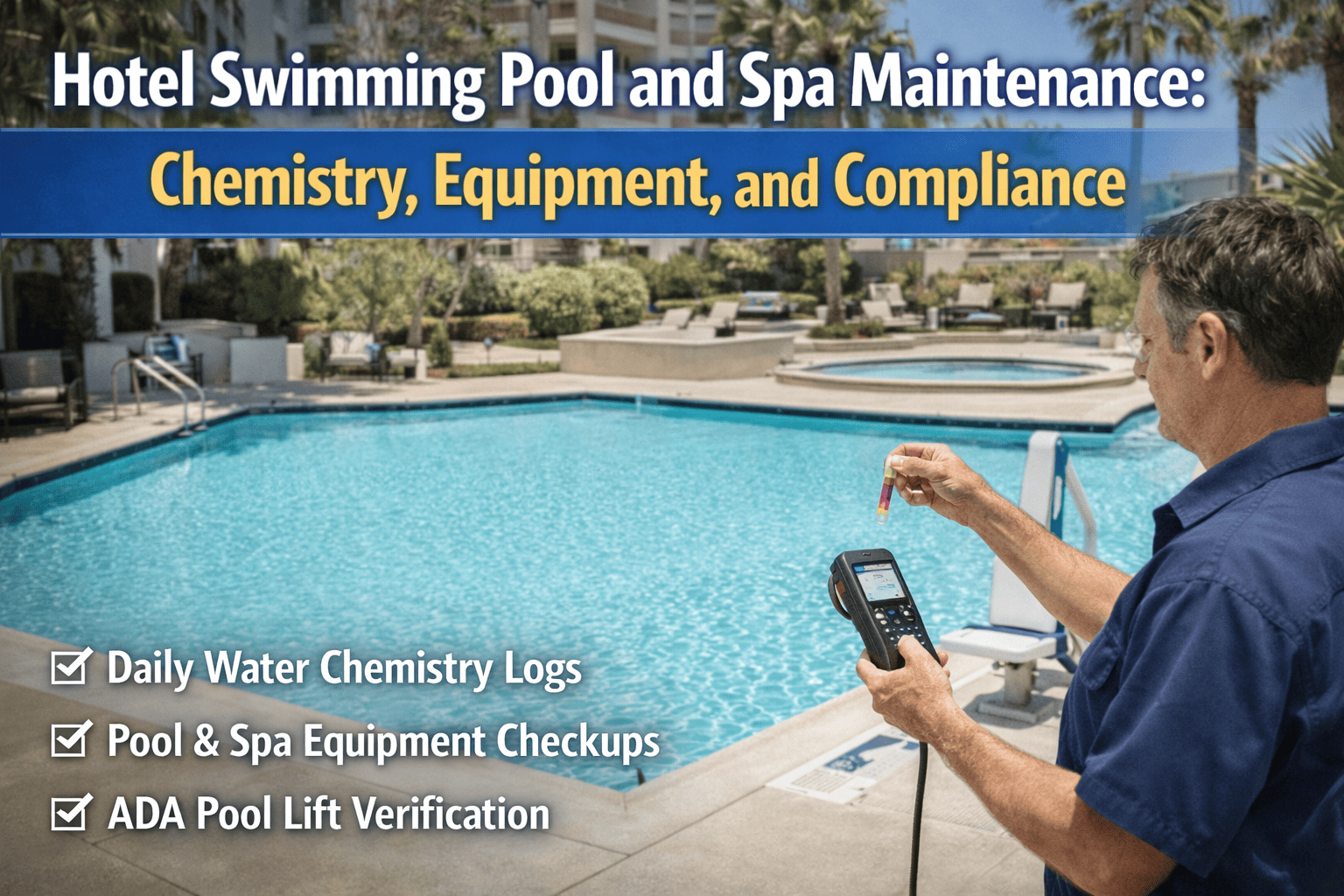
The hotel general manager got the call at 7:15 AM on the Saturday of a sold-out holiday weekend—the main pool was closed. Green water, cloudy conditions, and a chlorine smell so strong guests were complaining from the lobby. The pool had been "fine" according to yesterday's logbook entry, but the health inspector who arrived at 9 AM told a different story: pH at 8.9 (far above the 7.2-7.8 safe range), combined chlorine at 4 ppm indicating inadequate sanitation, and filter pressure 15 PSI above normal suggesting a bypass condition. Investigation revealed: no documented water chemistry testing for 6 days, pump strainer baskets not cleaned in 3 weeks, and a failed ORP sensor that had been "acting up" for a month. Health department citation: $4,500. Emergency remediation and shocking: $2,800. Lost revenue from pool closure: $18,000 over three days. Guest compensation and reputation damage: incalculable. A systematic daily pool checklist—requiring 20 minutes and standard test equipment—would have caught every problem before a single guest was affected.
The True Cost of Neglected Pool
Why systematic prevents health hazards and costly closures
47%
Of Commercial Pools Fail Inspection
$5-15K
Average Violation Fine
72 hrs
Typical Closure Duration
3x Daily
Required Testing Frequency
A comprehensive pool issue checklist transforms reactive crisis management into proactive facility protection. When facility teams can identify, document, and track water chemistry imbalances, equipment malfunctions, and safety hazards before they become health code violations and guest complaints, pools stay open, compliant, and profitable. Properties that implement digital pool tracking report 85% fewer emergency closures and dramatically lower liability exposure.
Understanding Pool Impact: The Numbers That Matter
Pool isn't just about clear water—it's about public health compliance, liability protection, and guest safety. Health departments across North America require documented testing, specific chemical ranges, and immediate correction of violations. Understanding the full impact of failures helps prioritize your inspection program and ensures nothing falls through the cracks.
Pool Failure Impact Analysis
How neglected affects operations, compliance, and safety
Recreational water illness outbreaks reported annually—Cryptosporidium, Legionella, and E. coli from inadequate sanitation
Average settlement for pool-related illness or injury claims—documentation proves due diligence
15-30%
Equipment Life Loss
Reduction in pump, heater, and filter lifespan when operating with improper water chemistry
Health Code Compliance Requirements
Most jurisdictions require water chemistry testing 3 times daily during operating hours, with results documented in a permanent log. Free chlorine must remain between 1-4 ppm, pH between 7.2-7.8, and combined chlorine below 0.5 ppm. Violations can result in immediate closure, fines up to $10,000 per day, and criminal liability for willful negligence.
Complete Pool System Issue Checklist
Effective pool requires systematic inspection of every component affecting water quality, safety, and regulatory compliance. This checklist covers the complete aquatic system from water chemistry to mechanical equipment, organized by priority and inspection frequency. When your team can see how digital checklists streamline pool compliance, health department inspections become routine instead of stressful.
Priority 1
Water Chemistry Testing
3x Daily Minimum
Primary Chemistry Parameters
Free chlorine level (1-4 ppm required)
pH level (7.2-7.8 required)
Combined chlorine (below 0.5 ppm)
Water temperature reading
ORP reading if equipped (650-750 mV)
Secondary Chemistry (Weekly)
Total alkalinity (80-120 ppm)
Calcium hardness (200-400 ppm)
Cyanuric acid/stabilizer (30-50 ppm outdoor)
Total dissolved solids (TDS)
Saturation index calculation
Why Priority 1:
Water chemistry imbalances are the #1 cause of health department violations and recreational water illnesses—proper levels prevent 95% of pool-related health incidents
Priority 2
Filtration & Circulation Systems
Daily Inspection
Filter System
Filter pressure reading (PSI)
Backwash schedule compliance
Filter media condition
Multiport valve operation
Sight glass clarity check
Circulation Components
Pump strainer basket (clean daily)
Pump motor temperature/noise
Flow meter reading (GPM)
Skimmer baskets (clean daily)
Main drain covers secure/compliant
Why Priority 2:
Inadequate circulation and filtration lead to dead spots, algae growth, and sanitation failures—proper turnover rate is required by health code
Priority 3
Safety Equipment & Pool Structure
Daily/Weekly
Safety Equipment (Daily)
Life ring and rope present/accessible
Shepherd's hook in good condition
First aid kit stocked and accessible
Emergency phone operational
AED checked and charged (if equipped)
Pool Structure (Weekly)
Tile and coping intact
Pool surface free of cracks/damage
Depth markers visible and accurate
Ladders/rails secure and rust-free
Pool lighting functional
Why Priority 3:
Safety equipment failures and structural hazards create immediate liability exposure—missing or damaged rescue equipment is an automatic health code violation
Document Every Test, Track Every Issue
See how facility managers are using digital checklists to create health department-compliant documentation, track issues, and prevent costly closures.
Water Testing Methods: Tools and Techniques
Different testing methods provide different levels of accuracy and compliance value. Health departments often specify acceptable testing methods, and some require electronic testing equipment for commercial pools. Your checklist should specify which method to use for each parameter. Properties that track test results digitally can identify trends and predict problems before they cause violations.
Pool Water Testing Method Comparison
Selecting the right tool for each testing requirement
ELECTRONIC
Digital Photometer
Accuracy: ±0.1 ppm
Best for: Commercial pools
Lab-grade precision
Multiple parameters
Data logging capable
$300-$800 cost
Preferred by health departments for accuracy
DPD
DPD Test Kit
Accuracy: ±0.2 ppm
Best for: Daily testing
Color comparison
Measures free/total Cl
Widely accepted
$50-$150 cost
Industry standard for routine chlorine testing
STRIPS
Test Strips
Accuracy: ±0.5 ppm
Best for: Quick checks
Fast results
Multiple parameters
Subjective reading
$15-$40 cost
Not accepted by all health departments
AUTOMATION
Chemical Controller
Accuracy: Continuous
Best for: 24/7 monitoring
Auto-dosing capable
Real-time alerts
Requires calibration
$2,000-$8,000 cost
Excellent for consistent chemical control
Health Code Documentation Requirements
Health departments require comprehensive documentation—not just testing. Understanding what records to maintain and how long to keep them protects your facility during inspections and in liability situations. Most jurisdictions require 3 years of pool records and immediate access during any inspection.
Pool Documentation Requirements
Records needed for health department compliance
| Record Type |
What to Document |
Why It Matters |
Retention Period |
| Water Chemistry Log |
Date, time, all parameters, technician ID |
Primary compliance document |
3 years minimum |
| Chemical Additions |
Product name, amount, time, reason |
Shows corrective actions taken |
3 years minimum |
| Equipment |
Date, work performed, parts replaced |
Proves equipment kept in good repair |
Life of equipment |
| Incident Reports |
Injuries, illnesses, fecal incidents |
Liability protection and trend tracking |
7 years minimum |
| Staff Training Records |
CPO certification, safety training dates |
Proves qualified operators |
Duration of employment + 3 years |
Swipe to see full table
Digital tracking ensures complete records are always available—critical during surprise inspections
Inspection Frequency by System Component
Different pool systems require different inspection frequencies based on health code requirements, safety criticality, and failure modes. Water chemistry needs testing multiple times daily, while structural inspections may be monthly or seasonal. This schedule meets or exceeds most health department requirements.
Recommended Pool Schedule
Swipe to see full schedule
| System Component |
Daily (3x) |
Daily (1x) |
Weekly |
Monthly |
| Water Chemistry |
Cl, pH, temp |
Combined Cl |
TA, CH, CYA |
TDS, metals test |
| Filtration System |
— |
Pressure check |
Backwash/clean |
Media inspection |
| Pump & Motor |
— |
Strainer basket |
Noise/vibration |
Amp draw check |
| Safety Equipment |
Rescue equipment |
First aid kit |
AED check |
Safety audit |
| Pool Structure |
Debris removal |
Drain covers |
Tile/coping |
Surface inspection |
| Heater System |
— |
Temp verification |
Visual inspection |
Full service check |
Paper Logs vs. Digital Pool Management: The Compliance Difference
Health inspectors don't accept "we tested it" as documentation. When they request 30 days of water chemistry records, you need dates, times, readings, technician initials, and corrective actions—instantly accessible. Paper logs get wet, lost, and illegible. Digital tracking makes compliance verification automatic and creates the legal documentation that defeats liability claims.
Pool Documentation Method Comparison
Paper Logbooks
to compile inspection records
Water test documentation:
Handwritten
Out-of-range alerts:
None
Inspection readiness:
High risk
Digital CMMS
Water test documentation:
Timestamped
Out-of-range alerts:
Automatic
Inspection readiness:
Always ready
100%
Health code documentation compliance
85%
fewer emergency pool closures
$0
violations with proper tracking
Expert Perspective: What Health Inspectors Actually Look For
"In 15 years of pool inspections, I can tell within 60 seconds if a facility takes seriously. I look at the logbook first—not yesterday's entry, but 10 days ago. Are there three readings per day? Are times recorded? When readings were out of range, is there documentation of corrective action? The facilities that pass every inspection have a system. Digital logs with automatic timestamps, alerts when readings exceed limits, and immediate documentation of chemical additions. Paper logs with gaps, scratched-out entries, and 'same as yesterday' written in? Those facilities get citations."
— Environmental Health Inspector, 15 years commercial pool experience
Testing Frequency
Health code requires 3x daily testing during operating hours. Missing even one day creates a gap inspectors notice immediately.
Corrective Actions
When readings are out of range, document what you added, when, and the follow-up test result. This proves due diligence.
Equipment Records
Pump repairs, filter , heater service—all should be documented. Equipment failures cause most water quality issues.
Common Pool Issues: What to Watch For
Pool problems don't appear suddenly—they develop through specific patterns that systematic inspection identifies early. Experienced operators recognize visual and performance indicators that suggest developing issues. Training your team to spot these signs during routine rounds catches problems before they cause closures.
Cloudy or hazy water appearance
Green tint indicating algae growth
Strong chlorine smell (combined chlorine)
Foam or bubbles on surface
Visible particles or debris in water
Unusual pump noise or vibration
Filter pressure above normal range
Reduced flow rate at returns
Heater not reaching setpoint
Chemical feeder pump failure
Loose or missing drain covers
Broken tile or coping stones
Damaged or missing safety signage
Non-functional emergency equipment
Lighting failures in pool area
Increasing chemical consumption
More frequent filter backwashing
pH constantly drifting high or low
Rising energy costs unexplained
Repeat issues at same location
Team Roles for Pool Program
Effective pool isn't a one-person job. Successful programs distribute responsibility across the team, with clear accountability for testing, documentation, and escalation. This structure ensures nothing falls through the cracks and compliance stays current even during staff changes.
Certified Pool Operator
CPO or AFO Certified Staff
Oversees all water chemistry management
Reviews daily logs for compliance
Handles health department inspections
Daily Operator
Trained Pool Attendant
Performs 3x daily water testing
Documents all readings in log
Makes routine chemical adjustments
Tech
Facilities Staff
Maintains pumps, filters, heaters
Performs weekly equipment checks
Documents all repairs and service
Facility Manager
Operations Director
Audits compliance weekly
Manages contractor relationships
Handles incident reporting
Keep Your Pool Open, Compliant, and Safe
Oxmaint gives pool operators complete testing documentation, automatic compliance alerts, and health department-ready reports. Protect your guests, protect your facility, protect your reputation.
Frequently Asked Questions
How often must commercial pool water be tested?
Most health departments require water chemistry testing at least 3 times daily during operating hours, with results documented in a permanent log. Free chlorine and pH must be tested before opening, mid-day, and before closing. Some jurisdictions require testing every 2 hours for high-bather-load facilities. All readings must include date, time, and the initials of the person performing the test. Out-of-range readings require immediate corrective action and documentation of chemicals added.
What are the required water chemistry ranges for commercial pools?
Standard health code requirements include: Free chlorine 1-4 ppm (some jurisdictions 1-5 ppm), pH 7.2-7.8, combined chlorine below 0.5 ppm (triggers superchlorination if exceeded), total alkalinity 80-120 ppm, and calcium hardness 200-400 ppm. Temperature must be maintained at 82-84°F for pools and 100-104°F for spas. Cyanuric acid (for outdoor pools) should be 30-50 ppm. Operating outside these ranges is a health code violation that can result in closure.
What documentation is required for health department pool inspections?
Health departments require: daily water chemistry logs with 3x daily readings, chemical addition records showing product and amount, equipment logs, incident reports for injuries or fecal incidents, current CPO/AFO certification for responsible operator, safety equipment inspection records, and proof of liability insurance. Records must be maintained for 3 years minimum and be available for immediate review during any inspection. Digital systems that timestamp entries and prevent backdating are preferred by many health departments.
What causes most commercial pool health code violations?
The most common violations are: inadequate free chlorine levels (35% of violations), pH out of range (25%), incomplete or missing documentation (20%), equipment deficiencies (10%), and safety/signage issues (10%). Most violations are preventable with systematic testing and documentation. Facilities with digital tracking systems that alert staff to out-of-range conditions report 85% fewer violations than those using paper logs.
What is the cost of a pool health code violation?
Costs vary by jurisdiction but typically include: first-time violations $500-$2,500, repeat violations $2,500-$10,000, violations involving illness outbreaks $10,000-$50,000+, and mandatory closure until remediation is complete (lost revenue of $1,000-$10,000+ per day depending on facility type). Beyond direct fines, facilities face increased insurance premiums, potential lawsuits, and reputation damage. Investment in proper systems typically costs 1-2% of annual pool operating budget but prevents 95%+ of violation-related costs.
Ready to Implement a Comprehensive Pool Program?
Join thousands of facility managers using Oxmaint to track water chemistry, document compliance, and maintain safe, healthy pools. Start preventing costly violations today.