The facility manager discovered it during Monday morning rounds—the main pool circulation pump had seized overnight, leaving the 50-meter competition pool without filtration for 14 hours. By the time the repair technician arrived, the water had turned cloudy, bacterial counts were rising, and the health department was requiring immediate closure until water quality was restored. The diagnosis: a worn mechanical seal that had been showing minor leakage for three weeks. Emergency pump replacement: $3,800. Water treatment chemicals to shock and restore balance: $1,200. Lost revenue during 48-hour closure: $18,500. Health department re-inspection fee: $450. Member refunds and service recovery: $6,200. Total cost of ignored maintenance: $30,150. A simple weekly pump inspection—requiring 10 minutes and attention to seal condition—would have caught the leak when a $280 seal replacement during regular hours could have prevented everything.
The True Cost of Neglected Pool Equipment
Why systematic maintenance prevents catastrophic failures
72%
Of Failures Are Preventable
$8K+
Average Emergency Repair
45%
Energy Waste from Poor Maintenance
5-7 yrs
Life Lost Without PM
A comprehensive pool system maintenance checklist transforms expensive emergency repairs into manageable scheduled maintenance. When pool teams can identify, document, and track potential issues before they become health code violations and equipment failures, operations run smoothly, water safety stays compliant, and budgets stay intact. Properties that implement digital pool maintenance tracking report 68% fewer emergency breakdowns and dramatically lower water quality incidents.
Understanding Pool Equipment Failure Impact: The Numbers That Matter
Pool equipment failures aren't just maintenance problems—they're health safety violations, liability exposures, and revenue killers. Health department regulations require specific water quality standards, equipment inspection frequencies, and safety protocols. Missing these requirements triggers citations, mandatory closures, and increased regulatory scrutiny. Understanding the full impact helps prioritize maintenance in your pool operations.
Pool Equipment Failure Impact Analysis
How neglected maintenance affects operations, safety, and costs
$15,000
Avg. Closure Cost
Typical daily revenue loss when pool equipment failure forces closure during peak season
72 hrs
Health Closure Risk
Time health departments may require closure for critical water quality or equipment violations
Additional energy consumption from poorly maintained pumps, filters, and heating systems
Health Department Compliance Requirements
State and local health codes require specific chemical ranges (pH 7.2-7.8, chlorine 1-3 ppm minimum), documented water testing, equipment maintenance logs, and safety equipment inspections. Critical violations can result in immediate closure, fines ranging from $500-$25,000+ depending on jurisdiction, mandatory remediation, and daily re-inspection fees. Systematic maintenance checks create the documentation trail that proves compliance—or reveals problems before inspectors arrive.
Complete Pool System Maintenance Issue Checklist
Effective pool maintenance requires systematic inspection of every equipment category. This checklist covers the complete aquatic facility from circulation systems to chemical control, organized by equipment type and failure likelihood. Work through each section methodically, documenting all findings. When your team can see how digital checklists streamline pool maintenance, compliance becomes automatic instead of stressful.
Priority 1
Water Quality & Chemical Systems
Check Daily
Water Chemistry Testing
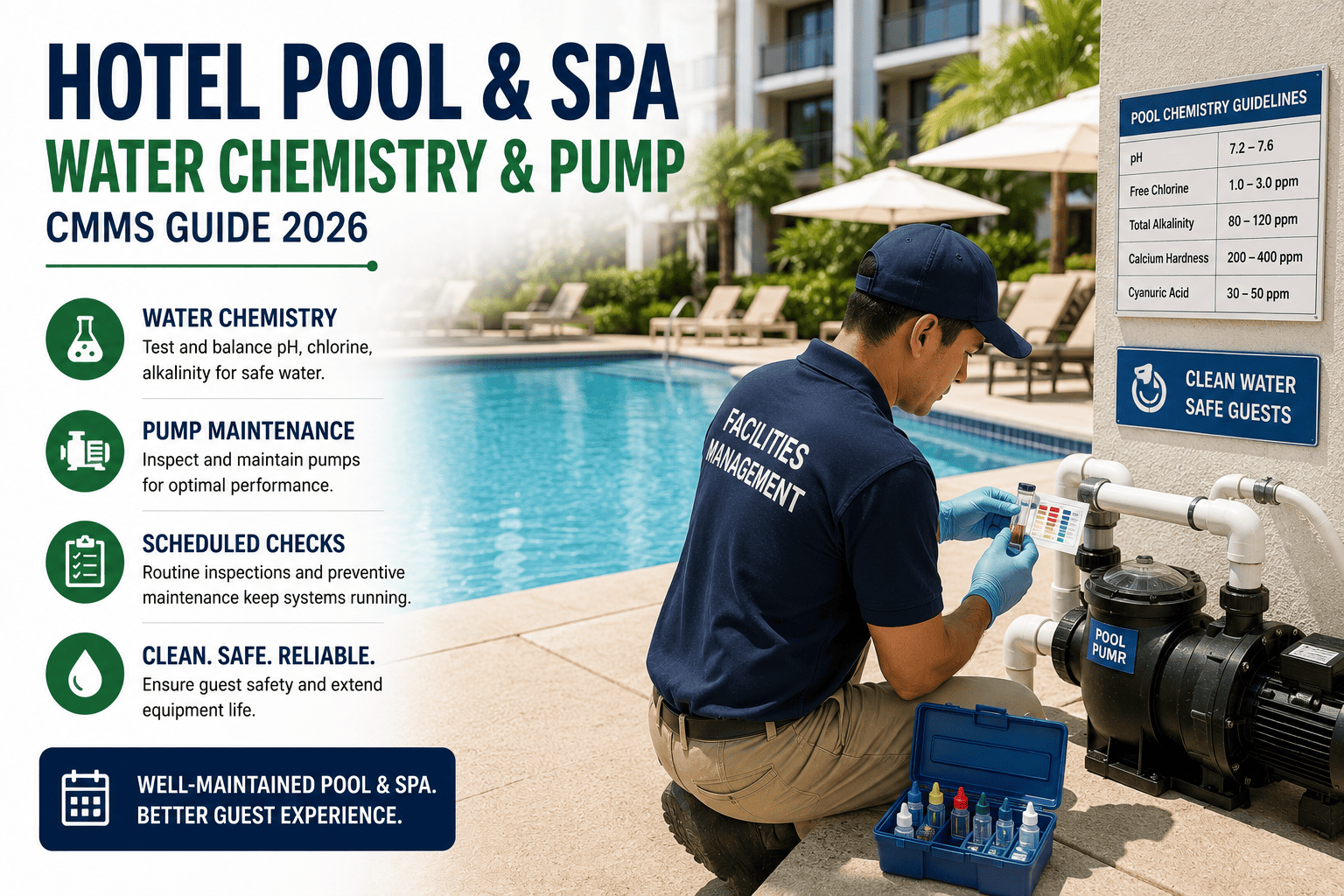
pH level within range (7.2-7.8 target)
Free chlorine 1-3 ppm minimum (or approved sanitizer level)
Total alkalinity 80-120 ppm
Calcium hardness 200-400 ppm
Cyanuric acid 30-50 ppm (outdoor pools)
Chemical Feed Systems
Chemical feeders operating properly
Chlorinator output verified
Chemical tank levels adequate
Feed pumps functioning, no leaks
Automation controller readings accurate
Why Priority 1:
Water quality failures create immediate health hazards and liability—82% of pool closures involve chemical balance or sanitization violations
Priority 2
Circulation & Filtration Systems
Check Daily/Weekly
Pumps & Motors
Pump primed and circulating properly
Strainer basket clean and in place
No leaks from seals or fittings
Motor running smoothly, no unusual noise
Pressure gauge readings normal
Filters & Backwash Systems
Filter pressure within operating range
Pressure differential indicates backwash need
Backwash valve operating correctly
Filter media condition acceptable
Sight glass showing clear water return
Why Priority 2:
Circulation failures compromise water clarity and sanitization—a pump failure can cause water quality violations within 8-12 hours
Priority 3
Heating & Energy Systems
Check Weekly/Monthly
Heaters & Heat Pumps
Water temperature at setpoint
Heater ignition functioning (gas units)
Heat exchanger clean, no scale buildup
Pressure relief valve functional
Venting system clear (gas heaters)
Solar & Alternative Systems
Solar panels clean and unobstructed
Solar pump circulating when appropriate
Temperature sensors accurate
Valves diverting properly
System controls functioning
Why Priority 3:
Heating system failures impact comfort and usability—scale buildup reduces efficiency by 25-40% and can lead to complete heater failure
Priority 4
Safety & Compliance Equipment
Check Daily/Weekly
Safety Equipment
Life rings and rescue poles accessible
First aid kit stocked and current
Emergency phone functional
Safety signage visible and legible
Depth markers clearly visible
Electrical & Lighting
GFCI protection tested and functional
Bonding connections intact
Pool lights operating properly
Underwater lights sealed, no moisture
Control panels secured and dry
Why Priority 4:
Safety equipment failures create liability exposure—electrical violations and missing safety equipment are immediate closure violations in most jurisdictions
Document Every Inspection, Track Every Issue
See how pool managers are using digital checklists to create health department-ready documentation, track repair timelines, and prevent costly equipment failures.
Maintenance Frequency by Equipment Type
Different pool equipment requires different maintenance frequencies based on usage intensity, water chemistry demands, and failure consequences. High-volume commercial pools need more frequent checks than residential installations. Adjust your schedule based on these factors and always document completion.
Recommended Pool Equipment Maintenance Schedule
Swipe to see full schedule
| Equipment Type |
Daily |
Weekly |
Monthly |
Quarterly |
| Water Chemistry |
Full test, adjust chemicals |
Comprehensive analysis |
Deep testing, water balance |
Professional lab analysis |
| Circulation Pump |
Visual check, listen |
Basket clean, seal check |
Impeller inspection, lubrication |
Professional PM service |
| Filter System |
Pressure check |
Backwash as needed |
Deep clean, media inspection |
Media replacement evaluation |
| Heater |
Temp verify, visual check |
Combustion check (gas) |
Heat exchanger inspection |
Professional service, cleaning |
| Chemical Feeders |
Output verify, tank level |
Calibration check |
Full cleaning, tubing check |
Replacement parts evaluation |
| Safety Equipment |
Visual inspection |
GFCI test, equipment check |
Full inventory, replacements |
Professional safety audit |
Equipment Issue Detection Methods: Tools and Techniques
Different equipment issues require different detection methods. A complete pump failure is obvious, while a developing chemical imbalance requires precise testing. Your checklist should specify which method to use for each inspection point. Properties that track detection method results digitally can identify patterns and predict where failures are likely to develop.
Pool Equipment Inspection Method Comparison
Selecting the right tool for each inspection scenario
CHEMISTRY
Digital Test Kit
Multi-parameter testing
Best for: Daily monitoring
pH, chlorine, alkalinity
±0.1 accuracy
Bluetooth data logging
$150-$400 cost
Essential for documenting water chemistry compliance
FLOW
Pressure Gauges
System pressure monitoring
Best for: Filter status
Pump performance
±2 PSI accuracy
Backwash indicators
$20-$80 cost
Critical for identifying circulation and filtration issues
ELECTRICAL
GFCI Tester
Safety verification
Best for: Protection
Trip testing
Required by code
Monthly minimum
$15-$50 cost
Required for electrical safety compliance and liability protection
SANITIZATION
ORP Meter
Oxidation-reduction potential
Best for: Sanitizer effectiveness
Real-time monitoring
Controller integration
Predictive capability
$200-$600 cost
Provides continuous sanitization verification beyond basic chlorine testing
Documentation Requirements for Health Inspections
Health inspectors don't accept verbal assurances of proper maintenance. When they request water quality logs, equipment service records, and safety inspection documentation, you need dates, readings, technician signatures, and corrective actions—instantly accessible. Paper systems make this nearly impossible. Digital tracking makes it automatic. The difference shows up when inspectors arrive.
Health Department Documentation Requirements
Records needed for pool operation compliance
| Document Type |
What to Record |
Why It Matters |
Retention Period |
| Water Quality Logs |
Time, pH, chlorine, temp, alkalinity, operator initials |
Proves continuous water safety compliance |
3 years minimum |
| Equipment Maintenance |
Date, equipment, work performed, parts, technician |
Demonstrates systematic maintenance program |
Life of equipment |
| Incident Reports |
Date, incident type, response, corrective action |
Shows proper safety protocols and response |
7 years minimum |
| Safety Inspections |
Date, equipment checked, condition, repairs needed |
Validates safety equipment readiness |
3 years minimum |
| Professional Service |
Date, contractor, certification, work scope, parts |
Documents qualified technical maintenance |
Permanent record |
Swipe to see full table
Critical violations require documented corrective action within 24 hours—digital tracking ensures compliance and creates defensible records for liability protection
Paper Logs vs. Digital Pool Maintenance Tracking
When health inspectors request your maintenance records, or when you need to prove proper operation during a liability claim, the documentation method matters. Paper logbooks get wet, fade, and disappear. Digital systems create automatic, timestamped, searchable records that protect your operation legally and operationally.
Pool Maintenance Documentation Comparison
Paper-Based Logs
to compile inspection records
Chemistry trending:
Manual review
Issue escalation:
Verbal only
Inspection readiness:
High risk
Digital CMMS
complete compliance package
Chemistry trending:
Automatic alerts
Issue escalation:
Auto-notify
Inspection readiness:
Always ready
68%
fewer emergency breakdowns
100%
compliance documentation complete
$0
fines with proper tracking
Expert Perspective: What Separates Top-Performing Pool Operations
"The pool facilities that never have surprise closures share one characteristic: they treat maintenance as a scheduled activity, not a reaction to problems. Every system has an inspection schedule, documentation protocol, and clear accountability. When I consult with operations struggling with compliance or equipment reliability, the first thing I examine is their maintenance documentation. Facilities with digital tracking have 65% fewer emergency repairs, zero health department citations, and their equipment lasts 5-7 years longer on average."
— Certified Pool Operator & Aquatic Facility Consultant, 24 years experience
System Accountability
Assign specific staff to specific systems. When someone owns pump maintenance or chemistry testing, accountability improves and issues get caught early.
Scheduled Prevention
Block time for equipment maintenance during off-peak hours. Systems maintained during slow periods don't fail when hundreds of swimmers depend on them.
Documentation Culture
If it's not documented, it didn't happen—especially critical for liability defense. Digital records protect you during inspections, lawsuits, and insurance claims.
Common Equipment Issue Indicators: What to Watch For
Not every equipment problem requires a certified pool technician to identify. Experienced pool operators recognize visual, auditory, and performance indicators that suggest developing issues. Training your team to spot these signs during daily operations catches problems early—before expensive repairs or closures are needed.
Water clarity declining or cloudy appearance
Pump leaking water from seals or fittings
Scale or corrosion on heat exchanger
Algae growth on walls or floor
Chemical residue or staining around feeders
Pump grinding or squealing sounds
Cavitation or air-pulling noise
Heater ignition problems (clicking)
Filter backwash valve leaking/dripping
Motor humming without starting
⚠️
Performance Indicators
Reduced water flow or weak returns
Temperature not reaching setpoint
Chemical levels drifting quickly
Filter pressure rising faster than normal
Extended backwash cycle required
Energy bills increasing without usage change
More frequent chemical additions needed
Increased maintenance frequency on same equipment
Water quality complaints rising
Heating costs escalating unexpectedly
Team Roles for Pool Equipment Maintenance Program
Effective pool maintenance isn't a one-person job. Successful programs distribute responsibility across the aquatic team, with clear accountability for testing, inspections, documentation, and escalation. This structure ensures nothing falls through the cracks and systems stay reliable through peak usage periods.
Program Owner
Aquatic Director or Pool Manager
Sets maintenance schedules and standards
Reviews completion reports daily
Approves repair expenditures and contractors
Head Operator
Lead CPO or Senior Lifeguard
Performs daily equipment checks
Documents all findings in CMMS
Coordinates with service technicians
Shift Operators
Lifeguards & Pool Attendants
Test water chemistry multiple times daily
Report equipment issues immediately
Complete shift-end documentation
Compliance Officer
Facility Manager or Safety Coordinator
Audits documentation weekly
Manages health inspection preparation
Tracks equipment lifecycle and budgets
Stop Equipment Failures Before They Close Your Pool
Oxmaint gives pool teams complete equipment tracking, automatic maintenance scheduling, and health department-ready documentation. Protect your swimmers, protect your facility, protect your reputation.
Frequently Asked Questions
How often should commercial pool equipment be inspected?
Inspection frequency varies by equipment type and regulatory requirements. Water chemistry must be tested at minimum 2-3 times daily for commercial pools, with many jurisdictions requiring testing every 2-4 hours during operating hours. Circulation equipment should receive daily visual inspection and weekly detailed inspection. Filters need pressure monitoring daily with monthly deep cleaning. Heaters require weekly combustion checks and quarterly professional service. Safety equipment must be inspected daily before opening. High-traffic facilities should increase all frequencies accordingly.
What water quality records are required by health departments?
Most health departments require documented water quality logs showing date, time, pH level, sanitizer concentration (chlorine or approved alternative), water temperature, total alkalinity, and operator initials for each test. Many jurisdictions require testing every 2-4 hours during operation. Logs must be retained for minimum 3 years and be available for immediate inspection. Digital logging systems with automatic timestamps and chemical controller integration are increasingly preferred as they prevent falsification and ensure accurate record-keeping.
What are the most common causes of pool equipment failure?
The top causes of pool equipment failure are: pump seal failure from lack of lubrication or chemical damage (causing 32% of failures), filter media degradation from improper backwashing, heater scale buildup reducing efficiency and causing overheating, chemical feeder malfunction from lack of calibration, and motor bearing failure from moisture exposure or age. All of these are preventable with systematic maintenance—properly maintained pool equipment lasts 5-7 years longer than neglected systems and operates 30-40% more efficiently.
How much does poor pool equipment maintenance really cost?
Poor maintenance creates compounding costs: emergency repairs cost 4-6x scheduled service, forced closures from health violations average $10,000-$25,000 in lost revenue per day, health department fines range from $500-$25,000+ with potential permanent closure, liability exposure from injuries due to equipment failure can reach millions, and equipment replacement cycles shorten by 40-50%. A typical commercial pool can lose $40,000-$80,000 annually from preventable equipment issues. Systematic maintenance programs typically cost $8,000-$15,000 annually but prevent 5-8x that amount in losses while dramatically reducing liability exposure.
What documentation do I need for health department and liability protection?
Essential documentation includes: water quality testing logs with all parameters (3-year minimum retention), equipment maintenance records showing all service performed (permanent retention), incident reports documenting any safety events or injuries (7-year minimum), safety equipment inspection records (3-year minimum), professional service invoices from certified contractors (permanent), operator training and certification records (current plus 3 years), and emergency action plan with documented drills. Digital CMMS systems automatically generate compliant, timestamped, tamper-proof documentation that provides legal protection during liability claims and regulatory inspections.
Ready to Implement a Comprehensive Pool Maintenance Program?
Join thousands of aquatic facilities using Oxmaint to track equipment, document water quality, and maintain health department compliance automatically. Start preventing costly failures today.
.png)