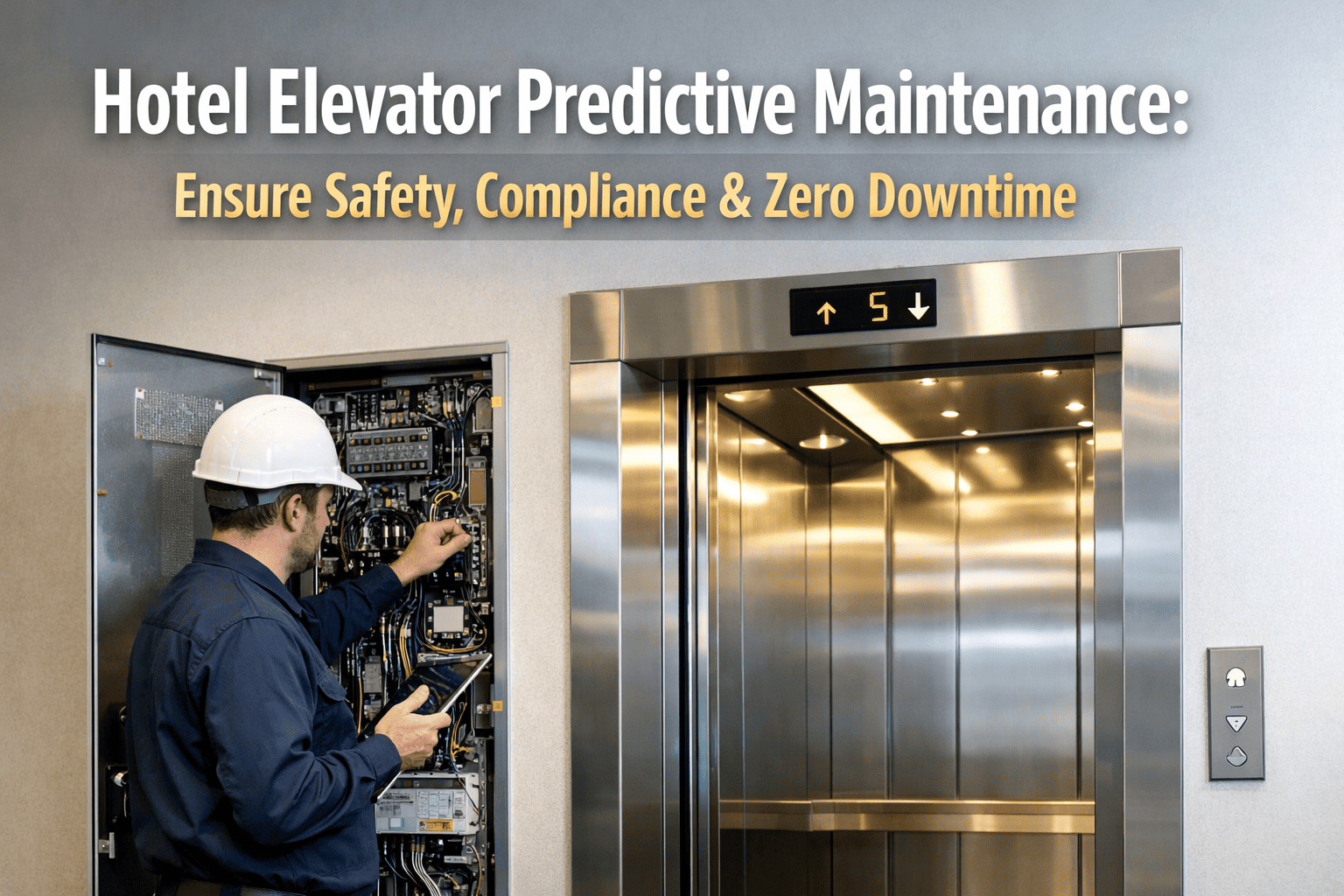
On a Friday evening at a 340-room urban hotel, Elevator 3 tripped offline during peak check-in. The door operator motor had been drawing 11% above its normal current for 26 days. No alert was generated — because nothing was watching. The result: a 3-hour outage, 58 displaced guests, one formal complaint escalated to brand management, and an emergency contractor invoice for $6,800. The component that failed cost $210 to replace when scheduled in advance. Sign up for OxMaint to turn your elevator controller data into 20-plus-day advance failure warnings, or book a demo to see OxMaint's elevator predictive maintenance platform in action for your property.
- First failure signal: machine stops in service
- PM interval fixed at 90 days regardless of duty cycle
- Emergency contractor callout at 3–5× planned rate
- Guest outage during peak occupancy — no advance scheduling
- Brand audit deficiency if outage frequency threshold exceeded
- No cross-unit pattern visibility — each failure is isolated
- First failure signal: performance alert 14–31 days before failure
- PM intervals adjust automatically based on cycle count and condition
- Planned maintenance at standard rate during low-demand window
- Maintenance scheduled away from peak occupancy — no guest impact
- Compliance readiness score maintained continuously — audit-ready
- Portfolio-level pattern analytics — recurring failure modes flagged early
Door operator motors log current draw with every open/close cycle. When a roller, guide, or safety edge component begins to wear, the motor works progressively harder to complete the same cycle — producing a current draw increase that OxMaint's analytics model detects as a statistically significant deviation from the unit's established baseline, typically 22–31 days before the component failure produces a guest-visible symptom or a mid-cycle outage. OxMaint also tracks door open/close cycle times and reopening event frequency — each provides a secondary signal stream that corroborates or advances the primary current-draw alert. Sign up for OxMaint to activate door mechanism monitoring today.
The hoisting machine is the highest-cost component in the elevator system and the subsystem where condition deterioration has the longest detectable advance window if the right data is being monitored. Motor winding degradation produces a current signature change measurable months before it causes a thermal protection trip. Gear oil temperature trending above baseline for a traction drive unit is a lubrication breakdown signal that leads to gear wear if unaddressed. Vibration anomalies at the motor housing surface bearing deterioration 15–28 days before audible symptoms begin. OxMaint's drive machine monitoring tracks all three signal streams and correlates them with the unit's complete service history. Book a demo to see OxMaint's drive machine monitoring configuration.
Elevator controllers generate a fault code log with every operating anomaly — but in most hotel properties, that log is only reviewed during a scheduled service visit or after an outage. OxMaint connects to the controller fault log and monitors fault code frequency trends continuously. A controller that generates 3 fault codes in a week when its baseline is under 0.5 per week is showing a deterioration pattern — in the board, the voltage supply, or the ventilation system — that warrants investigation before it produces a service-interrupting fault. OxMaint also tracks emergency power transfer test results monthly, ensuring compliance currency without manual scheduling tracking.
Brake performance is both a mechanical maintenance parameter and a safety certification requirement — brake response time and stopping accuracy are measured during annual regulatory inspections and must fall within defined limits under ASME A17.1 and applicable local codes. OxMaint tracks brake engagement response time per activation, floor-level stopping accuracy across all served floors, and brake magnet current draw — building a trend record that gives the engineering team advance visibility of brake performance drifting toward the regulatory non-compliance threshold well before the annual inspection reveals it. For hotels subject to mid-cycle audit inspections, OxMaint's brake performance trend record provides documented evidence of continuous compliance monitoring. Sign up for OxMaint to activate continuous brake performance monitoring.
Ride quality is the subsystem that generates the most guest complaints before engineering is aware of a maintenance issue — because guide roller wear, rail misalignment, and levelling inaccuracy produce passenger-perceptible vibration and imprecise floor-level stops that guests report through the front desk before engineering's inspection rounds identify the condition. OxMaint's ride quality monitoring tracks vertical vibration amplitude during travel segments, lateral movement at guide rollers, floor-level stopping accuracy per floor, and guide rail lubrication consumption rate — providing the engineering team with a deterioration signal in the 18–25 day window before the condition reaches a guest-noticeable stage. Book a demo to see OxMaint's ride quality monitoring for hotel elevator fleets.
5 subsystem monitoring categories. Controller integration available. Compliance documentation automatic. Zero unplanned outages as the operating target for your hotel.
| Compliance Requirement | Authority | Interval | OxMaint Output |
|---|---|---|---|
| Annual safety certificate documentation | State elevator inspection authority | Annual | Complete PM history, fault log, and inspection-ready export per unit generated in under 2 minutes |
| Brake performance test records | ASME A17.1 / local code | Annual + on event | Timestamped brake response time trend with pass/fail status per elevator — continuous record between inspections |
| Emergency power transfer verification | Fire code / AHJ | Monthly | Automated monthly test record with transfer time data — no manual log required from engineering team |
| Brand standard elevator audit | Franchise brand standards | Brand audit cycle | Pre-audit readiness report: PM compliance rate, open work orders, fault frequency, compliance score per unit |
| Entrapment and incident documentation | Insurance / liability / regulatory | Per event | Complete incident record with full preceding maintenance history, fault log, and engineer response timeline |
| PM completion records per contract | Manufacturer / service contract | Per schedule | Technician-attributed PM log with parts used, findings recorded, and next-due date auto-carried forward |
All outputs generated automatically from OxMaint maintenance records — no manual report preparation required from the engineering team.
OxMaint Platform Capabilities for Hotel Elevator Management
Four capability areas combine to deliver OxMaint's complete hotel elevator predictive maintenance programme — from initial monitoring activation through to portfolio-level analytics and capital planning outputs for ownership.
OxMaint logs elevator performance parameters continuously across all units — door cycle times, motor current, fault code frequency, brake timing, ride quality metrics. Baseline established per unit. Anomaly alerts generated when any parameter trends outside normal range. Works without controller integration via structured round data; enhanced with direct controller connection for real-time signals. Sign up for OxMaint to activate monitoring.
PM intervals adjust automatically based on daily cycle count accumulation per elevator unit — not calendar dates. A high-traffic convention hotel unit running 2× the normal cycle count receives proportionally more frequent condition-based PM attention. Service windows recommended for low-occupancy periods. No manual interval recalculation required from the engineering team. Book a demo to see usage-adjusted scheduling in action.
Real-time compliance readiness score per elevator unit — updated after every maintenance event, inspection, and performance data cycle. Pre-audit report generated on demand identifying any condition that would produce a brand deficiency finding. Complete inspection-ready documentation export for annual state elevator authority requirements. Brake performance trend maintained continuously between annual certification cycles. Sign up for OxMaint to build your audit-ready record.
Portfolio management view aggregates elevator performance data across all properties — giving regional engineering directors visibility of outage frequency, PM compliance rates, and compliance readiness scores across every unit from one dashboard. Condition-adjusted remaining useful life estimate per unit for modernisation timing. Contractor performance tracking against service contract terms built in. Book a demo to configure portfolio monitoring for your hotel group.
We had two elevator outages in the first eight months of last year — both during peak periods, both resulting in formal guest complaints, and both costing us well over $7,000 each. Six months after deploying OxMaint's elevator monitoring, we received our first predictive door operator alert. We scheduled the repair for a Tuesday morning. The chief engineer told me the outage it prevented would have hit us the following Friday at 3 PM. We have not had an unplanned elevator outage since.General Manager · 390-room full-service hotel, Southeast US · OxMaint deployment, 2024
Frequently Asked Questions
The Next Elevator Failure at Your Hotel Is Generating Warning Signals Right Now. OxMaint Catches Them Before Your Guests Do.
5 subsystem monitoring categories. No sensor installation required to start. Compliance documentation automated. 71% reduction in unplanned outage events.