-troubleshooting-low-airflow,-strange-noises-&-coil-issues-guide.png)
Air handler troubleshooting is one of the most critical diagnostic skills for facility managers, HVAC technicians, and commercial building operators. When an AHU develops low airflow, unusual noises, or coil problems, the downstream effects hit tenant comfort, energy budgets, and indoor air quality simultaneously. This guide covers the root causes, diagnostic steps, and preventive maintenance strategies that resolve the most common air handling unit failures before they escalate into costly repairs.
Why AHU Troubleshooting Demands a Systematic Diagnostic Approach
Commercial air handling units move conditioned air through ductwork, control ventilation rates, and manage indoor humidity across thousands of square feet. A single AHU fault can degrade comfort across entire floors, making fast and accurate diagnosis essential. Sign Up Free with OxMaint to centralize every AHU fault log and maintenance record from day one.
AHU Low Airflow Troubleshooting: Root Causes and Diagnostic Steps
Low airflow is the most common air handler complaint in commercial facilities. Effective AHU low airflow troubleshooting requires isolating whether the restriction is upstream (filters, mixing box), at the fan assembly, or downstream in the duct system. Book a Demo to see how OxMaint tracks airflow trend data across multi-building portfolios.
1. Dirty or Restricted Air Filters
Clogged filters increase static pressure drop by 0.3–0.8 inches WC, reducing supply fan airflow by 15–35%. In VAV systems, terminal units starve for airflow even while the AHU appears to run normally.
Measure filter differential pressure with a manometer and compare against manufacturer clean and dirty ratings. For multi-stage systems, measure each bank independently to find the restricting stage.
Replace all filter stages and document the as-found pressure drop to calibrate your PM interval. If filters load faster than expected, investigate duct leakage or construction activity as contributing sources.
2. Supply Fan Belt, Drive, or VFD Problems
A worn or misaligned belt reduces fan RPM below design without triggering fault codes. A fan at 85% design speed delivers only 61% of design static pressure — insufficient for taller buildings or longer duct runs.
Low airflow on VFD-controlled AHUs often traces to an incorrect BAS speed command from a miscalibrated static pressure sensor. Verify actual VFD output frequency against the BAS command signal directly.
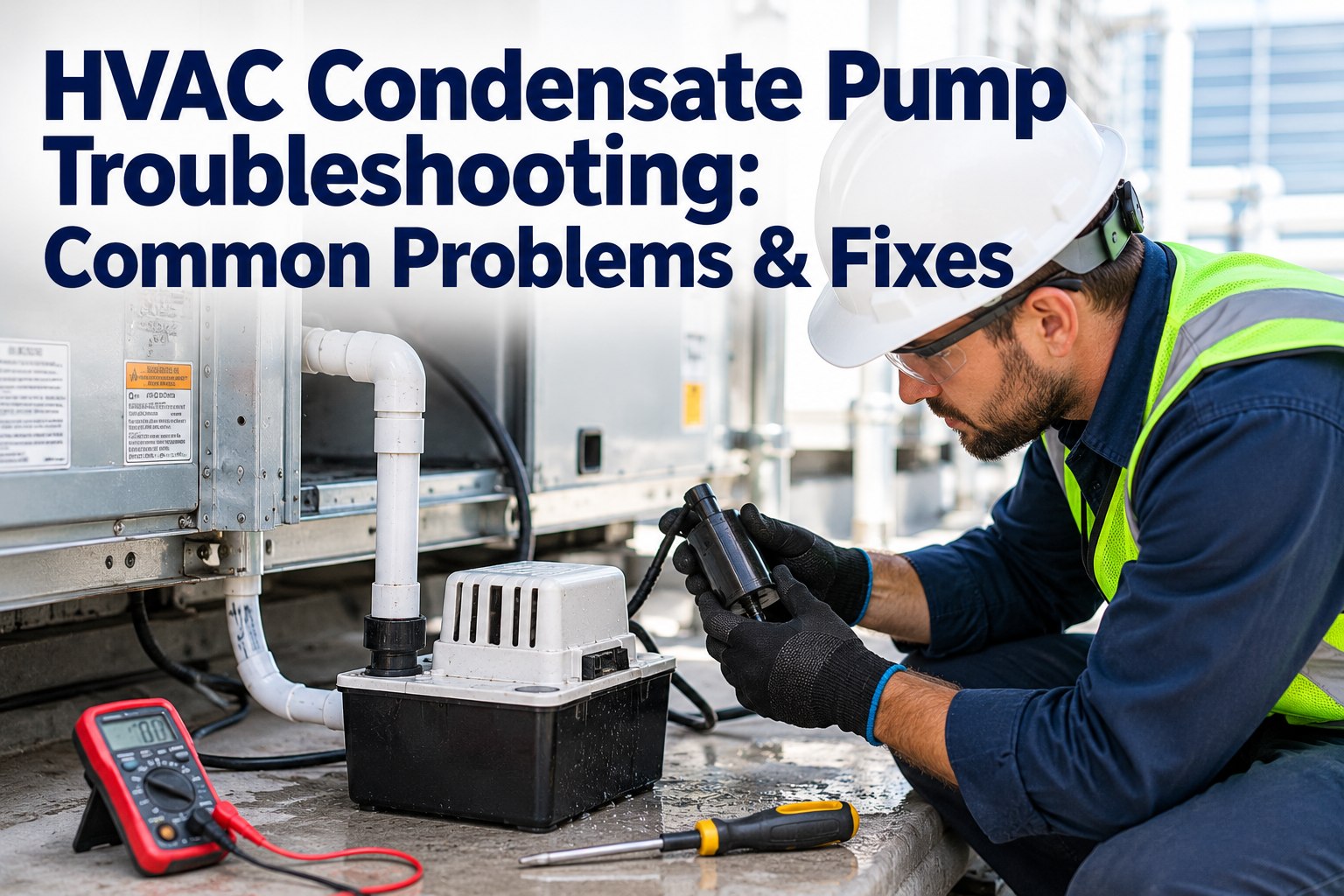
Debris on fan blades disrupts aerodynamic performance, reducing airflow and increasing motor current simultaneously. Trend motor amps versus airflow output to detect fouling before it causes a service call.
3. Damper Failures Causing Airflow Restriction
Outdoor air dampers frozen or failed-closed reduce total inlet air volume to the supply fan. A mismatch between commanded and actual BAS damper position confirms actuator or linkage failure requiring service.
A failed-closed return air damper forces the fan to draw against full negative pressure, causing abnormally low motor current. This is frequently misdiagnosed as a fan or VFD fault — always verify damper position first.
Air Handler Noise Troubleshooting: Identifying Abnormal AHU Sounds
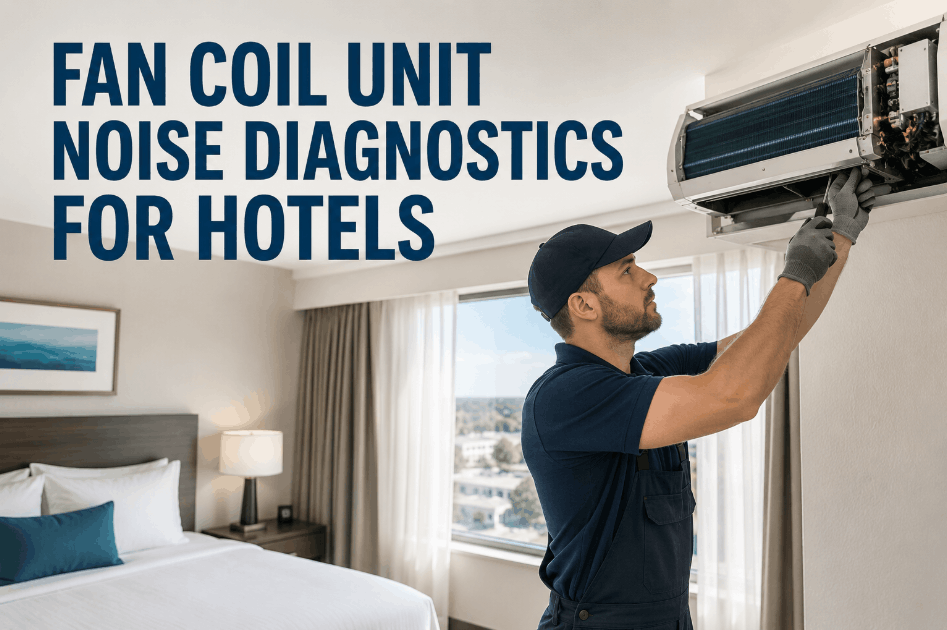
Abnormal AHU noises are early warning signals of mechanical degradation. The character of the noise — continuous vs. intermittent, speed-dependent vs. load-dependent — directly identifies the failing component. Sign Up Free to log AHU noise complaints and track maintenance response time from any device.
Belt slippage on drive sheave or worn bearing races. Speed-dependent squealing confirms belt or bearing origin; load-dependent squealing points to belt glazing under torque.
Re-tension belt and measure bearing temperature. A bearing running 20°F above ambient confirms imminent failure — schedule replacement promptly.
Loose cabinet fasteners, foreign object in fan wheel or plenum, or failed flexible duct connector. Rattling that varies with fan speed suggests fan wheel contact or debris accumulation.
Inspect all cabinet panels and fan wheel with unit running. Remove any debris in the fan wheel immediately to prevent blade damage or imbalance.
Fan wheel imbalance from debris or blade erosion, worn shaft bearings, or degraded isolation mounts no longer absorbing fan assembly vibration effectively.
Measure vibration velocity at bearing housings against ISO 10816. Inspect isolation mounts for hardening. Fan wheel cleaning and dynamic balancing resolve most AHU vibration issues.
Loose damper blade contacting its frame, fan wheel contacting housing due to bearing wear, or water hammer in coil piping. Startup banging that clears quickly often indicates sticking damper blades.
Check damper blade clearance and actuator end-stop settings. Inspect shaft bearing for axial play. Recurring banging requires immediate investigation to prevent structural damage.
AHU Coil Problems: Diagnosing Fouling, Icing, and Heat Transfer Failures
AHU coil issues sit at the intersection of airflow, refrigerant or water system performance, and indoor air quality — making them among the most consequential failures in commercial HVAC. Book a Demo to see how OxMaint tracks coil maintenance history and flags units trending toward reduced heat transfer before complaints begin.
Cooling Coil Fouling and Reduced Heat Transfer
20% fin surface fouling reduces heat transfer by 10–18% and increases air-side static pressure. Diagnose via rising supply air temperature at full cooling call and elevated CHW return temps. Annual coil cleaning with low-pressure cleaner and fin straightening is the primary corrective action.
Evaporator Coil Icing and Freeze Events
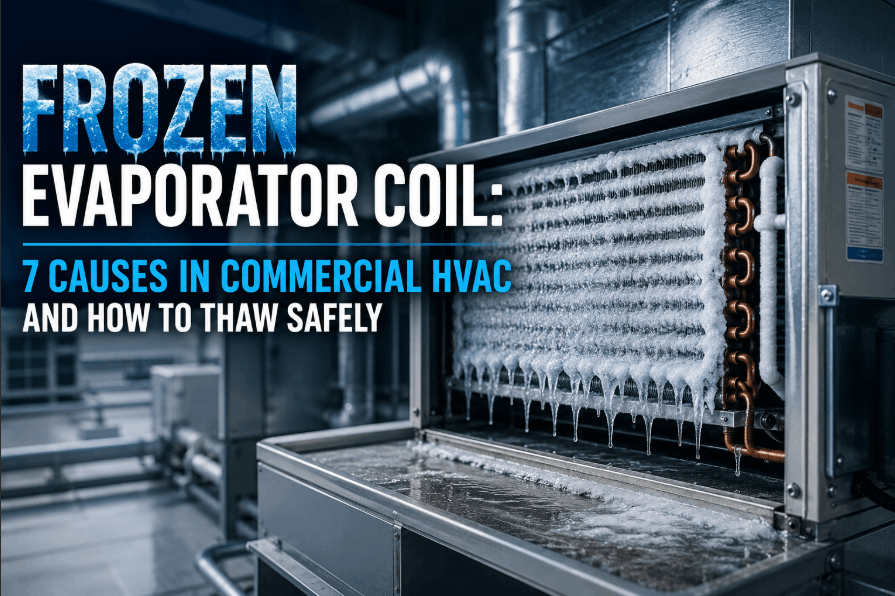
Coil icing stems from airflow below minimum threshold, refrigerant undercharge, or inadequate freeze protection. A frozen coil blocks airflow entirely within 20–40 minutes. On DX systems, suction pressure below 50 psig confirms icing; on CHW units, verify supply stays above 42°F under part-load.
Heating Coil Failures and Insufficient Output
Hot water coils fail from air entrapped in headers, stuck control valves, or tube scaling. Measure entering and leaving water delta-T under full heat call — below-design delta-T at full flow confirms a flow or fouling issue requiring immediate service.
Condensate Drain Pan Overflow and Water Damage
Algae and debris block the condensate outlet, causing overflow and ceiling damage. Inspect drain pan and P-trap semi-annually, treat with biocide annually, and verify positive drainage before peak cooling season begins.
AHU Diagnostics Reference: Symptoms, Causes, and PM Interventions
The table below consolidates the most common commercial air handler troubleshooting scenarios with root causes, diagnostic measurements, and preventive maintenance interventions. Sign Up Free to import this diagnostic framework directly into your OxMaint work order templates.
| Symptom | Most Likely Cause | Key Diagnostic Measurement | Preventive PM Task | Deferral Risk |
|---|---|---|---|---|
| Low supply airflow | Clogged filters or belt slip | Filter delta-P, fan RPM vs. nameplate | Monthly filter check, semi-annual belt inspection | Coil icing, motor overload |
| Warm supply air at full cooling | Fouled coil or refrigerant undercharge | Coil delta-T, suction pressure | Annual coil cleaning, refrigerant verification | Compressor damage, complaints |
| Supply fan squealing | Belt glazing or bearing wear | Bearing temperature, vibration amplitude | Semi-annual belt and bearing inspection | Bearing seizure, motor failure |
| Iced evaporator coil | Low airflow or low refrigerant charge | Suction pressure, filter pressure drop | Monthly filter check, annual refrigerant check | Total airflow loss, coil damage |
| Condensate overflow | Blocked drain or algae in pan | Visual drain pan inspection, flow test | Semi-annual drain cleaning with biocide | Ceiling damage, mold growth |
| Vibration and rumbling | Fan wheel imbalance or failed mounts | Vibration velocity at bearing housings | Annual fan wheel clean and balance check | Bearing failure, structural damage |
| No heating response | Failed control valve or air-locked coil | CHW/HW delta-T, valve position | Annual valve stroke test, coil air purge | Freeze event, occupant risk |
| Excess outdoor air infiltration | Economizer damper stuck open | Mixed air temp vs. OA temperature | Semi-annual damper actuator inspection | Humidity overload, energy waste |
Predictive AHU Maintenance: Shifting from Reactive to Data-Driven HVAC Operations
Modern facility management programs leverage BAS trend data, CMMS repair history, and IoT sensors to detect AHU degradation weeks before failure — eliminating the reactive model that drives emergency repair premiums and tenant satisfaction erosion. Book a Demo to explore how OxMaint integrates with BAS platforms to automate AHU fault detection and PM scheduling.
Establish Performance Baselines at PM Reset
Document filter pressure drop, supply static pressure, fan motor current, coil delta-T, and bearing vibration after each clean maintenance event. Without baselines, trending data has no reference point for anomaly detection.
Configure BAS Fault Detection Rules for AHU Anomalies
Set BAS alerts when supply fan static exceeds 110% of baseline (filter loading), mixed air deviates from economizer law by 3°F for 15+ minutes (damper fault), or motor current exceeds FLA for one hour. Each alert replaces a reactive emergency call.
Use Repair History to Calibrate PM Frequency per Asset
If CMMS records show a unit accumulating filter calls every six weeks, shorten that unit's interval. If another shows zero restriction failures at 90 days, extend to 120. Data-driven intervals reduce both risk and unnecessary labor cost.
Track Mean Time Between Failures as the Primary AHU Health KPI
Declining MTBF over three consecutive quarters — even with compliant PM visits — signals that failure mechanisms have accelerated beyond what the current program addresses. This provides an objective, defensible trigger for capital replacement discussions.