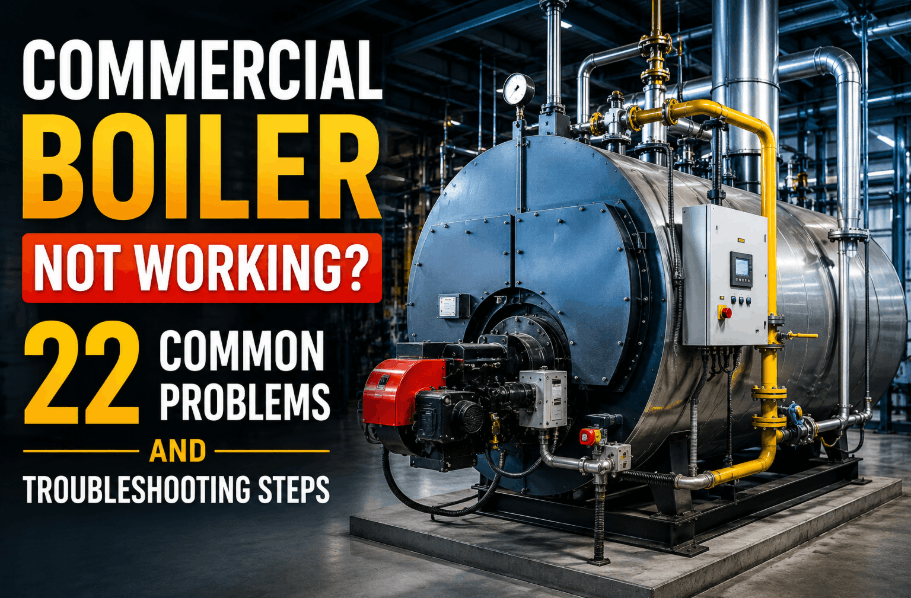
A chiller failure at peak load isn't just uncomfortable — it triggers a cascade of operational,
financial, and safety consequences that facility managers and HVAC technicians scramble to contain in real time.
Whether you're staring down a centrifugal chiller surge alarm, a screw chiller that refuses to start, or a system
stuck in low-pressure lockout, this guide covers the 27 most common chiller problems, their root
causes, and exactly what to check first. Bookmark this page — it's built for live troubleshooting scenarios. For teams
ready to move beyond reactive fixes, Sign Up Free and
start managing chiller health proactively.
OXMAINT CMMS FOR HVAC & CHILLER MAINTENANCE
Stop Fighting Chiller Failures. Start Preventing Them.
Oxmaint gives HVAC teams predictive fault alerts, structured work order management, and
chiller health dashboards — so the next failure is the one you planned for, not the one that caught you off guard.
Why Chiller Troubleshooting Requires a Systematic Approach
Chiller systems are complex refrigeration machines with dozens of interdependent components —
compressors, condensers, evaporators, expansion valves, oil systems, controls, and refrigerant circuits — all of
which can produce overlapping fault symptoms. A high refrigerant discharge temperature, for example, can stem from
condenser fouling, refrigerant overcharge, non-condensable gas contamination, or a failing condenser fan — and each
cause requires a different fix. Jumping to the wrong diagnosis wastes hours and risks compounding the original
fault.
Effective chiller fault diagnosis starts with the fault code, works backward through the system
data history, and uses a structured elimination process. Facilities that track chiller operating parameters —
suction pressure, discharge pressure, leaving water temperatures, oil pressure differential, and motor amperage — in
a CMMS can identify failure patterns 2–4 weeks before a trip event. Teams that don't track this data diagnose every
fault from scratch, burning hours that a building full of occupants cannot afford. To see how condition-based
chiller monitoring works in practice, Book a
Demo with the Oxmaint team.
Chiller downtime costs commercial facilities an average of $10,000–$50,000 per day in lost
productivity, emergency contractor fees, and occupant compensation — most events are preceded by weeks of observable
performance degradation.
27 Common Chiller Problems: Fault Patterns, Causes & How to Fix Them
The following chiller troubleshooting reference covers the fault patterns that account for the vast majority of chiller service calls. Each entry identifies the specific problem and the corresponding fix required to restore operation.
Compressor Faults
01
Chiller Not Starting — No Compressor Engagement
The Problem: 70% of no-start conditions trace to a latched safety lockout that requires manual root-cause correction before the unit can be cleared to run.
How to Fix: Verify control power, safety lockout history, and flow switch status. Check for low refrigerant pressure cutout before attempting a manual reset.
02
Centrifugal Chiller Surge
The Problem: Compressor operates outside its stable performance envelope, usually at low load with high lift differential between chilled and condenser water.
How to Fix: Check condenser water temperature and lift differential. Verify inlet guide vane position and inspect condenser tubes for fouling.
03
High Compressor Discharge Temperature
The Problem: Elevated discharge temperature accelerates bearing and valve wear, often caused by condenser fouling or non-condensable gases.
How to Fix: Compare condensing pressure against design wet bulb conditions. Purge non-condensables or clean condenser tubes to restore heat transfer.
04
Low Compressor Suction Pressure Trip
The Problem: Refrigerant starvation at the evaporator, potentially caused by low charge, expansion valve ice-over, or restricted water flow.
How to Fix: Check chilled water flow and evaporator approach temperature. Inspect the expansion valve bulb and filter-drier for temperature drops.
05
High Motor Current / Overload Trip
The Problem: Excessive power draw caused by high system lift, refrigerant overcharge, or internal motor winding degradation.
How to Fix: Verify lift conditions and refrigerant levels. Perform an insulation resistance test (megger) on motor windings to check for degradation.
06
Chiller Short-Cycling
The Problem: Rapid on/off cycles that stress start components, often due to an oversized chiller or low chilled water loop volume.
How to Fix: Verify loop water volume against minimum flow requirements. Adjust differential settings or staging logic to increase runtime.
Oil System Faults
07
Low Oil Pressure Fault
The Problem: Loss of lubrication that can cause catastrophic bearing failure within minutes, often due to pump wear or oil dilution.
How to Fix: Inspect oil pump operation and filter differential. Verify oil heater function to prevent refrigerant migration during off-cycles.
08
Oil Foaming at Startup
The Problem: Refrigerant-saturated oil foams during the startup pressure drop, stripping lubricant from critical bearing surfaces.
How to Fix: Ensure oil heaters stay active during standby. Extend pre-lubrication cycles and verify oil temperature is above saturation.
09
High Oil Temperature
The Problem: Oil degradation and lubrication film loss caused by oil cooler fouling or loss of cooling water flow.
How to Fix: Check oil cooler approach temperature. Clean oil cooler tubes and take an oil sample to check for contamination or viscosity loss.
Refrigerant Circuit Faults
10
Refrigerant Leak — Low Charge
The Problem: Loss of cooling capacity and potential compressor overheating due to insufficient refrigerant mass flow.
How to Fix: Perform a leak search on all joints. Repair leaks before recharging to design specs. Log recharge volume for environmental compliance.
11
Non-Condensable Gas Contamination
The Problem: Air/nitrogen in the system raises condensing pressure and reduces efficiency, often introduced during improper service.
How to Fix: Compare condensing pressure to saturation pressure. Use the purge unit or manually purge via service valves at the condenser high point.
12
Expansion Valve Hunting or Ice-Over
The Problem: Cyclic suction pressure swings or gradual capacity loss due to faulty valve control or moisture in the circuit.
How to Fix: Check bulb placement and electronic control signal. Replace filter-driers if moisture contamination is suspected.
13
Liquid Slugging at Compressor
The Problem: Liquid refrigerant entering the compressor, causing knocking noises and immediate mechanical component damage.
How to Fix: Verify superheat (min 10°F). Check for overcharge or low load. Ensure the expansion valve is closing correctly on shutdown.
Heat Exchanger and Water-Side Faults
14
Fouled Condenser Tubes
The Problem: Scale or biofilm buildup reduces heat transfer efficiency, raising condensing pressure and compressor power draw.
How to Fix: Check condenser approach temperature. Brush clean tubes or use chemical descaling if approach is >3°F above design.
15
Fouled Evaporator Tubes
The Problem: Reduced heat transfer in the evaporator leads to high leaving water temps and potential compressor low-pressure trips.
How to Fix: Monitor evaporator approach temperature. Clean tubes and verify chilled water chemistry is maintained within spec.
16
Low Chilled Water Flow Rate
The Problem: Inadequate flow causes low evaporator pressure and risks tube freeze-up during low-load operation.
How to Fix: Inspect the primary pump, clean strainers, and verify flow switch operation. Check balancing valve positions.
17
Chilled Water Temp Not Reaching Setpoint
The Problem: Failure to meet design load, often due to multiple small capacity losses across heat exchangers and compressor.
How to Fix: Conduct a full load calculation. Check approach temps and verify compressor slide valve or IGV modulation is functional.
18
Evaporator Freeze-Up
The Problem: Extremely low evaporator pressure causes ice formation, risking ruptured tubes and catastrophic water ingress.
How to Fix: Thaw the unit slowly. Reset safeties and verify low-limit control settings. Confirm glycol concentration if applicable.
Electrical and Controls Faults
19
Chiller Fault Code — Controls Lockout
The Problem: Automated shutdown triggered by safety sensors, with the most recent code often masking an earlier root cause.
How to Fix: Retrieve full fault history with timestamps. Map parameters at time of fault before attempting any reset.
20
Starter or VFD Fault
The Problem: VFD trip due to cooling fan failure, bus capacitor degradation, or high ambient temps in the panel.
How to Fix: Clean VFD air filters and check internal cooling fans. Verify bus voltage and inspect for loose power connections.
21
Sensor Fault — False Readings
The Problem: Drifted temperature or pressure sensors trigger phantom shutdowns, leading to unnecessary maintenance.
How to Fix: Cross-reference sensors with calibrated gauges. Replace any sensor that drifts >2°F from actual reference.
22
Communication Fault — BMS Integration
The Problem: Loss of link between the chiller and BMS causes staging failures and loss of demand-based control.
How to Fix: Check network cabling and protocol configuration. Verify the BMS polling interval isn't overwhelming the controller.
Cooling Tower and Tower Water Faults
23
High Condenser Entering Water Temp
The Problem: High inlet water temp raises condensing pressure, increasing compressor work and decreasing overall capacity.
How to Fix: Inspect tower fan operation and check tower approach temp. Verify tower spray nozzles are not clogged.
24
Legionella Risk — Water Treatment Fault
The Problem: Biological growth in tower water creates health liability and accelerates internal heat exchanger fouling.
How to Fix: Audit the biocide dosing system. Perform regular water chemistry testing and log all chemical levels.
Specialized Machine Faults
25
Crystallization — Absorption Chiller
The Problem: High solution concentration causes lithium bromide to solidify, blocking internal flow paths.
How to Fix: Apply controlled heat to crystallized sections. Verify dilution cycle is active and coolant flow is maintained.
26
Low Purge Capacity — Absorption Chiller
The Problem: Non-condensable accumulation reduces absorption efficiency and capacity in vacuum machines.
How to Fix: Check purge unit run hours and captured gas volume. Repair any leaks on the vacuum shell.
27
Slide Valve Fault — Screw Chiller
The Problem: Failure to load or unload, leading to poor part-load efficiency or compressor overload.
How to Fix: Check hydraulic pressure and solenoid operation. Inspect the slide valve actuator for mechanical binding.
lve wear is a cycle-count-based maintenance item.
Chiller Troubleshooting: Reactive vs. Predictive Approach Comparison
The following comparison shows the operational and financial difference between reactive chiller
fault response and a structured predictive maintenance approach. Teams using condition-based monitoring and
CMMS-tracked parameter trending consistently achieve lower MTTR and fewer unplanned outages. Sign Up Free to start tracking chiller parameters that
predict these faults before they trip.
| Fault Scenario |
Reactive Response |
Predictive Response |
Downtime Saved |
| Condenser tube fouling |
Capacity complaint triggers inspection; cleaning + restart: 8–16hrs |
Approach temperature trending triggers cleaning at scheduled shutdown; 0hr unplanned
downtime |
−100% unplanned |
| Refrigerant leak / low charge |
Low pressure trip; leak search; repair; recharge: 12–36hrs AOG |
Suction pressure trend and superheat rise flag 2 weeks ahead; planned repair |
−80% downtime |
| Compressor bearing wear |
Bearing failure; emergency rebuild or replacement: 3–14 day outage |
Vibration trend and rising oil temp trigger planned inspection at next service window
|
−90% downtime |
| VFD overheating |
VFD trip; cooling fan replacement + test: 4–8hrs; repeat trip risk high |
Internal temperature trend flags fan degradation; fan replaced at PM visit |
−75% downtime |
| Oil filter restriction |
Low oil pressure trip; emergency filter change + investigation: 3–6hrs |
Oil differential pressure tracked; filter changed on schedule before trip threshold
|
−100% unplanned |
Chiller KPIs Every Maintenance Team Should Be Tracking
Condenser Approach Temperature
Difference between condensing saturation temperature and leaving condenser water
temperature. Design is typically 3–5°F. Rising trend indicates tube fouling requiring cleaning.
Evaporator Approach Temperature
Difference between evaporating saturation temperature and leaving chilled water
temperature. Rising trend indicates evaporator fouling or refrigerant distribution issues.
Compressor Motor Amperage
Logged at known load points and trended over time. Rising amperage at equivalent load
conditions signals bearing degradation, refrigerant overcharge, or rising system lift.
Oil Pressure Differential
Difference between oil supply pressure and refrigerant pressure. Declining differential
trend indicates oil pump wear, filter restriction, or oil dilution by refrigerant.
Coefficient of Performance (COP)
Cooling output divided by power input at measured conditions. Deteriorating COP trend —
corrected for ambient and load conditions — is the composite signal that something in the system is degrading.
Compressor Vibration Signature
On instrumented chillers, vibration spectrum trending detects bearing wear, impeller
fouling, and refrigerant flooding weeks before mechanical failure. Annual vibration analysis is minimum for
large centrifugal machines.
OXMAINT FOR CHILLER AND HVAC MAINTENANCE
Build the Chiller Maintenance Programme That Prevents the 2 PM Emergency
The 27 fault patterns in this guide share one thing in common: they are all preceded by
observable performance trends that a CMMS-connected maintenance programme catches weeks before the trip. Oxmaint
puts chiller parameter trending, PM scheduling, fault history tracking, and mobile work orders in one platform —
with measurable downtime reduction in the first 90 days.
Chiller parameter trending with configurable alert thresholds
Structured PM scheduling — tube cleaning, oil analysis, leak checks, vibration
Fault history and repeat defect flagging across your entire chiller fleet
Frequently Asked Questions: Chiller Troubleshooting
What should I check first when a chiller won't start?
Before anything else, retrieve the full fault history from the chiller controller — not just
the most recent fault code. Many no-start conditions are lockouts triggered by an earlier safety trip that
requires root-cause correction before reset. Check control power, safety lockout status, and low refrigerant
pressure first. Confirm that chilled water and condenser water pumps are proven (flow switches closed) — most
chillers will not start without flow proof on both circuits. If safety lockouts are clear and the chiller still
does not engage, move to the starter or VFD for electrical fault diagnosis.
What causes centrifugal chiller surge and how do you stop it?
Centrifugal chiller surge is caused by operating outside the compressor's stable performance
map — most commonly at low load combined with high lift (high temperature differential between chilled water
supply and condensing temperature). The most common root cause is elevated condensing pressure from condenser
fouling or high condenser water temperature. Immediate mitigation: raise chilled water setpoint to reduce lift,
reduce load on the unit, or increase condenser water flow. Long-term fix: clean condenser tubes, optimise
condenser water temperature reset, and verify inlet guide vane control function. Sustained surge causes
catastrophic impeller and diffuser damage.
How often should chiller tubes be cleaned to prevent fouling-related faults?
Industry standard is annual condenser tube cleaning at minimum — more frequently in systems
with poor water quality control or high biological activity in the cooling tower. Approach temperature trending
is a more reliable indicator than calendar intervals: if condenser approach temperature rises more than 2°F
above the post-cleaning baseline, cleaning is overdue regardless of calendar date. Evaporator tubes in
well-maintained closed chilled water systems typically require cleaning every 3–5 years unless approach
temperature trends indicate earlier action.
What is the difference between a low refrigerant charge and a low suction pressure fault
caused by another source?
Both conditions produce low suction pressure, but their diagnostic signatures differ. Low
refrigerant charge produces high superheat, low subcooling, and reduced capacity simultaneously. Low evaporator
load or low chilled water flow produces low suction pressure with normal or low superheat and normal subcooling.
Expansion valve restriction produces low suction pressure with very high superheat. Mapping all three data
points — suction pressure, superheat, and subcooling — at the same moment allows differential diagnosis. Adding
refrigerant to a system where the cause is not confirmed as a leak is a compliance violation and diagnostic
mistake.
How can a CMMS help with ongoing chiller fault prevention?
A CMMS applied to chiller maintenance does three things reactive maintenance cannot: it
tracks operating parameter trends over time (catching performance degradation before trip events), it ensures PM
tasks are completed on schedule with documented results, and it builds a defect history that enables pattern
recognition. When the same fault recurs on a specific chiller, the CMMS flags it as a repeat event requiring
root-cause investigation rather than another identical repair. Teams using CMMS-based chiller maintenance
consistently achieve lower unplanned downtime rates and longer mean time between failures than those relying on
reactive dispatch.
How does chiller sequencing and staging impact individual unit reliability?
Improper staging — where one chiller runs at 100% while another cycles frequently — causes
uneven wear and premature failure of the primary unit. AI-driven sequencing in Oxmaint ensures balanced runtime
across the fleet, rotating "lead" status based on operating hours and current efficiency levels, extending the
overall lifecycle of the entire plant.
SMART CHILLER OPERATIONS WITH OXMAINT
Lead the Shift from Reactive Repairs to Predictive Reliability
Oxmaint provides the technical framework for the world's most efficient HVAC teams. From
parameter tracking to mobile work order execution, we give you the tools to eliminate the "2 PM emergency" for
good. Join the thousands of facilities optimizing their chiller uptime today.


-not-cooling-18-common-causes,-diagnostics-&-troubleshooting-guide.png)