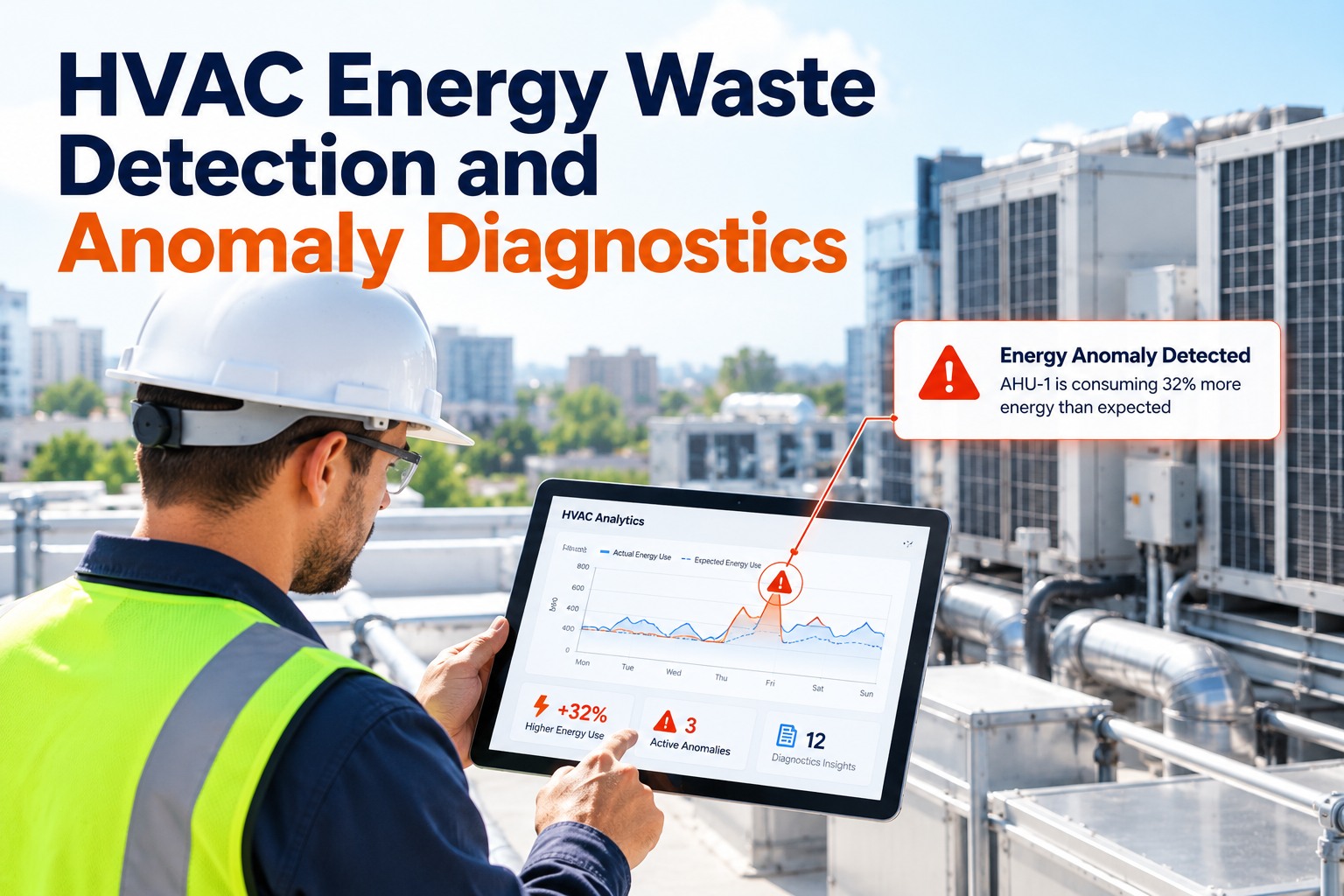
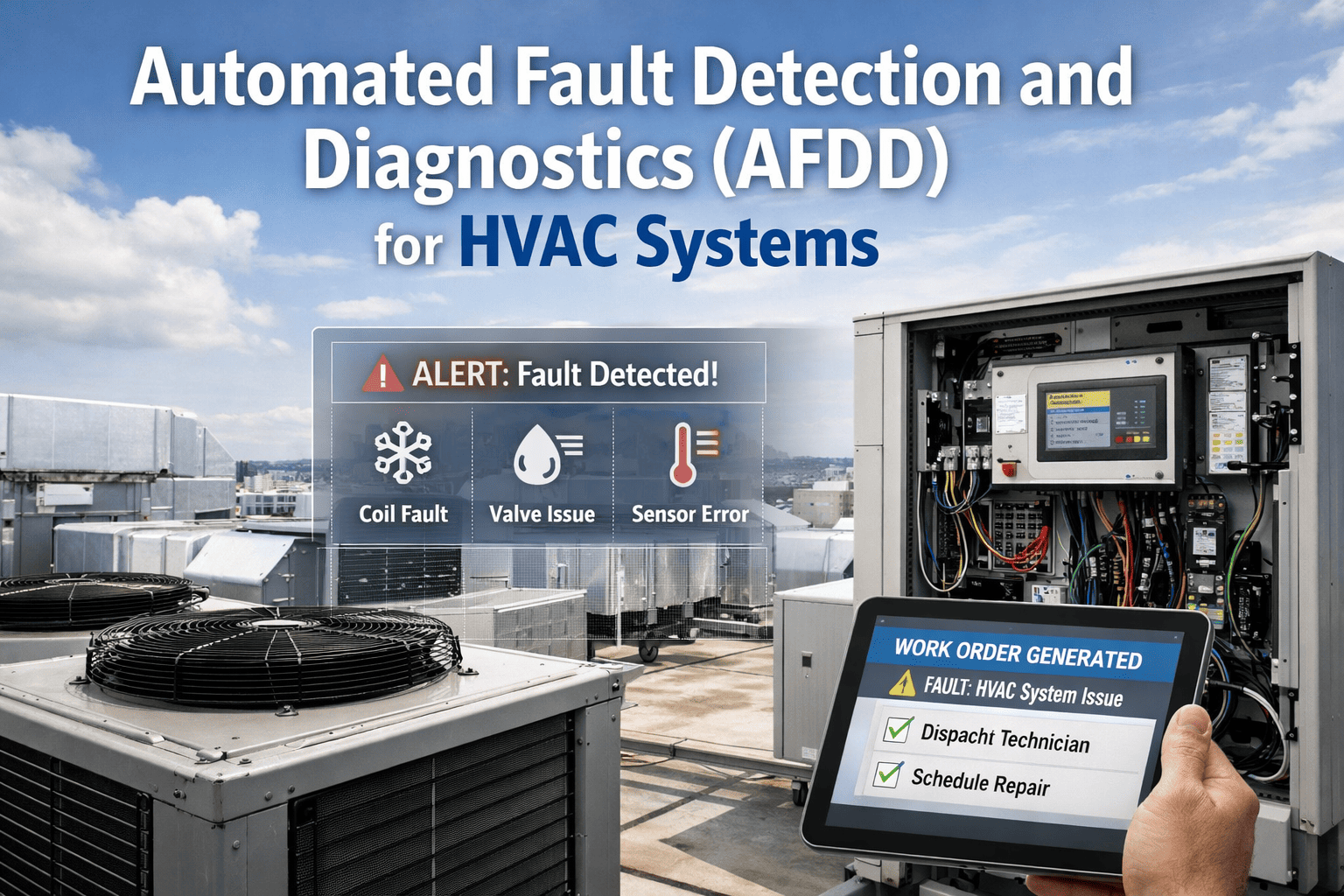
Commercial HVAC systems are failing right now and nobody knows. Not the building engineer, not the tenants, not the property manager. A rooftop unit is running with a stuck outdoor air damper, pulling in 100% outside air during peak cooling — burning $40–$80 per day in excess energy while the compressor works overtime trying to overcome the load. A chilled water valve is hunting between 30% and 70% open every 90 seconds because the actuator is fighting a miscalibrated controller — wasting energy, creating temperature swings, and wearing out the valve in a third of its expected life. A VAV box is simultaneously calling for heating and cooling because the dead band was set to zero during a commissioning shortcut three years ago — the heating coil and cooling coil are literally fighting each other, every hour of every day, and nobody has noticed because the zone temperature stays roughly at setpoint. These aren't catastrophic failures. The equipment is "running." The building is "conditioned." But these soft faults — operational inefficiencies, control logic errors, sensor drift, and mechanical degradation that don't trigger alarms or comfort complaints — consume 15–30% of total HVAC energy in the average commercial building. Across a 500,000 square foot portfolio, that's $75,000–$200,000 per year in wasted energy alone, plus $30,000–$80,000 in accelerated equipment wear and premature component replacement. AI-powered Fault Detection and Diagnostics (FDD) finds these faults automatically by continuously analyzing BMS data, comparing actual equipment behavior against expected performance models, identifying deviations that indicate faults, diagnosing the probable root cause, and prioritizing the findings by energy and cost impact so maintenance teams fix the most expensive problems first.
The Faults Hiding in Plain Sight
Average commercial building: 3–12 active HVAC faults at any given time, most invisible to operators and tenants
15–30%
of HVAC energy wasted on soft faults that never trigger alarms
60–80%
of faults are control and operational — not mechanical breakdown
$0.25–$0.75
per sq ft per year in energy wasted on undetected faults
2–6 months
average time a soft fault persists before manual detection
What FDD Is and How It Differs from Alarms and Predictive Maintenance
FDD occupies a specific and critical niche between traditional BMS alarms and predictive maintenance — and understanding the distinction is essential to setting expectations and deploying the right tool for the right job.
Detects: Hard failures and threshold violations
Supply air temp above 90°F. Discharge pressure high limit. Freeze stat trip. Filter differential pressure exceeded. These are binary conditions — something crossed a preset threshold and the system screams about it.
What it misses: Everything that doesn't cross a threshold. A stuck damper at 40% that should be at 100% doesn't alarm — it just wastes energy. A drifted sensor reading 2°F high doesn't alarm — it just causes continuous overcooling.
Detects: Operational faults, control errors, soft failures, efficiency degradation
Simultaneous heating and cooling. Economizer not functioning when outdoor conditions allow free cooling. Sensor drift causing incorrect control response. Short cycling from oversized equipment or improper dead band. Valve or damper hunting from unstable control loops. Degraded heat transfer from coil fouling.
How it works: Compares actual operating behavior against physics-based or data-driven models of expected behavior. When actual deviates from expected, the system identifies the fault pattern, diagnoses the probable cause, and estimates the energy/cost impact.
Detects: Mechanical degradation trending toward failure
Bearing vibration increasing toward seizure. Compressor current draw trending upward from winding degradation. VFD capacitor aging detected through harmonic analysis. These are components physically wearing out over time.
Overlap with FDD: Some faults detected by FDD are also PdM signals (e.g., degraded heat transfer can indicate both a fouled coil operational fault and a long-term efficiency degradation trend). The best systems integrate both capabilities.
The Fault Taxonomy: What AI FDD Actually Finds in Commercial Buildings
AI FDD doesn't just say "something is wrong" — it classifies faults into specific categories with diagnosed root causes and estimated cost impact, enabling maintenance teams to prioritize fixes by ROI. Facilities that connect their BMS data to an FDD-integrated CMMS platform turn every detected fault into a trackable, assignable, verifiable work order.
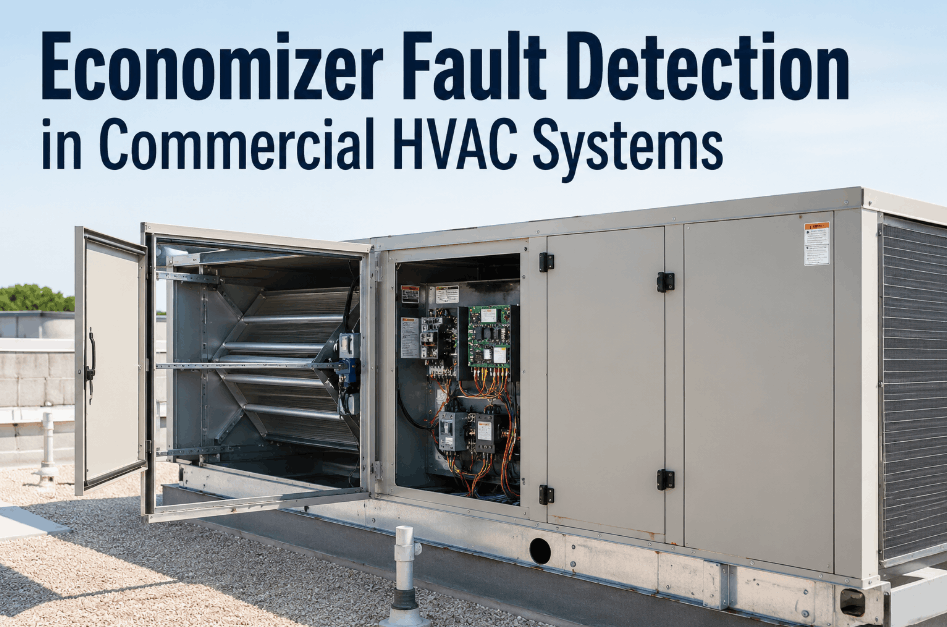
Economizer not activating when OAT permits free cooling
The outdoor air damper should open to provide free cooling when outdoor air is cool enough, but stays at minimum position. Causes: failed actuator, broken linkage, disabled economizer sequence in BMS, outdoor air temperature sensor failed/drifted high.
$1,500–$6,000 per RTU per year in excess compressor energy
Economizer stuck open — 100% outside air during occupied hours
Damper remains fully open regardless of outdoor conditions. During hot/humid weather, the system imports maximum cooling load. During cold weather, the heating system fights the excess ventilation. Causes: actuator failure in open position, linkage disconnected, control signal failure.
$2,000–$12,000 per RTU per year depending on climate zone
Outdoor air temperature sensor drift or failure
Sensor reads 5–15°F higher or lower than actual OAT. Reading high: economizer never activates (free cooling lost). Reading low: economizer opens when outdoor air is too warm (excess cooling load imported). A single failed $50 sensor can waste thousands in annual energy.
$800–$4,000 per RTU per year in misdirected economizer operation
Zone-level simultaneous heating and cooling (VAV reheat)
The AHU is cooling supply air to 55°F while the VAV box reheat coil is heating it back to 72°F. The central system and the zone system are fighting each other. Causes: supply air temperature setpoint too low for current load, dead band set to zero, reheat valve leaking through when closed, sensor error causing false cooling demand.
$200–$1,200 per VAV zone per year — multiplied across dozens or hundreds of zones
AHU-level mixed heating and cooling signals
Heating valve and cooling valve both open simultaneously at the AHU, or the preheat coil is active while the cooling coil is also energized. Causes: control sequence error, failed valve actuator not fully closing, overlapping heating/cooling schedules, incorrect interlock programming.
$3,000–$15,000 per AHU per year in direct energy waste
Space temperature sensor drift
Sensor reads 2–5°F above or below actual space temperature. Reading high: zone overcools continuously. Reading low: zone overheats. A 2°F offset in a space sensor causes the HVAC system to maintain the wrong setpoint 24/7 — increasing energy consumption 5–10% in that zone and generating comfort complaints that lead to maintenance calls investigating "equipment problems" that are actually a $30 sensor.
$400–$2,000 per zone per year in energy + nuisance service calls
Supply air temperature sensor failure
Controls the cooling and heating output of the AHU — if this sensor reads incorrectly, the entire air handler operates at the wrong supply temperature. Offset high: AHU overcools (compressors run harder than needed, zones may overcool). Offset low: AHU undercools (zones get warm air, comfort complaints, terminal reheat increases).
$2,000–$8,000 per AHU per year — affects every zone served
Equipment running outside occupied hours
AHUs, RTUs, or FCUs running at night, weekends, or holidays when the building is unoccupied. The most common and frequently the most expensive FDD finding. Causes: BMS schedule overridden and never restored, holiday schedule not updated, occupancy sensor bypass, after-hours override with no auto-reset.
$3,000–$25,000 per unit per year — often the single largest energy waste source
Incorrect staging or lead-lag sequencing
Multiple chillers, boilers, or compressor stages not staging efficiently — running two units at 40% load instead of one unit at 80%, or running the least efficient unit as lead. Part-load operation is dramatically less efficient for most equipment.
$5,000–$30,000 per plant per year depending on equipment size
Coil fouling and degraded heat transfer
Condenser coils, evaporator coils, and heating coils progressively lose heat transfer effectiveness from dirt, biological growth, mineral deposits, and fin damage. FDD detects this through approach temperature widening and capacity degradation trending — scheduling cleaning when ROI justifies the cost, not on a fixed calendar.
$500–$3,000 per coil per year in excess energy from degraded efficiency
Refrigerant charge deviation
Overcharge or undercharge detected through superheat, subcooling, and capacity analysis. A 10% undercharge reduces cooling capacity 5–10% and increases compressor energy consumption 10–15%. FDD tracks the refrigerant performance indicators continuously rather than relying on annual PM checks.
$800–$4,000 per circuit per year in excess energy + accelerated compressor wear
Your BMS Data Already Contains the Evidence of Every Fault. AI FDD Reads It.
OxMaint integrates AI-powered FDD with comprehensive CMMS work order management — automatically detecting operational faults, diagnosing root causes, estimating energy impact, and generating prioritized work orders so your team fixes the most expensive problems first.
How AI FDD Works: From Raw Data to Diagnosed Fault
The FDD diagnostic process follows a structured pipeline from raw BMS data to actionable maintenance work orders. Understanding this pipeline helps facilities teams evaluate FDD solutions and set realistic expectations for implementation.
BMS trend data (temperatures, pressures, valve positions, damper commands, fan speeds, equipment status) is collected at 1–15 minute intervals and normalized. The system reconciles different naming conventions, unit types, and data formats across multiple BMS platforms — a critical step in multi-building portfolios where each building may have a different BMS vendor. Typical data density: 50–200 data points per AHU, 10–30 per RTU, 5–15 per VAV/FCU.
The AI builds a performance model for each piece of equipment based on the first 4–8 weeks of operating data. The model captures the "normal" relationships between variables: how supply air temperature responds to cooling demand at different outdoor conditions, how chilled water valve position correlates with zone load, how compressor current relates to ambient temperature and return air conditions. Physics-based models use first-principles thermodynamics; data-driven models learn patterns statistically; hybrid models combine both for maximum accuracy.
The system continuously compares actual operating data against the equipment model. When actual behavior deviates from expected by more than the noise threshold, a fault condition is flagged. Detection algorithms use a combination of expert rules (e.g., "if outdoor air temp < 55°F AND economizer damper < 20%, then economizer fault"), statistical anomaly detection (multivariate deviation from baseline operating envelope), and pattern recognition (matching current behavior against known fault signatures from the training library).
Once a fault is detected, the diagnostic engine determines the probable root cause by analyzing which specific variables are deviating and in which direction. "Economizer not activating" is a detection. "Outdoor air temperature sensor reading 12°F high, causing economizer enable logic to never trigger" is a diagnosis. The diagnosis narrows the technician's investigation from "something is wrong with the economizer" to "check the outdoor air temperature sensor on RTU-12, likely failed or sun-exposed." This specificity is what transforms FDD from an alerting system into a diagnostic tool.
Each diagnosed fault is assigned an estimated energy impact (kWh/day or therms/day wasted), cost impact ($/month at current utility rates), comfort impact (affected zones and temperature deviation), and equipment wear impact (accelerated degradation from operating outside design parameters). Faults are ranked by total impact, giving maintenance teams a prioritized list where the first item is always the most expensive problem to leave unfixed. This prevents the common trap of fixing easy faults while expensive ones persist.
Faults exceeding the actionable threshold generate work orders in the CMMS automatically — pre-populated with the affected equipment, diagnosed fault, estimated impact, recommended corrective action, and the supporting data (trend charts, deviation timeline) that the technician needs to verify and resolve the fault. After repair, the system monitors the equipment to verify the fault is resolved — confirming that the corrective action worked and the energy waste has stopped. If the fault persists or recurs, the work order re-opens automatically.
Implementation: What FDD Requires and What It Delivers by Phase
Weeks 1–4
Connect & Discover
Requirements: BMS data access (BACnet, Modbus, API, or historian export), equipment inventory, floor plans or zone maps
Results: Immediate discovery of scheduling faults (equipment running when it shouldn't), obvious control errors (simultaneous heating/cooling), and failed sensors (readings physically impossible). These "quick wins" typically represent 30–50% of total fault energy waste and require zero AI — just data visibility.
Weeks 4–12
Model & Baseline
Requirements: Continued data flow through at least one full load cycle (ideally both heating and cooling seasons), equipment nameplate data for model calibration
Results: Equipment performance models calibrated, economizer fault detection active, coil performance baselines established, control loop stability analysis producing results. Fault detection accuracy reaches 80–90% with false positive rates under 15%.
Months 3–6
Diagnose & Optimize
Requirements: Technician feedback loop (confirming or correcting AI diagnoses improves model accuracy), CMMS integration for work order automation
Results: Full diagnostic capability with root cause identification. Impact estimation calibrated against actual utility data. Fault prioritization driving maintenance scheduling. False positives below 8%. Typical energy savings: 10–20% of HVAC energy cost with 40–60% of identified faults resolved.
Months 6–12
Sustain & Expand
Requirements: Ongoing data quality monitoring, model retraining as seasons change, expansion to additional buildings or equipment types
Results: Continuous fault monitoring prevents regression (faults that were fixed don't silently return). New fault types detected as models mature. Energy savings sustained at 15–25% of baseline HVAC cost. Full ROI data available for portfolio expansion decisions.
ROI: AI Fault Detection & Diagnostics for Commercial HVAC
$125K
Energy Waste Elimination
15–25% HVAC energy reduction from resolved economizer faults, eliminated simultaneous heating/cooling, corrected scheduling, and optimized sequencing
$68K
Extended Equipment Life & Reduced Wear
Resolving control faults that cause short cycling, hunting, and simultaneous operation reduces mechanical stress 20–40%, extending compressor, valve, and actuator life
$42K
Maintenance Efficiency Improvement
Technicians arrive with the diagnosis and supporting data instead of spending 30–60 minutes troubleshooting — first-visit fix rate increases from 40–60% to 75–90%
$35K
Comfort Complaint Reduction
50–70% fewer comfort calls — sensor drift, control faults, and airflow problems detected and resolved before tenants notice the temperature deviation
$18K
Avoided Nuisance Service Calls
Comfort complaints often trigger $150–$400 service calls that find "no problem" because the intermittent fault isn't active when the tech arrives — FDD provides the data trail
Expert Perspective: Deploying FDD Across a Commercial Portfolio
"
I deployed FDD across a 12-building, 3.8 million square foot commercial portfolio over 18 months. The first thing the system found — within 72 hours of connecting the first building's BMS data — was that 6 of 22 rooftop units were running 24/7 instead of shutting down at 7 PM. The BMS schedule had been overridden during a tenant event 14 months earlier and never restored. That single finding was costing $47,000 per year in electricity. A technician could have found it by looking at the BMS schedule — but nobody was looking because nobody knew to look. That's the fundamental value of FDD: it looks at everything, all the time, and finds the problems that humans don't have time to look for. Over the first six months, FDD identified 340 active faults across the portfolio. We prioritized by cost impact: the top 50 faults represented 78% of the total waste. We resolved those 50 faults in eight weeks using our existing maintenance team — no additional staff, no capital investment, just targeted work orders with diagnosis already attached. Total energy savings from those 50 fixes: $186,000 annualized. The remaining 290 faults were lower-impact items that we worked through over the following six months. The total first-year energy savings were $312,000 against a platform cost of $45,000. That's a 7× return in year one. But the compounding value was even more important: year two, because the system monitored continuously, faults that were fixed didn't silently return. New faults were caught within days instead of persisting for months. Our HVAC energy cost per square foot dropped 22% and stayed there. The biggest mistake we made: not involving the controls contractor from day one. About 40% of the faults FDD found were control sequence issues — simultaneous heating and cooling, incorrect economizer logic, unstable PID loops — that required BMS programming changes, not mechanical repairs. Our maintenance techs couldn't fix those faults because they weren't mechanical problems. Having the controls contractor engaged from the start would have cut our fault resolution time in half.
The first findings are usually the biggest — scheduling overrides and obvious control errors represent 30–50% of total waste
Prioritize by cost impact — the top 15% of faults typically cause 75–80% of the total energy waste
Engage the controls contractor from day one — 40% of faults are BMS programming issues, not mechanical problems
Continuous monitoring prevents regression — fixed faults stay fixed because the system catches recurrence within days, not months
AI Fault Detection and Diagnostics is the technology that makes HVAC maintenance proactive instead of reactive, targeted instead of calendar-based, and data-driven instead of experience-dependent. It finds the faults that are too subtle for alarms, too gradual for human detection, and too numerous for any maintenance team to discover through periodic inspections alone. If you're ready to see what faults are hiding in your buildings right now, book a free demo to see how FDD-integrated maintenance management works on OxMaint.
Every Fault Found. Every Root Cause Diagnosed. Every Dollar of Waste Quantified. Every Fix Verified.
OxMaint combines AI-powered Fault Detection and Diagnostics with full CMMS work order management — automatically identifying HVAC faults from your BMS data, diagnosing root causes, estimating cost impact, generating prioritized work orders, and verifying resolution. One platform from detection to verification.
Frequently Asked Questions
What BMS data does FDD need and how does it connect?
FDD requires trended BMS data — the time-series values that the BMS is already collecting but may not be storing long-term. The minimum data set per AHU includes: supply air temperature, return air temperature, mixed air temperature, outdoor air temperature, cooling valve position, heating valve position, outdoor air damper position, fan status and speed, and supply duct static pressure. For VAV boxes: zone temperature, airflow (if measured), damper position, and reheat valve position. For RTUs: compressor status, fan status, discharge air temperature, return air temperature, and outdoor air temperature. Connection methods range from direct BMS integration (BACnet/IP, Modbus TCP, or Niagara/Tridium API — the cleanest approach), to historian export (if the BMS already trends data to a SQL historian, FDD can query it directly), to IoT gateway overlay (a standalone gateway that reads BMS points without modifying the BMS configuration — the least invasive approach for buildings with restrictive BMS access policies). Most modern FDD platforms support all three connection methods. The integration typically takes 1–3 days per building for direct BMS connection, or 1–2 weeks if a gateway installation is required. The most common barrier is not technical but contractual — getting permission from the BMS vendor or controls contractor to access the data. Specifying FDD data access rights in BMS maintenance contracts is a best practice that eliminates this barrier.
How does AI FDD differ from rule-based FDD?
Rule-based FDD uses predefined engineering rules: "if outdoor air temperature is below 55°F and the economizer damper is below 20%, then economizer fault." These rules work well for known fault patterns with clear signatures — economizer faults, simultaneous heating and cooling, scheduling errors, and sensor failures can all be detected reliably with rules. The limitation is that rules only find what they're programmed to find, and they don't adapt to the specific characteristics of individual equipment. AI-based FDD adds three capabilities beyond rules. First, anomaly detection without predefined rules: the AI learns each piece of equipment's normal operating behavior and flags deviations that don't match any predefined rule — catching novel fault patterns that rule writers didn't anticipate. Second, adaptive thresholds: instead of fixed thresholds (e.g., "flag if valve position deviates more than 20% from expected"), AI learns the normal variability for each specific unit and adjusts sensitivity accordingly — reducing false positives on equipment with inherently variable operation while maintaining sensitivity on stable equipment. Third, pattern recognition across equipment populations: AI identifies fault signatures that appear across multiple similar units, even if the signature is subtle on any individual unit — for example, detecting that all RTUs with a specific VFD model are showing the same power quality anomaly, suggesting a firmware bug or batch manufacturing issue rather than individual equipment faults. The most effective FDD platforms use both approaches: rules for the well-understood, high-confidence fault patterns, and AI for the adaptive, novel, and cross-fleet detection that rules can't achieve.
What is a realistic false positive rate for commercial HVAC FDD?
False positive rate — the percentage of flagged faults that turn out to be false alarms when a technician investigates — is the single most important metric for FDD adoption. If the false positive rate is too high, technicians lose trust, stop responding to FDD findings, and the system becomes expensive noise. Realistic false positive rates by implementation phase: During the first 4–8 weeks (baseline period), expect 15–25% false positives as the system learns equipment behavior. Most false positives at this stage are caused by incomplete data (missing sensors, gaps in BMS trends), unusual operating conditions during the baseline period (seasonal transitions, special events), and equipment with inherently variable operation that the model hasn't yet characterized. By months 2–4, with model tuning and technician feedback (confirming or rejecting findings), false positive rates should drop to 8–12%. By months 4–6, a well-tuned system should operate below 5–8% false positive rate on established equipment. New equipment added to the system will restart the learning curve for those specific units. For context, a 5% false positive rate on a 200-unit portfolio producing 20 fault findings per month means approximately 1 false positive per month — an acceptable rate that maintains technician trust. A 20% rate means 4 false positives per month, which begins to erode confidence. The key to managing false positives is the technician feedback loop: when a technician investigates a finding and determines it's false, that feedback is used to retrain the model and suppress similar false triggers in the future.
Can FDD work with older BMS platforms that have limited data?
Yes, with realistic expectations about detection scope. Older BMS platforms (pre-2005 Tridium, legacy pneumatic/DDC, proprietary systems) typically have fewer trend points, lower data resolution (15-minute or hourly intervals versus 1-minute on modern systems), and limited or no historian capability. FDD can still deliver significant value on these systems through three approaches. First, IoT sensor overlay: adding standalone wireless sensors (temperature, current, vibration) to critical equipment, independent of the BMS. These sensors report to the FDD platform directly via cellular or WiFi gateway. This approach adds monitoring capability without touching the BMS and is often the fastest path to value on older buildings. Cost: $200–$800 per monitored unit. Second, BMS data extraction: even older systems typically expose some data via BACnet, Modbus, or LonWorks. A protocol gateway can read available points and trend them externally. The FDD scope is limited to the points available, but scheduling faults, basic economizer faults, and simultaneous heating/cooling detection are often possible with minimal data. Third, hybrid approach: use IoT sensors for the high-value monitoring points (compressor current, supply/return air temperatures, outdoor air temperature) and extract whatever the BMS provides for supplemental context (valve commands, damper positions, fan status). This combination typically provides 60–80% of the detection capability of a fully instrumented modern BMS at a fraction of the cost of a BMS upgrade. FDD on older systems won't achieve the same detection depth as on a modern, fully-trended BMS, but it will find the highest-impact faults — scheduling errors, failed economizers, simultaneous heating/cooling — that represent the majority of energy waste.
How does FDD integrate with the CMMS for work order management?
The FDD-to-CMMS integration is the critical connection that transforms detected faults into resolved faults. Without it, FDD findings accumulate in a dashboard that nobody checks regularly, and the same faults persist for months — exactly the problem FDD was supposed to solve. The integration operates through a defined workflow with configurable thresholds. When a fault's estimated monthly cost exceeds the actionable threshold (typically $50–$200/month, set by the facility), the FDD platform sends a work order creation request to the CMMS via API. The work order is pre-populated with: the specific equipment (asset ID, location, equipment type), the diagnosed fault (e.g., "RTU-14 economizer not activating — outdoor air temperature sensor reading 12°F above actual"), the estimated monthly energy cost of the fault, the recommended corrective action (e.g., "Replace outdoor air temperature sensor, verify economizer sequence activation after replacement"), supporting data (trend charts showing the deviation, timeline of fault onset), and suggested priority based on cost impact and safety relevance. The technician receives a work order that contains the diagnosis and the data — not just an alert that something is wrong. After the technician completes the repair, the CMMS marks the work order complete. The FDD platform then monitors the equipment for the next 48–72 hours to verify the fault is actually resolved. If the fault signature persists after the repair, the FDD system re-opens the work order with updated information — indicating that the initial repair didn't address the root cause and further investigation is needed. This closed-loop verification is what prevents "fixed on paper, still broken in reality" — a common problem in maintenance organizations where work orders are closed based on the technician's visit rather than verified resolution of the underlying fault.