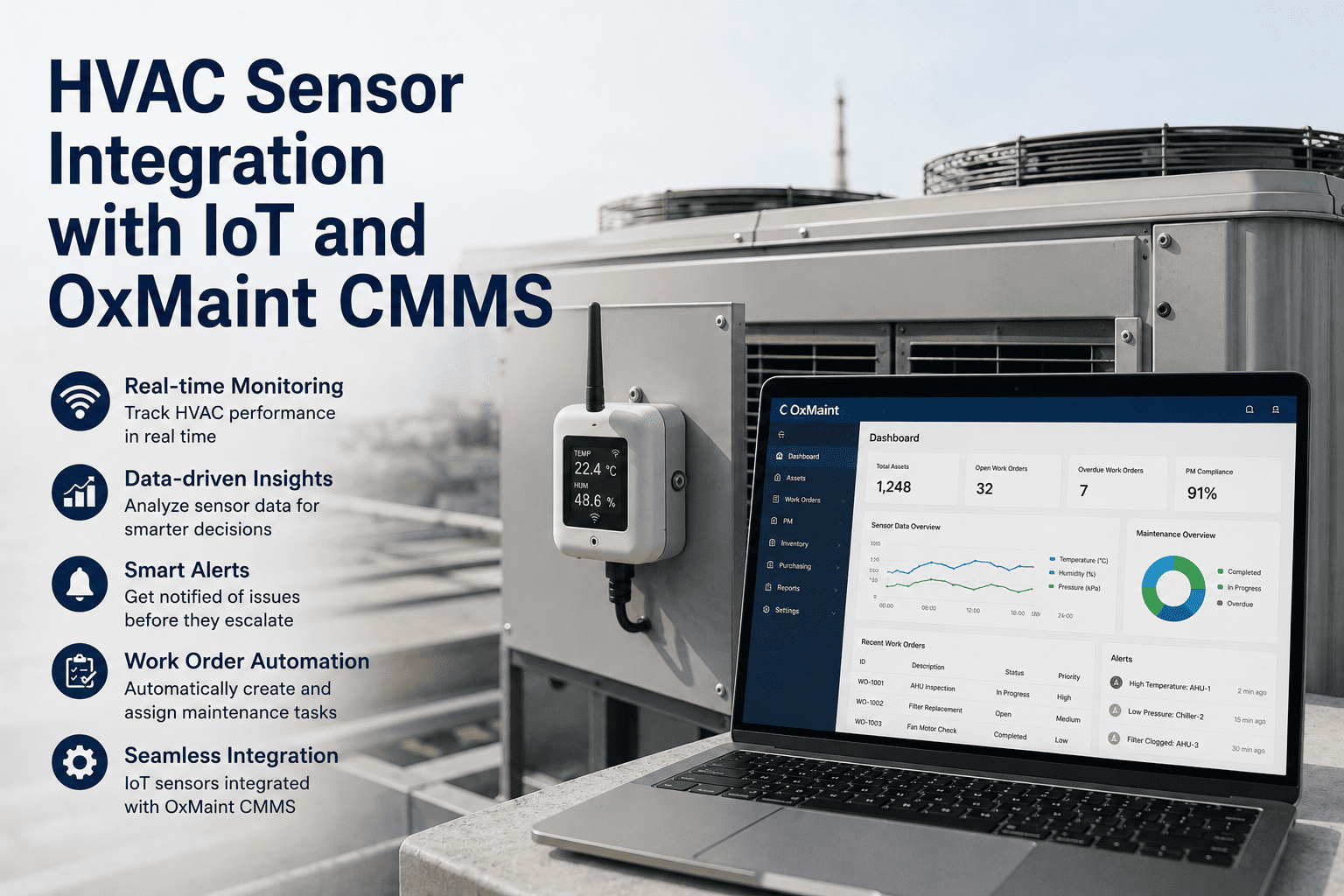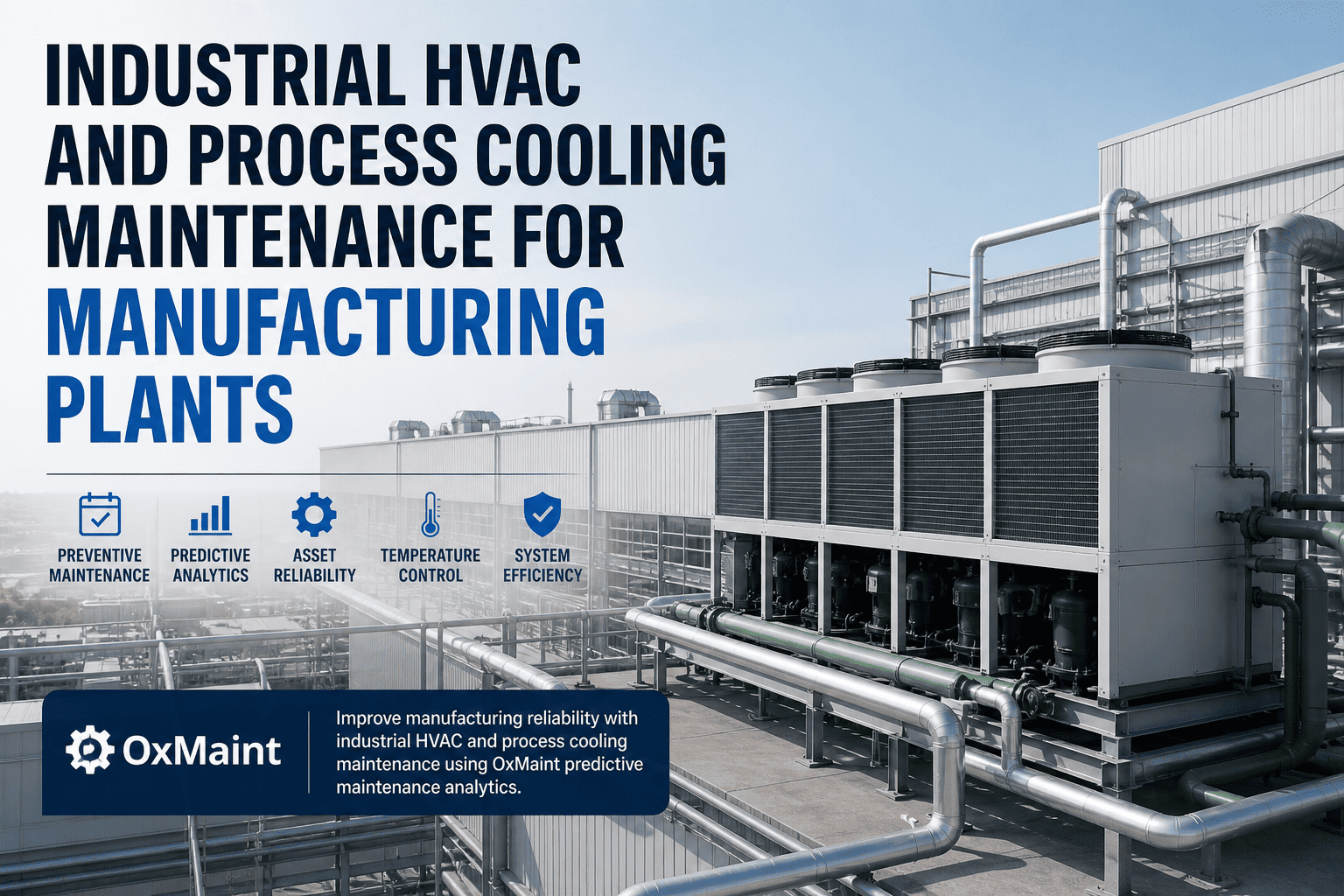
Manufacturing facilities operate on zero-tolerance margins — a single HVAC failure in a process cooling loop, cleanroom, or paint booth can halt production lines for hours and cost tens of thousands in lost output. Predictive HVAC maintenance for manufacturing facilities moves your team from responding to failures to preventing them, using real-time sensor data, AI-driven diagnostics, and structured PM workflows that keep ventilation, cooling, and humidity control running without unplanned downtime. Whether your facility runs continuous process manufacturing, precision assembly, or heavy fabrication, the maintenance strategies below reflect how industrial operations teams are extending HVAC equipment life and protecting production uptime in 2026. To build predictive maintenance schedules for every HVAC asset in your facility, Sign Up Free on OxMaint and connect your industrial HVAC assets to condition monitoring, work order automation, and capital planning from day one.
Why Manufacturing Facilities Need Predictive HVAC Maintenance in 2026
Industrial HVAC systems in manufacturing environments face conditions no commercial building system encounters — continuous operation cycles, process heat loads, airborne particulates, chemical vapors, and production-linked humidity demands that change by shift. Traditional preventive maintenance schedules built on calendar intervals miss developing failures between service visits. Predictive maintenance closes that gap by continuously monitoring equipment condition indicators — vibration signatures, motor current draw, refrigerant pressures, and airflow differentials — and triggering maintenance actions when readings deviate from baseline, not when the calendar says it's time. Book a Demo to see how OxMaint structures predictive maintenance workflows for industrial HVAC asset classes across your facility.
| Manufacturing HVAC Asset | Critical Failure Mode | Predictive Indicator | Production Impact if Missed |
|---|---|---|---|
| Process Cooling Chiller | Compressor failure from refrigerant deficit | Suction pressure trending below design range | Line shutdown — heat-sensitive processes halt immediately |
| Makeup Air Unit (MAU) | Heat exchanger fouling or burner failure | Supply air temperature deviation and rising gas consumption | Humidity and temperature excursions affect product quality |
| Industrial Exhaust Fan | Bearing failure from unmonitored vibration | Vibration amplitude increase beyond 0.25 in/s | Fume and vapor buildup — safety shutdown risk |
| Cooling Tower | Basin corrosion and Legionella proliferation | Water treatment chemistry drift and fill condition | Process cooling capacity loss and regulatory exposure |
| Cleanroom AHU | Filter bypass and pressure differential failure | DP sensor drift and airflow velocity reduction | Contamination event — product scrapping or recall risk |
| Compressed Air Dryer | Desiccant saturation causing moisture carryover | Dew point rising above process specification | Tool damage, corrosion in pneumatic lines, product defects |
The 5 Predictive Maintenance Pillars for Industrial HVAC Systems
Every predictive program starts by establishing what "healthy" looks like for each asset. OxMaint captures commissioning-phase readings — vibration, amperage, temperature differentials, and pressure data — as the baseline against which all future readings are compared. Without a documented baseline, condition trending is guesswork.
Sensors connected to OxMaint stream real-time data from fan motors, compressors, and cooling towers — flagging anomalies as they develop. Instead of finding a failed bearing on a quarterly inspection, your team receives an alert when vibration amplitude first begins trending upward, providing a 2 to 6 week intervention window before failure.
OxMaint's predictive maintenance AI analyzes patterns across your HVAC asset fleet — correlating motor current draw with ambient temperature, production load, and runtime hours to distinguish normal variation from developing faults. This reduces false positives that create alert fatigue in purely threshold-based systems.
When a predictive alert fires, OxMaint automatically generates a work order assigned to the appropriate technician, with the asset record, condition readings, and recommended corrective action attached. No manual ticket creation, no communication lag — the right technician receives the right information within minutes of the anomaly detection. Sign Up Free to activate automated work order workflows for your industrial HVAC assets.
Every corrective and preventive action logged in OxMaint builds a cost history against each HVAC asset tag. When repair frequency increases or condition indicators show permanent degradation, OxMaint's capital planning module surfaces the repair-vs-replace threshold before it becomes an emergency — giving finance teams the data they need for budget approval.
Manufacturing HVAC Failure Cost Benchmarks: 2026
HVAC Predictive Maintenance by Manufacturing Environment Type
AHU filter differential pressure, HEPA integrity, and room pressurization cascade monitoring. OxMaint logs every inspection result against the cleanroom asset record for regulatory audit readiness.
Refrigeration system superheat and subcooling monitoring, condensate drain inspection, and cold storage temperature excursion alerting — linked to HACCP documentation workflows inside OxMaint.
Paint booth exhaust fan vibration tracking, make-up air unit burner performance, and weld fume extraction system airflow monitoring — all connected to production shift scheduling in OxMaint.
ESD-safe environment humidity control monitoring, static dissipative flooring zone temperature trending, and precision cooling system dew point alerting for sensitive component protection.
Hazardous area ventilation fan runtime and airflow monitoring, process cooling tower water chemistry trending, and corrosion-resistant heat exchanger inspection scheduling inside OxMaint's asset register.
Humidity control system dewpoint trending, dryer section exhaust fan vibration monitoring, and compressed air dryer dew point alerting — protecting moisture-sensitive production processes from quality excursions.
Predictive vs Preventive vs Reactive: The Manufacturing HVAC Maintenance Comparison
| Maintenance Approach | Failure Detection Timing | Maintenance Cost Profile | Production Impact Risk | OxMaint Support |
|---|---|---|---|---|
| Reactive (Run-to-Fail) | After failure occurs | Highest — emergency labor and parts premiums | Maximum — unplanned production stoppage | Work order logging, failure cost tracking |
| Preventive (Calendar-Based) | At scheduled interval — may miss developing faults | Moderate — over-maintenance of healthy assets | Reduced but not eliminated | PM scheduling, compliance tracking, asset-linked work orders |
| Predictive (Condition-Based) | 2–6 weeks before failure via sensor data | Lowest — maintenance only when condition warrants | Minimal — planned interventions during scheduled downtime | Full AI anomaly detection, automated alerts, condition data logging |