Modern HVAC systems generate enormous operational cost — yet most facilities still react to failures after they occur. When occupancy patterns, real-time weather data, and Building Management System telemetry are combined with AI-powered analytics, facility teams can predict load spikes, comfort deviations, and component failures hours before they happen. Oxmaint brings this intelligence into a maintenance workflow that technicians actually use — connecting HVAC asset data, condition-based alerts, and work order execution in one platform. Teams ready to shift from reactive to predictive HVAC operations can Sign Up Free and begin building their asset hierarchy and alert rules within the first week. For facilities with complex multi-zone environments, Book a Demo to see how Oxmaint handles BMS-integrated predictive triggers at scale.
Oxmaint connects occupancy data, weather feeds, and BMS alerts to your maintenance workflow — so your team acts before comfort drops or equipment fails.
The 5 Data Streams That Power HVAC Predictive Alerts
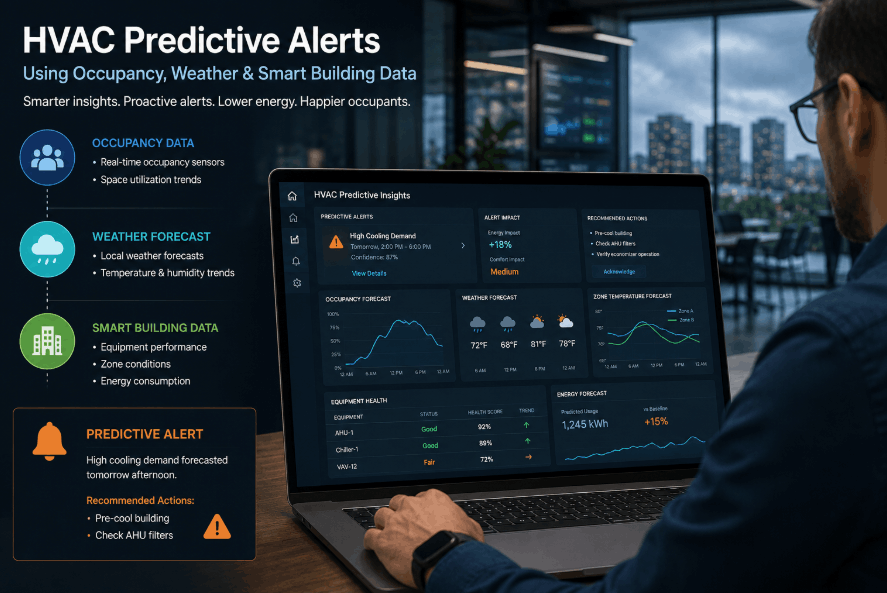
Effective HVAC predictive maintenance is not built on sensor data alone. It requires fusing occupancy schedules, external weather forecasts, BMS telemetry, energy consumption patterns, and historical asset failure data into a single operational picture. Facilities that Sign Up Free on Oxmaint can map these data streams to specific HVAC assets and configure threshold-based or condition-based work order triggers without writing a single line of code.
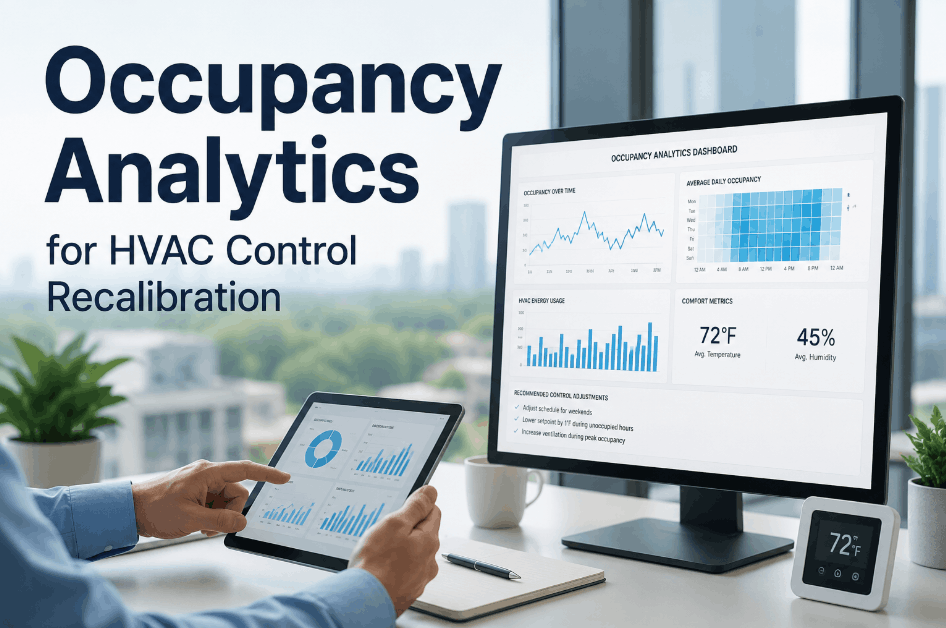
Scheduled occupancy data and real-time badge or sensor feeds allow the system to anticipate thermal load before a zone fills — enabling pre-conditioning instead of reactive correction.
Outdoor dry-bulb temperature, humidity, and solar gain forecasts drive HVAC load projections up to 48 hours ahead — triggering PM tasks and equipment readiness checks before weather events hit.
Building Management System fault codes, supply air deviations, and delta-T anomalies feed directly into condition-based work order triggers — converting BMS alerts into actionable maintenance tasks.
Unexpected energy draw spikes on HVAC circuits — without corresponding occupancy increases — signal compressor inefficiency, refrigerant loss, or coil fouling before temperature complaints surface.
Oxmaint's asset history engine identifies units with repeat failure patterns, enabling reliability engineers to set tighter condition thresholds on high-risk HVAC assets proactively.
Combining zone temperature trends, humidity deviation, and occupancy density enables PMV-based comfort predictions — alerting maintenance before occupants report issues via helpdesk tickets.
HVAC Predictive Alert Types: From Load Spikes to Component Failures
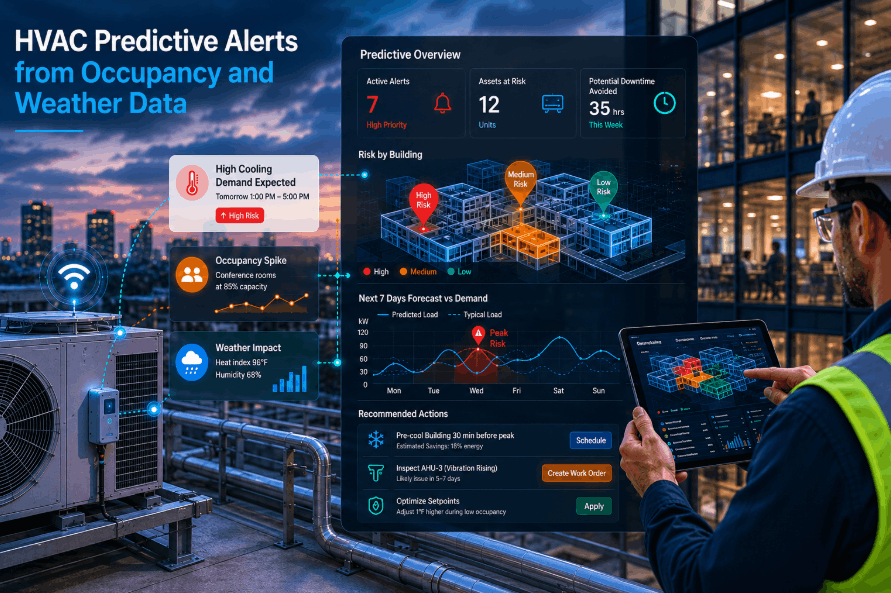
Not all HVAC alerts carry equal urgency or operational consequence. A structured alert taxonomy helps maintenance teams prioritise responses, assign the right technician, and close work orders with complete fault data. Use this framework to score your current HVAC monitoring capability and identify the gaps that Oxmaint's condition-based PM engine closes. Facilities with legacy reactive programs are encouraged to Book a Demo to see how alert-to-work-order automation works in live building environments.
| Alert Type | Data Source | Trigger Logic | Maintenance Action | Priority |
|---|---|---|---|---|
| Load Spike Warning | Occupancy + Weather | Forecast occupancy > 80% + outdoor temp > 32°C | Pre-stage AHU capacity, inspect filters | Critical |
| Comfort Deviation Alert | Zone sensors + BMS | Supply air delta-T outside setpoint by >2°C for 15 min | Inspect dampers, check refrigerant charge | Critical |
| Coil Fouling Prediction | Energy meters + runtime | kW draw up 12% vs baseline at same outdoor temp | Schedule coil cleaning PM work order | Important |
| Filter Restriction Alert | Static pressure sensors | ESP differential exceeds manufacturer limit | Filter replacement work order auto-generated | Important |
| Refrigerant Loss Signal | Suction pressure + superheat | Superheat deviation >10°F from target for 30 min | Dispatch refrigeration technician | Critical |
| Bearing Wear Indication | Vibration sensors | RMS vibration increase >15% over 7-day baseline | Schedule motor inspection PM | Important |
| Economiser Lockout Risk | Weather API + BMS | Outdoor enthalpy exceeds economiser enable threshold | Verify damper control sequence, log compliance | Routine |
| Seasonal Readiness Check | Calendar + asset history | 30 days before peak cooling/heating season | Trigger comprehensive seasonal PM checklist | Routine |
How Facilities Deploy HVAC Predictive Alerting Without a 12-Month IT Project
The barrier to HVAC predictive maintenance is rarely the technology — it is the implementation model. Legacy platforms require months of systems integration work before a single alert fires. Oxmaint is designed for facilities teams, not IT departments — with no-code asset setup, API-based BMS connections, and a 60-day path to live predictive work orders. Facilities ready to start can Sign Up Free and build the HVAC asset hierarchy in the first session.
- BMS API or IoT gateway integration in days, not months
- No-code condition trigger setup for each HVAC asset type
- Automatic work order generation when alert thresholds are breached
- Mobile technician app with offline capability on the plant floor
- Live KPI dashboards: MTTR, PM compliance, reactive vs planned ratio
- Audit trail for every alert, inspection, and work order closure
- No IT team? No-code setup — facilities team owns the configuration
- Legacy BMS? REST API and standard protocol connectors included
- Multiple sites? Multi-site hierarchy with consolidated dashboards
- Paper-based team? Mobile-first app drives technician adoption fast
- Budget scrutiny? Single prevented failure typically covers annual cost
- Compliance gaps? Every PM and inspection is timestamped and attributed
18 Questions to Ask Before Selecting an HVAC Predictive Maintenance Platform
Platform demonstrations show capabilities under ideal conditions. These questions surface integration realities, alert quality, and true cost of ownership before your facility commits. Facilities shortlisting platforms can Book a Demo with Oxmaint for direct, documented answers during the evaluation process.
- What BMS protocols and brands do you have pre-built connectors for?
- How is weather API data ingested and mapped to specific HVAC assets?
- Can occupancy schedules from access control systems be imported automatically?
- Is there a documented REST API for custom sensor or IoT gateway connections?
- How is data normalised across multi-vendor sensor environments?
- Can condition-based thresholds be set without coding or vendor involvement?
- Does the system automatically generate work orders when alert conditions are met?
- Can alert thresholds differ by asset criticality tier?
- What is the typical latency from sensor threshold breach to work order creation?
- Can multi-variable alert logic combine occupancy, weather, and BMS data?
- Does the mobile app support offline work order completion in plant floor dead zones?
- Can technicians attach photos and notes directly to HVAC work orders in the field?
- How are alert-triggered work orders prioritised in the technician's daily task view?
- Is QR or barcode scanning supported for HVAC unit identification on mobile?
- What HVAC-specific KPIs are available out-of-the-box without custom reports?
- Can the platform produce planned vs reactive maintenance ratio by asset?
- How is energy savings from predictive maintenance tracked and reported?
- What is the 3-year total cost of ownership including integration and support?
HVAC Predictive Maintenance ROI: Costs, Savings, and Payback Timeline
Per-user SaaS pricing with no server infrastructure, no custom integration project, and structured onboarding support. Most facilities are live with condition-based HVAC alerts within 30–45 days.
Facilities with legacy BMS platforms often underestimate connector development costs. Prioritise platforms with pre-built BMS and IoT connectors over those requiring custom middleware builds.
Desktop-primary CMMS tools see low technician adoption. Mobile-first platforms with QR scan and photo capture on work orders reduce training overhead and increase daily active use significantly.
Facilities with structured HVAC predictive programs report 30–50% reductions in emergency callout labour within the first year. A single after-hours compressor failure often costs more than the annual licence fee.
Coil fouling, filter restriction, and refrigerant loss silently inflate HVAC energy consumption by 10–25% before failure. Early detection restores efficiency and directly reduces utility spend.
Timestamped PM completion records, inspection checklists, and alert-to-work-order audit trails reduce compliance preparation time and support ASHRAE, ISO, and customer audit requirements.
Why Facility Teams Choose Oxmaint for HVAC Predictive Maintenance
Oxmaint is not a standalone analytics tool — it is a complete maintenance execution platform with condition-based alerting built in. When a BMS fault code or sensor threshold breach fires, Oxmaint creates a work order, assigns it to the right technician, and tracks it to closure. Facilities can Sign Up Free and begin connecting HVAC asset data without an IT project. For operations teams managing multi-site portfolios, Book a Demo to see consolidated HVAC KPIs across buildings in a single dashboard.
Set meter-based, sensor-threshold, or BMS-triggered PM rules per HVAC asset. When conditions are met, work orders generate and assign automatically — no manual monitoring required.
Build your full HVAC asset hierarchy — AHUs, chillers, FCUs, cooling towers — with criticality tiers, linked spare parts, and alert thresholds. No IT involvement required for setup or changes.
Field technicians receive alert-triggered work orders on mobile, scan QR codes to confirm the asset, complete inspection checklists, and attach photos — all from the shop floor without desktop access.
Planned Maintenance Ratio, Schedule Compliance, Mean Time to Repair, and reactive vs planned breakdown visible in real time — role-based and accessible without custom report configuration.
Manage HVAC predictive programs across multiple buildings or campuses from a single Oxmaint account — with site-specific user roles and consolidated executive dashboards for portfolio comparison.
Every HVAC alert, PM completion, and inspection record is timestamped and attributed — giving facility managers the audit trail needed for ASHRAE, ISO, and tenant compliance obligations.
Oxmaint gives facilities teams condition-based HVAC alerting, mobile work order execution, and live KPI dashboards — go live in 60 days without an IT project.
HVAC Predictive Alerts — Questions Facility and Maintenance Leaders Ask
Occupancy schedules allow the system to anticipate thermal load before a zone fills, enabling pre-conditioning instead of reactive correction. Combined with weather forecasts, this eliminates the comfort complaints and equipment stress that come from under-prepared HVAC systems at peak occupancy periods.
Oxmaint connects to BMS platforms via REST API and standard IoT gateway protocols. Book a Demo to confirm your specific BMS brand integration and review the connector documentation before shortlisting.
Yes. Oxmaint's condition-based PM engine creates and assigns work orders automatically when sensor thresholds, BMS fault codes, or multi-variable conditions are met — removing the manual monitoring step that most reactive programs rely on.
Coil fouling, filter restriction, and refrigerant loss each contribute 5–15% energy overconsumption individually. Early detection through predictive alerts typically recovers 10–25% in HVAC energy spend on assets where degradation went undetected under reactive programs.
Most facilities are live with HVAC assets configured, condition thresholds set, and the first alert-triggered work orders running within 30–45 days. Oxmaint's no-code setup means the facilities team owns the configuration without IT project involvement.
Every PM completion, inspection checklist, and alert-triggered work order is timestamped and attributed in Oxmaint's audit trail — providing the documented maintenance history required for ASHRAE 180, ISO 50001, and tenant compliance reviews.
Oxmaint gives facility teams occupancy-aware, weather-integrated HVAC predictive alerting with mobile work order execution and live performance dashboards — no IT project required.