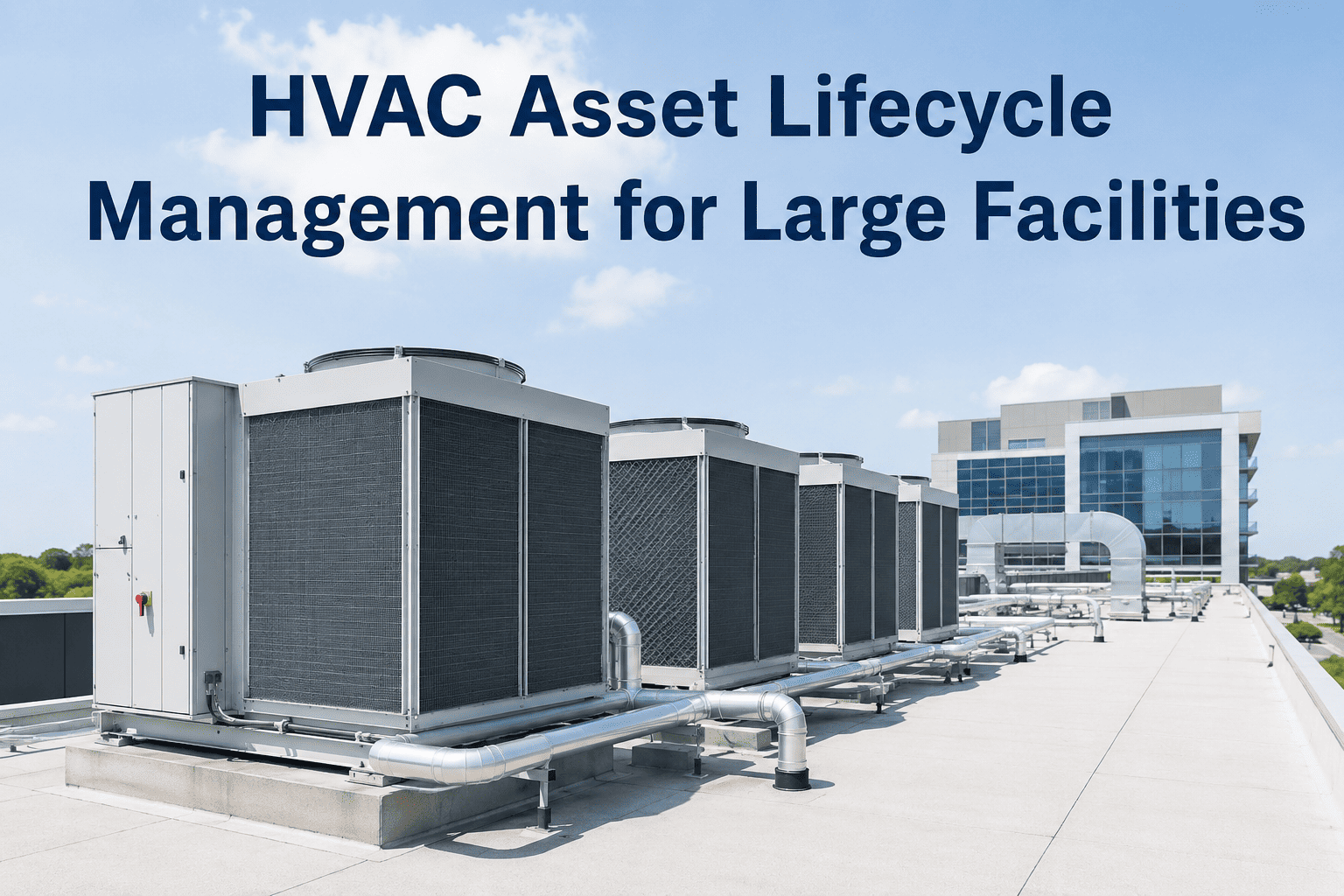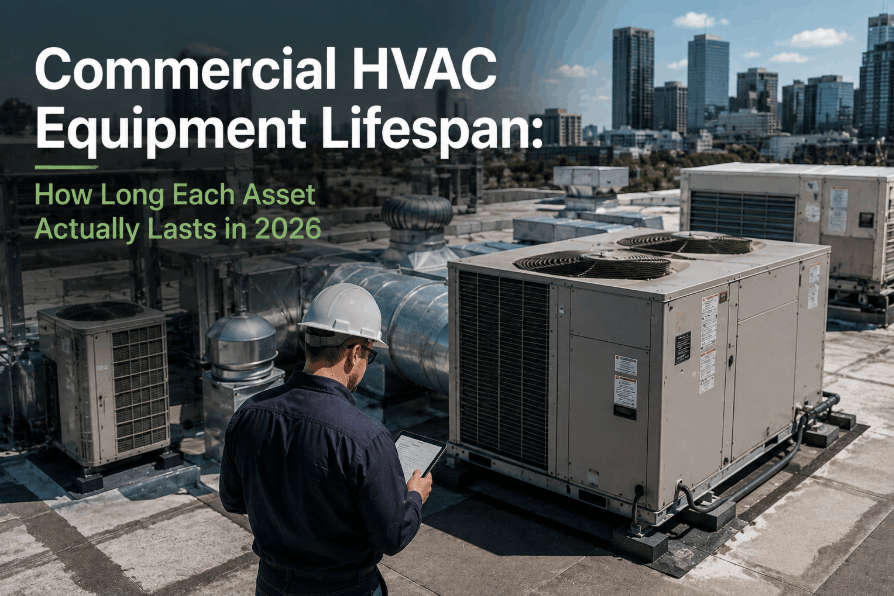
Commercial HVAC systems represent one of the largest capital investments in any facility — yet most maintenance teams manage equipment replacement reactively, budgeting for failures rather than planning around predictable service life. Understanding commercial HVAC equipment lifespan by asset type gives facility managers and operations leaders the data they need to build accurate capital plans, schedule preventive maintenance at the right intervals, and avoid emergency replacements that cost two to three times more than planned ones. Whether you manage a portfolio of office buildings, healthcare facilities, or industrial sites, the lifecycle benchmarks below give you a 2026 baseline for every major HVAC asset class. To track equipment age, maintenance history, and replacement forecasts in one place, Sign Up Free on OxMaint and connect your HVAC asset lifecycle data to your maintenance workflows from day one.
Commercial HVAC Equipment Lifespan by Asset Type: 2026 Benchmarks
ASHRAE and industry lifecycle data consistently show that HVAC equipment lifespan varies dramatically by asset class — from 15 years for packaged rooftop units under heavy use to 35 or more years for well-maintained centrifugal chillers. The table below gives you the service life range for each major commercial HVAC asset type, the maintenance factor that most directly affects that range, and the end-of-life signal that typically appears 2 to 3 years before failure. Use these benchmarks to Book a Demo and map your facility's current asset ages against replacement windows in OxMaint's capital planning module.
| HVAC Asset Type | Typical Service Life | Key Maintenance Factor | Primary End-of-Life Signal |
|---|---|---|---|
| Centrifugal Chiller | 25–35 years | Refrigerant leak management and tube cleaning frequency | Compressor efficiency drop below 85% of rated COP |
| Scroll / Screw Chiller | 20–25 years | Oil analysis interval and condenser maintenance | Recurring compressor failures and rising energy consumption |
| Packaged Rooftop Unit (RTU) | 15–20 years | Filter change compliance and coil cleaning frequency | Heat exchanger cracks and compressor short-cycling |
| Air Handling Unit (AHU) | 20–30 years | Belt and bearing replacement intervals, coil condition | Casing deterioration and fan motor failure rate increase |
| Cooling Tower | 20–30 years | Basin treatment, fill replacement, and drift eliminators | Structural basin corrosion and persistent Legionella risk |
| Hot Water Boiler (Commercial) | 25–35 years | Water treatment program and heat exchanger inspection | Flue gas combustion efficiency below 80% and recurring leaks |
| Steam Boiler | 20–30 years | Blowdown frequency and feedwater quality control | Tube failures and rising makeup water consumption |
| Fan Coil Unit (FCU) | 15–20 years | Coil cleaning and drain pan maintenance | Persistent noise, coil fouling beyond cleaning recovery |
| Variable Air Volume (VAV) Box | 20–25 years | Actuator calibration and damper linkage inspection | Actuator failure rate above 15% of installed units annually |
| Cooling Tower Fan / Motor | 10–15 years | Vibration analysis and lubrication compliance | Bearing vibration beyond 0.3 in/s and motor winding degradation |
Why Preventive Maintenance Determines Where Your HVAC Assets Land in Their Lifespan Range
The difference between 15 years and 25 years for the same RTU model is almost entirely determined by maintenance program quality. Facilities with structured preventive maintenance programs — with documented PM task completion rates above 90% — consistently see HVAC assets reach the upper bound of their service life ranges. Facilities running reactive maintenance average 30 to 40 percent shorter asset lifespans. OxMaint's HVAC maintenance module lets facility teams Sign Up Free and build PM schedules for every chiller, AHU, and RTU in their portfolio, with automatic work order generation and completion tracking that keeps assets on the right lifecycle trajectory.
Schedule annual tube bundle inspections, refrigerant log reviews, and oil analysis intervals. Track compressor efficiency readings over time to detect degradation before it accelerates.
Automate filter change, belt inspection, coil cleaning, and drain pan treatment work orders by asset tag and seasonal trigger — not calendar reminders that get missed.
Log every combustion analysis, water treatment test, and heat exchanger inspection against the specific boiler asset, building a compliance record that satisfies insurance and regulatory audits.
Track basin treatment logs, Legionella test results, and fill condition assessments in OxMaint — linked directly to the cooling tower asset record for instant lifecycle visibility.
Log fan motor vibration readings, bearing temperature trends, and oil analysis results against each HVAC asset — creating the condition data needed for predictive replacement planning.
Use asset age, maintenance cost trend, and failure frequency data in OxMaint to generate 5 and 10-year capital plans that finance teams can actually use for budget approval.
The Five Lifecycle Stages of Commercial HVAC Equipment
Equipment runs at peak efficiency with manufacturer warranty coverage active. Key task is establishing baseline performance data — energy consumption, temperature differentials, and vibration readings — that will serve as the comparison point for degradation tracking throughout the asset's life.
The lowest-cost phase of HVAC asset ownership. Preventive maintenance costs are predictable, failure rates are low, and energy efficiency remains near design specification. Facilities with structured PM programs extend this phase by 3 to 5 years compared to reactive maintenance operations.
Component wear accelerates. Compressor efficiency begins declining, seals and gaskets require more frequent replacement, and energy consumption creeps upward. This is the phase where maintenance cost trending in OxMaint first signals whether repair-or-replace analysis is approaching.
Repair costs begin exceeding 30 to 40 percent of replacement cost annually. Parts availability decreases for older equipment. Energy penalties from reduced efficiency add operating cost on top of maintenance spend. This phase requires active capital planning — not reactive response. Book a Demo to see how OxMaint generates replacement forecasts from maintenance cost and age data automatically.
The structured replacement decision compares annualized repair cost, energy penalty versus modern equipment, refrigerant compliance risk (particularly R-22 and R-123 phase-out impacts), and downtime risk. OxMaint's asset lifecycle reporting gives facilities the cost history data needed to make this decision with documentation rather than intuition.
HVAC Lifespan Performance Benchmarks for Facility Teams in 2026
When to Repair vs Replace: Decision Triggers by HVAC Asset Type
How OxMaint Supports HVAC Lifecycle Management Across Your Facility Portfolio
Managing HVAC asset lifecycle manually — through spreadsheets, paper service logs, and disconnected work order systems — creates the exact conditions that lead to unplanned failures and emergency replacement spend. OxMaint gives facility teams a single platform where every HVAC asset's age, service history, PM schedule, and repair cost trend is connected. When a chiller reaches a maintenance cost threshold that signals approaching end-of-life, OxMaint's asset health reporting surfaces that data before the next budget cycle — not after an emergency failure. Sign Up Free and connect your HVAC asset records to a maintenance and capital planning workflow that works the way your facility team actually operates.
| Lifecycle Management Challenge | OxMaint Solution | Facility Outcome |
|---|---|---|
| No visibility into asset age across portfolio | Centralized asset register with install date, warranty status, and age tracking per unit | Accurate capital replacement horizon visibility |
| PM schedules not tied to specific equipment | Asset-linked PM templates auto-generating work orders by season, runtime, or calendar trigger | Higher PM completion rates and longer asset service life |
| No repair cost history by asset | Every work order cost logged against the specific HVAC asset tag automatically | Data-driven repair-or-replace decisions with documented cost basis |
| Capital requests lack maintenance data support | Asset lifecycle reports showing cumulative repair cost vs replacement cost ratio over time | Finance-ready capital justification with maintenance cost trending |
| Condition data stored in technician notes, not systems | Structured inspection forms capturing vibration, temperature, and efficiency readings per asset | Condition-based maintenance triggers before failure occurs |