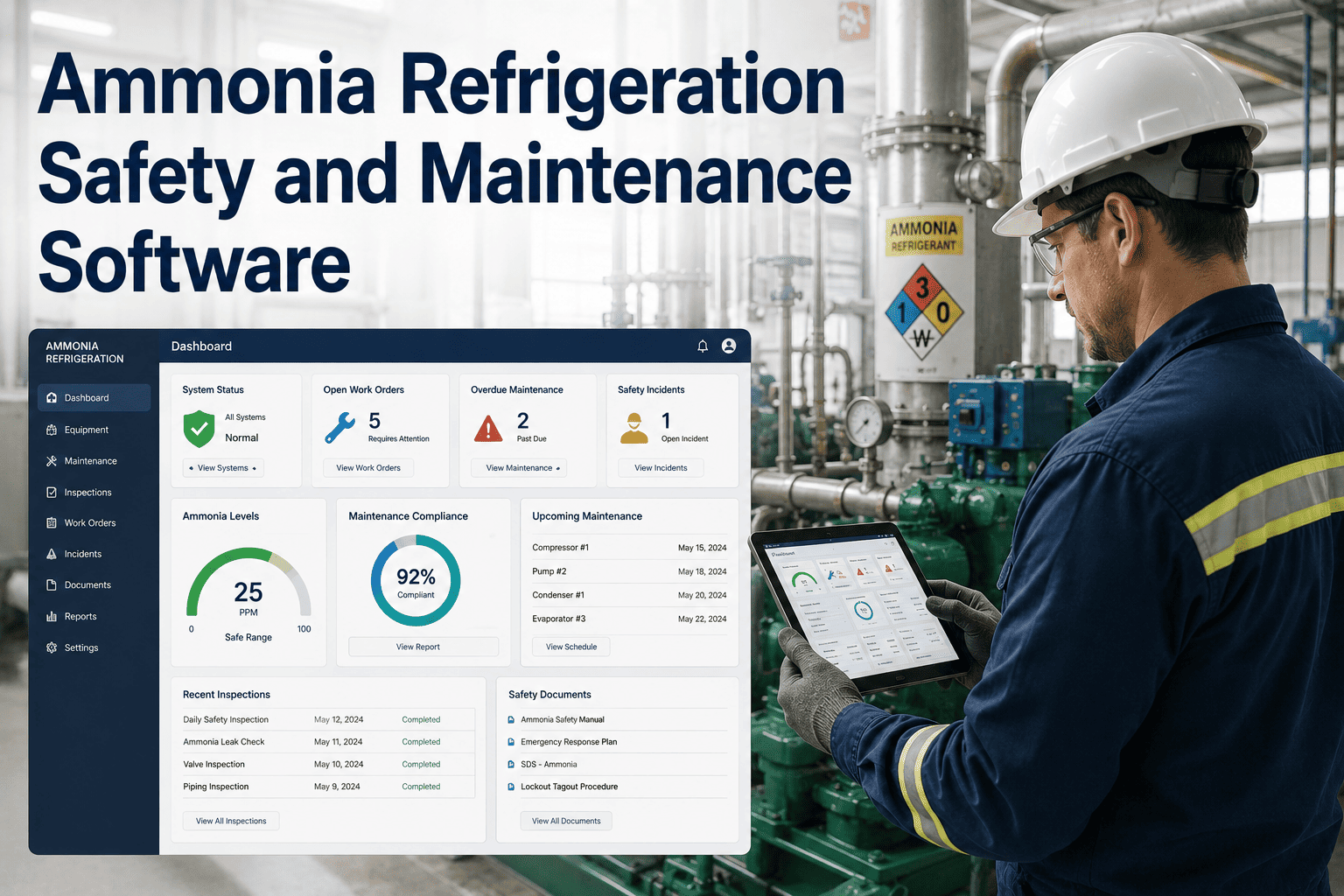
Ammonia refrigeration systems are the backbone of large-scale cold storage, food processing, and industrial cooling operations — delivering thermodynamic efficiency 20–30% superior to HFC alternatives, while simultaneously presenting the most consequential safety and compliance obligations in any refrigeration environment. Anhydrous ammonia (R-717) is acutely toxic at concentrations above 25 ppm (OSHA PEL) and flammable above 15% by volume, triggering regulatory obligations under EPA RMP (Risk Management Program), OSHA PSM (Process Safety Management), and IIAR (International Institute of Ammonia Refrigeration) standards that collectively require hundreds of documented inspection, maintenance, and safety verification records per year. Most facilities using paper-based maintenance systems are not actually non-compliant — they are non-demonstrably compliant, which in an EPA RMP audit produces the same outcome. OxMaint's Compliance Tracking module digitises every ammonia refrigeration inspection, leak check, safety device test, mechanical integrity record, and emergency procedure verification into a searchable, immutable audit trail that satisfies EPA, OSHA, and IIAR requirements simultaneously. Book a demo to see ammonia refrigeration compliance workflows live in OxMaint.
Article · Industrial Refrigeration · Ammonia Safety · Compliance Tracking
Ammonia Refrigeration Safety and Maintenance Software
Leak inspection records, mechanical integrity documentation, safety device testing, PSM/RMP compliance workflows, and contractor safety management — the complete ammonia refrigeration compliance framework for facilities subject to EPA and OSHA Process Safety Management regulations.
What This Guide Covers
01 · Regulatory Framework
02 · Leak Inspection Protocol
03 · Mechanical Integrity
04 · Safety Device Testing
05 · Live Alert Dashboard
06 · Compliance Records Table
07 · Expert Review
08 · FAQs
Regulatory Framework — EPA RMP, OSHA PSM, and IIAR Obligations
Any facility with more than 10,000 lbs (4,536 kg) of anhydrous ammonia is subject to both OSHA PSM (29 CFR 1910.119) and EPA RMP (40 CFR Part 68) — the most documentation-intensive regulatory framework in US industrial refrigeration. IIAR Bulletin 110 provides the industry-accepted mechanical integrity and inspection standards referenced by both agencies. Understanding what each framework requires from your maintenance system is the starting point for a compliant programme.
OSHA PSM
29 CFR 1910.119 — Process Safety Management
Written process safety information (P&IDs, equipment specifications)
Process hazard analysis (PHA) — revalidated every 5 years
Mechanical integrity programme with documented inspection records
Management of change (MOC) procedure for all equipment modifications
Incident investigation within 48 hours of any release event
OxMaint stores all MI records, MOC documentation, and incident reports per asset
EPA RMP
40 CFR Part 68 — Risk Management Program
RMP Plan filed with EPA — updated within 5 years or after accidental release
Prevention Programme: same elements as OSHA PSM for Program 3
Emergency response programme with documented drills and coordination records
Compliance audit every 3 years — findings and corrective actions documented
5-year accident history reported — any release above threshold
OxMaint generates 5-year accident history and audit finding records automatically
IIAR
IIAR Bulletin 110 / IIAR 6 — Inspection & Testing
Annual inspection of all pressure vessels per NBIC (National Board) requirements
Pressure relief valve testing every 5 years (or annually if subject to wet seat)
Level control and safety device verification — minimum quarterly
Compressor oil analysis at manufacturer-specified intervals
Vibration analysis on rotating equipment per IIAR 6 Table
OxMaint auto-schedules all IIAR 6 inspection intervals per equipment type
Live Ammonia Safety Monitor — OxMaint Compliance Dashboard
Simulated · Real-time sensor + permit integration
Engine Room NH3
2 ppm
TLV: 25 ppm · Safe
Condenser Deck NH3
4 ppm
TLV: 25 ppm · Normal
MI Records Overdue
2
PRV test — Vessel V-04
Open Safety WOs
4
1 critical · 3 routine
PSM Compliance Score
94%
Audit-ready status
Next Scheduled Drill
14 days
Emergency response drill
P1 — SAFETY
High-Stage Compressor CS-02 · Engine Room
Oil pressure differential below IIAR 6 threshold — 28 kPa (minimum: 35 kPa). Compressor auto-tripped on oil safety switch. WO #8841 created. Root cause: oil pump wear or oil contamination. Oil sample collection WO dispatched.
22 min ago · Safety Control System + OxMaint
COMPLIANCE DUE
Pressure Relief Valve PRV-04 · Vessel V-04
IIAR 6 PRV test due date exceeded by 8 days. PSM Mechanical Integrity record open. Certified contractor scheduled for next Tuesday. EPA RMP compliance gap flag active until test completion and record archived in OxMaint.
Overdue 8 days · IIAR 6 / 40 CFR 68 compliance gate
RESOLVED
Leak Inspection — Condenser Deck
Quarterly leak check completed. 0 points above 10 ppm. Electronic detector sweep + soap bubble test on all joints. 28 test points recorded. Certificate generated. PSM MI record closed WO #8829. Next inspection due: 91 days.
Yesterday · MI Record archived
Ammonia Leak Inspection Protocol and Documentation
OSHA PSM 1910.119(j)(4) requires that inspections and tests be performed on process equipment in accordance with recognised and generally accepted good engineering practices (RAGAGEP) — for ammonia refrigeration, this means IIAR Bulletin 110 and IIAR 6. Leak inspections are both a safety requirement and a maintenance signal: a joint or valve packing showing 50–100 ppm in a quarterly check that showed 0 ppm in the prior quarter indicates a developing seal failure that should generate a maintenance work order, not just a log entry.
Daily Visual Inspection
ScopeEngine room walk-through — visual oil staining, frost patterns, ammonia odour assessment
NH3 monitor checkFixed detector readings confirmed <25 ppm in all zones
Compressor observationOil pressure, suction/discharge pressure, vibration — normal operating range
OxMaint recordMobile daily checklist — auto-time-stamped, mandatory sign-off
Quarterly Leak Detection Survey
InstrumentElectronic detector calibrated to NIOSH method (detection limit <1 ppm)
Test pointsAll flanged joints, valve packings, relief valve inlets, gauge connections, compressor seals
Action threshold>10 ppm at any point = corrective action work order same day
OxMaint recordPoint-by-point readings per test point ID — PSM MI record generated
Annual Pressure Vessel Inspection
StandardNBIC (National Board Inspection Code) — by certified inspector (NBI-commissioned)
ScopeExternal visual, thickness measurement, weld examination, nozzle condition, nameplate verification
Record requiredNBI inspection form R-1 or equivalent — retained for life of vessel
OxMaint recordInspection certificate attached to vessel asset record — expiry alert auto-set
Mechanical Integrity — OSHA PSM 1910.119(j) Requirements
OSHA PSM's Mechanical Integrity element requires facilities to establish and implement written procedures to maintain the ongoing integrity of process equipment — including compressors, vessels, piping, relief devices, emergency shutdown systems, and controls. Deficiencies found during inspection must be corrected before further use, or documented with a safe operating plan if correction cannot be immediate. The documentation trail that satisfies this requirement must cover every inspection, every deficiency found, every corrective action taken, and the verification that the correction was effective.
| Equipment Category |
IIAR 6 Inspection Frequency |
Required MI Record Content |
Retention Period |
OxMaint Automation |
| Pressure vessels (receivers, accumulators) |
Annual external visual + thickness survey |
Inspector ID, NBI cert number, findings, thickness readings, next due date |
Life of equipment |
Annual WO auto-scheduled — certificate stored per vessel |
| Pressure relief valves (PRVs) |
Test every 5 years (1 year if wet-seated) |
Set pressure, actual pop pressure, tested by, calibration cert, pass/fail |
Life of equipment |
5-year WO scheduled per PRV — compliance gap alert if overdue |
| Compressors (reciprocating/screw) |
Oil analysis semi-annual · Vibration quarterly · Overhaul per OEM hours |
Oil analysis report, vibration readings, overhaul scope, parts replaced, run hours |
Life of equipment |
Hour-meter triggered WOs — oil analysis results attached per record |
| Refrigerant piping (above OSHA threshold) |
Annual visual + ultrasonic thickness (corrosion-susceptible sections) |
Pipe section ID, wall thickness readings, corrosion assessment, inspector sign-off |
Life of system + 5 years |
Piping segment assets — inspection WO per segment with thickness log |
| Emergency shutdown system (ESD) |
Functional test quarterly — full trip test annually |
Test scenario, actuation confirmation, response time, restoring actions, tester ID |
3 years minimum |
Quarterly and annual ESD test WOs — pass/fail mandatory gate |
| NH3 detection system (fixed) |
Calibration every 6 months with certified reference gas |
Detector ID, calibration gas concentration, as-found/as-left readings, certificate |
3 years |
Semi-annual calibration WO — reference gas cert attached |
COMPLIANCE TRACKING
Every PSM Record. Every IIAR Inspection. Audit-Ready in Minutes.
OxMaint auto-schedules every IIAR 6 inspection interval per equipment type, stores every MI record against the asset that generated it, and flags compliance gaps before an auditor does. EPA RMP and OSHA PSM documentation that previously required days to compile is a dashboard export in OxMaint.
Before vs After — Ammonia Refrigeration Compliance Programme
A 240,000 sq ft cold storage and food processing facility in the US Midwest with 48,000 lbs anhydrous ammonia charge subject to both OSHA PSM and EPA RMP implemented OxMaint Compliance Tracking across its entire ammonia refrigeration system. Results at 18 months post-deployment versus the paper-based baseline.
Before OxMaint
MI records current and accessible41% of required records
Overdue inspection items23 items at any given time
Compliance audit prep time4–6 days manual
PSM compliance score (audit)67/100 — two significant findings
Leak check documentation rate74% of required inspections documented
After OxMaint
MI records current and accessible98% — automated scheduling
Overdue inspection items0–2 at any given time
Compliance audit prep timeUnder 2 hours — dashboard export
PSM compliance score (audit)96/100 — zero significant findings
Leak check documentation rate100% — mobile mandatory workflow
Expert Review
RB
Robert Ballantyne
Certified Ammonia Refrigeration Operator (CARO) · 28 years · IIAR Member · Texas A&M, Mechanical Engineering · PSM/RMP Compliance Consultant, North American Cold Storage Industry
The most common PSM finding I see during compliance audits of ammonia refrigeration facilities is not a missing procedure or a failed safety device — it is a gap in the mechanical integrity record that nobody knew existed until the auditor asked for the PRV test certificate on a specific vessel. In paper-based systems, a record that was completed but misfiled is functionally identical to a record that was never created: neither satisfies the auditor's request. Digital compliance systems like OxMaint solve this specifically because the record cannot be detached from the asset. When the auditor asks for the PRV test history on Vessel V-04, the answer is two clicks away — the certificate, the tester's credentials, the set pressure confirmation, and the next due date are all attached to V-04's asset record. The second most common finding — overdue inspection items — is structurally prevented by automated scheduling and compliance gap alerts that fire before the due date passes, not after.
Frequently Asked Questions
Which ammonia refrigeration facilities are subject to OSHA PSM and EPA RMP requirements?
OSHA PSM (29 CFR 1910.119) applies to any facility with 10,000 lbs or more of anhydrous ammonia in a process above atmospheric pressure. EPA RMP (40 CFR Part 68) applies to the same threshold — 10,000 lbs in a process. Both thresholds apply to the quantity present in a connected process system, not to the total facility inventory. Most cold storage facilities operating systems with multiple receivers, evaporators, and compressors exceed the threshold in the evaporator and high-side receiver inventory alone. The practical test is the P&ID: if any single connected system boundary contains 10,000 lbs or more, PSM and RMP both apply.
OxMaint's asset registry stores refrigerant charge quantities per system boundary to support threshold determination and RMP Plan documentation.
How frequently does OSHA PSM require ammonia leak inspections under the Mechanical Integrity element?
OSHA PSM 1910.119(j)(4) requires inspections and tests in accordance with RAGAGEP — for ammonia refrigeration, the applicable standard is IIAR 6-2019. IIAR 6 Table 1 specifies leak inspection frequency by system component: electronic detector surveys at all accessible joints and valve packings are required at least quarterly, with visual inspection for oil staining, frost patterns, and physical damage performed daily by the operator. Any detection reading above 10 ppm at a test point requires a corrective action work order and follow-up retest after repair. OxMaint auto-schedules quarterly leak inspection work orders per system section and enforces the point-by-point documentation requirement as a mandatory workflow field.
Book a demo to see the IIAR 6 inspection workflow in OxMaint.
What is the required frequency for pressure relief valve testing on ammonia vessels?
IIAR Bulletin 110 and IIAR 6 require pressure relief valves on ammonia vessels to be tested or replaced every 5 years under normal conditions. However, if a PRV has experienced a wet seat — any event where liquid ammonia has been present at the relief valve inlet, such as an overfill event or inverted vessel orientation — the interval is reduced to annual testing. The PRV test must be performed at a certified testing facility or by a qualified technician, with the set pressure, actual pop pressure, and reseat pressure all documented against the specific valve serial number. OxMaint tracks the wet-seat history of each PRV from maintenance records and automatically adjusts the scheduled test interval from 5-year to annual for any valve with a documented wet-seat event.
Explore PRV asset tracking in OxMaint.
How does OxMaint support EPA RMP compliance audits for ammonia refrigeration facilities?
EPA RMP compliance audits (required every 3 years per 40 CFR 68.79) examine the Prevention Programme documentation, which for Program 3 facilities mirrors OSHA PSM requirements: mechanical integrity records, management of change documentation, incident investigation reports, employee training records, and emergency response drill documentation. OxMaint stores all of these records in a searchable database linked to the relevant process assets — generating RMP compliance audit packages covering any specified time period in under 2 hours, versus the 4–6 day manual compilation process most facilities without CMMS support endure.
Book a 30-minute demo to see the RMP compliance export workflow.
OXMAINT COMPLIANCE TRACKING · AMMONIA REFRIGERATION
Every Leak Check. Every PRV Record. Every MI Document. One Audit Trail.
OxMaint digitises your entire ammonia refrigeration compliance programme — IIAR 6 inspection schedules, mechanical integrity records, leak detection surveys, PSM/RMP documentation, and contractor safety management — into a searchable audit trail that satisfies EPA and OSHA requirements on demand. Most ammonia facilities are live in under one week.