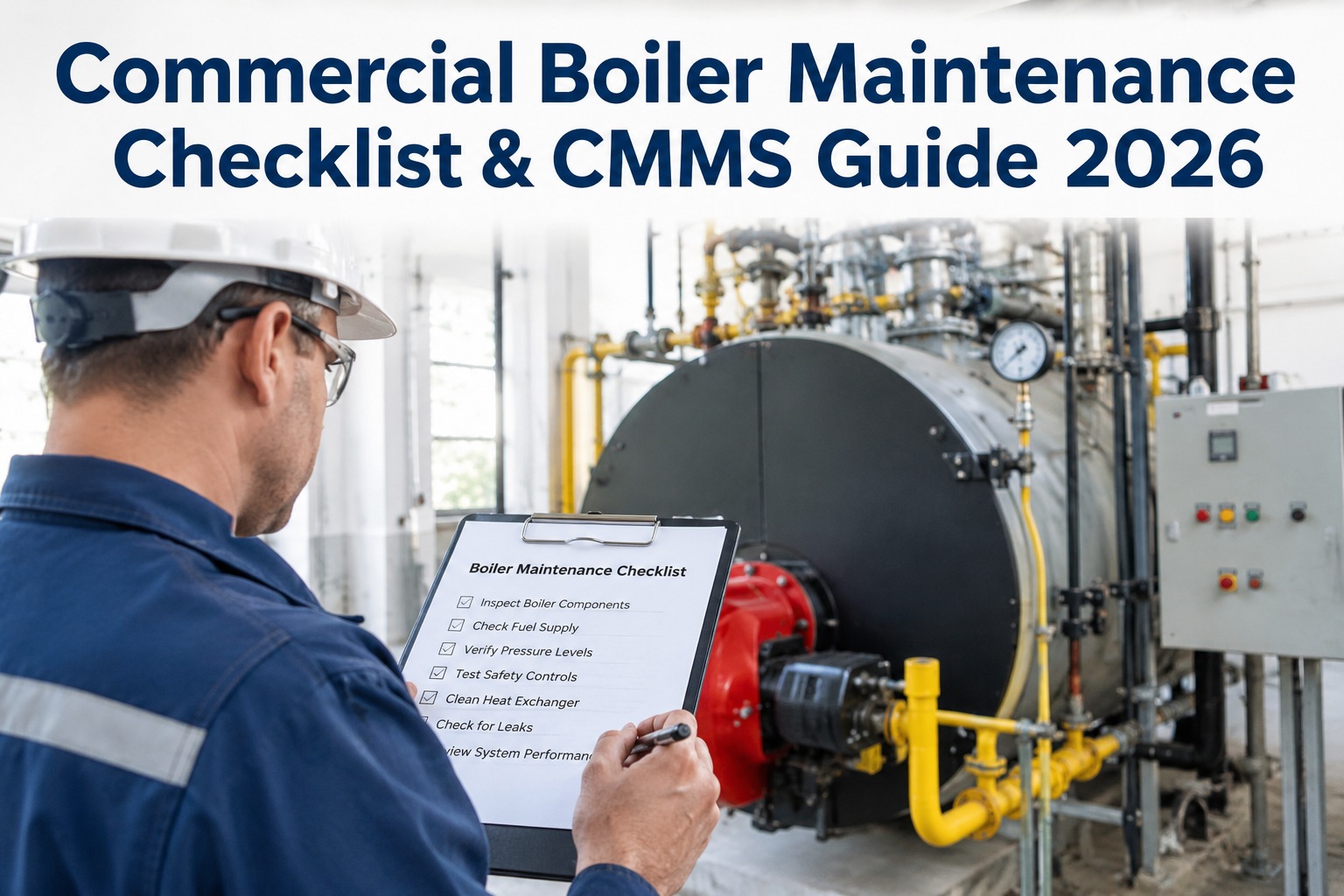
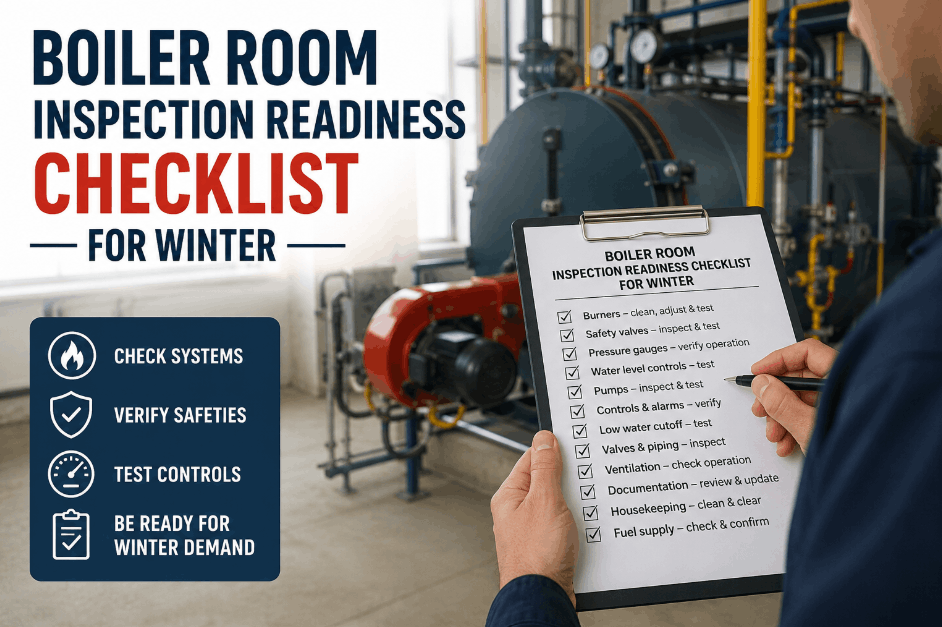
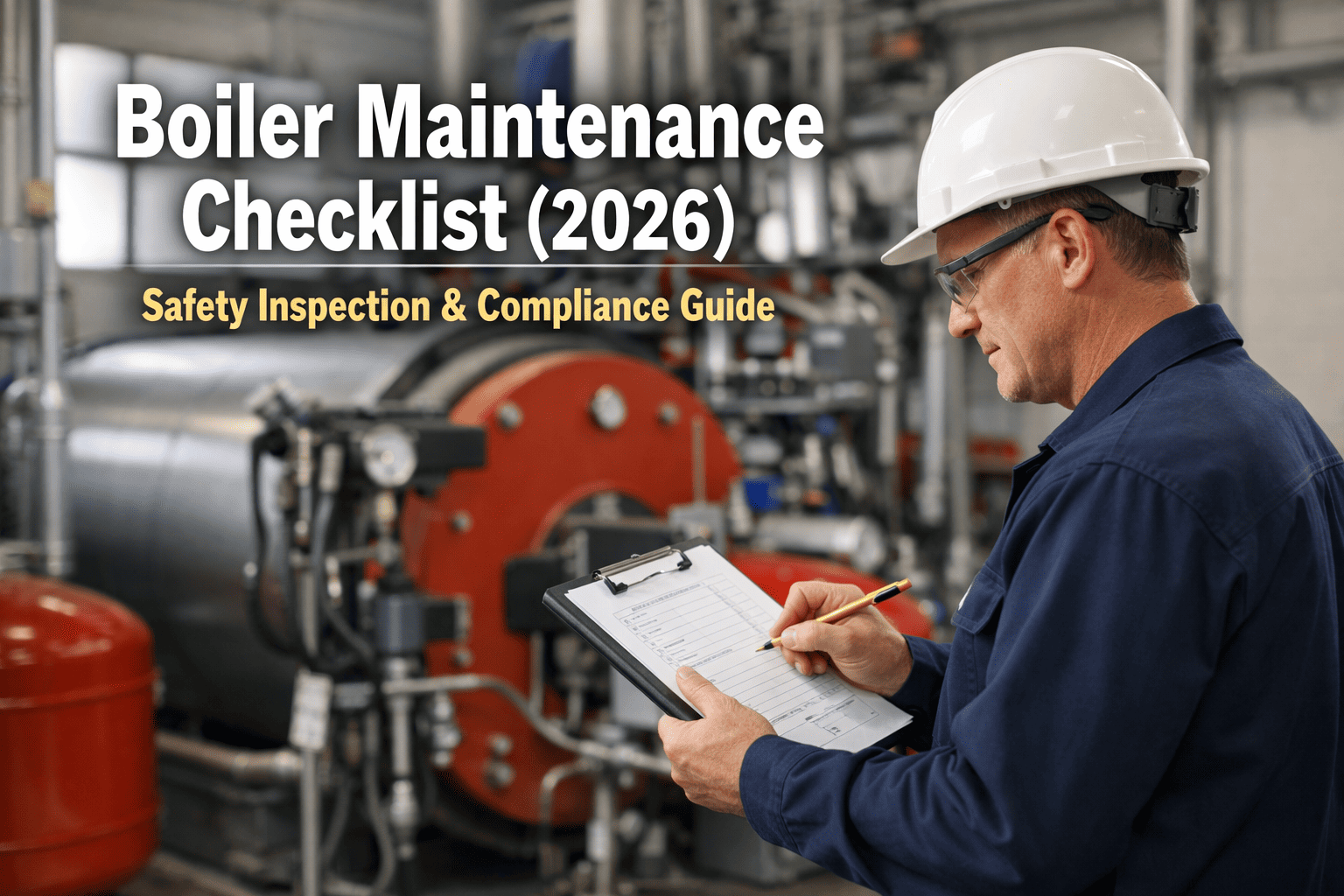
Boiler Maintenance Checklist: Safety Inspections and Preventive Tasks for Commercial Heating
By oxmaint on March 12, 2026
A boiler failure in a commercial or industrial facility is never just an inconvenience — it's a safety event, a compliance risk, and a costly operational disruption all at once. Boilers operate under high pressure and extreme temperatures, meaning the margin for error is essentially zero. Facilities that run structured preventive maintenance programs catch corroding tubes, fouled burners, and drifting safety controls weeks before they become headline incidents. This complete boiler maintenance checklist covers every critical area — from safety valve testing and combustion analysis to water treatment and refractory inspection — built specifically for commercial and industrial heating systems. Sign up on OxMaint to digitize and track every boiler PM task with automated work orders and compliance-ready records.
Commercial and industrial boilers are subject to strict regulatory oversight from jurisdictions including ASME, OSHA, and local boiler inspection authorities. An unmaintained boiler doesn't just risk equipment damage — it risks personnel safety, facility shutdowns, and voided insurance coverage. Studies show that over 70% of boiler failures are attributable to deferred maintenance and neglected water treatment. Book a demo to see how OxMaint helps facility teams stay ahead of every boiler compliance requirement with automated PM scheduling and real-time dashboards.
70%
Boiler failures caused by deferred maintenance
5×
Higher repair cost vs. scheduled PM
30%
Efficiency loss from scale buildup on tubes
25yr
Avg boiler lifespan with proper PM program
01
Safety Valve and Pressure Control Inspection
Annual + After Any Pressure Event
02
Combustion Analysis and Burner Inspection
Semi-Annual + Seasonal Startup
03
Flame Safeguard and Control System Verification
Annual + Per Manufacturer Schedule
Track Every Boiler Safety Task — Automatically
OxMaint auto-generates boiler PM work orders by frequency and season, assigns them to certified technicians, and keeps time-stamped records for every inspection — ready for your next regulatory audit.
Commercial boiler operations are governed by a layered framework of standards. Sign up for OxMaint to map your PM tasks directly against these standards and generate audit-ready compliance reports on demand.
ASME Section I & VIII
Power boiler design, construction, and pressure vessel code — governs safety valve ratings and MAWP
NFPA 85
Boiler and combustion systems hazards code — covers flame safeguard, burner management, and interlock requirements
OSHA 29 CFR 1910
General industry standards applicable to boiler room safety, lockout/tagout, and PPE requirements
National Board Inspection Code
Governs inservice inspection, repair, and alteration of pressure-retaining equipment across jurisdictions
Boiler PM Frequency Quick Reference
Use this schedule as your baseline. High-pressure steam systems and critical process boilers may require more frequent intervals. Book a demo to see how OxMaint auto-assigns work orders based on your specific boiler type and jurisdiction.
PM Task
Monthly
Quarterly
Semi-Annual
Annual
Safety Valve Lever Test
Water Treatment Testing
Low-Water Cutoff Flush
Bottom Blowdown
Combustion Analysis
Burner Cleaning
Flame Safeguard Test
Tube and Shell Inspection
Refractory Inspection
Safety Valve Replacement
Why Facilities Switch from Logbooks to Digital Boiler PM
Paper boiler logs and spreadsheet-based PM tracking create invisible compliance gaps. Entries get skipped, logbooks go missing, and jurisdictional inspectors find records that don't hold up. Sign up for OxMaint and replace manual logbooks with digital checklists that capture readings, photos, and technician signatures in one tamper-proof system.
Jurisdiction-Ready Records
Every boiler PM is timestamped and stored — exportable as a full inspection history report for state or local boiler inspectors.
Automated Work Order Triggers
Set PM frequencies once per boiler asset. OxMaint auto-generates monthly, quarterly, and annual work orders without manual scheduling.
Reading Capture with Limits
Technicians enter pressure, temperature, CO, and pH readings directly in the app — with alerts when readings fall outside acceptable ranges.
Run a Safer, More Compliant Boiler Program
From monthly safety valve tests to annual tube inspections, OxMaint keeps every task on schedule, every record audit-ready, and every technician accountable.
How often should a commercial boiler receive a full safety inspection
Most jurisdictions require a formal external inspection annually and an internal inspection every one to two years for steam boilers operating above 15 psi. Hot water heating boilers typically require annual inspection. These intervals represent regulatory minimums — high-usage systems and older units often benefit from more frequent PM visits between official inspections.
What is the most dangerous boiler maintenance failure and how is it prevented
Low-water condition is consistently cited as the leading cause of catastrophic boiler failure. When water level drops below the safe operating level and the burner continues to fire, the heat exchanger overheats and can rupture under pressure. Monthly low-water cutoff testing combined with continuous water level monitoring through a CMMS like OxMaint is the most effective prevention approach.
What does combustion analysis measure and why does it matter for boiler maintenance
Combustion analysis measures the composition of flue gases — primarily oxygen, carbon dioxide, carbon monoxide, and stack temperature — to calculate combustion efficiency and identify unsafe conditions. A high CO reading, for example, indicates incomplete combustion that poses both an efficiency loss and a carbon monoxide poisoning risk. Regular combustion analysis also identifies when burner tuning is needed before efficiency losses become significant on the utility bill.
What boiler water treatment parameters should be tested monthly
For steam boilers, monthly water testing should cover pH (target 10.5–12.0), total dissolved solids or conductivity, hardness, alkalinity, and chemical inhibitor residuals such as oxygen scavenger and scale inhibitor. Hot water boilers require pH (target 8.5–10.5), hardness, and inhibitor testing. Results should be logged and trended — a drift in any parameter over consecutive months is an early warning of system changes requiring attention.
When should boiler refractory be replaced rather than repaired
Refractory patching is appropriate for isolated surface cracks less than 1/4 inch wide that have not penetrated through the full lining thickness. Full replacement is necessary when cracking is widespread across more than 20% of the lining, when the refractory shows signs of spalling or crumbling, when hot spots appear on the outer casing indicating loss of insulation value, or when the burner block shows erosion that affects flame geometry and combustion stability.
Can OxMaint store boiler inspection records for regulatory audits
Yes. OxMaint stores all PM work orders, checklist completions, technician signatures, and uploaded photos in a permanent, timestamped record tied to each boiler asset. When a jurisdictional inspector requests maintenance records, facilities can export a complete inspection history for any asset and any date range in minutes — eliminating the logbook hunting that has historically caught maintenance teams off guard during surprise inspections.