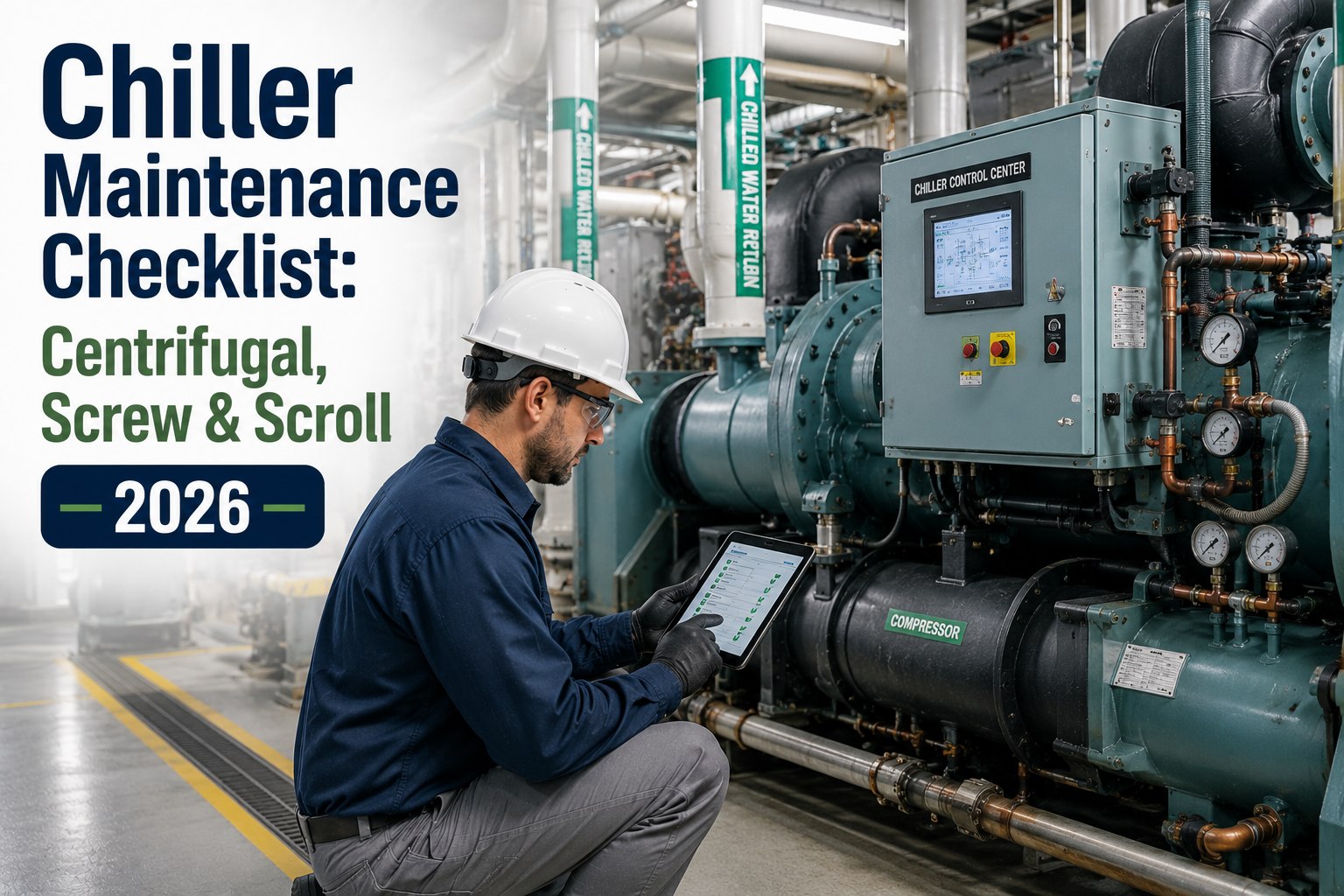
Centrifugal, screw, and scroll chillers together account for a disproportionate share of commercial HVAC energy spend — often 35–55% of a building's electrical load — which makes a disciplined chiller maintenance checklist one of the highest-leverage programs a facility team can run. This guide breaks the work into chiller-type-specific tasks across daily, weekly, monthly, quarterly, and annual intervals, with real performance thresholds (approach temperature, oil pressure, refrigerant charge, vibration) so technicians know exactly when a reading drifts from healthy to actionable. A 500-ton centrifugal machine left with a 3°F approach penalty can quietly burn $9,000–$14,000 per year in extra compressor kWh; the checklists below are designed to catch that drift weeks before it shows up on the utility bill. Teams that operationalize this through a CMMS see 8–18% lower annual chiller energy intensity and 30% fewer unplanned shutdowns within the first cooling season. Ready to digitize the entire program? Start Free Trial and roll it out to your technicians this week.
The one checklist your chiller room has been missing.
Daily, weekly, monthly, quarterly, and annual tasks — tuned for centrifugal, screw, and scroll machines — with the exact thresholds that separate a healthy chiller from a $12,000/year energy drift.
Centrifugal, screw, and scroll machines fail differently — PM them differently.
ASHRAE Guideline 36 and most OEM service manuals describe very different wear signatures across the three compressor architectures. Treating them as one generic "chiller" is the most common reason PM programs underperform.
A 180-asset pharmaceutical plant in the Carolinas was running three 350-ton centrifugal chillers on a generic quarterly PM schedule. Approach temperatures had drifted from 1.8°F to 4.6°F on two machines across a single summer — undetected because readings lived in a paper logbook. Energy billing showed a $41,800 spike versus the prior season. After moving to the type-specific daily/weekly thresholds below inside a CMMS, the team caught the next drift at 2.4°F and recovered full efficiency within one tube-cleaning cycle. Net payback on the CMMS investment: under 90 days.
The short-cycle checks that catch 70% of drift early.
Roughly seven in ten chiller efficiency losses are detectable from a two-minute walkaround and a log entry. These tasks apply to every compressor type and should never be skipped during the cooling season.
- Log leaving chilled-water temperature vs setpoint (±2°F)
- Record condenser entering/leaving water ΔT
- Listen for surge, knock, or abnormal bearing whine
- Inspect for oil seepage at compressor seals
- Confirm no active alarms on the chiller panel
- Calculate condenser approach (refrigerant sat temp − leaving CW temp)
- Flag if approach rises > 1°F above the machine's clean baseline
- Record kW/ton from the panel or BAS trend
- Compare to the OEM performance curve at current load
- Enter the reading into the CMMS trend — not a paper log
- Check refrigerant level/sight glass; log if low
- Sample compressor oil — color, clarity, moisture indicator
- Verify oil heater energized when compressor off (prevents refrigerant migration)
- Inspect cooling-tower water treatment logs (scale drives condenser fouling)
- Confirm glycol concentration still matches the original charge (process loops)
- Inspect chilled/condenser pump seals for weep
- Verify 2-way and 3-way valves stroking fully
- Clean tower strainers — pressure drop drives the whole loop
- Check VFD status and fault history on pump/tower motors
- Walk the chiller room for humidity/condensation on the machine shell
Where centrifugal, screw, and scroll PM diverge.
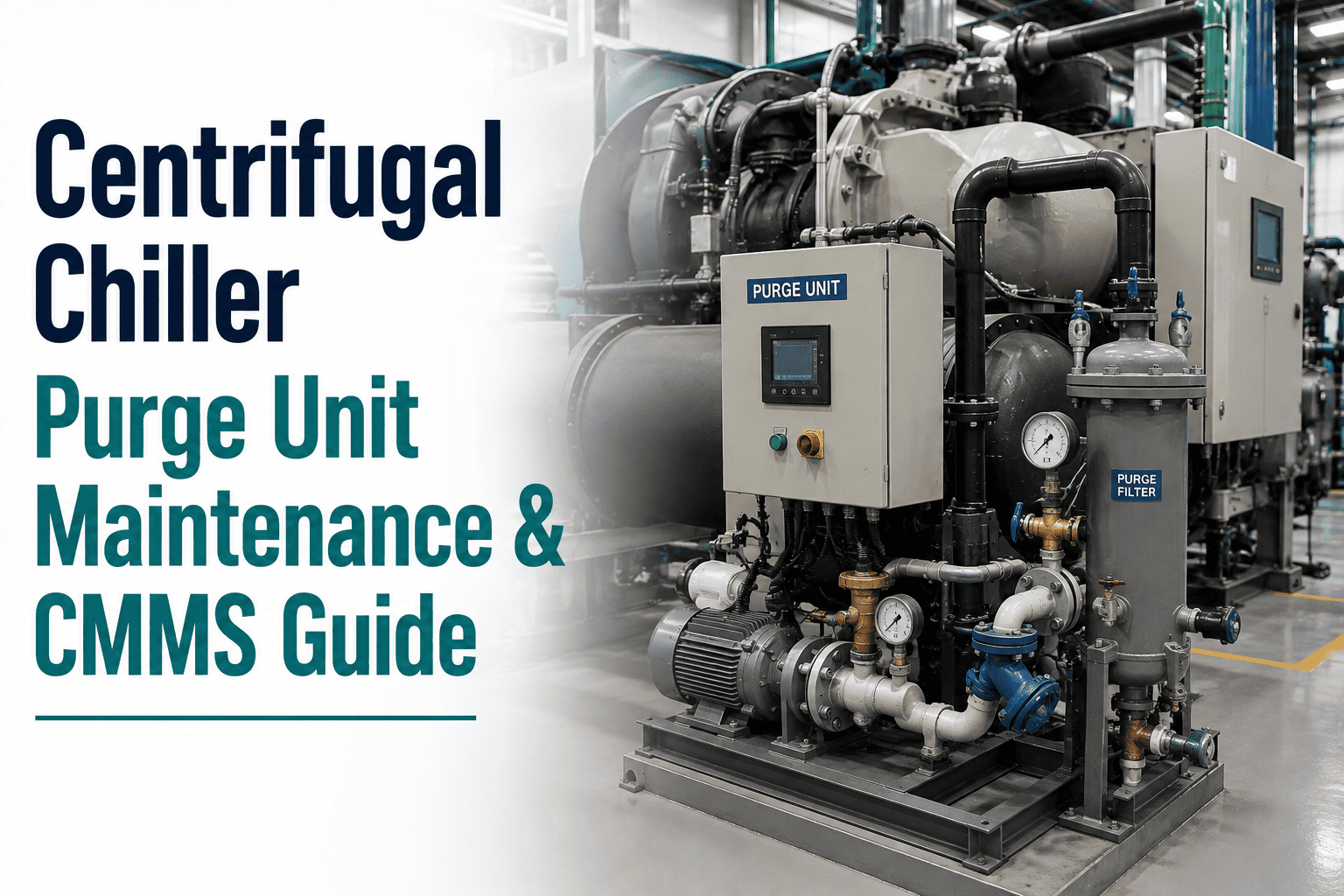
Below the short-cycle checks, each architecture has its own wear priorities. Centrifugal machines are dominated by bearings and surge control; screw machines by oil systems and slide valves; scroll machines by refrigerant tightness and electrical integrity.
- Trend compressor vibration at front & rear bearing housing (mil/ips)
- Inspect surge control line and modulating inlet guide vanes
- Verify oil return temperature within OEM band (≈120–140°F)
- Megohm test motor windings (PI > 2.0, IR > 100 MΩ)
- Calibrate refrigerant & oil pressure transducers
- Trend capacity control — confirm full stroke 25%↔100%
- Pull oil sample for lab analysis (metals, viscosity, moisture)
- Verify oil pressure differential across compressor (OEM spec, usually 40–75 psid)
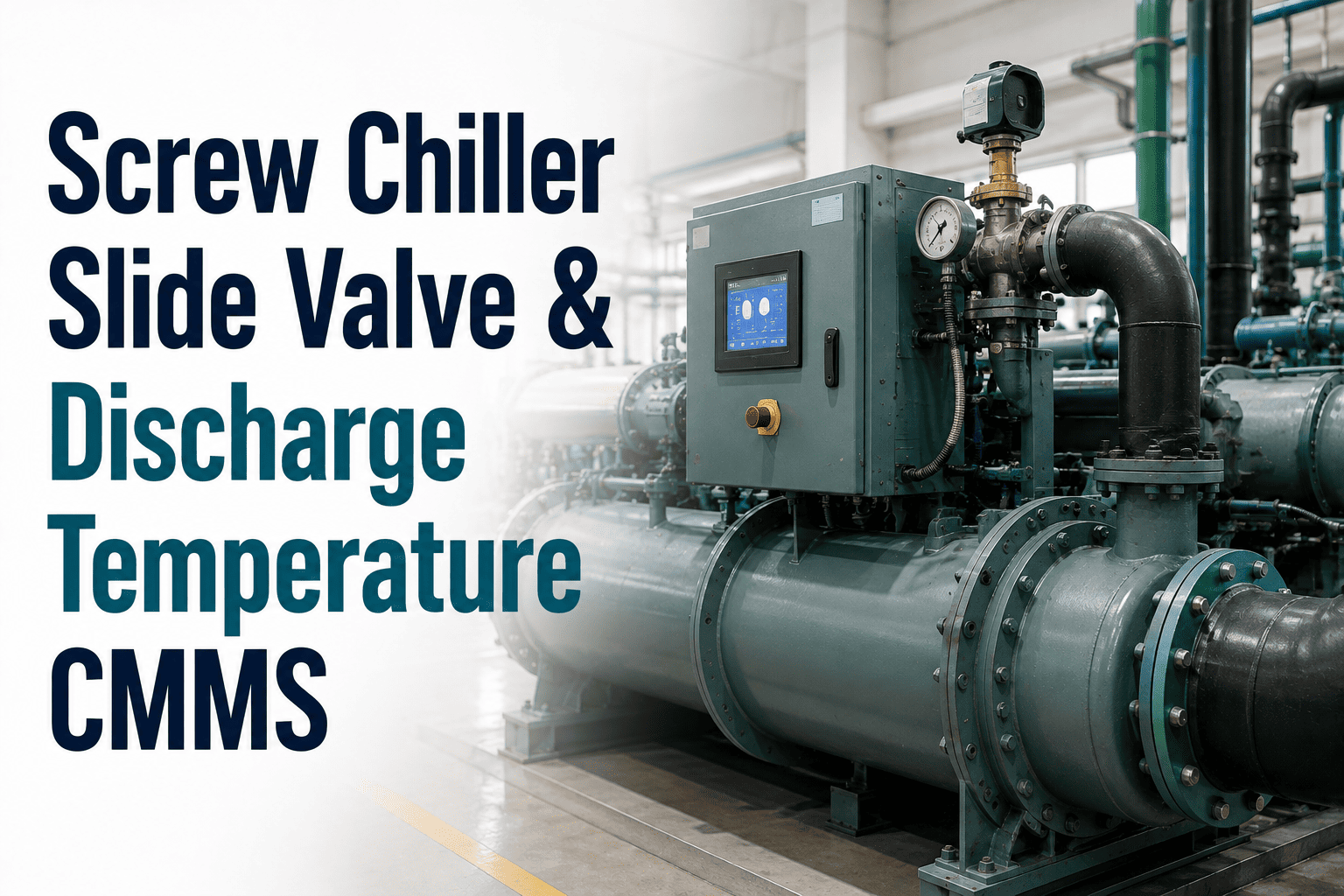
- Inspect capacity slide-valve position feedback
- Check suction/discharge pressures vs saturated conditions
- Inspect oil cooler / heat exchanger for fouling
- Test solenoid valves on capacity & economizer circuits
- Megohm test motor; trend bearing temperature
- Verify check valves seal under reverse-flow conditions
- Inspect for refrigerant leaks at brazed joints & service valves
- Verify superheat at the expansion device (typically 8–12°F)
- Confirm compressor sound profile — new buzzing = bearing wear
- Clean condenser coil fins on air-cooled scroll units
- Inspect contactors and compressor terminal box for pitting
- Trend run-hours across lead/lag/standby rotation
- Check crankcase heater continuity when off-cycle
The annual that pays for itself in one tube cleaning.
Annual work is where the biggest recoverable dollars hide. ASHRAE's own data places a 1°F condenser approach penalty at roughly 3% added compressor energy; on a 500-ton machine that is $4,000–$7,000 per year per chiller. Use these thresholds to decide what passes, what gets cleaned, and what triggers an OEM call.
| Threshold | Healthy | Watch | Action required |
|---|---|---|---|
| Condenser approach temperature | 0.5–2.0°F | 2.1–3.0°F | Brush & chemically clean tubes; re-test |
| Chilled-water approach | 0.5–2.5°F | 2.6–3.5°F | Inspect evaporator / water treatment |
| Oil pressure differential (screw/centrifugal) | Within OEM band | ±10% of spec | Replace filter; inspect oil pump |
| Compressor vibration (centrifugal) | < 0.1 ips | 0.1–0.2 ips | Vibration analysis; bearing inspection |
| Motor insulation resistance | > 100 MΩ | 50–100 MΩ | Dry motor; re-test; plan rewind if persistent |
| Refrigerant moisture (color indicator) | Green / dry | Yellow / trace | Replace filter-drier; recharge if wet |
| kW/ton vs OEM curve at current load | Within 5% | 5–10% over | Full performance test; investigate surge/fouling |
LOTO the chiller per NFPA 70E. Recover refrigerant to storage, drain oil, and isolate water sides with blinds.
Inspect waterboxes, brush condenser and evaporator tubes, chemically flush as needed. Re-test approach after restart.
Oil filter, refrigerant filter-drier, shaft seal (if due), and contactors. Pull oil sample for lab analysis on large machines.
Recharge, verify leak-tight, run performance test at three load points, and write the new approach baseline into the CMMS.
Turn a paper logbook into a self-running PM program.
A checklist on a clipboard catches less than half of the drifts a CMMS will, because the value is in the trend — not the single reading. The right tool auto-schedules every task above, escalates out-of-band readings, and gives the chief engineer a single dashboard across every chiller in the portfolio.
Every daily, weekly, monthly, quarterly, and annual task above is generated automatically per chiller type — no technician has to remember the cadence.
Approach, oil pressure, vibration, and megohm readings trigger automatic work orders the moment they cross from "watch" into "action required."
One screen shows every chiller's current kW/ton, next-due PM, and outstanding anomalies — across one site or one hundred.
Every reading, work order, and signature is timestamped and searchable — built for ISO 55000, ASHRAE 90.1, and internal energy audits.
Stop logging chiller readings on paper.
Spin up the full centrifugal, screw, and scroll PM program in OxMaint in under an afternoon — thresholds, alerts, and dashboards pre-configured.
Answers to the questions chiller owners ask most.
Five things facility and energy managers consistently want clarified before they standardize a chiller PM program across their portfolio.
Daily walkarounds and approach logging apply to every chiller during the cooling season. Centrifugal machines add monthly vibration trending and quarterly megohm testing because bearing and motor failures dominate. Screw machines add weekly oil-pressure checks and quarterly slide-valve inspection. Scroll units need monthly leak inspection and quarterly coil/contactors work — they run unattended far longer than people assume.
Condenser approach temperature — the gap between refrigerant saturated temperature and leaving condenser-water temperature. A clean machine runs at 0.5–2.0°F; each 1°F above baseline typically costs about 3% in compressor energy. Trended daily, it surfaces fouling, tube scaling, and water-treatment problems weeks before the utility bill does. You can set this up as an auto-trend in OxMaint — Start Free Trial and the threshold alerts are pre-built.
The compressor-type tasks stay the same, but the heat-rejection side differs. Water-cooled machines add tower water treatment, strainer cleaning, and condenser tube brushing. Air-cooled machines add fin cleaning, fan motor inspection, and coil face airflow verification. Both still trend approach — water-cooled against condenser water, air-cooled against ambient dry-bulb.
Industry data from ASHRAE and major OEM service programs places a typical under-maintained chiller at 8–18% above its clean kW/ton curve. On a 500-ton centrifugal running 3,500 equivalent full-load hours at $0.11/kWh, that is $18,000–$40,000 per machine per year — usually recovered within one annual tube cleaning and a recalibrated controls sequence.
Yes — typically in the first cooling season. A single avoided approach drift on one large centrifugal can cover a year of CMMS licensing. Want a walkthrough of how the thresholds, alerts, and dashboards map to your plant? Book a Demo and we'll build it live with your chiller list.
Run the checklist that pays for itself.
Every task, threshold, and alert from this guide — preloaded for centrifugal, screw, and scroll chillers, ready for your technicians today.
Free 14-day trial · No credit card