Commercial Chiller Maintenance Checklist: Daily, Weekly, Monthly, and Annual Tasks

By oxmaint on March 13, 2026

commercial-chiller-maintenance-checklist-daily-weekly-monthly

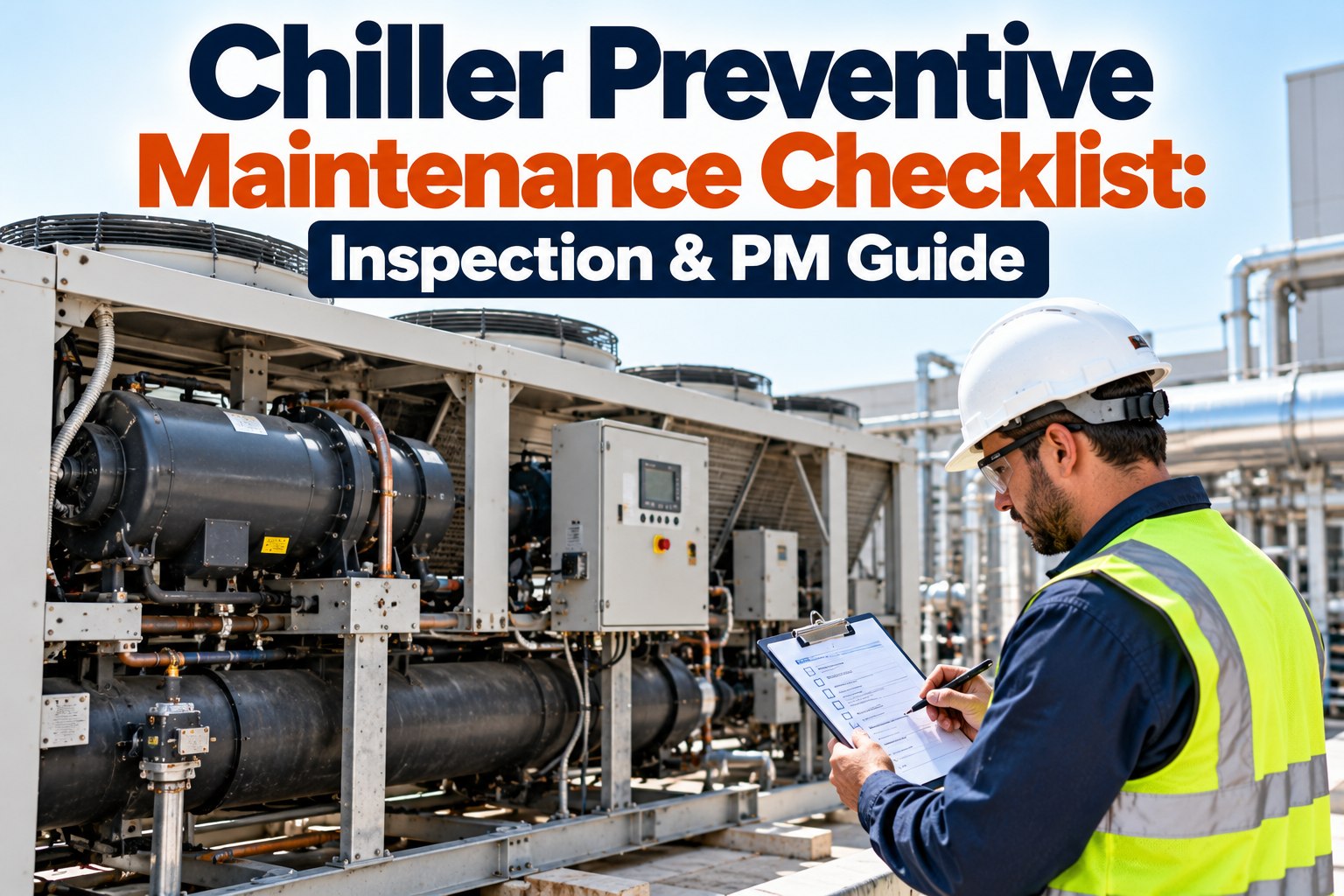
When a commercial chiller fails mid-summer, the cost isn't just the repair bill — it's halted production, occupant discomfort, emergency technician rates, and refrigerant recovery fees that pile up fast. Facilities that follow a structured, frequency-based maintenance program consistently report 30–45% fewer unplanned outages and equipment that lasts 5–8 years longer than industry averages. Whether your plant runs centrifugal, screw, or scroll chillers, the checklists below give every technician and facility manager the exact tasks needed — every day, every week, every year — to keep chiller systems running at peak efficiency.

01
Scale Costs More Than You Think

A 0.001-inch scale layer on condenser tubes cuts heat transfer efficiency by 10% and adds 6–8% to your energy bill every month it goes untreated.

02
Oil Failures Are Silent and Expensive

Missed oil analysis leads to compressor bearing failures averaging $45,000–$90,000 to repair — 900x the cost of a $50 lab test every six months.

03
Refrigerant Leaks Go Undetected for Months

Without weekly leak checks, small refrigerant losses go unnoticed until system efficiency drops 20–30% — far beyond what routine monitoring would catch in days.

Every Shift

Daily Operating Log Checklist

Record every parameter at the start and end of each operating shift. Flag any reading that deviates more than 10% from your established baseline. Teams using OxMaint — sign up now capture these readings digitally with auto-alert thresholds built in.

Every Week

Weekly Visual and Mechanical Inspection

A focused 25–35 minute walkdown that catches developing issues before they become costly work orders. Assign this task weekly in your CMMS — book a demo to see how OxMaint automates scheduling.

Every Month

Monthly Preventive Maintenance Checklist

Core PM tasks that protect compressor longevity, maintain efficiency, and satisfy most OEM warranty requirements. Sign up for OxMaint to auto-generate these work orders with technician assignments every 30 days.

Centrifugal Specific

Centrifugal Chiller PM Checklist

Covers surge, impeller health, and oil system tasks unique to centrifugal compressor units.

Screw and Scroll Specific

Screw and Scroll Chiller PM Checklist

Rotary compressor systems common from 20 to 500 tons require targeted checks not covered in general PM tasks.

Water-Side Maintenance

Chiller Tube Cleaning and Water-Side Inspection Checklist

Scale and biofilm are silent efficiency killers. A 0.001-inch deposit reduces heat transfer by 10%. Most facilities that track tube condition through OxMaint catch fouling 3x earlier — create your free account today and prevent the worst costs.

Annual Shutdown

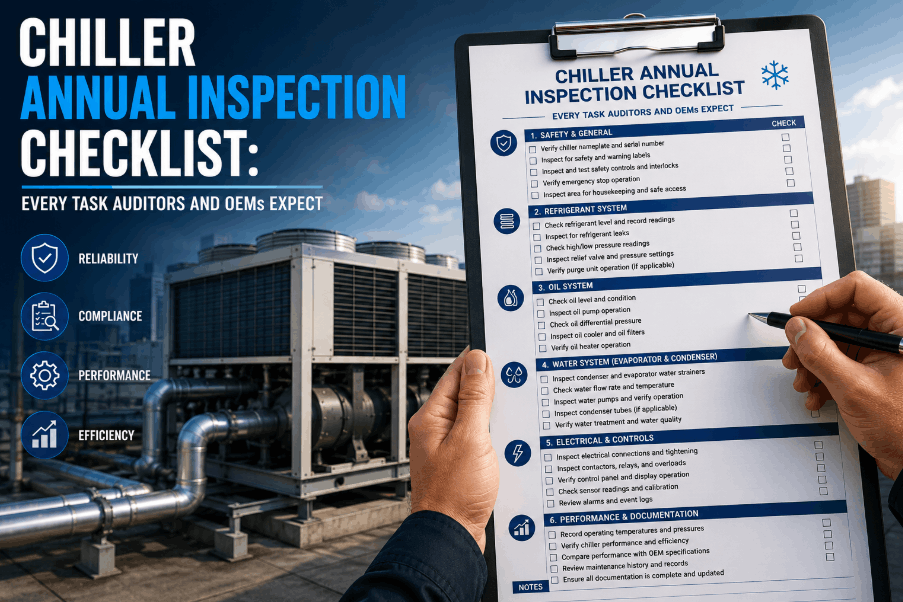
Annual Comprehensive Chiller Inspection Checklist

Full-scope shutdown inspection performed during low-demand periods. Schedule, assign, and document every step digitally — book a demo to see OxMaint's annual PM workflow live.

Trusted by 500+ Facilities Teams

Ditch Paper Logs. Run Smarter PM Programs.

OxMaint digitizes every checklist above — auto-assigns tasks, captures readings with pass/fail limits, flags anomalies instantly, and produces compliance-ready audit reports without any manual effort.

No credit card required · Free setup · Cancel anytime

Key Operating Parameters to Track Daily

These six benchmarks separate well-maintained chillers from ones heading toward failure. Tracking them manually is error-prone — sign up for OxMaint to configure automatic alerts the moment any parameter drifts outside its target range.

Chilled Water Delta-T 8 – 12 F

Below 8 degrees indicates low flow or evaporator fouling. Above 12 degrees may signal oversized load or underperforming plant.

Condenser Approach Temp Under 5 F

Rising approach temperature is the first reliable sign of condenser tube fouling or inadequate condenser water flow rate.

Oil Pressure Differential 18 – 25 psid

Low differential oil pressure on centrifugal and screw compressors triggers safety shutdown to prevent catastrophic bearing failure.

System Efficiency 0.5 – 0.7 kW/Ton

Well-maintained centrifugal at full design load. Above 0.8 kW/ton warrants immediate investigation of fouling or refrigerant charge.

Compressor Superheat 8 – 12 F

Measured at suction inlet. High superheat points to restricted metering device or low refrigerant charge requiring immediate attention.

Motor Winding Insulation Over 100 Mohm

Annual megohm test baseline. Readings below 10 megohms require immediate motor inspection before the next startup attempt.

Chiller Oil Analysis Schedule

A $50 oil lab test can prevent a $60,000 compressor replacement. Spectrographic analysis detects wear particles weeks before they cause catastrophic bearing failure. OxMaint automates your oil sampling reminders — sign up free.

Interval Test Type What It Detects
Every 6 Months Spectrographic Analysis Iron, copper, and aluminum wear particles from internal compressor components
Annually Full Oil Panel Viscosity, acid number (TAN), moisture content, and refrigerant contamination percentage
Post-Repair Baseline Sample Confirms clean oil charge and absence of contamination from the repair process
Trigger-Based Emergency Sample Any noise change, efficiency drop, or purge unit runtime spike — sample within 24 hours

Frequently Asked Questions

How often does a commercial chiller need to be serviced
Commercial chillers require daily operating log checks every shift, a focused 25–35 minute visual walkdown each week, core preventive maintenance tasks monthly including leak detection, water treatment checks, and sensor calibration, and a comprehensive shutdown inspection annually. High-runtime or critical-facility units may also need quarterly tube cleaning depending on local water quality conditions and treatment program effectiveness.
What are the most common causes of commercial chiller failure
The three leading causes are refrigerant leaks that go undetected for months without regular electronic leak surveys, condenser tube fouling that raises discharge pressure beyond safe operating limits, and lubrication failures from deferred or missed oil analysis cycles. All three are entirely preventable with a structured daily-through-annual PM program supported by a digital CMMS platform that enforces task completion and logs all readings automatically.
What is approach temperature in a chiller and why should I track it daily
Approach temperature is the difference between the refrigerant saturation temperature inside a heat exchanger and the leaving water temperature. On the condenser side, a rising approach temperature — even increasing from 3 degrees to 7 degrees Fahrenheit — signals tube fouling, scale buildup, or insufficient water flow. Tracking it daily gives maintenance teams an early warning that tube cleaning is needed before efficiency losses compound into substantially higher energy costs and potential equipment damage.
How do I know when chiller tubes need cleaning
The primary indicators are rising condenser or evaporator approach temperatures, increasing kW/ton consumption under similar load conditions, elevated discharge pressure on water-cooled units, and visible deposits or biological growth visible during visual inspection. Most water-cooled chillers in standard water quality conditions require tube cleaning at minimum once annually. Facilities with hard water or inadequate treatment programs often require cleaning twice per year to maintain efficiency and prevent tube wall degradation.
What is the difference between centrifugal and screw chiller maintenance requirements
Centrifugal chillers require close attention to surge margins, pre-rotation vane condition, purge unit runtime trends, gear oil condition, and bearing clearances. Screw chillers focus on slide valve operation across the full modulation range, discharge temperature limits, oil separator element replacement intervals, and compressor starts-per-hour tracking to prevent motor overheating. Scroll chillers are mechanically simpler but still require refrigerant charge verification, crankcase heater checks each off-cycle, and reed valve inspection during annual teardown procedures.
Can OxMaint manage chiller maintenance checklists and scheduling digitally
Yes. OxMaint allows your team to digitize every checklist on this page, schedule recurring work orders by frequency, assign tasks to specific technicians, capture numeric readings with defined pass/fail thresholds, and automatically escalate anomalies to supervisors in real time. Compliance-ready audit reports are generated automatically — no manual reporting required. Over 500 facilities teams currently use OxMaint to manage PM programs across HVAC, mechanical, and production equipment at scale.
Start in Under 10 Minutes

Your Entire Chiller PM Program, Automated

From daily operating logs to annual teardown documentation — OxMaint keeps every task on schedule, every reading on record, and every technician accountable without the paperwork.
Share This Story, Choose Your Platform!