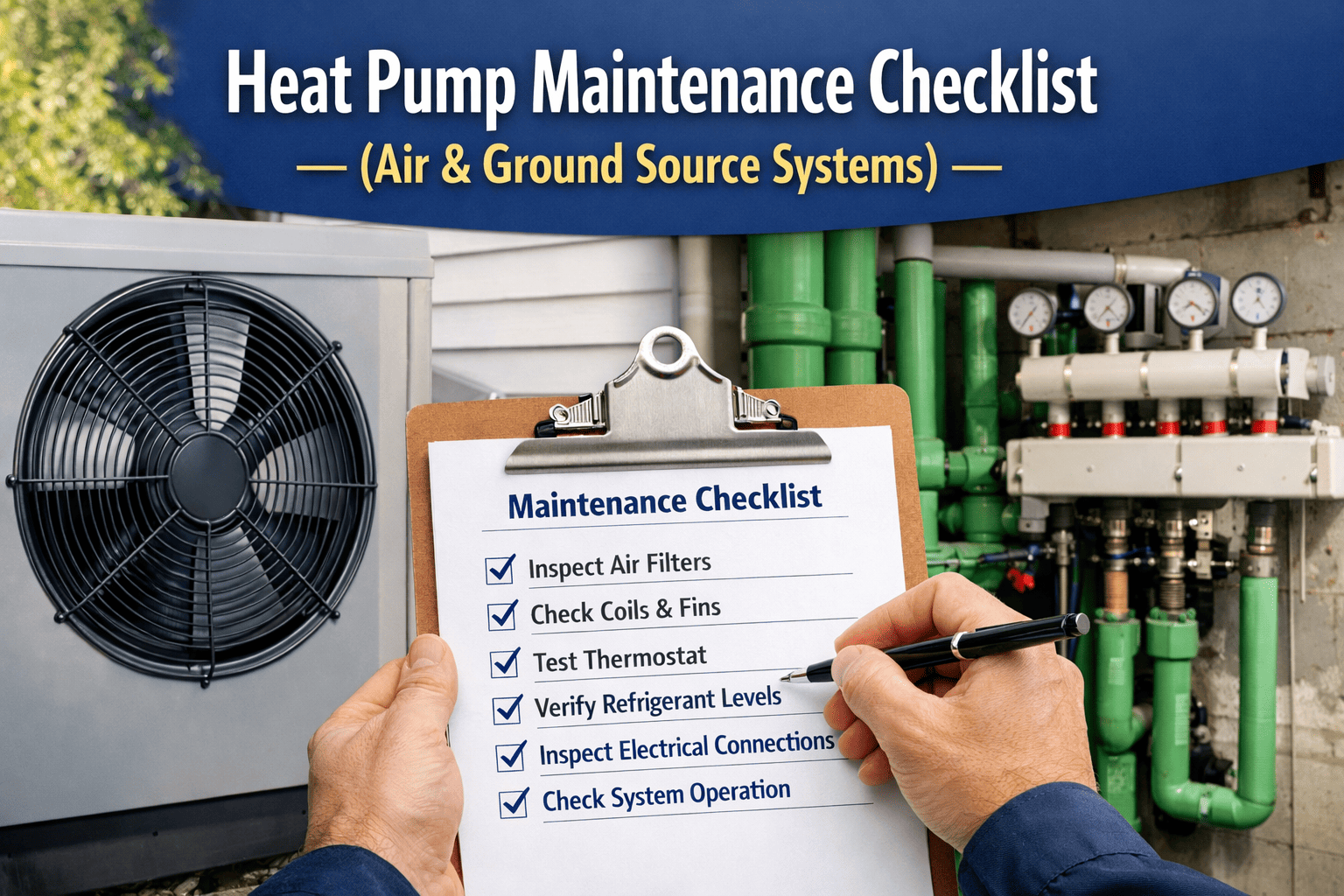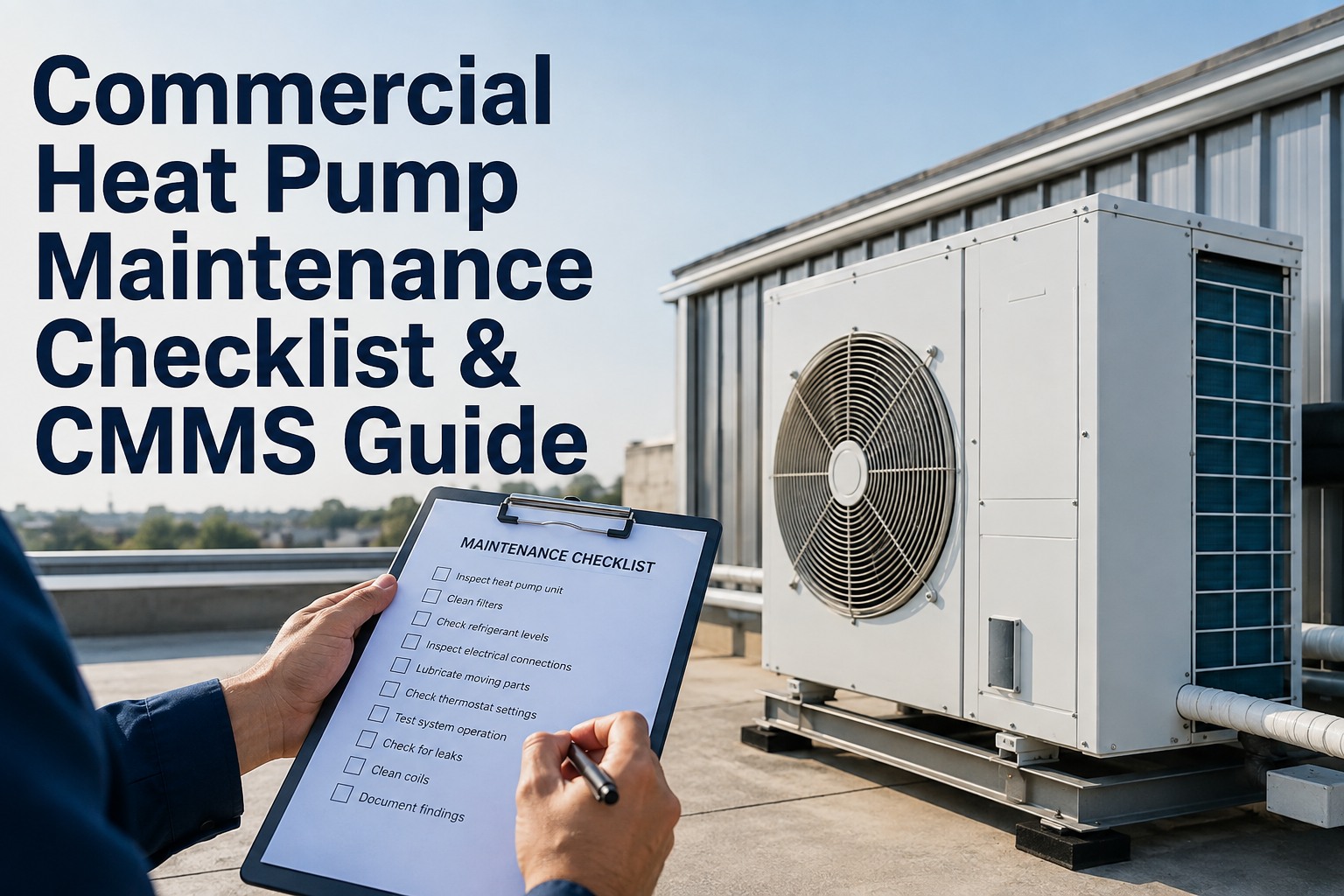
A commercial heat pump maintenance checklist is the structured, repeatable service routine that keeps rooftop and water-source heat pumps running at rated efficiency, preventing the 20–40% energy drift, compressor failures, and unplanned downtime that reactive teams absorb every heating season. This heat pump CMMS guide pairs a field-ready inspection checklist — covering reversing valve testing, defrost cycle verification, and refrigerant charge check — with the work-order, scheduling, and analytics capabilities of OxMaint so reliability teams can convert that checklist into a managed, auditable heat pump maintenance program. Whether you oversee 12 rooftop units or 300+ geothermal loops, standardizing on a CMMS-driven heat pump service schedule is the fastest way to cut emergency callouts, extend equipment life beyond 15 years, and prove compliance — and you can Start Free Trial to deploy it on your assets today.
Heat Pump Maintenance Checklist & CMMS Guide
Every missed defrost cycle costs you 8–12% in seasonal efficiency.
A standardized commercial heat pump maintenance checklist — automated through a CMMS heat pump program — catches reversing valve faults, refrigerant drift, and coil fouling before they become $4K–$18K compressor replacements. Deploy one across every rooftop unit, water-source loop, and split system in your portfolio.
The Cost of Skipping Maintenance
Why Commercial Heat Pump Maintenance Matters in 2026
Commercial heat pumps operate in both heating and cooling modes, meaning they accumulate twice the run-hours of a straight-cool air conditioner — yet most facilities service them once a year. The result: a 20–40% efficiency drift within 3–5 years, a 15% shorter equipment lifespan, and emergency callout rates that run 2.5× the cost of planned service. With heat pump adoption surging for decarbonization and electrification mandates, a disciplined heat pump maintenance program is no longer optional — it is the baseline for operating budget control.
Field-Ready Inspection Checklist
Commercial Heat Pump Maintenance Checklist: Pre-Season & Routine Tasks
Use this heat pump inspection checklist as the master template inside your CMMS heat pump program. Each task below maps to a work-order line item with a target frequency, acceptance range, and photo-attachment requirement — ensuring every technician follows the same standard regardless of building or unit type.
Refrigeration Cycle & Refrigerant Check
- Measure & log refrigerant charge against manufacturer subcooling/superheat targets
- Test reversing valve operation — confirm full stroke in heating & cooling modes
- Verify defrost cycle initiation, termination timer, and sensor accuracy
- Inspect filter drier, sight glass, and TXV/EEV operation for flashing or frost
- Leak-test all flare/braze joints with electronic leak detector
Airflow, Coils & Filters
- Replace or clean air filters — measure static pressure drop before & after
- Chemically clean indoor & outdoor coils; straighten fins with comb
- Measure supply & return CFM; confirm within 10% of design airflow
- Inspect condensate drain, trap, and pan — clear blockages, verify float switch
- Confirm outdoor unit clearance — 24 in. minimum on all sides for airflow
Electrical & Controls
- Tighten all line-voltage connections — measure amperage on compressor & fans
- Test run & start capacitors — replace if within 10% of rated tolerance
- Inspect contactor pitting; measure voltage drop across contacts
- Verify thermostat/controls staging, O/B terminal configuration, and sensors
- Megohm test compressor motor insulation — flag below 100 MΩ
Mechanical & Seasonal Prep
- Lubricate indoor blower & outdoor fan motors — do not over-grease
- Inspect accumulator, crankcase heater operation, and suction line insulation
- Verify snow/ice clearance provisions and unit elevation above grade
- Document baseline pressures, temps & amperage for trend comparison
- Update asset record in CMMS with parts used, labor hours & next due date
Service Frequency Reference
Heat Pump Service Schedule: How Often & What to Check
A heat pump service schedule must account for the unit's dual-mode operation. The table below defines the minimum task frequency for a commercial heat pump guide 2026 compliant program. Pushing these intervals into a CMMS heat pump maintenance module ensures no task slips and every completion is audit-ready.
| Maintenance Task | Frequency | Acceptance Range / Standard | Impact if Missed |
|---|---|---|---|
| Filter inspection & replacement | Quarterly (monthly in high-load) | Static pressure drop < 0.50 in. WC | 5–15% airflow reduction, coil freeze risk |
| Refrigerant charge & subcooling check | Pre-season (Fall & Spring) | Within ±3°F of OEM subcooling target | 10–20% efficiency loss, compressor damage |
| Defrost cycle verification | Pre-heating season | Initiates at 35–40°F coil temp, terminates correctly | Ice buildup, emergency heat lock-in, 30%+ energy spike |
| Reversing valve function test | Bi-annually | Full stroke confirmed, no bypass leakage | Loss of heating or cooling mode entirely |
| Coil cleaning (indoor & outdoor) | Bi-annually | Visual + ΔT within 2°F of design | 40% efficiency degradation over 2 seasons |
| Electrical & capacitor megohm test | Annually | Insulation > 100 MΩ, capacitance ±10% | Catastrophic compressor or fan motor failure |
| Condensate drain & float switch | Quarterly | Free flow, switch triggers on rise | Water damage, ceiling/property loss |
Worked ROI Example
The Real Cost of Reactive vs. CMMS-Managed Heat Pumps
Consider a commercial campus operating 60 heat pumps across three buildings — a typical mid-size portfolio. Without a structured heat pump maintenance program, the team absorbs reactive callouts, premature replacements, and energy waste. Moving to a CMMS heat pump program flips those losses into measurable savings within the first year.
Annual Savings Formula
(Callouts Avoided × $650) + (Energy Recovered × $0.14/kWh) + (Compressor Life Extended × Depreciated Cost)
60 units × 1.8 avoided callouts × $650 = $70,200 in emergency labor savings alone.
Energy Recovery Estimate
Units × Average kW Run-Hours × Efficiency Drift % × Utility Rate
60 units × 8.5 kW × 2,200 hrs × 18% drift × $0.14 = $28,224 recovered annually.
| Cost Category | Reactive (Spreadsheet) | CMMS Heat Pump Program | Annual Difference |
|---|---|---|---|
| Emergency callout labor | $112,000 | $41,800 | $70,200 saved |
| Compressor & motor replacements | $48,000 (4 units/yr) | $12,000 (1 unit/yr) | $36,000 saved |
| Energy waste from drift | $28,224 | $4,234 | $23,990 saved |
| Audit & compliance admin time | $9,600 | $1,200 | $8,400 saved |
| Total Annual Cost | $197,824 | $59,234 | $138,590 saved |
That is a 70% reduction in total heat pump operating cost — recovered in the first year of deploying OxMaint as the CMMS backbone for the portfolio.
Stop Drowning in Paper Work Orders
See OxMaint manage your heat pump fleet — book a 30-min demo.
We will load your asset list, map this checklist into automated work orders, and show you the predictive analytics dashboard live on your equipment.
OxMaint Platform Capabilities
How OxMaint Powers Your CMMS Heat Pump Maintenance Program
OxMaint turns the checklist above into an automated, self-auditing system. Each capability below maps directly to a pain point that reactive heat pump maintenance creates — and delivers a specific, measurable outcome your reliability team can report to leadership.
Automated PM Work Orders
Auto-generate pre-season and quarterly heat pump service schedule triggers. Eliminate 100% of missed PM dates and cut manual scheduling admin by 80%.
Predictive Analytics
AI-driven trend analysis on temperature, pressure & amperage logs predicts compressor and reversing valve failures 2–6 weeks before they happen.
Asset & Parts Tracking
Track every heat pump by model, serial, refrigerant type, and install date. Link spare-parts inventory to auto-reorder and cut parts stockouts 90%.
Mobile-First Compliance
Technicians complete checklist items on mobile with photo proof, digital signatures, and timestamp logging — audit-ready for ISO 55000 & internal QA.
Frequently Asked Questions
Commercial Heat Pump Maintenance FAQ
How often should commercial heat pumps be serviced?
Commercial heat pumps require a minimum of two full preventive maintenance visits per year — one before the heating season (fall) and one before the cooling season (spring) — because they run in both modes and accumulate more run-hours than cooling-only equipment. High-load or critical facilities should add quarterly filter and condensate checks. A CMMS heat pump program like OxMaint automates these triggers so no interval is ever missed.
What is included in a heat pump maintenance checklist?
A complete heat pump inspection checklist covers refrigerant charge and subcooling verification, reversing valve function test, defrost cycle verification, coil cleaning, filter replacement, airflow measurement, electrical connection tightening, capacitor and contactor testing, condensate drain clearing, and controls/thermostat calibration. Each item should have a pass/fail acceptance range and be logged with photo evidence for audit compliance.
How does a CMMS improve heat pump maintenance?
A CMMS like OxMaint eliminates spreadsheets and paper work orders by auto-generating preventive maintenance triggers, dispatching mobile work orders to technicians, tracking parts inventory, and trending asset performance data over time. Teams typically cut unplanned downtime 30–50%, reduce emergency callouts by 60%, and gain instant audit-readiness. You can Start Free Trial to see your assets configured in minutes.
What are the signs a heat pump reversing valve is failing?
Common reversing valve failure signs include the unit stuck in one mode (only heating or only cooling), a hissing sound indicating internal refrigerant bypass, lukewarm discharge lines when the opposite mode is commanded, and abnormal suction/discharge pressure readings. Test the solenoid coil for continuity and confirm the valve achieves full stroke — if it does not, schedule replacement before the peak season to avoid an emergency no-heat or no-cool callout.
How much can I save with a CMMS heat pump program?
A 60-unit commercial portfolio typically saves $100K–$140K annually by switching from reactive maintenance to a CMMS-driven heat pump program — through avoided emergency labor, extended compressor life, recovered energy efficiency, and reduced compliance admin. The payback period for a CMMS deployment is usually under 3 months once PM scheduling and predictive analytics are active. Book a personalized ROI walkthrough via Book a Demo.
Deploy Your Heat Pump Program Today
Turn your checklist into a managed, predictive maintenance program.
Load your assets, map your heat pump service schedule, and let OxMaint automate the work orders, compliance logs, and failure predictions — all in one platform.
Free 14-day trial · No credit card