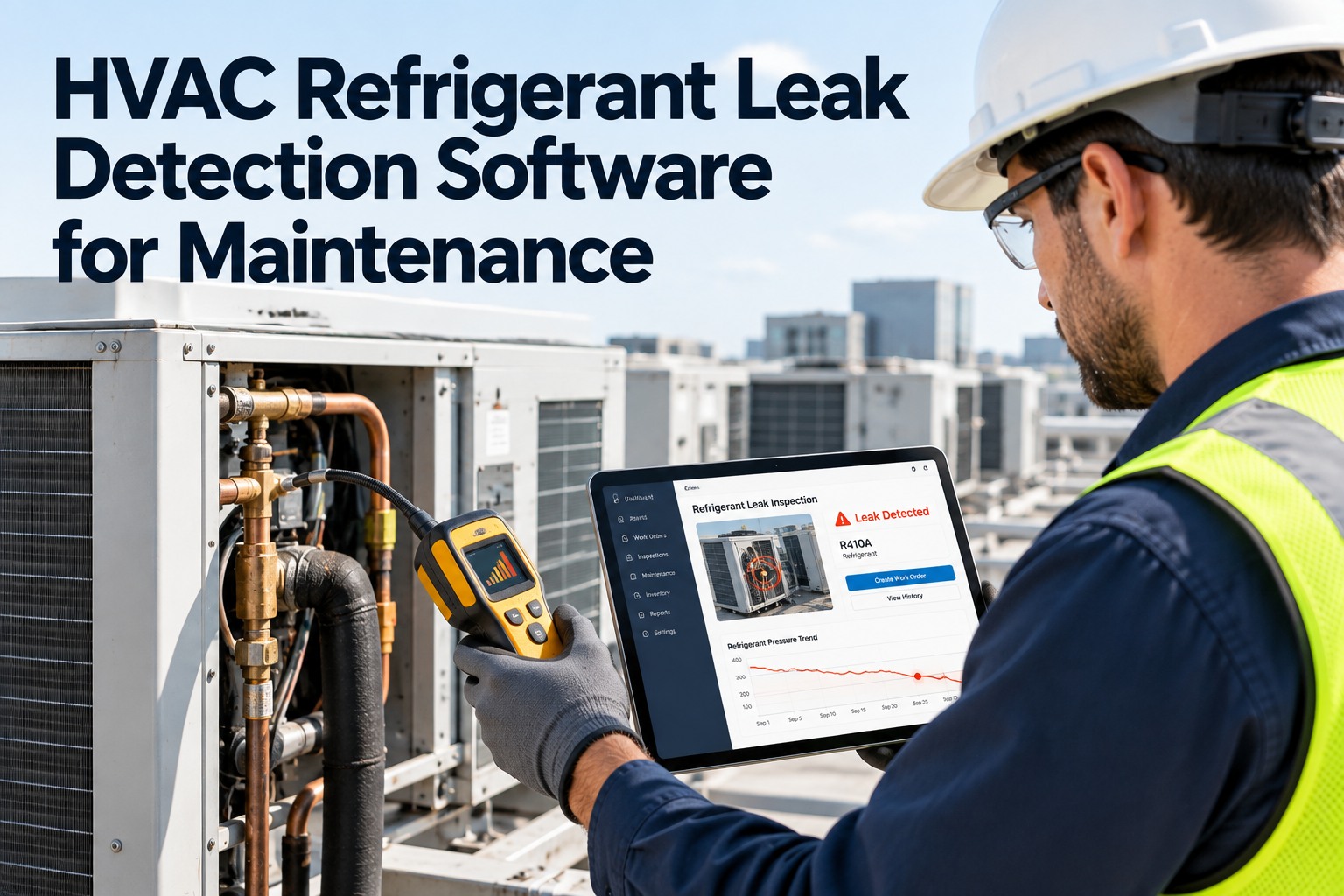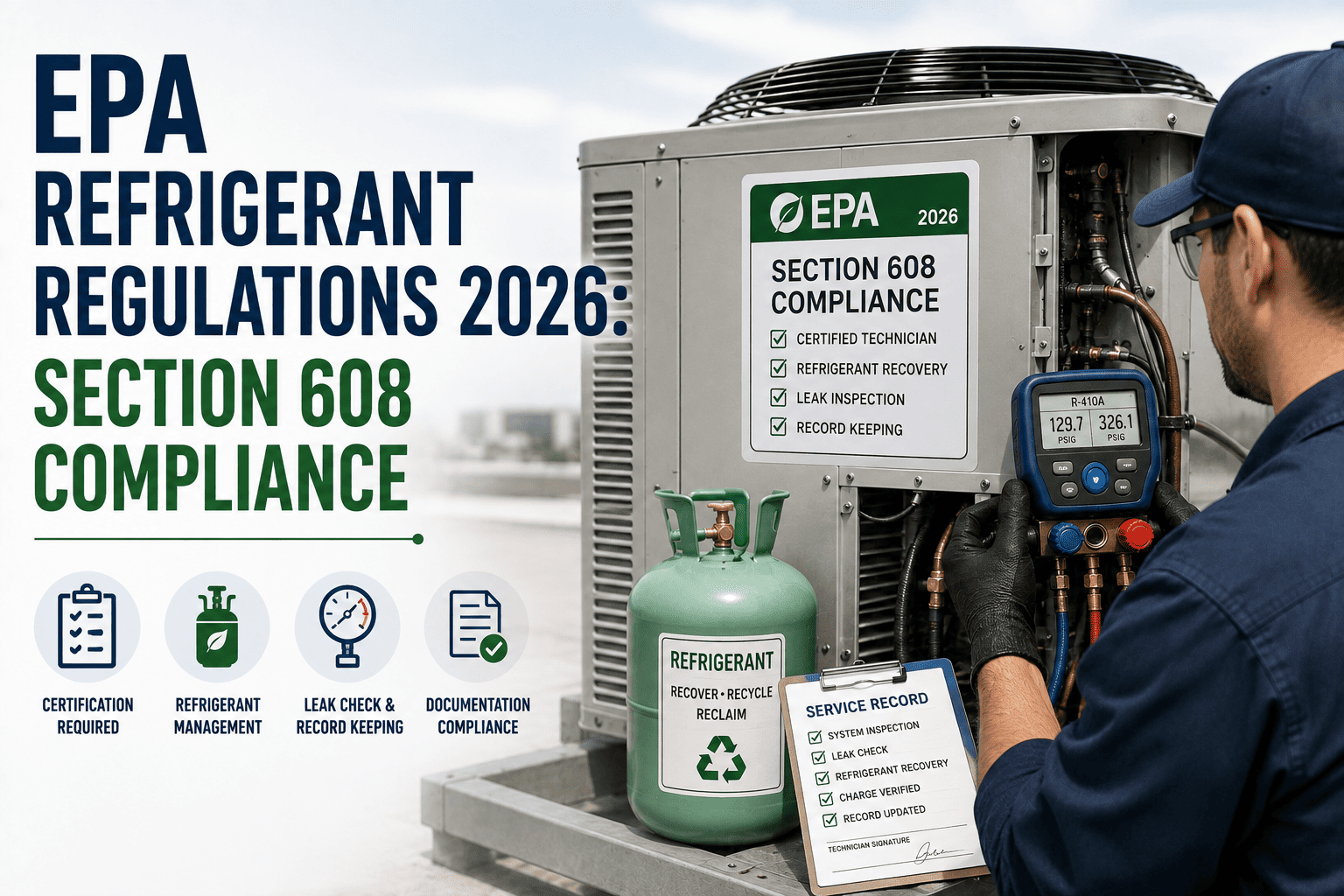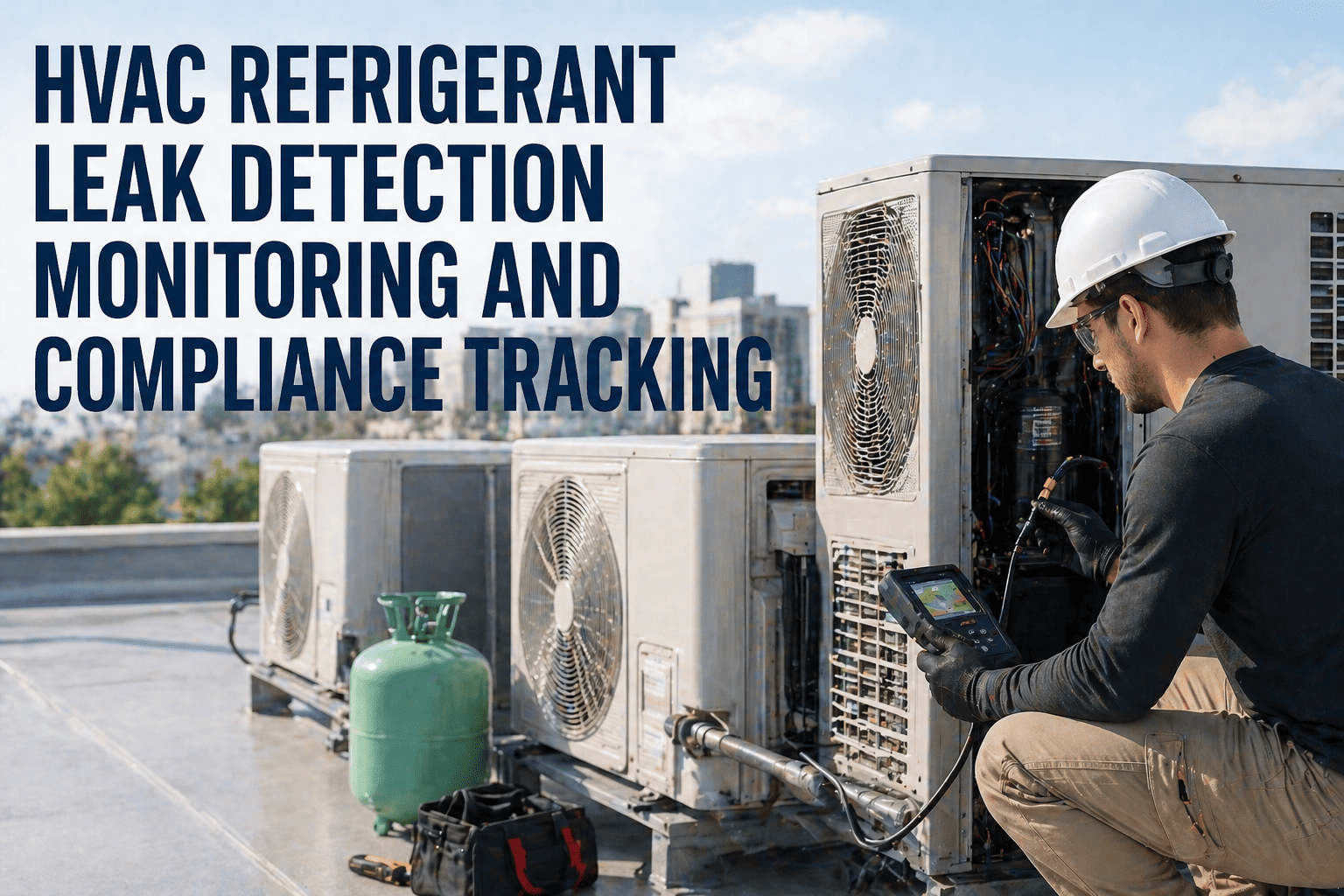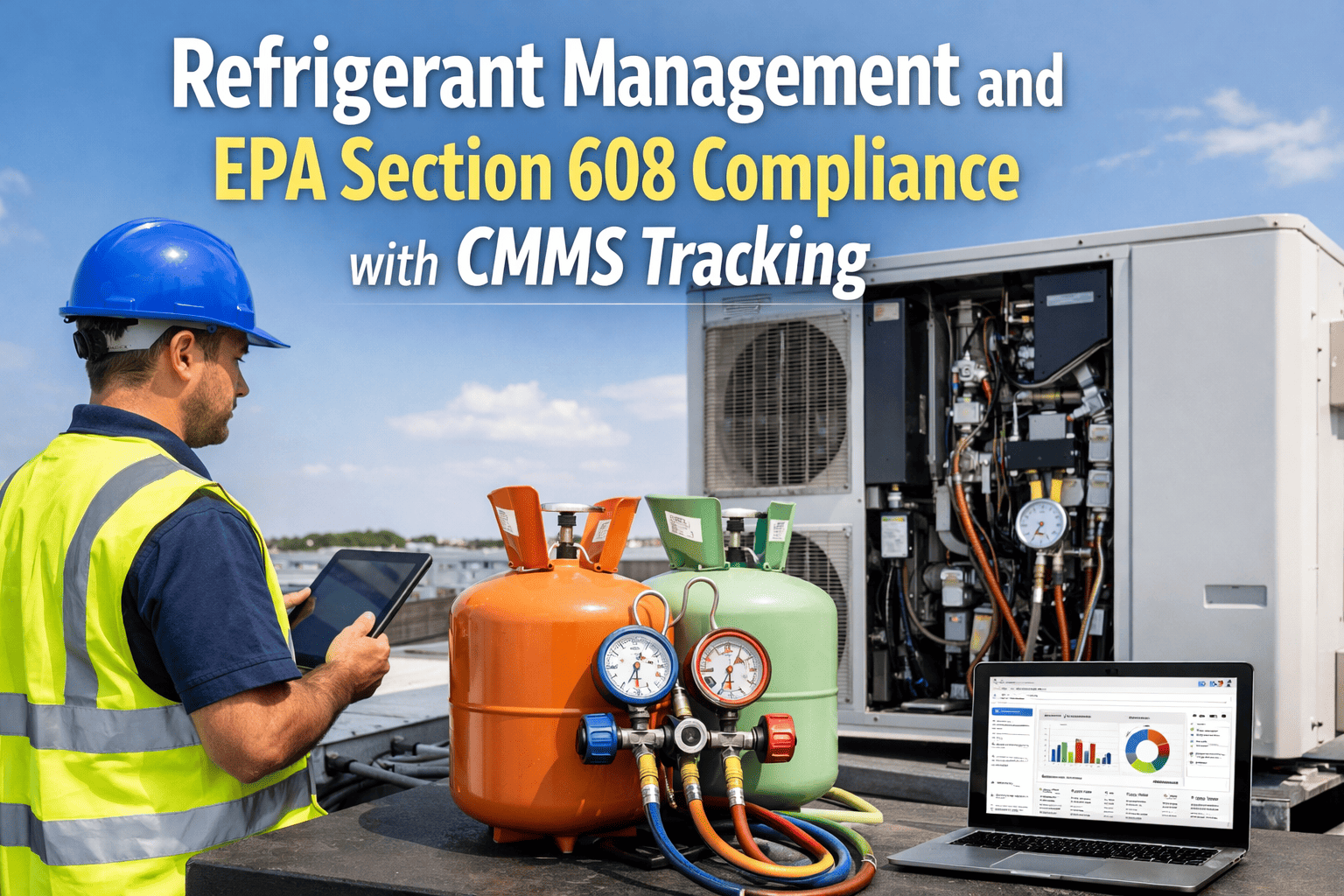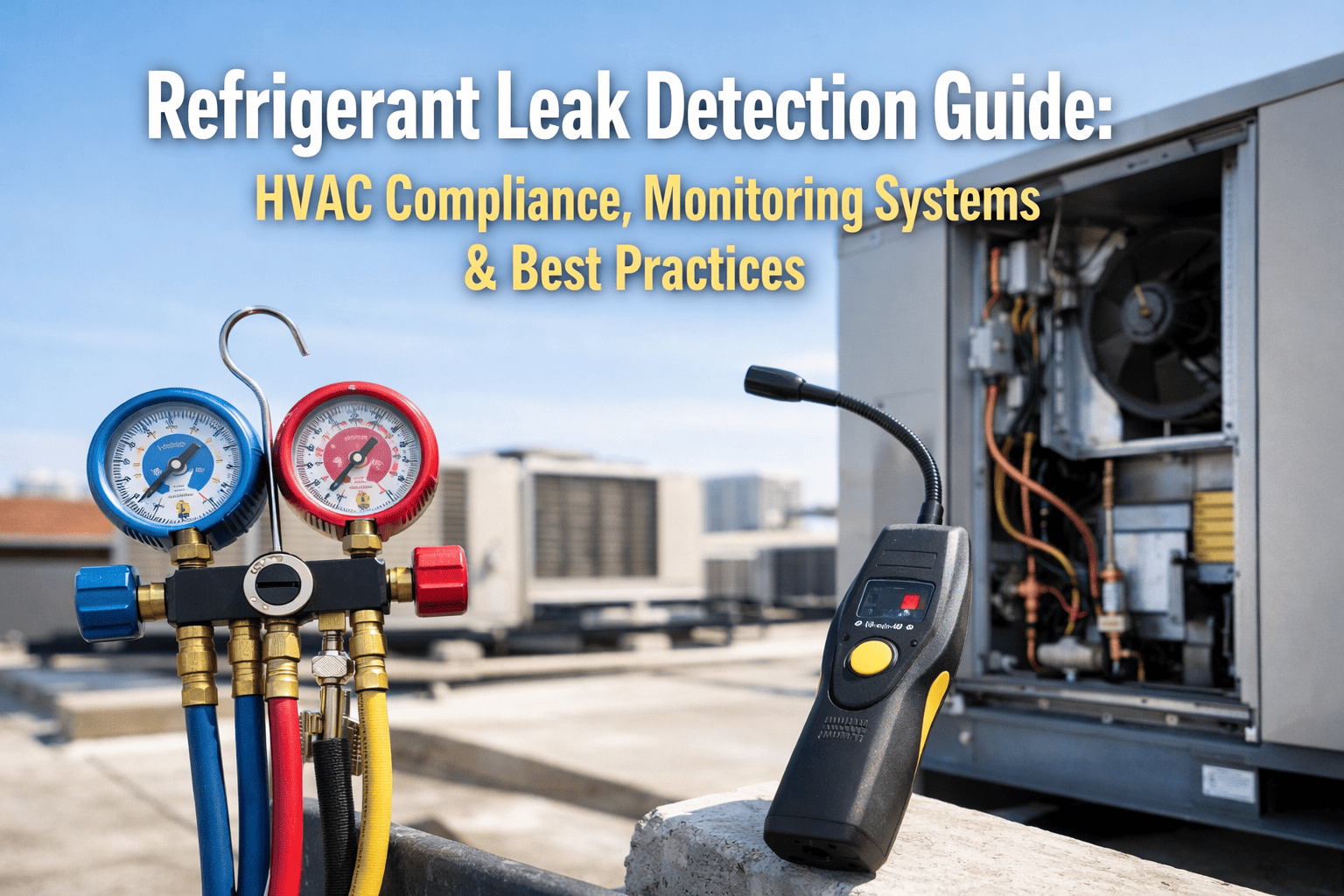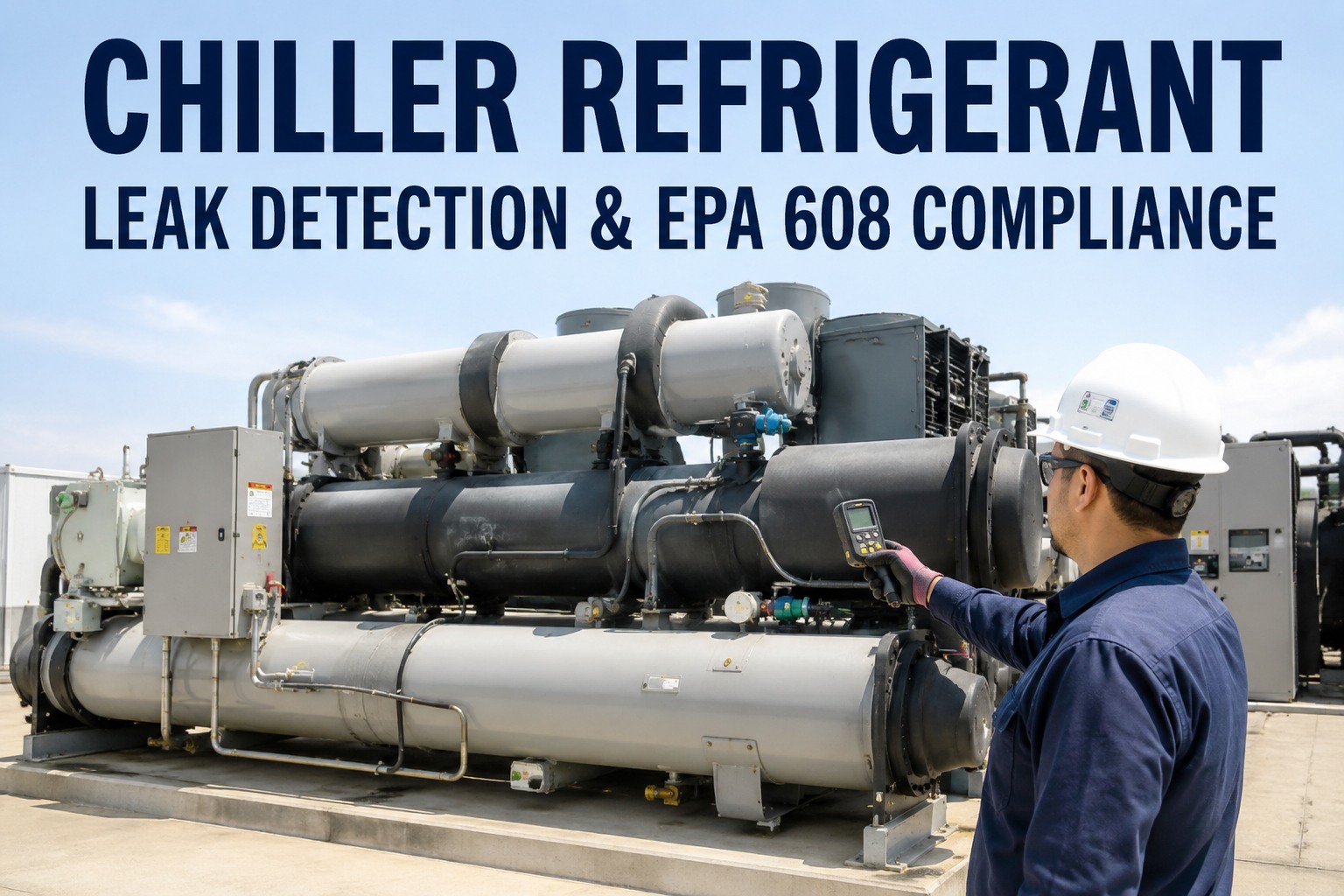
Refrigerant leaks are the single most expensive chronic failure mode on a commercial chiller — a 1,000-ton R-123 machine losing 5% of its charge annually wastes roughly $4,200 in refrigerant, adds 3–7% to compressor kW, and quietly pushes the plant out of EPA Section 608 compliance. The 30-day repair clock starts the moment a leak is documented, not when it is "confirmed," so the difference between a $1,500 service call and a $40,000 EPA penalty is almost always process, not equipment. The guide below breaks down leak survey intervals, purge-unit runtime thresholds, the 608 notification and recordkeeping chain, and how a CMMS keeps the whole audit trail defensible. If you want to skip the spreadsheet work, you can Start Free Trial and import your chiller inventory in under an hour.
Is your 1,000-ton chiller quietly venting refrigerant — and starting a 30-day EPA clock you do not even know is running?
Under the 2024 Section 608 revisions, any appliance with a full charge ≥ 50 lbs must be surveyed on a documented schedule, and the 30-day repair requirement begins the day a leak at or above the applicable rate is discovered. The average commercial chiller leaks 4–6% of its charge per year — most of it undetected between annual services.
The maximum calendar days from leak discovery to a compliant repair, final verification test, and signed record — no extensions for parts lead time.
The 608 leak-rate triggers you have to hit, by chiller type
EPA sets the "applicable leak rate" as a 12-month rolling percentage of full charge. Exceed it and the 30-day repair obligation, follow-up verification test, and documentation chain all activate — automatically.
| Chiller / Refrigerant Class | Commercial Comfort-Cooling | Industrial Process Refrigeration | Required Survey Interval |
|---|---|---|---|
| HCFC-123 / low-pressure centrifugal | 10% | 10% | Annual (or continuous purge monitoring) |
| HCFC-22 / mid-pressure screw & reciprocating | 10% | 10% | Annual |
| HFC-134a / R-514A high-pressure centrifugal | 10% | 10% | Annual + leak inspection after any service opening |
| Any appliance ≥ 500 lbs full charge | 10% | 10% | Annual, plus documented follow-up within 12 months of repair |
| Auto-bleed / fugitive purge units | — | — | Continuous runtime monitoring (see Section 4) |
Rates shown reflect the EPA Section 608 rule effective through 2026. State programs (CA CARB, WA Ecology) impose stricter thresholds — for example, CARB caps commercial comfort-cooling at 10% but requires quarterly inspections on systems ≥ 50 lbs with leaks in the prior year.
Five leak-detection methods, ranked by sensitivity and defensibility
A method that cannot detect 0.5 oz/yr will not satisfy the EPA's "failure to maintain" standard — and it will not catch a leak before it becomes a reportable event.
Sensitivity: 0.15 oz/yr
Best all-around field tool. Sniffs the full refrigerant envelope, purge vent, and access valves in under 20 minutes on a 500-ton centrifugal. Calibrate before each survey; log the calibration serial number with the work order.
Sensitivity: ~0.5 oz/yr at 5 ft
Catches high-pressure gas leaks at flanges and rupture disks where the technician cannot reach safely. Pairs with electronic sniffing — never replaces it. Useful on running chillers where soap solution is impractical.
Sensitivity: 0.05 oz/yr
Used when the chiller is empty and the leak is below electronic range. Requires recovery to below atmospheric pressure, then pressurize with the tracer blend. Slower (4–8 hr) but the gold standard for sub-assembly QC after a major repair.
Sensitivity: ~1.5 oz/yr
Acceptable only as a confirmatory method on visible joints. UV dye stays in the system for up to 12 months and is useful for slow leaks that resist electronic detection between surveys — but dye residue complicates oil analysis.
Sensitivity: 1 ppm ambient
Permanently installed in the chiller room; alarms at 100 ppm for most HFCs. Required by ASHRAE 15 / 34 on high-charge systems and qualifies as a substitute for one annual EPA survey on comfort-cooling equipment ≥ 50 lbs.
Sensitivity: 2% annual leak
A low-pressure chiller's purge runtime is a free, continuous leak alarm — see Section 4 for the runtime thresholds that trigger an EPA reportable leak before any sniffing begins.
What a single undetected leak actually costs a 1,000-ton plant
The numbers below are from a real mid-Atlantic district-cooling plant audited in 2024 — a 1,000-ton R-123 centrifugal that drifted from 1.2 hr/week of purge runtime to 4.8 hr/week over eight months before anyone opened the work order.
Full Charge (lbs) × Annual Leak Rate (%) = Lost Refrigerant (lbs/yr)
1,200 lbs × 6% = 72 lbs of R-123 lost per year
72 lbs × $58/lb = $4,176 in refrigerant aloneLeak Rate (%) × 0.6% kW penalty per 1% charge loss = Annual Energy Loss
6% × 0.6% = 3.6% additional compressor kW
3.6% × $118K annual chiller kW = $4,248 in wasted electricityThe plant recovered the leak in week two of a quarterly electronic survey — a $1,400 service call that would have grown into a $40,000+ EPA penalty if the leak had crossed the 30-day mark undocumented. Documented runtime trending in a CMMS would have flagged the threshold breach at week five.
The purge-unit runtime chart every chiller operator should keep on the wall
A low-pressure centrifugal chiller's purge unit is the cheapest, most reliable continuous leak detector in the mechanical room — if someone is logging its runtime weekly and trending it.
Healthy envelope. Air ingress limited to normal permeation and startup purge. Continue monthly runtime logging in the CMMS.
Early leak signature or degrading purge efficiency. Schedule an electronic leak survey within 14 days; verify purge condenser and relief-valve seal.
Treat as a reportable leak. Open an EPA 608 work order, perform the leak survey within 5 working days, and start the 30-day repair clock the day the survey documents the leak.
Refrigerant loss exceeds 6% per year. Shutdown recommended. Document the runtime log, perform the leak survey, and notify the designated responsible officer in writing.
The 8-step EPA 608 leak-repair chain — and where most plants break it
Eight steps. Each one generates a record. Miss any single record and the entire audit becomes non-defensible — even if the repair itself was perfect.
Document the leak discovery
Date, time, technician, method, location on the chiller, and refrigerant ID. This is the legal start of the 30-day clock — not the repair date.
Open a 608 work order in the CMMS
Tag the work order with the EPA appliance ID, refrigerant type, full charge, and calculated leak rate (% of charge). Auto-assign a 30-day due date.
Recover refrigerant to atmospheric
Recover to ≤ 0 psig (or per ASHRAE 15) before opening the envelope. Log the recovery cylinder weight, technician certification number, and date.
Perform the repair
Weld, replace the failed component, or torque the joint to spec. Document labor hours, parts, and the technician's 608 certification number on the work order.
Conduct the initial verification test
Pressurize with nitrogen to 150 psig (or design pressure, whichever is lower) and soap-test the repair. The initial test must happen before recharging.
Recharge and run the follow-up test
Within 30 days of the repair, re-survey with an electronic detector while the chiller is at full charge and operating. This is the test that closes the 608 record.
File the leak-repair record
Owner name, appliance ID, refrigerant, full charge, leak rate, repair date, method, technician cert number, follow-up test date and result. Retain for 3 years minimum.
Schedule the 12-month follow-up inspection
EPA requires a follow-up leak inspection within 12 months of any repair on appliances ≥ 50 lbs. The CMMS should auto-generate this work order when Step 7 closes.
Stop tracking 30-day repair deadlines on a whiteboard.
oxmaint auto-generates the 608 work order the day a leak is documented, pings the responsible technician at day 14, day 21, and day 27, and attaches the follow-up test record to the asset's permanent file — defensible on day one of an EPA audit.
EPA 608 chiller leak detection — what operators actually ask
When does the 30-day repair clock officially start?
The clock begins the day a leak at or above the applicable rate is discovered — not the day it is confirmed, repaired, or reported. If a technician documents a 6% leak on Friday using an electronic detector, day 30 is exactly 30 calendar days later, weekends and holidays included. Documenting the discovery date in a CMMS work order the same day is the single most defensible thing a plant can do.
Can purge-unit runtime substitute for an annual leak survey?
No. EPA accepts a fixed continuous monitor (photoacoustic or infrared) as a substitute for one annual survey on comfort-cooling equipment ≥ 50 lbs, but purge-runtime trending is an operational indicator, not an EPA-approved leak-inspection method. Use it to trigger an electronic survey earlier — not to skip one.
What records do I need to keep, and for how long?
Three categories: (1) leak-inspection records with method, date, and technician cert number; (2) leak-repair records including refrigerant added, parts replaced, and verification test results; (3) refrigerant inventory and recovery/recycling logs. EPA requires a minimum 3-year retention, but most insurers and corporate ESG programs ask for 5–7 years. A CMMS with asset-level history handles this automatically.
What happens if I miss the 30-day deadline?
The chiller is out of compliance and must be retrofitted, retired, or granted a one-time extension under 608.161(c) — which itself requires written EPA notification within 30 days of the original repair deadline. Civil penalties under the Clean Air Act start at $44,539 per day per violation (2024 inflation-adjusted) and scale with the size of the operator.
Do HFO low-GWP refrigerants like R-1233zd and R-514A fall under the same rules?
Yes. Section 608 applies to any refrigerant that is an ozone-depleting substance or a listed substitute with a GWP exemption — and HFOs are explicitly covered even though their GWP is below 150. The leak-rate thresholds, survey intervals, and 30-day repair window are identical to HFC and HCFC chillers of the same charge class. You can Book a Demo to see how oxmaint tags HFO assets for the same audit trail.
One platform for every chiller, every leak, every 30-day deadline.
Import your chiller inventory, set the EPA 608 thresholds, and let oxmaint auto-generate the work orders, runtime alerts, and audit-ready records your next inspection will demand.
Free 14-day trial · No credit card