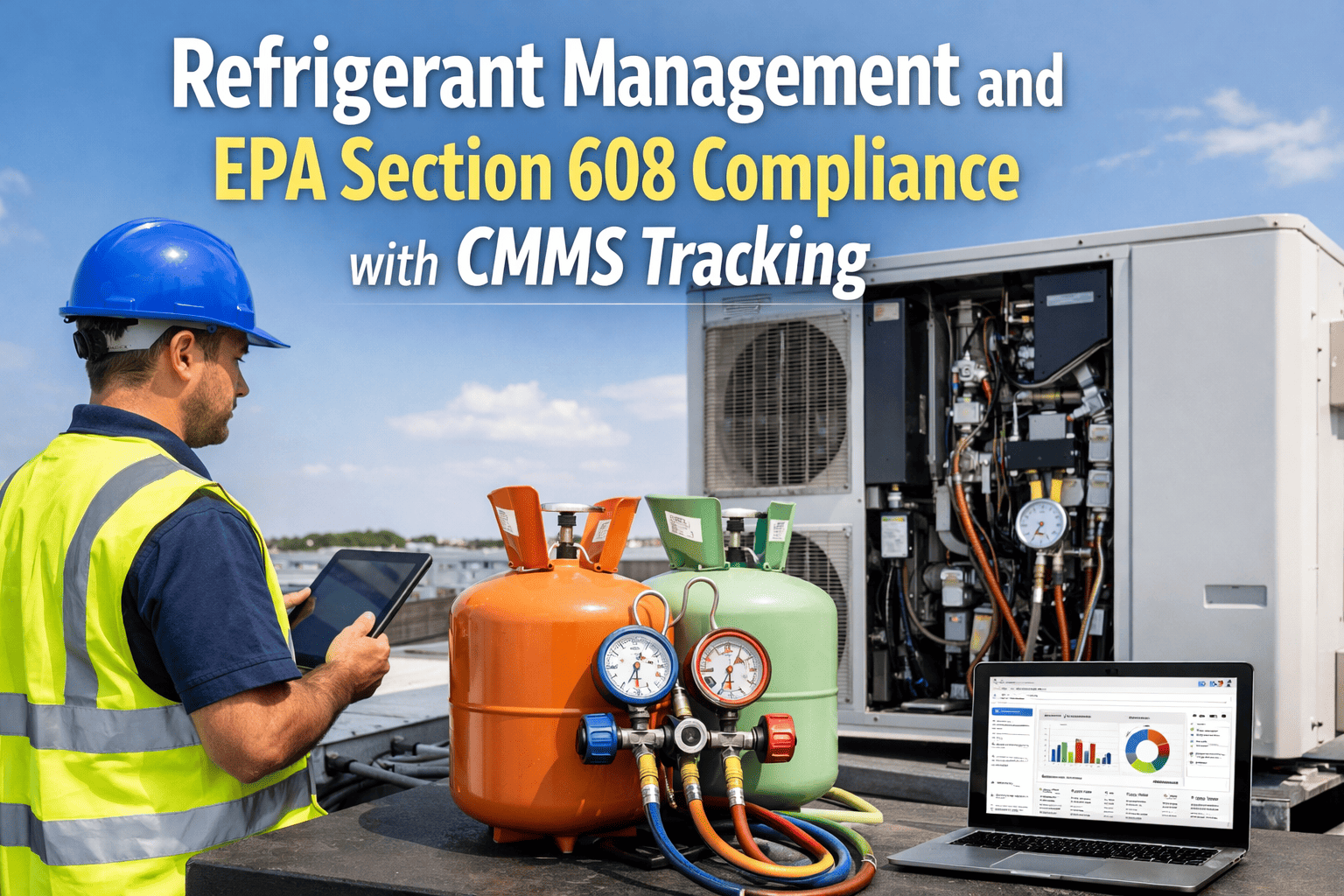
Refrigerant Management and EPA Section 608 Compliance with CMMS Tracking

By James smith on April 4, 2026

refrigerant-management-epa-section-608-compliance-cmms-tracking

Every time a Section 608-certified technician adds refrigerant to a system containing 50 pounds or more, two compliance clocks start simultaneously — a leak rate calculation that must be recalculated and compared against the applicable threshold, and a 30-day repair timeline that begins if the leak rate exceeds that threshold. The record documenting the addition — the date, amount, and type of refrigerant — must be retained for a minimum of three years and be available for EPA inspection on demand. Most facilities manage these obligations across dozens of chillers, rooftop units, and refrigeration systems in paper invoices, contractor files, and email attachments. When an EPA inspector arrives, the question is not whether the maintenance was performed — it is whether the records can prove it, whether the leak rates were calculated, and whether the repair timelines were met. Sign in to OxMaint to link refrigerant records to the asset they serve — or book a demo to see EPA Section 608 compliance tracking configured for your refrigerant portfolio.

Regulatory Stakes

The Compliance Numbers Every Refrigerant Manager Must Know

50 lbs
Full charge threshold — systems at or above 50 lbs trigger mandatory leak inspection, repair timeline, and full recordkeeping requirements under EPA Section 608
30 days
Repair timeline from leak discovery for appliances above the applicable leak rate threshold — extendable to 120 days only for industrial process refrigeration with documented shutdown
3 years
Minimum record retention period for all refrigerant service records — available for EPA inspection on demand, 40 CFR Part 82 Subpart F
85%
AIM Act HFC production reduction target by 2036 — R-410A no longer manufactured for new US equipment from 2025, driving reclaimed refrigerant costs higher annually
Compliance Thresholds

EPA Section 608 Leak Rate Thresholds by Equipment Type

The applicable leak rate threshold determines whether a refrigerant addition triggers mandatory repair obligations. The threshold differs by equipment category — and must be recalculated every time refrigerant is added to any system containing 50 or more pounds. Knowing which threshold applies to each asset in your portfolio is the first step to understanding your compliance exposure. Sign in to OxMaint to configure the applicable leak rate threshold per asset and activate automatic compliance calculations.

Equipment Type Examples Charge Threshold Leak Rate Trigger Inspection Frequency Repair Timeline
Comfort Cooling (HVAC) Chillers, rooftop units, split systems ≥50 lbs 10% annual leak rate Annually 30 days from discovery
Commercial Refrigeration Walk-in coolers, display cases, supermarket systems ≥50 lbs 20% annual leak rate Annually (quarterly if >500 lbs) 30 days from discovery
Industrial Process Refrigeration Industrial cooling, pharmaceutical, food processing ≥50 lbs 30% annual leak rate Annually (quarterly if >500 lbs) 30 days (120 days with documented shutdown)
Large Commercial / Industrial Systems ≥500 lbs in any above category ≥500 lbs Same as category above Quarterly until 4 clean quarters 30 days from discovery
AIM Act Expansion (proposed) Any system ≥15 lbs of HFC or GWP>53 substitute ≥15 lbs TBD — pending final AIM Act Part III rule Mandatory inspection proposed 30 days (proposed)
Auto-Leak Detection Required Commercial/industrial refrigeration ≥1,500 lbs HFC ≥1,500 lbs Any leak — automatically detected Automatic detection system mandatory 30 days from alarm

Thresholds reflect current Section 608 requirements and AIM Act Part III proposed rules as of early 2026. The AIM Act expansion to 15-pound systems is proposed but not yet final — verify current applicability with your EPA regional office. Book a demo to configure applicable thresholds per asset in OxMaint.

Leak Rate Calculation

How to Calculate Annual Leak Rate — EPA Approved Methods

Section 608 requires owners and operators to recalculate the leak rate every time refrigerant is added to a system containing 50 or more pounds. EPA approves two calculation methods. The result must be compared against the applicable threshold for the equipment type — and if the threshold is exceeded, the 30-day repair clock starts from the date the leak was discovered (typically the date of refrigerant addition). Sign in to OxMaint to calculate leak rates automatically from refrigerant addition records per asset.

Method 1
Annualizing Method
Leak Rate = (Refrigerant Added ÷ Full Charge) × (365 ÷ Days Since Last Addition or Installation)
Calculates the rate at which refrigerant is leaking based on the amount added and the time period since the last service event. Most commonly used for systems with intermittent additions. Days in the denominator is the shorter of: days since last refrigerant addition, or days since installation if no prior addition exists.
Example: Chiller with 200 lb full charge. 30 lbs added, 180 days since last addition.
Leak Rate = (30 ÷ 200) × (365 ÷ 180) = 15% × 2.03 = 30.4% annual rate → exceeds 10% HVAC threshold → 30-day repair obligation triggered
Method 2
Rolling Average Method
Leak Rate = (Total Refrigerant Added in Past 12 Months ÷ Full Charge) × 100
Uses the total refrigerant added over the prior 12-month period divided by the full charge — providing a rolling annual rate that smooths out single large addition events. Preferred for systems with frequent small additions. Must be recalculated at each addition event using the 12-month lookback from the date of that addition.
Example: Walk-in cooler with 80 lb full charge. Total added in prior 12 months: 18 lbs.
Leak Rate = (18 ÷ 80) × 100 = 22.5% annual rate → exceeds 20% commercial refrigeration threshold → 30-day repair obligation triggered
OxMaint calculates leak rates automatically using both methods at each refrigerant addition event — surfacing threshold exceedances immediately and starting the documented repair timeline in the asset record. Book a demo to see automatic leak rate calculation per asset.
Every Refrigerant Addition Should Trigger a Leak Rate Calculation. Does Yours?
OxMaint calculates Section 608 leak rates automatically at every refrigerant addition event, compares them against the applicable threshold per asset, and starts the documented 30-day repair timeline when a threshold is exceeded.
Recordkeeping Requirements

What Section 608 Requires You to Document — Per Asset

EPA Section 608 (40 CFR Part 82, Subpart F) establishes specific recordkeeping requirements that differ by appliance size and the nature of the service event. Records must be retained on site for a minimum of three years and made available to EPA inspectors on demand. The following table maps each record type to its required content, retention trigger, and how OxMaint captures it automatically. Sign in to OxMaint to activate refrigerant record tracking against each HVAC and refrigeration asset in your portfolio.

ADD
Refrigerant Addition Record
Required elements (systems ≥50 lbs)
Date of service
Type of service performed
Amount of refrigerant added (lbs)
Type of refrigerant added (refrigerant designation)
Technician name and Section 608 certification number
OxMaint captures
Logged at work order close — linked to asset, timestamped, technician-attributed
LEAK
Leak Rate Calculation Record
Required elements (systems ≥50 lbs)
Date of calculation
Calculation method used (annualizing or rolling average)
Inputs: full charge, amount added, days since last addition
Calculated leak rate percentage
Applicable threshold and exceedance determination
OxMaint captures
Auto-calculated at each addition — both methods — stored against asset record with threshold comparison
REP
Leak Repair and Verification Record
Required elements (when threshold exceeded)
Date leak discovered (triggers 30-day clock)
Date and type of repair performed
Initial verification test — type, date, result
Follow-up verification test — type, date, result
Repair method and components replaced
OxMaint captures
Auto-generated corrective work order on threshold exceedance — repair and verification logged with 30-day deadline tracker
RCV
Refrigerant Recovery Record
Required elements (systems ≥5 lbs)
Date of recovery
Type and quantity of each refrigerant recovered
Name of person to whom refrigerant was transferred
Fate of refrigerant — reclamation or destruction
Equipment disposal confirmation (if applicable)
OxMaint captures
Recovery event logged at work order close — reclaimer identity, quantity, and fate recorded per asset
INSP
Leak Inspection Record
Required elements (annual or quarterly)
Date of inspection
Inspector certification number
Inspection method — electronic detector, UV dye, etc.
Components inspected — all visible and accessible
Findings — pass, leak detected, location
OxMaint captures
Inspection PM auto-scheduled per applicable frequency — results logged with mandatory sign-off and technician certification verification
TECH
Technician Certification Record
Required elements
Technician name
Section 608 certification number and type
Certifying body name
Copy of certification card at place of business
Applicable equipment types — Types I, II, III, or Universal
OxMaint captures
Technician certification stored per technician record — linked to all work orders they close on refrigerant-containing assets
Expert Review

What Refrigerant Compliance Specialists Say

"
In fourteen years of conducting EPA Section 608 compliance audits and enforcement actions, the pattern is consistent: the facilities that get cited are not the ones whose equipment leaks the most. They are the facilities whose documentation cannot demonstrate that they calculated the leak rate, compared it to the threshold, and took action within 30 days when it was exceeded. A chiller that leaked 25% annually and was repaired within 28 days is in full compliance. A chiller that leaked 12% and has no record of the calculation is in violation. OxMaint addresses exactly this gap — every refrigerant addition triggers an automatic leak rate calculation, every threshold exceedance starts a documented 30-day repair timeline, and every record is stored against the specific asset with the technician attribution and timestamp that an EPA inspector will check first. That is the difference between a compliance programme and a record-keeping exercise.
OxMaint Refrigerant Capabilities

What OxMaint Delivers for EPA Section 608 Compliance

Tracking
Per-Asset Refrigerant Charge Registry
Every refrigerant-containing asset registered with refrigerant type, full charge amount, equipment category, and applicable leak rate threshold. Every addition, recovery, and inventory adjustment logged against the specific asset — building the complete charge history that Section 608 requires. Sign in to register your refrigerant asset portfolio.
Calculation
Automatic Leak Rate Calculation
At every refrigerant addition event, OxMaint automatically calculates the annualising and rolling average leak rates, compares each to the configured threshold for that asset's equipment category, and flags exceedances immediately — without requiring the technician or compliance officer to perform manual calculations. Book a demo to see leak rate automation.
Escalation
30-Day Repair Timeline Tracking
When a leak rate threshold is exceeded, OxMaint auto-generates a repair work order with the 30-day compliance deadline visible to the maintenance manager and facility director. Overdue repair alerts escalate at the deadline. Every repair, verification test, and closure is logged against the triggering exceedance record.
Schedule
Inspection PM Auto-Scheduling
Annual or quarterly leak inspection PMs auto-scheduled per asset based on equipment category and charge size — switching from annual to quarterly automatically when quarterly inspection is triggered by sustained exceedance. Inspection PMs include mandatory sign-off fields and technician certification verification. Sign in to activate leak inspection scheduling.
Transition
Refrigerant Type and AIM Act Tracking
Refrigerant type recorded per asset — tracking R-410A, R-32, R-454B, R-134a, and legacy refrigerants separately. AIM Act phase-down status visible per refrigerant type. Facilities managing the R-410A transition can see which assets are running legacy refrigerant, track service history, and plan replacement timelines from the same system. Book a demo to see AIM Act transition tracking.
Audit
EPA-Ready Record Export
When an EPA inspector requests three years of refrigerant service records for a chiller — the export generates in minutes. Includes: all addition events, leak rate calculations, threshold comparisons, repair timelines and completion, verification test results, recovery records, and technician certifications — per asset, per date range, in the documented format 40 CFR Part 82 Subpart F requires. Sign in to generate a compliance export for your refrigerant assets.
The EPA Doesn't Ask Whether You Repaired the Leak. It Asks Whether You Can Prove You Calculated the Rate, Crossed the Threshold, and Met the Deadline.
OxMaint provides automatic leak rate calculation, 30-day repair timeline tracking, and EPA-ready record export for every refrigerant-containing asset in your portfolio. Free trial. No implementation fees.
Common Questions

Facility Managers and Compliance Teams Ask These About Section 608

Which systems are subject to EPA Section 608 leak rate requirements?
Systems containing 50 or more pounds of ozone-depleting refrigerant or regulated substitute (including HFCs) are subject to leak rate calculation, mandatory repair timelines, and full recordkeeping requirements. The AIM Act Part III proposes extending these requirements to systems with 15 pounds or more of HFC refrigerant or substitutes with GWP above 53 — verify current applicability with your EPA regional office as this rule is pending finalisation. Sign in to register all refrigerant-containing assets with their full charge and applicable threshold in OxMaint.
How is the annual leak rate calculated under Section 608?
EPA approves two methods. The annualising method: (lbs added ÷ full charge) × (365 ÷ days since last addition). The rolling average method: (total lbs added in prior 12 months ÷ full charge) × 100. The owner or operator must recalculate using one of these methods every time refrigerant is added to a system containing 50 or more pounds — and compare the result against the applicable threshold (10% HVAC comfort cooling, 20% commercial refrigeration, 30% industrial process refrigeration). Book a demo to see OxMaint calculating both methods automatically at each addition event.
What is the 30-day repair requirement and when does it apply?
When the leak rate calculation exceeds the applicable threshold for the equipment type, the owner or operator must initiate repairs within 30 days of discovering the leak (the date of the addition event that triggered the calculation). An extension to 120 days is available for industrial process refrigeration systems only, with documented plant shutdown. The repair must be followed by an initial verification test before additional refrigerant is added, and a follow-up verification test after the system returns to normal operating conditions. Sign in to track 30-day repair deadlines per asset in OxMaint.
How long must Section 608 refrigerant records be retained?
Section 608 requires records to be retained for a minimum of three years and made available to EPA inspectors on demand. Records must be kept at the location of the equipment or at a central location — not stored solely in a contractor's files. Technician-provided invoices satisfy the documentation requirement for additions but must be retained by the facility owner, not only by the service contractor. Book a demo to see OxMaint's three-year retention and EPA-ready record export.
How does the AIM Act affect refrigerant management compliance obligations?
The AIM Act requires an 85% reduction in US HFC production and consumption by 2036. R-410A is no longer manufactured for new US equipment from 2025 — meaning service of existing R-410A systems requires reclaimed refrigerant, whose cost and availability will change significantly over the phase-down period. AIM Act Part III proposes expanding Section 608 leak requirements to systems with 15+ pounds of HFC refrigerant. Systems with 1,500+ pounds of HFC refrigerant in commercial or industrial refrigeration must install automatic leak detection. Facilities should audit their refrigerant portfolio now for phase-down exposure and replacement timelines. Sign in to see AIM Act phase-down status per refrigerant type in OxMaint.

Share This Story, Choose Your Platform!