The EPA's refrigerant management requirements under Section 608 of the Clean Air Act are not optional for commercial building owners and operators — and they are not only about environmental compliance. A refrigerant leak that goes undetected for 30 days in a 150-ton chiller representing an 18% annual leak rate triggers mandatory reporting, retrofit or retirement obligations, and potential civil penalties of up to $44,539 per day of violation. The operational cost compounds the regulatory exposure: a leaking chiller running low on charge consumes 10–25% more energy per unit of cooling, degrades compressor reliability, and eventually fails during peak cooling demand. Leak detection monitoring is not a compliance burden — it is the earliest warning system for equipment that is degrading silently while the building manager focuses on other priorities. Book a demo to see how OxMaint's Compliance Tracking automates refrigerant leak monitoring schedules, tracks annual leak rates, and generates EPA Section 608-compliant documentation across your refrigeration portfolio.
Refrigeration Systems · EPA Section 608 · Compliance Tracking
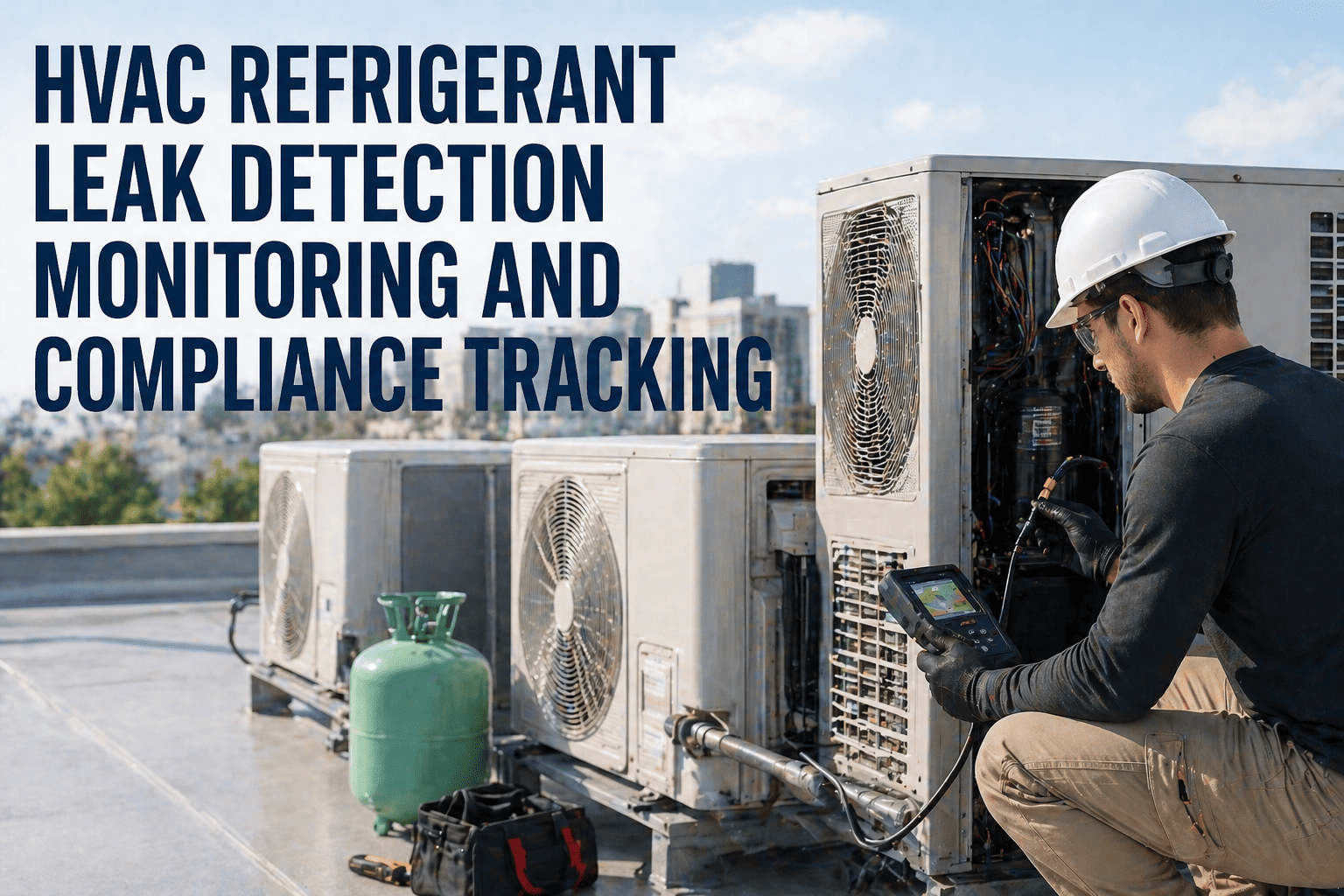
HVAC Refrigerant Leak Detection Monitoring & Compliance Tracking
Annual leak rate calculation, mandatory reporting thresholds, electronic leak detector inspection schedules, refrigerant log requirements, and retrofit/retirement decision frameworks — a complete EPA Section 608 compliance programme for commercial refrigeration and HVAC systems.
10%
EPA annual leak rate threshold — comfort cooling systems >50 lbs charge triggering mandatory repair and reporting obligations
30 days
Maximum time to complete repairs after leak detection for systems with annual leak rates exceeding EPA thresholds
$44,539
Maximum civil penalty per day of violation for non-compliant refrigerant management under EPA Section 608
3 years
Minimum record retention for all refrigerant purchase, recovery, and leak inspection records per EPA 40 CFR Part 82
Zone 1 — Refrigerant Inventory
Zone 2 — Leak Detection Methods
Zone 3 — Annual Leak Rate
Zone 4 — Mandatory Reporting
Zone 5 — Recordkeeping
Compliance Risk by Refrigerant System Status
Exceeded Leak Threshold
Critical — 30-day repair deadline, mandatory EPA reporting, civil penalty exposure
No Refrigerant Log
Critical — EPA citation; all purchases and additions must be recorded per 40 CFR Part 82
Leak Detected — Uninspected
High — leak detected but source not identified; 30-day timer starts at detection
Inspection Overdue
High — scheduled leak check missed; regulatory programme gap if system has triggered threshold
Approaching Threshold
Medium — annual leak rate trending toward 10%; increase inspection frequency
Zone 01
Refrigerant System Inventory — Know Every Pound Before You Track Any
EPA Section 608 compliance obligations are triggered by system charge size. Systems containing 50 pounds or more of regulated refrigerant are subject to annual leak rate calculation, reporting thresholds, and repair requirements. Without a complete inventory showing the full charge weight of every system, compliance managers cannot determine which systems are subject to which requirements — and cannot demonstrate to EPA inspectors that the programme covers all regulated equipment.
Inventory Development Tasks
EPA 40 CFR Part 82 Subpart F
Create asset record for every refrigerant-containing system — include system ID, location, equipment type, manufacturer, model, serial number, refrigerant type, and nameplate charge weight; register in OxMaint as individual assets
Record: Refrigerant system register · Role: Facility Manager
Identify systems containing 50+ lbs of regulated refrigerant — these trigger EPA Section 608 reporting thresholds; flag separately in OxMaint with "Regulated System" classification and applicable leak rate threshold
Record: Regulatory classification per system · Role: Facility Manager / Compliance Officer
Document refrigerant type per system — HFCs (R-410A, R-134a), HCFCs (R-22), or blends; applicable leak thresholds and phaseout schedules differ by refrigerant class; R-22 systems have additional HCFC phaseout compliance obligations
Record: Refrigerant type in asset detail · Role: Facility Manager
Record actual charge weight after last refrigerant addition or recovery — nameplate charge is the baseline; actual operating charge may differ after repairs, additions, or retrofits; log actual weight with date and technician name
Record: Current charge log per system · Role: EPA Section 608 Certified Technician
Zone 02
Leak Detection Methods — Inspection Frequencies and Accepted Techniques
EPA Section 608 does not mandate a single leak detection method, but it does require that the method used is capable of detecting a leak rate of 0.5 oz per year or greater. The inspection frequency must be appropriate to detect leaks before the annual threshold is exceeded. For systems approaching or previously exceeding the threshold, more frequent inspections are both a regulatory requirement and a cost-effective practice given the cost of refrigerant, the energy penalty of low charge operation, and the 30-day repair window.
Inspection Frequency by System Status
EPA 40 CFR §82.157
Systems below 10% annual leak rate threshold — minimum annual visual inspection plus electronic leak detection; OxMaint schedules annual inspection work order per system with 30-day advance reminder
Record: Annual inspection report · Role: EPA Section 608 Certified Technician
Systems that previously exceeded threshold and were repaired — quarterly leak check required until system demonstrates two consecutive clean inspections; OxMaint auto-generates quarterly work orders and tracks consecutive clean count
Record: Quarterly inspection reports with consecutive clean count · Role: EPA Section 608 Certified Technician
Systems with installed continuous monitoring — verify continuous monitor is operational, last calibration date is within 12 months, and alarm set points are configured per manufacturer specification and EPA guidance
Record: Monitor calibration and alarm verification log · Role: HVAC Technician
Inspection Tasks — Electronic Leak Detection
EPA §82.157(f)
Electronic leak detector verified operational before inspection — confirm sensitivity rating, calibration status, and battery condition; record detector serial number, model, and calibration date on inspection form
Record: Detector verification on inspection form · Role: EPA Section 608 Certified Technician
All accessible leak points inspected — service valves and stems, flare fittings, brazed joints, shaft seals (compressor and pump), pressure relief valve discharge, sight glass, evaporator and condenser coil connections, and any previously repaired locations
Record: Component-by-component inspection log with detection result · Role: EPA Section 608 Certified Technician
Oil staining inspection — yellow-brown oil staining on or near refrigerant connections is a reliable indicator of slow refrigerant leaks that electronic detectors may not catch in ventilated areas; photograph and record all oil stain locations
Record: Visual inspection findings with photos · Role: EPA Section 608 Certified Technician
Subcooling and superheat verification — operating subcooling below rated range indicates low refrigerant charge; superheat above rated range is consistent with low charge; document operating parameters and compare against design specifications
Record: Operating parameter log with design specs · Role: EPA Section 608 Certified Technician
OxMaint auto-schedules refrigerant leak inspections per system status, tracks EPA threshold proximity, and generates the 40 CFR Part 82-compliant documentation your EPA compliance programme requires.
Zone 03
Annual Leak Rate Calculation — The Number That Triggers Regulatory Action
The EPA annual leak rate is calculated as the total pounds of refrigerant added to a system during a rolling 12-month period, divided by the system's full charge, expressed as a percentage. This calculation must be maintained for every regulated system (50+ lbs charge) throughout the year — not just when an inspection occurs. A system that receives multiple small refrigerant additions across the year can cross the reporting threshold without any single addition being individually significant.
Leak Rate Calculation Tasks
EPA Annual Leak Rate = (Lbs Added / Full Charge) × 100
Record every refrigerant addition to any system >50 lbs — date, quantity in pounds (not cylinders), and reason for addition; OxMaint auto-calculates running annual leak rate and alerts when the system is within 2% of the applicable threshold
Record: Refrigerant addition log per system in OxMaint · Role: EPA Section 608 Certified Technician
Recalculate annual leak rate on rolling 12-month basis at each refrigerant addition — the rate is not a calendar year calculation; it uses the 12 months preceding each calculation date; OxMaint maintains the rolling calculation automatically
Record: Rolling leak rate calculation per system · Role: OxMaint Automated + Compliance Officer Review
Threshold comparison by system type — comfort cooling systems: 10% annual leak rate; industrial process refrigeration: 20%; commercial refrigeration: 20%; verify applicable threshold for each system type in OxMaint asset configuration
Record: Threshold configuration per system · Role: Compliance Officer
Zone 04
Mandatory Reporting & Repair Obligations
When a refrigerant system exceeds its applicable annual leak rate threshold, EPA Section 608 mandates specific actions with specific timelines. The 30-day repair deadline begins from the date the leak rate threshold is exceeded — not from the date repairs are completed or the date a service company is engaged. Missing this deadline is a per-day civil penalty violation that compounds until repairs are verified complete.
When Threshold Is Exceeded — Required Actions
EPA §82.157(d) — 30-Day Compliance Clock
OxMaint generates a Priority 1 compliance work order immediately when annual leak rate calculation exceeds threshold — document the threshold exceedance date as the start of the 30-day repair window; this date is not negotiable
Record: Threshold exceedance work order with start date · Role: OxMaint Automated + Facility Manager
Leak source identified and repair plan documented within 10 days — who will perform repairs, estimated completion date, and interim measures taken to minimise additional refrigerant release; document in OxMaint work order
Record: Repair plan in work order · Role: Facility Manager + HVAC Contractor
Leak verification test completed within 30 days of threshold exceedance — repair completed, system recharged, and electronic leak test performed and passed; document test result with technician certification number and date
Record: Repair completion and verification test · Role: EPA Section 608 Certified Technician
Retrofit or retirement evaluation required for systems with chronic leaks — systems that exceed threshold twice in 12 months require retrofit (to lower-GWP refrigerant) or retirement analysis; document evaluation and decision with supporting cost-benefit data
Record: Retrofit/retirement evaluation report · Role: Facility Manager + FPE / Compliance Counsel
Zone 05
Refrigerant Recordkeeping — What EPA Requires and How Long to Keep It
EPA Section 608 recordkeeping requirements are specific and enforceable. An EPA inspector can request records on-site during a compliance visit, and the inability to produce required records is treated as a violation regardless of whether the underlying refrigerant management was compliant. OxMaint maintains all required records per system with automatic retention tracking — no manual filing, no records assembled at audit time.
Required Records per Regulated System
EPA 40 CFR §82.166 — 3-Year Retention Minimum
Refrigerant purchase and addition log — date, quantity added, refrigerant type, service technician name and EPA certification number, and reason for addition; retain per-transaction records for a minimum of 3 years
Record: Refrigerant addition log in OxMaint · Role: EPA Section 608 Certified Technician
Leak inspection records — date, inspector name and certification, method used, locations inspected, result (pass/detect), quantity of any leak indication; all inspection records retained 3 years minimum
Record: Inspection records per system in OxMaint · Role: EPA Section 608 Certified Technician
Repair records — date, description of leak location and repair method, technician name and certification, post-repair verification test result, and date leak rate dropped back below threshold
Record: Repair completion records in OxMaint · Role: EPA Section 608 Certified Technician
Retrofit or retirement records — if system was retrofitted or retired following chronic leakage, retain documentation of the decision, the refrigerant recovered (type and quantity), recovery contractor certification, and disposal/reclaim certificate
Record: Retrofit/retirement package in OxMaint compliance module · Role: Facility Manager
Compliance Reference
EPA Section 608 Thresholds, Timelines & Record Requirements
| Requirement |
Comfort Cooling |
Commercial Refrigeration |
Industrial Process |
OxMaint Tracking |
| Annual leak rate threshold |
10% |
20% |
20% |
Auto-calculated per system; alert at 8% (comfort) / 18% (commercial) |
| Repair deadline after threshold exceedance |
30 days |
30 days |
30 days |
30-day countdown from threshold exceedance date; escalation at Day 15 |
| Post-repair verification inspection |
Required |
Required |
Required |
Verification work order auto-generated after repair completion |
| Quarterly inspection (post-threshold) |
Required until 2 consecutive clean |
Required until 2 consecutive clean |
Required until 2 consecutive clean |
Quarterly PM auto-scheduled; consecutive clean counter tracked per system |
| Minimum record retention |
3 years |
3 years |
3 years |
Retention date tracked per record; compliance dashboard flags expiring records |
| Technician certification required |
EPA Section 608 Certified |
EPA Section 608 Certified |
EPA Section 608 Certified |
Certification expiry tracked per technician; unqualified assignment blocked |
Expert Review
What Refrigerant Compliance and HVAC Professionals Say
01
The EPA violation pattern I see most often in enforcement actions is not a facility that ignored refrigerant management — it is a facility where the programme existed but the annual leak rate calculation was not being maintained in real time. They add refrigerant in March, a bit more in July, some again in October, and nobody totals it up until an EPA inspector arrives in December. By then they are looking at an 18% annual leak rate on a system with a 10% threshold and nine months of uncalculated, un-remediated violation. The calculation has to be live and automatic. That is not a nice-to-have — it is the only way the 30-day repair clock means anything.
EPA Section 608 Compliance Consultant · Former EPA Region II Enforcement Specialist · 16 Years Refrigerant Regulatory Compliance
02
Subcooling and superheat are the most underused diagnostic tools in refrigerant leak management. An electronic leak detector tells you there is a leak where it finds refrigerant vapour. Operating parameters tell you the cumulative effect of everything that has leaked — the detector catches active leaks, but parameter deviation catches the chronic, slow leak that has been losing 2% per month for six months and is not producing enough vapour concentration to trigger the detector on a single pass. Running both methods together is what catches the systemic leakers before they cross the reporting threshold.
Certified Energy Manager (CEM), LEED AP · HVAC Systems Engineer, Large Commercial Portfolio · 19 Years Refrigeration Systems Management
03
Our EPA compliance programme went from a quarterly spreadsheet reconciliation exercise to a continuous tracking system in OxMaint — and the first month we deployed it, we identified a 200-ton chiller that had been added to twice in three months without anyone calculating the annualised leak rate. It was already at 14% and heading for a reporting threshold breach before the end of the quarter. We caught it because OxMaint flagged the running total. Without that alert, we would have had a violation before the next manual reconciliation ran.
Director of Engineering, Commercial Real Estate Portfolio · 3.2M sq ft Under Management · 14 Years HVAC Compliance Management
FAQs
Frequently Asked Questions
Does the EPA 10% leak rate threshold apply to systems containing HFCs like R-410A, or only to ozone-depleting HCFCs?
The EPA's leak rate thresholds under 40 CFR Part 82 Subpart F apply to all refrigerants regulated under the CAA, including HFCs (R-410A, R-134a, R-32) and not just ODS refrigerants like R-22. The AIM Act of 2020 extended EPA's authority to regulate HFCs, and EPA's updated Section 608 regulations apply leak rate thresholds to systems containing HFC refrigerants in addition to HCFCs and CFCs. For comfort cooling systems containing 50+ lbs of any regulated refrigerant — including R-410A — the 10% annual leak rate threshold and associated reporting, repair, and recordkeeping obligations apply in full.
Book a demo to see OxMaint's refrigerant type configuration for EPA threshold tracking.
What counts as the start date for the 30-day repair clock when a system exceeds the annual leak rate threshold?
The 30-day repair clock begins on the date the system's annual leak rate is calculated to exceed the applicable threshold — which is the date the most recent refrigerant addition pushes the rolling 12-month total over the limit. If the addition is recorded on a service visit invoice dated June 15th, the 30-day clock starts June 15th, regardless of when the invoice is processed, when the work order is closed, or when the facility manager reviews the record. This is why OxMaint's real-time rolling calculation matters — it identifies the threshold exceedance date at the moment of the addition, not when someone reviews the records later.
See how OxMaint auto-calculates the rolling leak rate and start date tracking.
Can a facility manager perform refrigerant leak inspections, or must they be done by an EPA Section 608-certified technician?
Visual inspections for oil staining, ice formation, or physical damage can be performed by any building staff member as part of a routine facility check. However, inspections that involve handling refrigerant, connecting gauges to refrigerant systems, or performing any test that could result in the intentional venting of refrigerant require an EPA Section 608-certified technician. Electronic leak detection inspections that do not involve opening the refrigerant circuit can technically be performed by uncertified personnel, but best practice and most legal interpretations recommend Section 608 certification for all persons performing formal leak inspections that generate EPA compliance records. OxMaint tracks Section 608 certification expiry per technician and flags expired certifications before work order assignment.
Every Pound Added. Every Inspection. Every Threshold. One EPA Compliance Record.
OxMaint's Compliance Tracking calculates rolling annual leak rates in real time, auto-schedules inspection work orders per system status, generates 30-day repair countdown alerts, and produces the 40 CFR Part 82-compliant documentation that EPA inspectors request — as a byproduct of your normal refrigerant management operations.