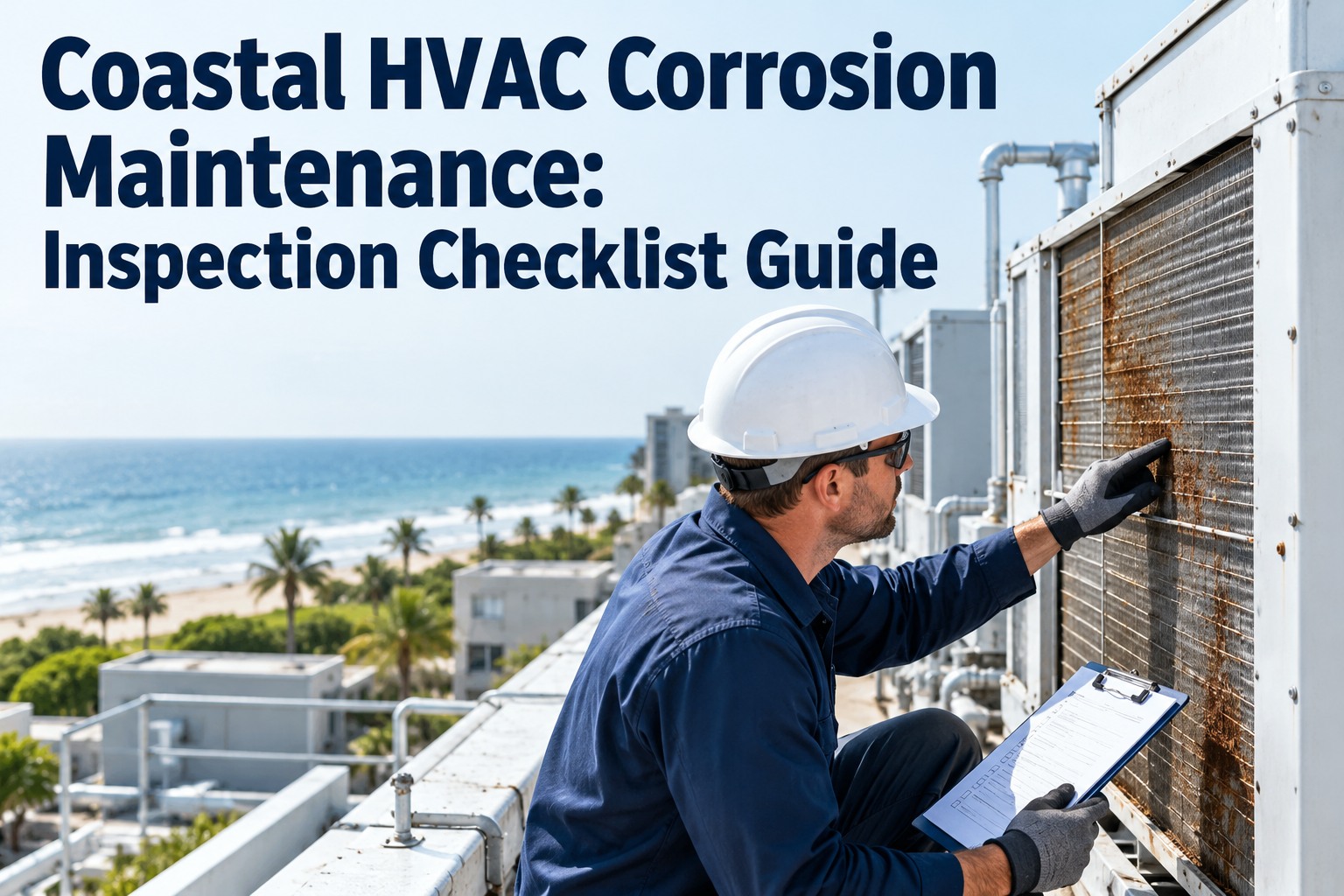
White powder dusting the coil fins, rust creeping up the cabinet screws, a pinhole refrigerant leak that keeps coming back — on the coast, salt air never sleeps, and it eats metal quietly enough that the first real symptom is often a failed coil or a dead compressor. A generic PM checklist walks right past it. This coastal corrosion checklist puts coils, coatings, cabinets, fasteners and cleaning on a schedule that matches your salt zone — run on OXMAINT AI, the AI-powered CMMS that turns every corrosion finding into a tracked, ranked work order.
HVAC Facility Operations · Coastal Corrosion · Inspection Checklist
Coastal HVAC Corrosion Maintenance: Inspection Checklist Guide
Standardize coastal HVAC corrosion inspections on one platform — coils, coatings, cabinets, fasteners, electrical and cleaning, on a cadence matched to your distance from the water, with every corrosion finding raising a ranked corrective work order and logged per unit for warranty and replacement planning.
1 Inspect
2 Rinse
3 Protect
4 Document
1–2 Miles
the coastal band where salt corrosion runs the fastest
2× a Year
coastal service cadence, against once-yearly for inland units
>70% RH
salt plus humidity forms the layer that quietly eats metal
3 Fronts
coils, cabinet and fasteners all attacked at once
Why Coastal HVAC Earns Its Own Checklist
Salt particles settle on every metal surface, and in humid coastal air they form a corrosive film that works on aluminum fins and copper tubing around the clock. The damage is slow and silent — heat transfer drops, energy creeps up, and a coil develops a pinhole leak long before anything looks dramatic. By the time a standard annual PM notices, the cabinet is rusting from the outside in and the repair is a replacement. A coastal checklist catches it while it is still cleaning and touch-up, not capital. Sign up free and build your coastal corrosion checklist in OXMAINT AI.
Know Your Salt Zone — Distance Sets the Cadence
The single biggest driver of corrosion rate is how far the unit sits from salt water. Set the inspection and rinse cadence to the zone, not to one blanket calendar, and the checklist does the rest. Book a demo to see cadence set automatically by salt zone.
SEVERE
Within ~1 mile · beachfront
Constant salt deposition and spray. Coated coils and stainless hardware are essential, not optional.
Rinse monthly · inspect quarterly
HIGH
About 1–5 miles
Regular salt-laden breeze reaches the equipment. Coil coatings strongly advised on every unit.
Rinse quarterly · inspect semi-annually
MODERATE
About 5–20 miles
Intermittent salt carried inland on strong winds. Watch for early signs and treat them fast.
Rinse semi-annually · inspect annually
Distances are general guides — prevailing wind, dunes, barriers and elevation shift the real exposure, so let observed corrosion rate fine-tune the zone.
What Corrosion Looks Like — Catch It Early
Salt damage shows itself the same few ways across every coastal site. Train every technician to spot these four on sight, and most corrosion gets caught while it is still a cleaning job.
1
White / Chalky Fin Buildup
Powdery oxide on the coil fins — heat transfer is already dropping.
2
Rust Streaks & Bubbling Paint
On cabinet, panels, screws and fasteners — corrosion working inward.
3
Pinhole Refrigerant Leaks
Tiny perforations in the copper — recurring low-charge service calls.
4
Electrical Contact Pitting
Corroded contactor points and terminals — intermittent, nagging faults.
The Coastal Corrosion Inspection Checklist
Six component areas, each on its own cadence. Tick as you go — the boxes are live. Start free and run this checklist on mobile, one tap per check.
Baseline frequency:
M · Monthly
Q · Quarterly
S · Semi-Annual
A · Annual
When You Find It — Corrective Actions
A corrosion finding is only worth logging if it turns into the right fix before the metal is gone. These four cover almost every coastal finding, in rising order of cost. Book a demo to auto-raise a corrective work order from any failed check.
RINSE & CLEAN
Salt deposits or chalky film on coils and surfaces
Low-pressure freshwater rinse with power off — clear the salt before it etches.
RECOAT / TOUCH UP
Coating chipped or worn to bare metal
Touch up or schedule a recoat before pitting starts under the breach.
REPLACE FASTENERS
Screws and bolts rusted or seizing
Swap for stainless — never reuse a corroded fastener on a coastal unit.
REPAIR / REPLACE PART
Coil pinhole, pan rust-through or pitted contacts
Repair or replace the component, and log it against the unit's corrosion history.
Preventive Maintenance — Stop It Before It Starts
The cheapest corrosion repair is the one you design out. A coastal PM program leans on a handful of habits that keep salt off the metal and the metal protected. Start free and schedule coastal PMs by salt zone.
A
Service Twice a Year
Coastal units get two professional services a year, not the inland one.
B
Rinse on a Zone Schedule
Freshwater coil rinses matched to how close the unit sits to the water.
C
Specify Protection at Install
Coated coils and stainless hardware chosen at install or replacement time.
D
Close Small Repairs Early
Clearance kept, irrigation redirected, and every small finding fixed fast.
Catch the Corrosion While It's Still a Cleaning Job.
Put the salt-zone cadence, the inspection checklist, the corrective work orders and the per-unit corrosion history on one platform — so coastal equipment gets the attention the inland schedule never gave it.
How OXMAINT AI Runs the Coastal Corrosion Program
One platform behind the whole loop — the zone, the schedule, the checklist, the corrective work orders and the history. This is the maintenance management software that keeps coastal HVAC inspected on the right cadence and evidenced for warranty and capital planning.
ZONE IT
Every Unit Tagged by Salt Zone
Each asset carries its distance-from-coast exposure, so cadence and protection match the real risk — not one blanket schedule.
SCHEDULE IT
Rinse & Inspection PMs by Zone
Monthly to annual PMs fire on the interval each zone needs, so no coastal unit quietly slips onto the inland calendar.
INSPECT IT
The Checklist on Every Phone
Coils, coatings, cabinet, fasteners, electrical and cleaning as one-line checks — the same inspection on every unit.
FIX IT
A Finding Becomes a Work Order
Any corrosion check that fails opens a ranked corrective work order — rinse, recoat, re-fasten or replace — tracked to close.
TRACK IT
Coating & Hardware History
Recoats, stainless swaps and coating condition held per unit, so you know exactly what protection each asset carries.
PROVE IT
Corrosion Record for Warranty
Full corrosion history per asset — the evidence behind a warranty claim and the data behind a replace-or-repair call.
"
Our beachfront rooftop units were on the same annual PM as the ones ten miles inland, and we kept wondering why they died in half the time. Once we tagged them by salt zone and started monthly rinses with a real corrosion checklist, the coil replacements basically stopped. The checklist didn't tell us anything a good tech didn't already know — it made sure the beachfront units actually got looked at on a beachfront schedule.
Facilities Manager · Coastal Hospitality Group
Frequently Asked Questions
How often should coastal HVAC units be inspected and cleaned?
Set it by salt zone. Beachfront units (within about a mile) do best with monthly rinses and quarterly inspections; one to five miles out, quarterly rinses and semi-annual inspections; further inland, semi-annual rinses and annual checks. Coastal equipment generally gets two professional services a year versus one inland.
Sign up free to schedule by zone in OXMAINT AI.
How does salt air actually damage HVAC equipment?
Salt settles on metal surfaces and, with coastal humidity, forms a corrosive film that attacks aluminum fins and copper tubing. It reduces heat transfer, pits cabinets and fasteners from the outside in, and drills pinhole refrigerant leaks — often with no obvious symptom until efficiency drops or a coil fails.
Do coastal HVAC coils need special coatings?
In the severe and high zones, yes. A factory or field-applied coil coating slows salt attack dramatically and is strongly advised within a few miles of the water. Pair it with stainless hardware and regular freshwater rinses for the biggest gain in equipment life.
How far inland does salt-air corrosion reach?
Corrosion is fastest within a mile or two, but salt-laden breezes carry well inland — often five to twenty miles on strong prevailing winds. Local terrain, dunes and barriers change the real exposure, so the observed corrosion rate should fine-tune each unit's zone.
Why track coastal corrosion in a CMMS?
It sets each unit's cadence by salt zone, runs the same inspection every time, raises a corrective work order when a check fails, and keeps a corrosion history per asset — the evidence for a warranty claim and the data behind a replace-or-repair decision.
Right Zone. Right Cadence. Every Coastal Unit on the Record.
Move your coastal HVAC corrosion program onto OXMAINT AI — salt-zone cadence, a standard inspection checklist, corrective work orders raised on the spot, and a full corrosion history per unit. Stop replacing coils in the dark and start staying ahead of the salt.