Your HVAC system accounts for 40% of your building's total energy bill — the single largest operating expense under your roof. A neglected system consumes 20% more energy, fails 3 to 5 times more expensively, and dies 8 to 10 years earlier than a maintained one. Preventive maintenance delivers a documented 545% return on every dollar invested, reduces unplanned downtime by 73%, and extends equipment life from 12 years to over 20. Yet most facility teams still manage HVAC schedules on spreadsheets or paper logs that cannot track completion, flag overdue tasks, or build the service history needed for capital planning decisions. This guide covers every HVAC equipment type, recommended frequencies, seasonal scheduling, and how OxMaint CMMS turns manual tracking into automated, documented PM programs.
Complete Guide to HVAC Preventive Maintenance: Equipment, Schedules, and CMMS Integration
Every equipment type. Every recommended frequency. Seasonal scheduling. CMMS integration. The definitive HVAC PM reference for facility managers and building operators.
Why HVAC Preventive Maintenance Is Non-Negotiable
A dirty air filter alone increases energy consumption by 15% immediately. Multiply that across a building with 20 units over several months of neglect and you face thousands in wasted energy before any mechanical failure enters the picture. A poorly maintained 20-ton rooftop unit typically fails after just 9 years, while a well-maintained unit reaches its expected 14-year lifespan or beyond — a difference of tens of thousands in avoided replacement costs per unit.
Facilities with structured PM programs see 50% lower total maintenance costs, 5-8 years longer equipment life, and ROI exceeding 500%. Those without them spend 3-5 times more on emergency repairs and replace equipment years earlier than necessary. The choice is not whether to invest in PM — it is how quickly you can move from reactive firefighting to a systematic, tracked program that compounds savings every month. Sign up for OxMaint to start building that program today.
PM Frequency Framework: What Gets Done and When
Effective HVAC maintenance is not one annual visit. It is a layered program of tasks performed monthly, quarterly, and annually — each addressing different degradation timelines and failure modes. The frequency framework below applies to all commercial HVAC systems and should be adapted based on facility type, climate zone, and equipment criticality. Book a demo to see how OxMaint auto-generates work orders at each frequency tier.
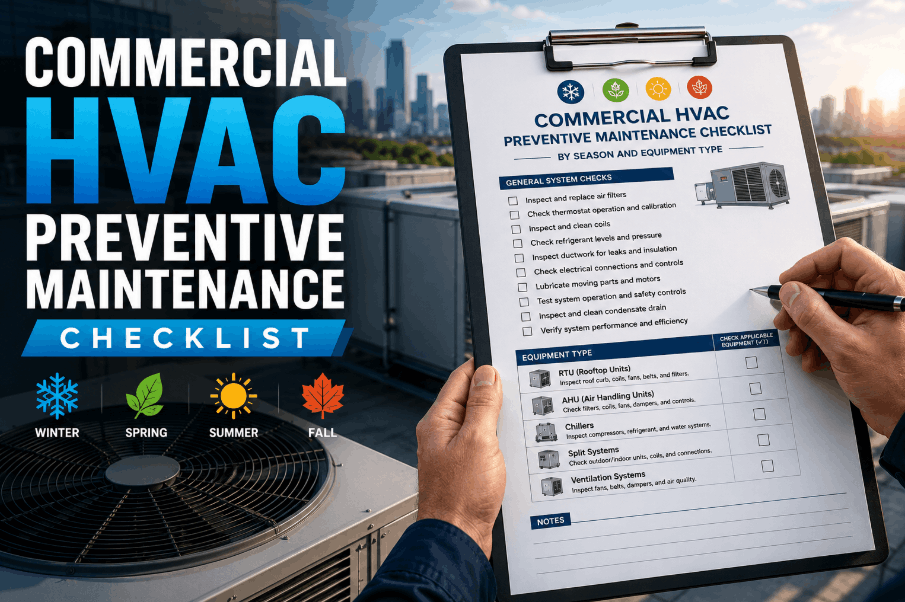
Air filter inspection and replacement is the single most impactful monthly task. Additionally, technicians should check belt tension and alignment, tighten electrical terminals, verify thermostat accuracy, clear condensate drain lines, and record equipment run hours for baseline tracking. These tasks take 15-30 minutes per unit and prevent the most common causes of efficiency loss and premature failure.
Professional inspection covers evaporator and condenser coil cleaning, refrigerant level testing and leak detection, lubrication of all moving parts, safety control and limit switch testing, and ductwork inspection. ASHRAE 180 and most manufacturer warranties require quarterly professional service for commercial systems.
The annual inspection is your HVAC system's full physical exam. It includes performance evaluation against manufacturer specifications, comprehensive electrical testing, heat exchanger inspection for cracks or corrosion, capital planning review for end-of-life assets, and refrigerant compliance checks for the R-410A phase-out transition.
As of January 2025, R-410A refrigerant is being phased out under the AIM Act in favor of R-32 and R-454B. New HVAC equipment costs are expected to increase 10-15%, and repairs on older R-410A systems will become progressively more expensive. Your annual inspection should include a refrigerant compliance assessment for every unit.
Equipment-Specific PM Requirements
Different HVAC equipment types have different failure modes, service intervals, and maintenance complexity. The table below maps each asset type to its recommended service frequency, expected lifespan with and without PM, and the key maintenance tasks that determine longevity.
| Equipment Type | Service Frequency | Life (No PM) | Life (With PM) | Key PM Tasks |
|---|---|---|---|---|
| Rooftop Unit (RTU) | Quarterly + seasonal | 8-10 years | 15-20 years | Filters, coils, belts, refrigerant, economizer |
| Chiller | Monthly + annual overhaul | 15 years | 25-30 years | Tube cleaning, oil analysis, vibration, controls |
| Boiler | Weekly checks + annual | 15 years | 25-35 years | Water chemistry, burner tuning, safety controls |
| Air Handling Unit | Monthly + quarterly | 12 years | 20-25 years | Filters, coils, bearings, dampers, VFD |
| Split System | Bi-annual | 10 years | 15-18 years | Refrigerant, coils, electrical, drainage |
| Cooling Tower | Monthly + seasonal | 10-12 years | 20+ years | Water treatment, fill media, basin, fans |
| VRF/VRV System | Quarterly | 10-12 years | 18-22 years | Refrigerant, compressor oil, filters, controls |
Seasonal Scheduling: Spring and Fall Preparation
The two most critical maintenance windows are spring (before cooling season) and fall (before heating season). These are where deferred maintenance becomes visible as performance failures during peak demand. Spring preparation focuses on cooling system readiness: condenser coil cleaning, refrigerant charge verification, economizer calibration, and cooling tower startup. Fall preparation focuses on heating system readiness: boiler startup procedures, heat exchanger integrity, combustion analysis, and fuel system checks. Both seasons should include full filter replacement, belt inspection, and electrical connection tightening across all units. Sign up for OxMaint to auto-schedule seasonal prep with pre-built task lists.
How OxMaint Transforms HVAC Maintenance
Paper logs document maintenance after the fact. They do not prevent failures. OxMaint replaces manual tracking with an automated system that schedules tasks, dispatches technicians, captures completion evidence, and builds a full asset history. Sign up free and have your first PM schedule running within the hour.
Auto-Scheduled PM Work Orders
Calendar-based and meter-based triggers generate work orders for every HVAC unit automatically. Monthly filter changes, quarterly inspections, and seasonal prep all fire on schedule with no manual intervention required.
Mobile Completion with Photos
Technicians complete PM tasks on their phone at the unit. Photo capture documents coil condition, filter state, and belt wear. Timestamped records build the service history that auditors and warranty providers require.
Energy and Cost Tracking
Link maintenance events to energy consumption data. Track cost per unit, cost per square foot, and repair-vs-replace analytics. Identify the 20% of units consuming 80% of your maintenance budget.
Compliance Documentation
ASHRAE 180 compliance, refrigerant tracking for the R-410A phase-out, and fire marshal inspection records are generated automatically from PM completion data. Audit preparation drops from days to minutes.
Preventive maintenance reduces equipment breakdowns by 40% and increases efficiency by 15-20%. But the real differentiator is not just having a PM program — it is executing the right tasks at the right cadence and documenting every one of them.
-- HVAC Industry Best Practice, ASHRAE Standard 180
Turn This Guide Into an Automated PM Program
Every schedule recommendation on this page becomes a tracked, assigned, and documented work order inside OxMaint. Auto-scheduled by frequency. Completed on mobile. Stored with timestamps and photos. Ready for any audit, any warranty claim, any capital planning decision.