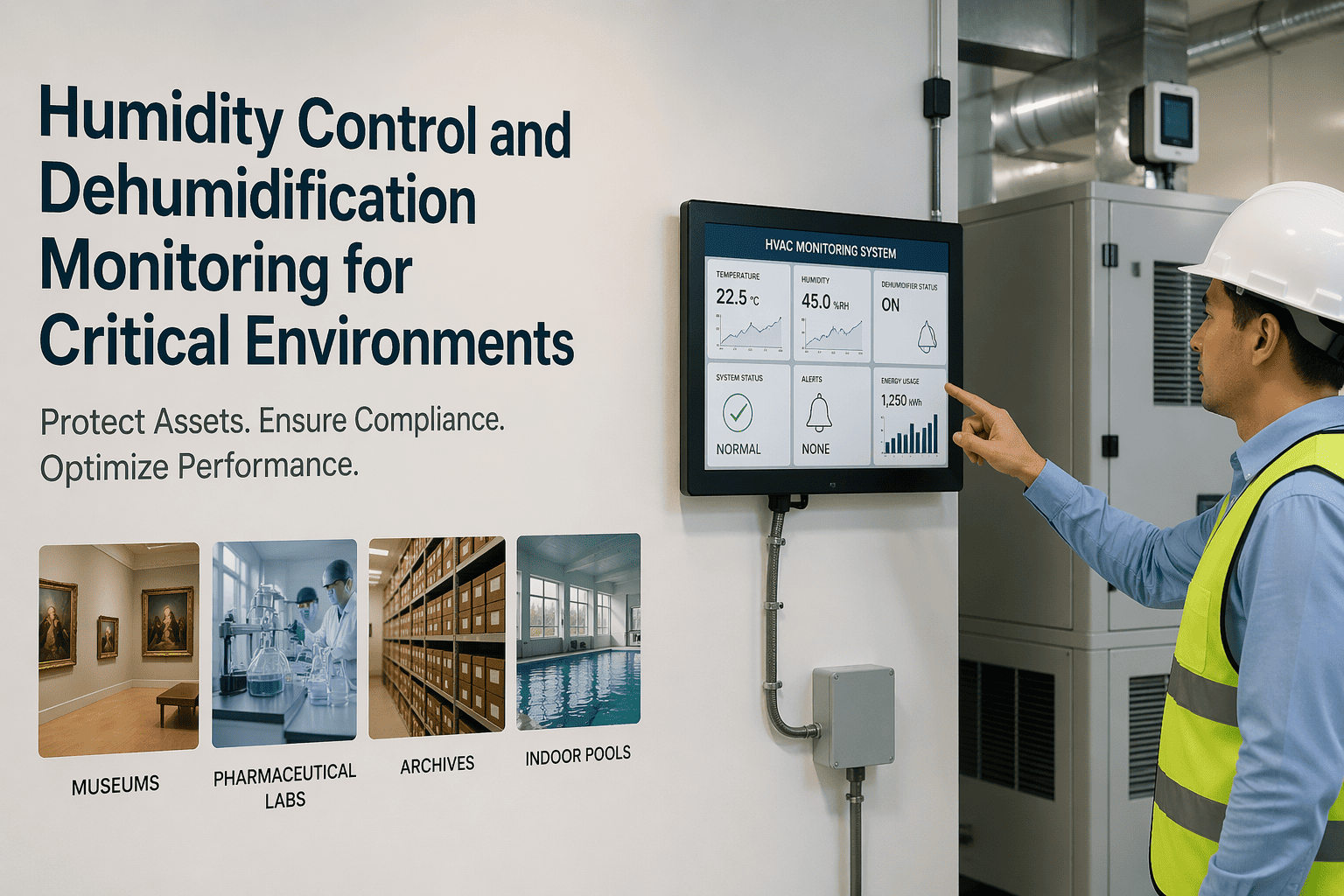
Humidity control failures are silent until they become expensive — 18% RH in winter triggering respiratory complaints, 68% RH in summer establishing mould behind wall liners and in drain pans. ASHRAE 55 requires 30–60% RH for occupied commercial spaces; ASHRAE 170 tightens that to 25–55% for healthcare with documented monitoring. A humidifier cylinder scaled to 30% of rated output still draws full current, still shows 100% demand signal, and still reports normal in the BAS while the building drifts out of specification. OxMaint’s Preventive Maintenance platform schedules every humidity system inspection, sensor calibration, and water treatment check on configurable intervals — building the digital record that proves your humidity controls are working, not just assumed to be.
Environmental Control · HVAC · Humidity Systems
HVAC Humidity Control System Monitoring Checklist
Steam humidifiers, evaporative and ultrasonic units, dehumidification coils, and humidity sensors — complete PM coverage referenced to ASHRAE 55, ASHRAE 170, ASHRAE Guideline 12, and WELL Building Standard.
30–60%
ASHRAE 55 acceptable RH band for occupied commercial spaces
<30% RH
Accelerates respiratory irritation, static events, and virus transmission
>60% RH
Mould growth risk threshold — 70%+ for 48 hrs creates colonisation conditions
25–55%
ASHRAE 170 tighter band for healthcare — documented monitoring required for accreditation
Zone 01 · Steam Humidifiers
Steam Humidifier Inspection Checklist
Scale accumulation on electrodes or heating elements reduces output capacity while energy draw remains constant. A cylinder covered 50%+ in scale delivers 30–40% of rated output while signalling normal operation. Drain function and fill rate are the first indicators of developing scale before any output shortfall appears.
Weekly
Monthly
Seasonal Rebuild
Weekly
Confirm drain valve cycles correctly — blocked drain causes rapid scale build-up within days in hard water areas. Confirm timed drain is active and flushingRecord: Drain cycling · Pass / Fail
Check fill rate — cylinder should reach operating level within 2–3 minutes of demand signal; slow fill indicates restricted fill valve or low supply pressureRecord: Fill rate: Normal / Slow · Water level: Correct / Low / High
Inspect steam dispersion manifold in AHU duct for blockage or mineral deposits — blocked tubes concentrate steam delivery and cause localised duct condensationRecord: Dispersion tubes: Clear / Partial blockage (tubes noted)
Monthly
Inspect electrodes for scale build-up — photograph and compare against baseline. Replace or descale per manufacturer conductivity-based schedule; do not judge solely by visual appearanceRecord: Scale level: Light / Moderate / Heavy (replace) · Conductivity: ___ μS/cm
Verify humidifier output tracks BAS demand signal — output <80% of demand at full signal indicates scale, electrode wear, or control fault requiring investigationRecord: Demand: ___% · Output: ___% · Deviation: ___%
Seasonal Rebuild
Drain and clean cylinder completely — inspect cylinder shell for corrosion pitting. Track cylinder hours-of-use for replacement (typically 2,000–4,000 hours depending on water hardness)Record: Cylinder hours: ___ · Pitting: None / Present · Replace: Yes / No
Replace all gaskets, O-rings, and drain valve seals — do not reuse seals past one full season regardless of visual condition; hardened seals fail under thermal cycling before deterioration is visibleRecord: Seals replaced · Parts logged · Role: Qualified Technician
Zone 02 · Evaporative & Ultrasonic Humidifiers
Evaporative & Ultrasonic Inspection Checklist
Both types introduce water directly into the airstream. Any contaminant in the supply water — bacteria, minerals, endotoxins — enters the occupied air. ASHRAE Guideline 12 applies to evaporative systems with open water surfaces. Ultrasonic units running on unfiltered hard water release mineral aerosol (“white dust”) that represents a real IAQ exposure, not just a maintenance annoyance.
Weekly
Inspect evaporative media pad for biological growth, scale, and structural integrity — slime, discolouration, or odour requires immediate cleaning and disinfection before system is returned to serviceRecord: Media: Clean / Scale / Biological growth (immediate action) · Ref: ASHRAE Guideline 12
Inspect ultrasonic transducer for mineral scale — scale reduces output efficiency by up to 40% and causes overheating. Descale with citric acid or manufacturer-approved solution onlyRecord: Scale: None / Light / Heavy · Last descale: ___
Measure reservoir water conductivity — target <200 μS/cm for ultrasonic units; high mineral content creates “white dust” mineral mist released into occupied air at every humidification cycleRecord: Conductivity: ___ μS/cm · Target: <200 μS/cm · Water treatment: Active / Fault
Monthly
Confirm Legionella control measures: supply water temperature <20°C (cold) or >60°C (hot), no stagnant dead-leg sections in feed lines, biocide dosing active per Water Safety PlanRecord: Supply temp: ___°C · Biocide dosed: Yes / No · Ref: ASHRAE Guideline 12 / OSHA 3385
Confirm bleed-off and daily drain function — standing water in reservoir between demand cycles must drain daily to prevent biological growth; confirm automatic bleed-off rate is set to prevent mineral concentrationRecord: Bleed-off active: Yes / No · Daily drain: Confirmed / Not confirmed
Schedule humidifier inspections, sensor calibrations, and water quality tests automatically across every AHU.
Zone 03 · Dehumidification Systems
Dehumidification Inspection Checklist
Cooling-coil dehumidification fails silently: RH climbs while air conditioning appears to run normally. Blocked condensate drain, fouled cooling coil, and refrigerant loss each reduce dehumidification capacity without triggering any alarm until humidity-driven mould or occupant complaints emerge weeks later.
Weekly
Confirm condensate drain pan and drain line are clear — pour water into pan and confirm drainage. Blocked condensate drain is the primary cause of AHU drain pan mould; standing water overflowing pan requires same-day clearingRecord: Drain flow: Free / Slow / Blocked (work order) · Standing water: None / Present
Verify zone RH is at or below cooling-season setpoint — sustained above-setpoint RH during cooling season triggers investigation: coil fouling, reduced airflow, refrigerant loss, or control sequence errorRecord: Zone RH: ___% · Setpoint: ___% · If above: investigation triggered
Monthly
Inspect cooling coil face for fouling or biological growth — a 10% reduction in coil face area reduces dehumidification capacity by approximately the same percentage. Biological growth on coil surface also contaminates supply air directlyRecord: Coil face: Clean / Fouled (cleaning work order) · Ice: None / Present (airflow fault)
For desiccant dehumidifiers: inspect desiccant wheel for oil contamination or physical damage — oil contamination irreversibly reduces desiccant capacity and cannot be cleaned; contaminated wheels require replacementRecord: Wheel condition: Good / Oil contamination (replace) / Physical damage
Zone 04 · Humidity Sensors & Controls
Sensor Calibration & BAS Control Checklist
A humidity control system is only as accurate as its sensors. Capacitive sensors drift 5–10% RH over 4–5 years without calibration verification. A sensor reading 45% when actual RH is 55% causes the humidifier to run continuously in an already over-humidified space — creating the condensation and mould conditions the control system was supposed to prevent.
Monthly
Compare fixed sensor against calibrated portable hygrometer at same location — allowable deviation ≤3% RH; deviation >5% requires recalibration or replacement. Test in occupied mode at stable temperatureRecord: Fixed: ___% · Portable: ___% · Deviation: ___% · Action: None / Calibrate / Replace
Confirm sensor location is representative — 1.1–1.8 m height, >1.5 m from supply diffusers, >0.5 m from exterior walls, away from localised moisture sources. A correctly calibrated sensor in the wrong location provides accurate but non-representative dataRecord: Sensor height: ___ m · Diffuser distance: ___ m · Location: Representative / Relocate
Quarterly
Calibrate or verify all duct-mounted RH sensors — return air sensors controlling humidifier output require ±2% RH accuracy; outdoor air sensors for economiser control require ±3% RH for effective enthalpy decisionsRecord: Duct sensor deviation per AHU · RA: ___% · SA: ___% · OA: ___%
Verify BAS alarm setpoints and confirm alert routing — high RH alarm at 63%; low RH alarm at 27% for standard commercial (healthcare per ASHRAE 170). Test alarm activation and confirm notification delivery to named responsible personRecord: High alarm: ___% · Low alarm: ___% · Alarm test: Pass / Fail · Routing: Confirmed
Confirm humidifier setpoint and deadband are correct for current season — a winter setpoint of 45% not adjusted for summer risks humidifier and dehumidifier running simultaneously in humid climatesRecord: Setpoint: ___% · Deadband: ±___% · Season-appropriate: Yes / No
Zone 05 · Water Treatment
Water Quality & Treatment Checklist
Water quality is the primary maintenance variable for steam and evaporative humidifiers. Hard water (300 mg/L) requires 3–4× more frequent descaling than soft water (80 mg/L). Water treatment reduces this burden — but softeners, RO systems, and chemical dosing programmes each require their own inspection cycle to remain effective.
Weekly
Measure supply water conductivity at humidifier inlet — electrode humidifiers: 125–1,250 μS/cm per manufacturer; ultrasonic: <200 μS/cm. Values outside range indicate water treatment failure or supply quality change requiring immediate investigationRecord: Conductivity: ___ μS/cm · Target: ___–___ μS/cm · In range: Yes / No
Check water softener salt level and confirm regeneration cycle is operating — a depleted softener passes hard water through to the humidifier; scale build-up begins within 24 hours in high-hardness areasRecord: Salt: Adequate / Low / Empty · Last regeneration: ___ · Next: ___
Monthly
Check RO/DI permeate conductivity (where installed for ultrasonic units) — replace membrane when permeate exceeds 10% of feed conductivity or >50 μS/cm absolute. Log membrane installation date and running hours for lifecycle trackingRecord: Permeate: ___ μS/cm · Feed: ___ μS/cm · Rejection: ___% · Membrane age: ___ months
Collect and submit water sample for laboratory analysis — Legionella, HPC, conductivity, hardness, pH, and inhibitor levels. Any Legionella positive result triggers immediate system shutdown per site Water Safety Plan regardless of concentrationRecord: Sample reference: ___ · Results received: Yes / Pending · Ref: ASHRAE Guideline 12 / CDC
KPIs
Humidity System Performance Metrics
| Metric | Target | OxMaint Tracking |
| RH Compliance Rate |
>95% of occupied hours within 30–60% RH · ASHRAE 55 |
Continuous sensor exceedance per zone |
| Sensor Calibration Compliance |
100% within calibration interval |
Calibration due dates auto work order per sensor |
| PM Completion Rate |
>95% of scheduled PM completed |
Auto-scheduled weekly / monthly / seasonal per unit |
| Drain Blockage Events |
<2 per AHU per year |
Drain blockage WO history per AHU |
| Water Sample Compliance |
100% on schedule · Zero Legionella positives |
Monthly sample WO per humidifier; results logged |
Expert Review
What Humidity Specialists Say
01
Electrode humidifier cylinders need to be replaced on hours-of-use tracking — typically 2,000–4,000 hours depending on water hardness — not on calendar or visual condition. A cylinder covered 70% in scale delivers 30% of rated output while drawing full current and showing 100% demand signal. The BAS looks normal; the building is out of specification.
Certified HVAC Engineer (MCIBSE), Commercial Humidification Specialist — 21 Years
02
Ultrasonic humidifiers running without RO or DI supply water below 200 μS/cm are introducing mineral aerosol into occupied air on every cycle. The sensor only measures relative humidity — it does not measure the mineral particle load that accumulates on surfaces and in occupant airways. Hard water plus ultrasonic humidifier equals an IAQ problem that looks like a housekeeping problem.
Certified Industrial Hygienist (CIH), WELL AP — IAQ Consultant · 17 Years
03
The most common humidity control failure I find in facility audits is not the humidifier — it is the sensor. A capacitive sensor in service 4–5 years without calibration typically reads 5–10% RH low. The humidifier runs continuously trying to reach 45% while actual zone RH is already 52%. The control system thinks it is maintaining setpoint. Nobody knows the building is chronically over-humidified.
Senior Facilities Manager, Class A Office Portfolio — 1.8M sq ft · 23 Years
FAQs
Frequently Asked Questions
How often should commercial HVAC humidity sensors be calibrated?
What is the Legionella risk in evaporative and ultrasonic humidifiers?
Evaporative systems with open water surfaces at 20–45°C are a defined Legionella risk under ASHRAE Guideline 12 and require a documented Water Safety Plan with biocide dosing, temperature control, and monthly laboratory sampling. Ultrasonic humidifiers present lower Legionella risk because they operate at ambient temperature, but require the same water quality monitoring for mineral aerosol control. Healthcare facilities (The Joint Commission) and institutional buildings have enforceable Legionella control requirements.
Book a demo to see how OxMaint manages water safety plan tasks per humidifier asset.
Why does RH drop in winter even when the humidifier appears to be running?
Winter RH drops for three reasons independent of humidifier function: cold outdoor air infiltration brings in air with very low absolute moisture content; heating reduces relative but not absolute humidity; and building pressurisation increases envelope leakage. A humidifier running continuously but unable to maintain setpoint in cold weather is either undersized for actual winter infiltration load, has reduced output from scale or electrode wear, or is facing an outdoor air volume exceeding its capacity. The last condition requires a load calculation review, not additional humidifier maintenance.
Preventive Maintenance · OxMaint · HVAC Humidity
Humidity Failures Are Silent Until They’re Expensive. Start Catching Them on Schedule.
OxMaint schedules every humidifier inspection, electrode check, water quality test, sensor calibration, and drain verification on configurable intervals — building the compliance record that proves your humidity controls are working, not just assumed to be.