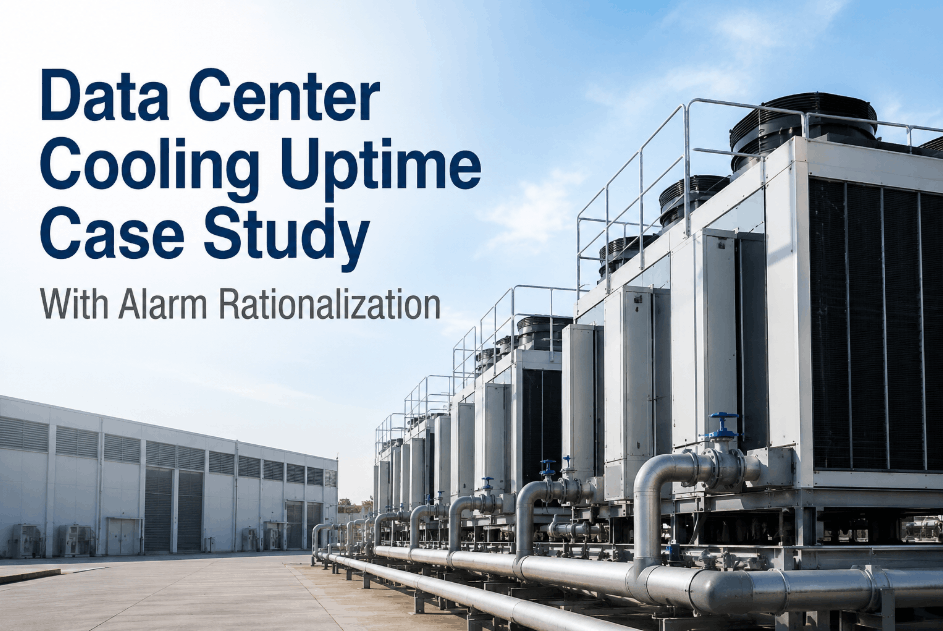
Data centers running mission-critical cooling infrastructure face an uptime risk that rarely comes from cooling equipment failing outright — it comes from alarm volume burying the one alert that actually matters. CRAC units, chillers, and cooling towers generate constant threshold notifications, and when every minor fluctuation triggers the same alert as a real thermal event, on-call engineers stop trusting the alarm feed altogether. A single-site Tier III colocation facility ran into exactly this pattern: alarm volume had grown past what NOC staff could triage in real time, genuine cooling anomalies sat buried in routine noise, and leadership had no reliable way to separate nuisance alerts from early failure signals. If your facility is managing data center cooling uptime without alarm rationalization or asset-level threshold tuning, Sign Up Free to see how Oxmaint structures alarm rationalization for critical cooling systems — or Book a Demo with a critical facilities specialist.
Alarm Rationalization · Predictive Cooling Alerts · Auto Work Orders
Stop Triaging Every Alarm the Same Way and Start Trusting the One That Matters
Asset-specific thresholds, predictive anomaly detection, and automated work order escalation — Oxmaint helps critical facility teams turn alarm noise back into a signal NOC staff can act on.
Facility Profile
The Operation: A Mission-Critical Cooling Fleet Drowning Its Own Real Alerts in Routine Noise
Facility Overview
IndustryMission-critical data center — Tier III colocation facility
Scope1 facility, 42,000 sq ft of white space, 86 monitored cooling assets (CRAC/CRAH units, chillers, cooling towers, pumps)
Team6 facility engineers, 4 NOC controllers, 1 critical facilities manager
Prior SystemBMS alarm feed routed to on-call pager and email with no severity tiering or link to asset service history
Oxmaint FeaturesPLC & Sensor Integration · Predictive Maintenance · Work Order Management · AI & Automation · Analytics & Reporting Dashboards · Asset Management
Baseline Alarm Issues
1,140/mo
Average monthly alarm events generated across the cooling fleet
68%
Of alarms fell below any threshold requiring technician action
22 min
Average time before NOC staff distinguished a real cooling deviation from routine noise
Root Cause Analysis
Why Real Cooling Deviations Stayed Buried in Alarm Noise
A review of the BMS alarm log, NOC escalation tickets, and cooling asset service history revealed four compounding gaps in how alerts were structured and acted on. The cooling fleet itself was sound — the failure was in how alarm data was prioritized. Sign Up Free to bring alarm rationalization to your cooling fleet — or Book a Demo to see threshold tuning on a live system.
38%
Every Cooling Asset Shared the Same Alarm Thresholds Regardless of Criticality
CRAC units feeding redundant zones triggered the same severity tier as units with no backup, so NOC staff treated every alert with equal — or equally low — urgency.
29%
No Link Between Repeat Nuisance Alarms and Asset Health Trends
A chiller could trip a minor threshold dozens of times in a week with nothing flagging the pattern as a developing fault, so early degradation looked identical to sensor noise.
21%
Work Orders Created Manually After Alarms, Not From Verified Deviations
NOC staff had to manually open a ticket for every alarm worth escalating, a slow step that delayed response and was occasionally skipped during high-volume nights.
12%
No Reporting Connected Alarm Volume to Actual Cooling Incidents
Leadership couldn't show whether rationalization or cooling capex was reducing real incidents, since alarm counts and verified failures lived in separate systems.
The Solution
How Oxmaint Rationalized Cooling Alarms and Automated Escalation by Asset Criticality
The facility deployed Oxmaint to connect live cooling data to a single asset register, rebuild thresholds around actual criticality, and let predictive models flag genuine degradation. Sign Up Free to see asset-specific threshold tuning on your own cooling fleet — or Book a Demo to walk through predictive anomaly detection live.
01
Sensor and PLC Integration Brought Live Cooling Data Into One Asset Register
Oxmaint's PLC and sensor integration connected directly to the cooling fleet's controllers, giving every CRAC unit, chiller, and cooling tower a live feed tied to its specific asset record instead of a shared, undifferentiated alarm queue.
02
Asset-Specific Threshold Tuning and Predictive Anomaly Detection Cut Nuisance Alerts
Each asset's thresholds were rebuilt around its real criticality and historical behavior, and predictive maintenance models began flagging trend-based degradation instead of waiting for a hard threshold breach.
03
Verified Deviations Now Auto-Generate Prioritized Work Orders
When sensor data crosses a rationalized threshold or a predictive model flags a genuine anomaly, Oxmaint automatically creates a work order, assigns it by asset criticality, and routes it to the right technician — no manual ticketing step required.
04
Consolidated Analytics Dashboards Track Alarm Volume Against Verified Incidents
Facility leadership now sees alarm volume, escalation rate, and confirmed cooling incidents on one dashboard, making it possible to measure whether rationalization is actually reducing risk.
Results at 60 Days
Alarm Volume, Response Time, and Predictive Catches Two Months After Deployment
71%
Reduction in total monthly alarm volume after threshold rationalization
6 min
Average time to acknowledge a verified cooling deviation — down from 22 minutes
100%
Of cooling assets now on asset-specific, criticality-based thresholds
4
Early-stage faults caught by predictive flags before reaching alarm threshold
34%
Reduction in unplanned cooling-related downtime minutes
2.9×
ROI on Oxmaint platform cost within 60 days from reduced NOC overtime and avoided downtime
| Metric |
Before Oxmaint |
60 Days After |
Change |
| Monthly alarm volume |
1,140 average events |
~330 average events |
-71% |
| Time to acknowledge verified deviation |
22 minutes average |
6 minutes average |
-73% |
| Assets on rationalized thresholds |
0% asset-specific |
100% asset-specific |
+100% |
| Unplanned cooling downtime |
Untracked baseline |
34% reduction measured |
-34% |
| Work order creation from alarms |
Manual, per alarm |
Automated for verified deviations |
Automated |
| Platform ROI |
Not measured |
2.9× within 60 days |
2.9× |
Key Business Impact
What Alarm Rationalization Means for Data Center Cooling Uptime
Data centers don't usually lose cooling uptime to a single dramatic failure — they lose it to alert fatigue, where the alarm that actually mattered got treated the same as the hundredth nuisance trip that week. Rationalizing thresholds by asset criticality and letting predictive models flag real degradation is what turns an alarm feed back into something a NOC team can trust. Oxmaint gives facility teams that structure without re-engineering the BMS itself — just a connected asset register and thresholds that reflect how each unit actually fails.
Marcus Whitfield, Critical Facilities & Data Center Cooling Reliability Specialist
14 years critical infrastructure operations · Former site reliability engineer, Tier III colocation provider · Specialist in alarm rationalization, predictive cooling maintenance, and uptime reporting for mission-critical facilities
Rationalized Thresholds · Faster Response · Predictive Catches
Give Your NOC Team an Alarm Feed Worth Trusting Again
Asset-specific thresholds, predictive anomaly detection, automated work order escalation, and consolidated alarm reporting — Oxmaint helps critical facility teams protect cooling uptime with one reliable signal.
FAQs
Frequently Asked Questions
How does Oxmaint help reduce alarm noise from data center cooling systems?
Through PLC and sensor integration combined with asset-specific threshold tuning, rationalizing alerts by criticality so nuisance alarms drop and real deviations stand out.
Can Oxmaint automatically create work orders from cooling system alarms?
Yes. Verified deviations crossing rationalized thresholds or flagged by predictive models auto-generate prioritized work orders routed to the right technician.
Does Oxmaint support predictive maintenance for cooling assets like CRAC units and chillers?
Yes. Sensor and PLC data feeds predictive models that flag developing faults before they reach an alarm threshold.
How does Oxmaint report on alarm volume versus actual cooling incidents?
Consolidated analytics dashboards track alarm counts, escalations, and confirmed incidents together so leadership can measure whether rationalization reduced real risk.
How long does it take to rationalize alarm thresholds across a cooling fleet with Oxmaint?
Most facility teams complete asset-specific threshold tuning within the first few weeks of integration, with automated work order routing active shortly after.
Every Cooling Asset, One Reliable Signal
Bring Alarm Rationalization and Predictive Cooling Maintenance to Your Data Center
Oxmaint brings asset-specific thresholds, predictive anomaly detection, automated escalation, and consolidated reporting to mission-critical facility teams — without re-engineering your BMS.