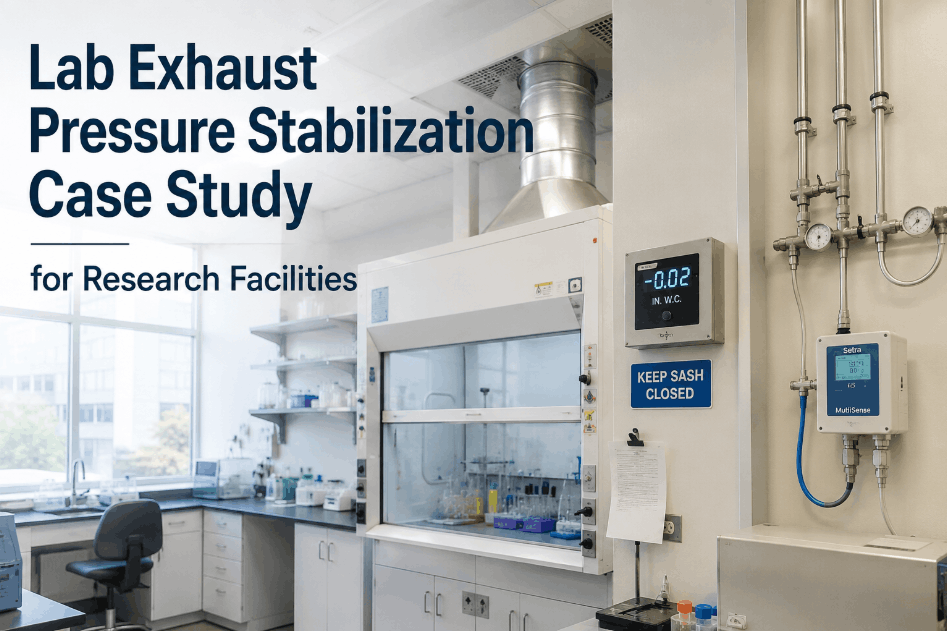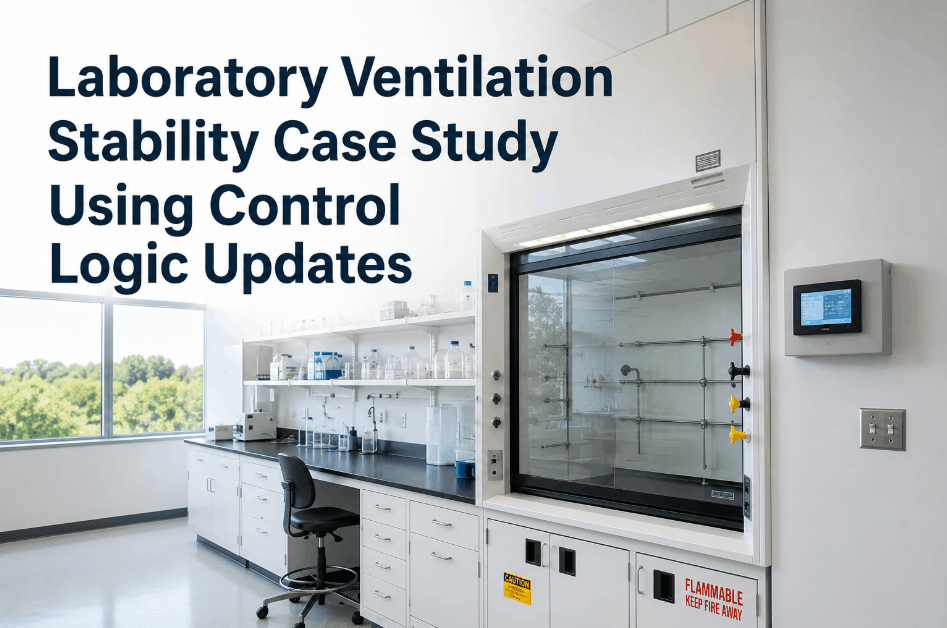
Ventilation instability in laboratory environments is a high-consequence maintenance problem — not merely a comfort issue, but a compliance and safety exposure that compounds with every hour that airflow, exhaust balance, and room pressure relationships drift outside acceptable ranges. A research facility operating multiple critical lab spaces found its ventilation system unable to maintain stable conditions under varying occupancy and equipment loads. Control logic had not been updated since original installation, exhaust balance across rooms had shifted over time as equipment configurations changed, and room pressure response to load variations had never been formally tested or documented. The result was an environment where airflow instability threatened both regulatory compliance and the integrity of sensitive research work. If your laboratory or research facility is managing ventilation instability without structured control validation and maintenance documentation, Sign Up Free to see how Oxmaint supports critical environment maintenance execution — or Book a Demo with a facility maintenance and compliance specialist.
The Operation: Research Laboratory Facility With Outdated Control Logic and Ventilation Instability Under Changing Loads
Why Laboratory Ventilation Kept Drifting — And Why Load Changes Exposed the Control System's Limits
A structured diagnostic review of control logic records, exhaust balance data, and room pressure readings across all 11 laboratory spaces identified four compounding gaps that were sustaining the ventilation instability problem. The facility had functional mechanical infrastructure — the failure was in control logic currency, exhaust network balance, and the absence of structured test and validation records. As lab equipment configurations evolved and room usage patterns shifted since commissioning, the control system had never been updated to reflect those changes, leaving the facility operating on assumptions that no longer matched actual conditions. Sign Up Free to build structured ventilation maintenance and compliance records for your laboratory facility — or Book a Demo to see how Oxmaint structures critical environment work order execution.
How Oxmaint Supported Laboratory Ventilation Stability Through Structured Control Updates and Validation Records
The facility deployed Oxmaint to bring structured execution and documentation to a ventilation maintenance environment that had been running without records or escalation processes. Each laboratory room and exhaust zone was set up as an asset in Oxmaint. Control logic review and update tasks were structured as work orders with engineering sign-off fields, creating a documented record of every change to VAV sequences and room setpoints. Exhaust balance work was scheduled as a structured project across all three risers, with flow readings captured before and after rebalancing at each branch. Room pressure response testing was formalized as a recurring compliance-linked PM task, with structured checklists capturing supply, exhaust, and differential pressure under low-load, normal-load, and high-load conditions. Ventilation anomalies were escalated through the work order system rather than resolved verbally, building the first audit-ready maintenance record the facility had produced. Book a Demo to see how Oxmaint manages compliance-linked maintenance execution for critical environments.
VAV control sequences were reviewed against current laboratory configurations and updated where mismatches were found. Each control change was documented as a work order in Oxmaint with before-and-after parameter records, the triggering finding, and engineering sign-off captured — creating the first auditable control change log the facility had maintained since commissioning.
Exhaust balance work across all three risers was structured as a series of linked work orders in Oxmaint, with flow readings at each branch documented before rebalancing and after. Room-to-room pressure relationships were verified at each stage, and riser sign-off required verified differential readings within specification before the work order was closed — replacing informal adjustments with a documented, verifiable process.
Room pressure response tests were scheduled in Oxmaint as recurring PM tasks for all 11 laboratory spaces, with checklists capturing supply, exhaust, and differential pressure readings under three load conditions. Test results were stored against each room's asset record, creating a baseline for trend comparison and a compliance-ready documentation set for each space that had never previously existed.
Airflow deviations, pressure alerts, and ventilation complaints were structured as work orders in Oxmaint linked to the specific room and VAV asset. Escalation thresholds were configured to flag deviations that exceeded acceptable ranges, and every corrective action was documented with findings and resolution before closure — building a compliance record that replaced informal handling with a traceable, auditable log.
Ventilation Stability, Compliance Documentation, and Control Consistency Metrics Three Months After Deployment
| Metric | Before Oxmaint | 90 Days After | Change |
|---|---|---|---|
| Rooms meeting pressure specification under load | 4 of 11 rooms | 10 of 11 rooms | +6 rooms |
| Pressure recovery time after load change | 4.2× design specification | Within 1.1× specification | -76% |
| Room pressure response test records | 0 rooms documented | All 11 rooms documented | +100% |
| Control logic change documentation | None — no records since commissioning | Full work order audit trail | Structured |
| Ventilation anomalies resolved informally | High — no work order process | 83% reduction | -83% |
| Exhaust network balance verification | Book a Demo |