Heat pumps have become the dominant choice for energy-efficient heating and cooling in commercial and residential buildings — but their efficiency advantage over conventional systems exists only when the equipment is properly maintained. An air-source heat pump operating with a dirty coil, low refrigerant charge, or failing reversing valve can consume 40% more energy than its rated COP while delivering less comfort. Geothermal systems face additional risks from ground loop pressure loss and antifreeze degradation that most facilities teams are not equipped to detect without a structured protocol. This maintenance checklist covers both air-source and ground-source heat pump systems — aligned with ACCA, ASHRAE, and manufacturer PM standards — and is designed to integrate directly with OxMaint's preventive and predictive maintenance platform for automated scheduling and compliance documentation.
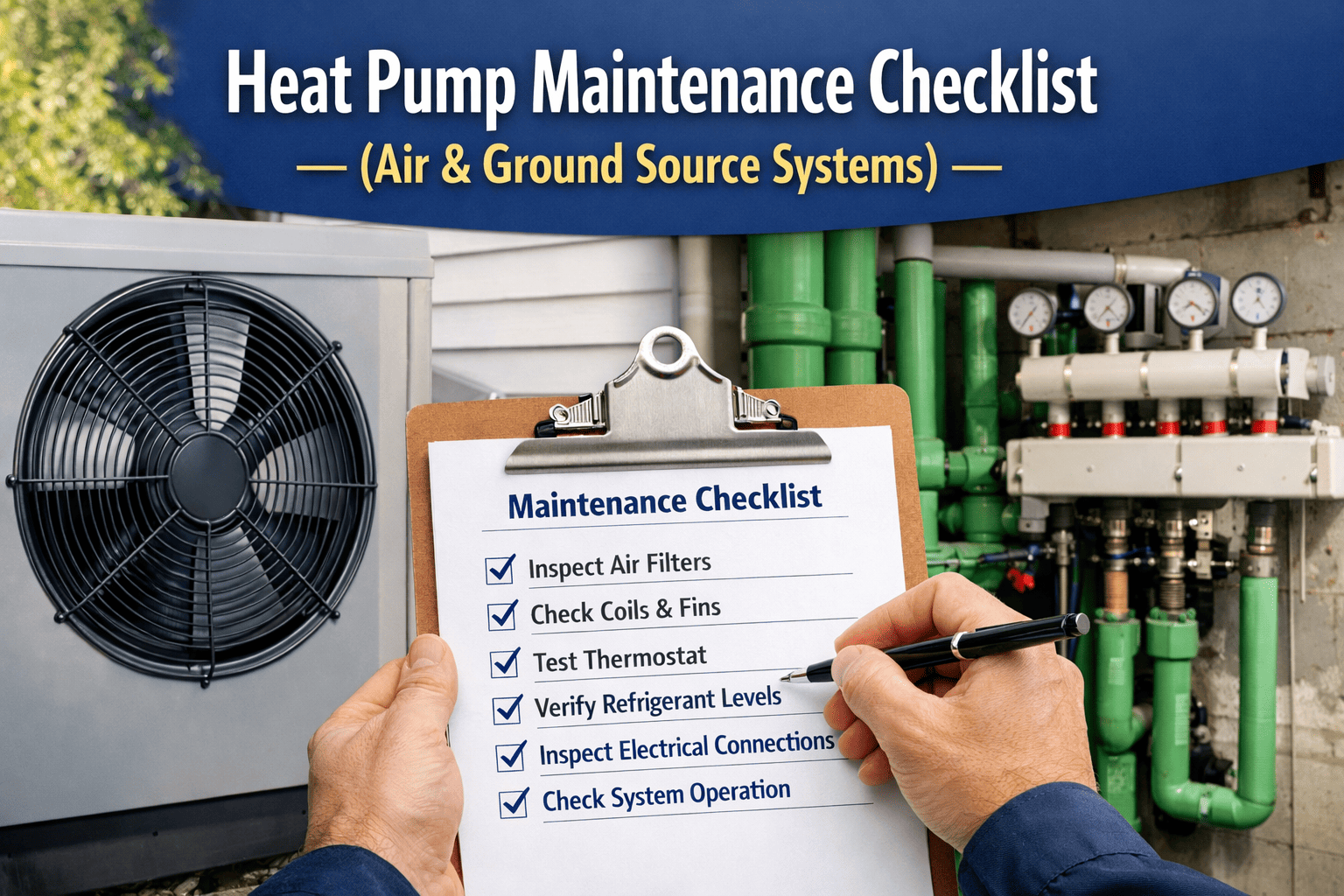
Heat Pump Maintenance Checklist — Air Source & Ground Source Systems
Seasonal inspection protocols, efficiency verification steps, and compliance documentation requirements for air-source and geothermal heat pump systems — built for facilities teams managing HVAC performance at scale.
Seasonal Inspection Checklist — Air Source
Air-source heat pumps require pre-season inspection before both the cooling season and heating season — the reversing valve, defrost controls, and outdoor coil condition must be verified before peak demand loads arrive.
- Clean outdoor coil — remove debris, check fin straightness
- Measure refrigerant charge — verify subcooling and superheat
- Inspect reversing valve — test switching in both modes
- Check contactor contacts — replace if pitted
- Clean indoor coil and blower assembly
- Verify thermostat and emergency heat operation
- Log all pressures and compare to prior year data
- Test defrost control board and defrost termination sensor
- Inspect auxiliary/strip heat elements — verify amperage
- Check crankcase heater operation — critical in cold climates
- Inspect outdoor coil clearance — snow accumulation risk
- Test low ambient lockout controls if installed
- Verify balance point setting matches building load profile
- Record heating capacity at rated outdoor temperature
Geothermal Ground Loop Checklist
Ground loop integrity is the highest-risk maintenance area for geothermal systems. A slow pressure leak or degraded antifreeze concentration can reduce system efficiency by 25–40% without triggering obvious alarms — and loop repairs are expensive and disruptive. Annual loop testing is non-negotiable.
Verify static loop pressure is within design spec (typically 30–50 PSI). Pressure drop greater than 5 PSI from prior year indicates leak — locate before next season.
Antifreeze concentration (propylene glycol or methanol) must be verified annually with a refractometer. Freeze protection below design outdoor temp results in catastrophic loop failure.
Check pump amp draw vs. nameplate, inspect shaft seal for leaking, and verify flow rate against commissioning data. Reduced flow is the leading cause of geothermal efficiency loss.
Log entering water temperature (EWT) and leaving water temperature (LWT) and compare to commissioning baseline. Rising EWT in summer or falling EWT in winter indicates loop sizing or flow issues.
OxMaint tracks seasonal performance trends for every heat pump in your portfolio — alerting your team when COP degrades, refrigerant readings drift, or loop pressures indicate early-stage leaks. See it live in 30 minutes.
Efficiency Benchmarking — What Good Looks Like
Heat pump performance degrades gradually — making benchmarking against rated specs the only reliable way to detect efficiency loss before it compounds into a repair event. Log these metrics at every seasonal visit and trend over time.
| Performance Parameter | Rated / Target | Alert Threshold | Action if Exceeded |
|---|---|---|---|
| Cooling COP (air-source) | 3.0–4.5 (SEER 14–21) | >15% below rated | Check refrigerant charge and coil fouling |
| Heating COP (air-source at 47°F) | 2.5–3.8 | >20% below rated | Inspect reversing valve and defrost cycle |
| Geothermal COP (cooling) | 4.0–6.0 (EWT 77°F) | >10% below rated | Check loop flow rate and EWT rise |
| Compressor suction superheat | 8–12°F (cooling mode) | <5°F or >20°F | Verify refrigerant charge and TXV operation |
| Outdoor coil delta-T (cooling) | 15–25°F above ambient | Outside range | Clean coil — verify airflow over condenser |
| Ground loop flow rate | Per design (GPM) | >10% below design | Inspect pump and check loop for restriction |
"The facilities that get the best ROI from heat pump investments share one characteristic — they treat efficiency benchmarking as a maintenance output, not just a commissioning activity. I see systems that were installed at 4.2 COP running at 2.8 COP three years later, and the operators have no idea. A heat pump that is 30% below rated efficiency costs more to operate than the gas system it replaced. Annual performance logging is the only thing that catches this drift before it becomes permanent equipment degradation."
— Certified Energy Manager (CEM), IGSHPA Accredited Geothermal Designer — 20 years in commercial HVAC performance contracting
ASHRAE research confirms that heat pump systems with documented annual maintenance records maintain 92–96% of rated efficiency over 15 years — vs. 70–78% for systems with no structured PM program. The difference compounds into tens of thousands in energy cost over equipment life.
Every Degree of Efficiency Saved is Money Kept
OxMaint's preventive and predictive maintenance platform gives your team automated seasonal checklists, COP trend alerts, and digital inspection records for every heat pump in your portfolio. Stop discovering efficiency loss at the utility bill — catch it at the next inspection visit instead.