Every breath a patient takes in your hospital depends on an invisible infrastructure that most people never see—the intricate network of air handlers, pressure differentials, and ventilation controls that separate sterile surgical environments from infectious disease isolation areas. When a 63-year-old immunocompromised patient enters your bone marrow transplant unit, the positive pressure environment protecting them from airborne pathogens isn't just an engineering specification—it's the invisible barrier between recovery and potentially fatal infection.
Yet across American hospitals, HVAC compliance failures remain among the most frequently cited deficiencies during Joint Commission surveys, with infection prevention citations appearing in over 77% of hospitals surveyed in 2023-2024. The stakes extend far beyond regulatory checkboxes—hospital-acquired infections affect approximately 1 in 31 hospital patients on any given day, with airborne transmission pathways representing a significant and preventable risk factor when ventilation systems fail to perform as designed. Sign up today to transform your HVAC maintenance from reactive to proactive.
The Critical Numbers Behind Hospital HVAC
Understanding Pressure Relationships: The Foundation of Patient Safety
Hospital HVAC systems operate on a simple but critical principle: air must flow from clean areas to less clean areas. This directional airflow prevents contamination from spreading to vulnerable patients and sterile environments. Book a demo to see how Oxmaint helps you monitor these critical pressure differentials 24/7.
Positive Pressure Areas
Air flows OUT of the room, protecting the space from corridor contaminants.
- Operating Rooms: 20+ ACH total, minimum +0.01 in.w.g. differential
- Protective Environment (PE) Rooms: 12+ ACH for immunocompromised patients
- Pharmacy Compounding: 30+ ACH for ISO Class 7 environments
- Labor/Delivery/Recovery: 6+ ACH protecting mother and newborn
Negative Pressure Areas
Air flows INTO the room, containing airborne pathogens and preventing escape.
- Airborne Infection Isolation (AII): 12+ ACH containing TB, measles, COVID-19
- Bronchoscopy Rooms: 12+ ACH for aerosolized respiratory pathogens
- Decontamination Areas: 10+ ACH preventing dirty-to-clean cross-contamination
- Soiled Utility Rooms: 10+ ACH containing biohazardous waste odors
A single pressure reversal in an airborne infection isolation room can expose staff, visitors, and vulnerable patients throughout the corridor. Continuous monitoring isn't optional—it's lifesaving.
The Regulatory Landscape: Standards You Cannot Ignore
Healthcare facilities operate under the most stringent HVAC compliance requirements in the world. Understanding which regulations apply to your facility is the foundation of any compliance strategy. North America's healthcare HVAC compliance landscape involves multiple overlapping authorities, each with specific requirements that facilities must meet simultaneously. Start your free trial to ensure compliance across all standards.
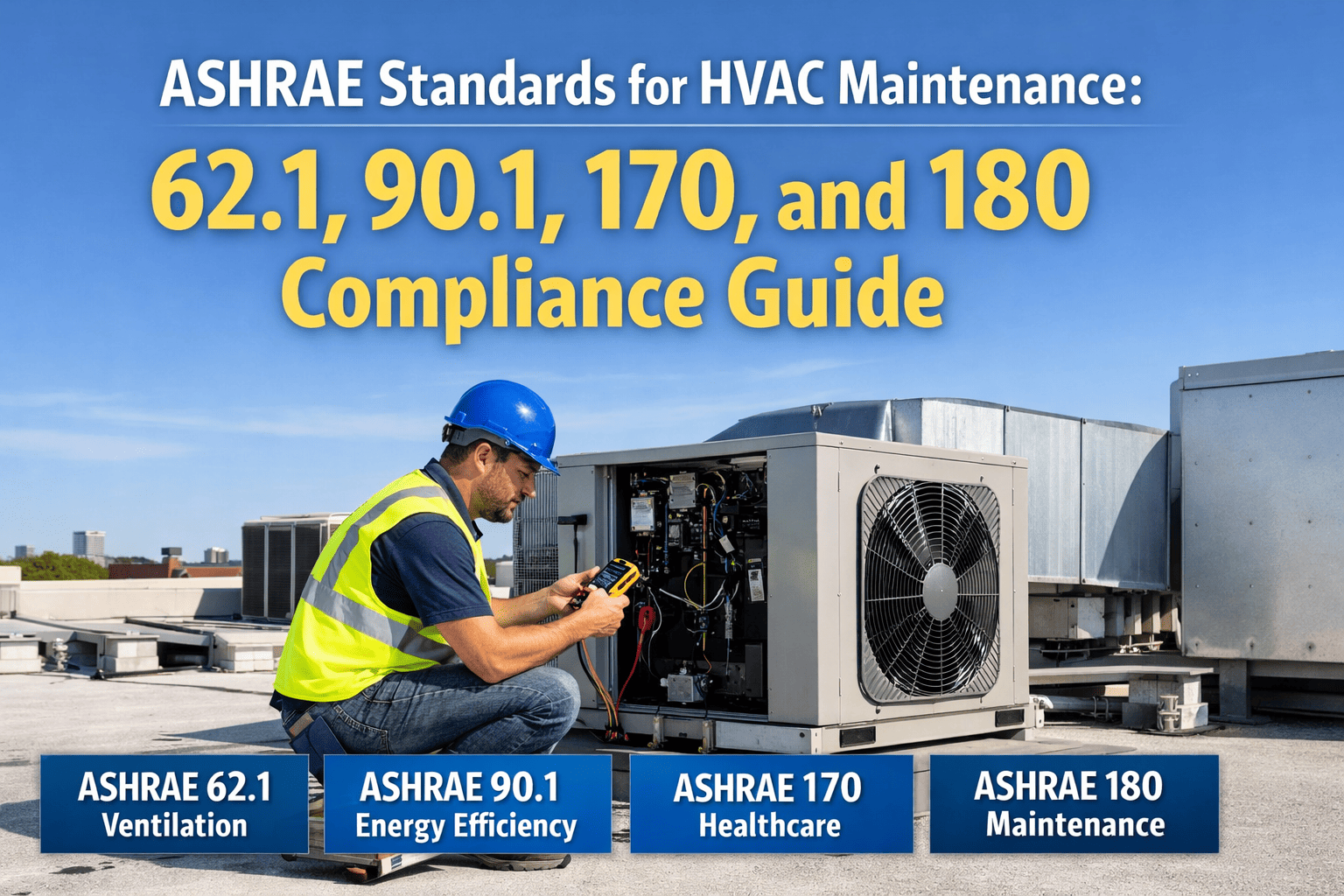
ANSI/ASHRAE/ASHE Standard 170
The cornerstone standard for healthcare ventilation. The revised 2025 edition introduces requirements for natural ventilation options, updated imaging room classifications, and clarified unoccupied turndown requirements. It defines minimum ventilation rates, pressure relationships, filtration requirements, temperature, and humidity ranges for over 60 distinct healthcare space types.
The Joint Commission (TJC)
Surveyors evaluate HVAC compliance under standard EC.02.05.01, requiring that ventilation systems in areas designed to control airborne contaminants provide appropriate pressure relationships, air-exchange rates, filtration efficiencies, temperature, and humidity. Failing a Joint Commission survey can directly impact your facility's accreditation status and Medicare certification.
CMS Conditions of Participation
The Centers for Medicare & Medicaid Services adopts NFPA 99 Health Care Facilities Code, under which ASHRAE 170 is enforced. For facilities constructed or modified after July 5, 2016, compliance with these standards is required to maintain Medicare and Medicaid reimbursement eligibility.
NFPA 99 Health Care Facilities Code
This code establishes the fire protection and safety requirements for healthcare facilities, incorporating HVAC ventilation standards as critical components of the overall facility safety framework.
HEPA Filtration: Your Last Line of Defense
High-Efficiency Particulate Air (HEPA) filters are the gold standard for critical healthcare environments, capable of removing 99.97% of particles 0.3 micrometers or larger. In critical areas such as operating rooms, isolation rooms, and pharmaceutical compounding areas, Ultra-Low Penetration Air (ULPA) filters may be required, offering even higher efficiency at 99.999% for particles 0.12 micrometers and larger. Schedule a demo to learn how Oxmaint tracks your filtration lifecycle.
Maintenance Best Practices for HEPA Systems
Scheduled Inspections
Quarterly inspections or as needed based on pressure drop monitoring
Differential Pressure Monitoring
Track pressure drop to assess clogging and airflow resistance
Integrity Testing
Annual DOP/PAO aerosol testing for leak verification
Safe Replacement
Follow biohazard protocols using PPE and sealed bags
Ready to Transform Your Hospital HVAC Maintenance?
Join hundreds of healthcare facilities that have switched from reactive repairs to proactive, compliance-ready maintenance management with Oxmaint.
The True Cost of HVAC Failures in Healthcare
When HVAC systems fail in healthcare settings, the consequences cascade rapidly. A malfunctioning ventilation system could allow contaminated air to circulate through sterile areas, putting patients and staff at risk. Emergency repairs cost 50-100% more than standard calls, and every $1 of deferred maintenance eventually becomes $4 in capital renewal costs. Start preventing costly failures today.
Real-World Impact of HVAC Failures
- Immediate Patient Safety Risks: Compromised air quality in critical care areas
- Canceled Surgeries: Operating rooms closed until pressure relationships are restored
- Healthcare-Associated Infections: Preventable infections due to improper ventilation
- Regulatory Violations: Joint Commission citations and potential loss of accreditation
- Financial Penalties: CMS reimbursement penalties and potential lawsuits
- Patient Transfers: Some facilities must transfer patients to other hospitals during major failures
Building a Proactive Maintenance Program
Facilities that rely on paper-based tracking or spreadsheets simply cannot keep pace with the complexity of healthcare HVAC requirements. The hospital HVAC systems market was valued at $11.03 billion in 2024 and is projected to reach $22.19 billion by 2034, reflecting the increasing investment healthcare organizations are making in sophisticated air quality management. See how Oxmaint streamlines compliance.
Daily Verification
Critical areas like operating rooms and airborne infection isolation rooms require daily visual verification of pressure relationships with documented inspections.
Preventive Scheduling
Industry best practices target 70-80% preventive maintenance with only 20-30% reactive. Facilities hitting 80%+ planned ratios experience 40-50% lower total maintenance costs.
Documentation & Compliance
Complete maintenance records are essential for Joint Commission surveys. The Joint Commission expects facilities to demonstrate ongoing compliance through continuous monitoring or regular documented inspection cycles.
The Digital Transformation of HVAC Compliance
A CMMS like Oxmaint centralizes all HVAC maintenance activities into a single digital platform. It automates inspection scheduling based on space type and regulatory requirements, provides mobile-friendly checklists aligned to ASHRAE 170 parameters, captures real-time inspection data with timestamps and technician identification, tracks corrective actions to completion, and generates comprehensive audit reports instantly.
Get Started with OxmaintFrequently Asked Questions
What is ASHRAE Standard 170 and why does it matter for healthcare facilities?
ANSI/ASHRAE/ASHE Standard 170 is the primary standard governing ventilation in healthcare facilities across North America. It defines minimum requirements for air changes per hour, pressure relationships, filtration efficiency, temperature, and humidity for over 60 distinct healthcare space types including operating rooms, isolation rooms, patient rooms, pharmacies, and laboratories. Compliance is enforced by the Joint Commission, CMS, and state health departments. Without meeting these standards, facilities risk losing accreditation and Medicare/Medicaid reimbursement eligibility.
How often should healthcare HVAC systems be inspected for compliance?
Inspection frequency depends on the space type and applicable regulations. Critical areas like operating rooms and airborne infection isolation rooms require daily visual verification of pressure relationships and regular documented inspections. General patient care areas typically require periodic inspections on monthly or quarterly schedules. The Joint Commission expects facilities to demonstrate ongoing compliance through continuous monitoring or regular documented inspection cycles with complete maintenance records.
What happens if a healthcare facility fails an HVAC compliance audit?
Consequences range from required corrective action plans with specific deadlines to conditional accreditation status, financial penalties, and in severe cases, loss of Joint Commission accreditation. Since CMS ties Medicare and Medicaid reimbursement to accreditation status, a failed audit can directly threaten a facility's financial viability. Additionally, compliance failures that result in patient harm can trigger litigation and regulatory action from state health departments.
What are the key differences between HVAC requirements for operating rooms versus patient rooms?
Operating rooms require a minimum of 20 air changes per hour with positive pressure relative to adjacent spaces, MERV 14 or higher filtration, and strict temperature and humidity control. Patient rooms typically require 6 ACH with no specific pressure relationship to corridors, though some specialized patient care areas like burn units and immunocompromised patient rooms have higher requirements. The filtration, airflow direction, and monitoring intensity all differ significantly between these space types.
How does a CMMS like Oxmaint help with HVAC compliance in healthcare?
OxMaint centralizes all HVAC maintenance activities into a single digital platform. It automates inspection scheduling based on space type and regulatory requirements, provides mobile-friendly checklists aligned to ASHRAE 170 parameters, captures real-time inspection data with timestamps and technician identification, tracks corrective actions to completion, and generates comprehensive audit reports instantly. This eliminates paper-based documentation gaps, standardizes inspection procedures across your facility, and ensures you can demonstrate continuous compliance during any survey.
What changed in the ASHRAE 170-2025 edition that facility managers should know about?
The 2025 edition introduces several significant updates including requirements for the optional use of natural ventilation, total outdoor air calculation methods for mixed-standard systems, updated requirements for Class 2 and Class 3 imaging rooms, clarified unoccupied turndown requirements for outpatient spaces, additional function of space types for behavioral health facilities, updated cooling and heating reserve capacity requirements, and reorganized Section 10 covering ventilation requirements during construction activities.
Don't Let Compliance Gaps Put Patients at Risk
Your HVAC system is the invisible guardian of patient safety. Ensure it receives the attention it deserves with Oxmaint's specialized healthcare maintenance platform.