HVAC Asset Management Best Practices | Improve Reliability and Control Costs
By Riley Quinn on February 6, 2026
Your facility has 47 HVAC units across three buildings. You know the ones that break—the rooftop unit on building C that fails every summer, the air handler in the east wing that eats belts. But can you answer this: what's the total cost of ownership on each of those units? Which ones have already cost more in repairs than they're worth? Which will need replacing in the next 18 months? If you can't answer those questions in under five minutes, you don't have an asset management problem—you have a visibility problem. And it's costing you somewhere between 20-60% of your operating budget in maintenance spend you can't fully explain or control.
Why HVAC Asset Management Demands Attention
15-20
years
Average commercial HVAC system lifespan—but only with proper maintenance and tracking
40%
of energy
Building energy consumed by HVAC—the single largest controllable operating expense
91%
of facilities
Now use asset management systems to schedule and track preventive maintenance tasks
$4
per $1 deferred
Every dollar of deferred maintenance eventually becomes four dollars in capital renewal
You can't manage what you can't see. That statement has been repeated so often it's become cliché—but in HVAC asset management, it's literally true. A 2025 industry report found that in 2024, 52% of facilities reported a quarter to half of their annual work orders were reactive. By 2025, that dropped to just 22%—and the single biggest driver was better asset visibility through centralized tracking systems. When you know exactly what equipment you have, where it sits, what condition it's in, and what it costs to maintain, every decision improves. Replacement timing becomes strategic instead of panicked. Budget requests become data-backed instead of emotional. And the chronic "surprise" failures that derail your week become predictable events you handle on your schedule.
6 Pillars of HVAC Asset Management Excellence
Each practice builds on the one before it—start at the foundation and work up
01
Standardized Asset Registry
Build a single source of truth for every HVAC asset—model, serial number, install date, location, criticality rating, warranty status, and linked documentation. No spreadsheets. No tribal knowledge.
Reduces diagnostic time by giving technicians instant access to full equipment history
02
Criticality-Based Prioritization
Not every HVAC unit deserves equal attention. Rate assets by failure impact, safety risk, and operational dependency. A chiller serving a data center gets a different maintenance strategy than a unit conditioning a storage closet.
Focuses resources where failures carry the highest operational and financial consequences
03
Condition-Based Maintenance
Move beyond fixed schedules. Use real-time data—vibration monitoring, temperature trending, amperage draws—to detect degradation early. Condition-based maintenance increases HVAC MTBF by 90-175 hours over reactive approaches.
Catches failures weeks before they happen—when fixes cost hundreds, not thousands
04
Lifecycle Cost Tracking
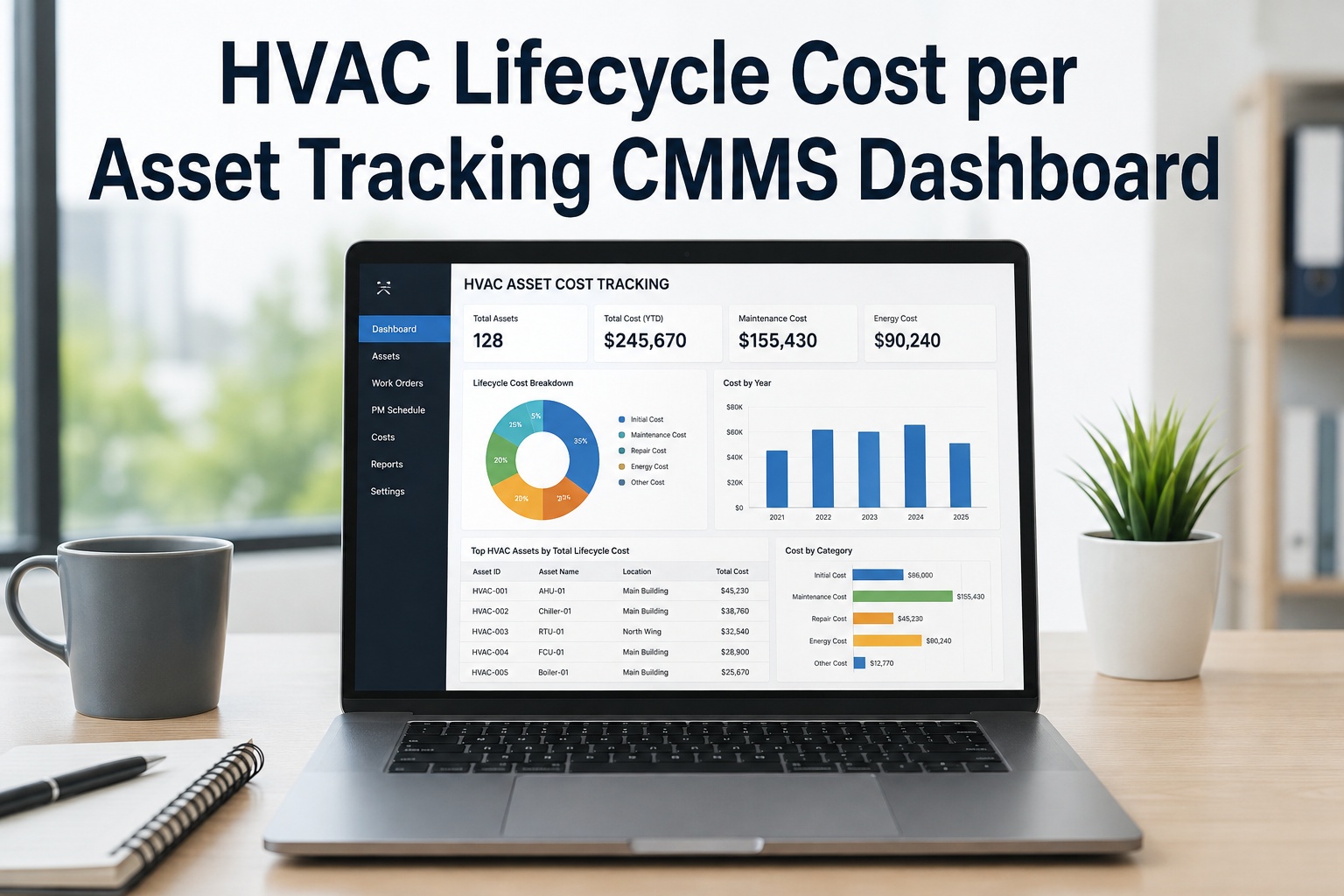
Track total cost of ownership per asset—purchase price, installation, every repair, energy consumption, and downtime impact. When annual maintenance exceeds 50% of replacement value, the data makes the capital case for you.
Transforms repair-vs-replace from guesswork into data-driven capital planning
05
Strategic Spare Parts Management
Stock critical spares for high-priority units using VED analysis (Vital, Essential, Desirable). A CMMS tracks consumption, automates reorder alerts, and prevents both stockouts and expensive overstocking.
Eliminates the #1 cause of extended downtime: waiting for parts that aren't in stock
06
Performance Metrics and Continuous Improvement
Track MTBF, MTTR, PM compliance, energy efficiency, and cost per asset. Facilities achieving 80%+ planned maintenance ratios experience 40-50% lower total maintenance costs per square foot.
Makes maintenance performance visible, measurable, and continuously improvable
The HVAC Asset Lifecycle: What Happens at Each Stage
Every HVAC unit follows the same lifecycle arc—but how you manage each stage determines whether you get 12 years of frustration or 22 years of reliable performance. ASHRAE data shows commercial air conditioners average 15 years, heat pumps 14 years, gas furnaces 18 years, and boilers up to 25 years. But these are averages, not guarantees. Equipment prices have risen roughly 40% since 2020, with new HVAC equipment costs expected to increase another 10-15% due to the R-410A refrigerant phase-out under the AIM Act. That makes every additional year of reliable operation increasingly valuable.
The 5 Stages of HVAC Asset Lifecycle Management
Stage 1
Acquisition and Installation
Document specifications, warranties, and commissioning data
Register asset in CMMS with full hierarchy and criticality rating
Establish baseline performance metrics from day one
Stage 2
Active Operation and PM
Execute scheduled preventive maintenance per manufacturer and criticality
Track energy efficiency, filter condition, and refrigerant levels
Log every work order with costs, parts, and labor hours
Stage 3
Condition Monitoring and Optimization
Deploy sensors for vibration, temperature, and current analysis
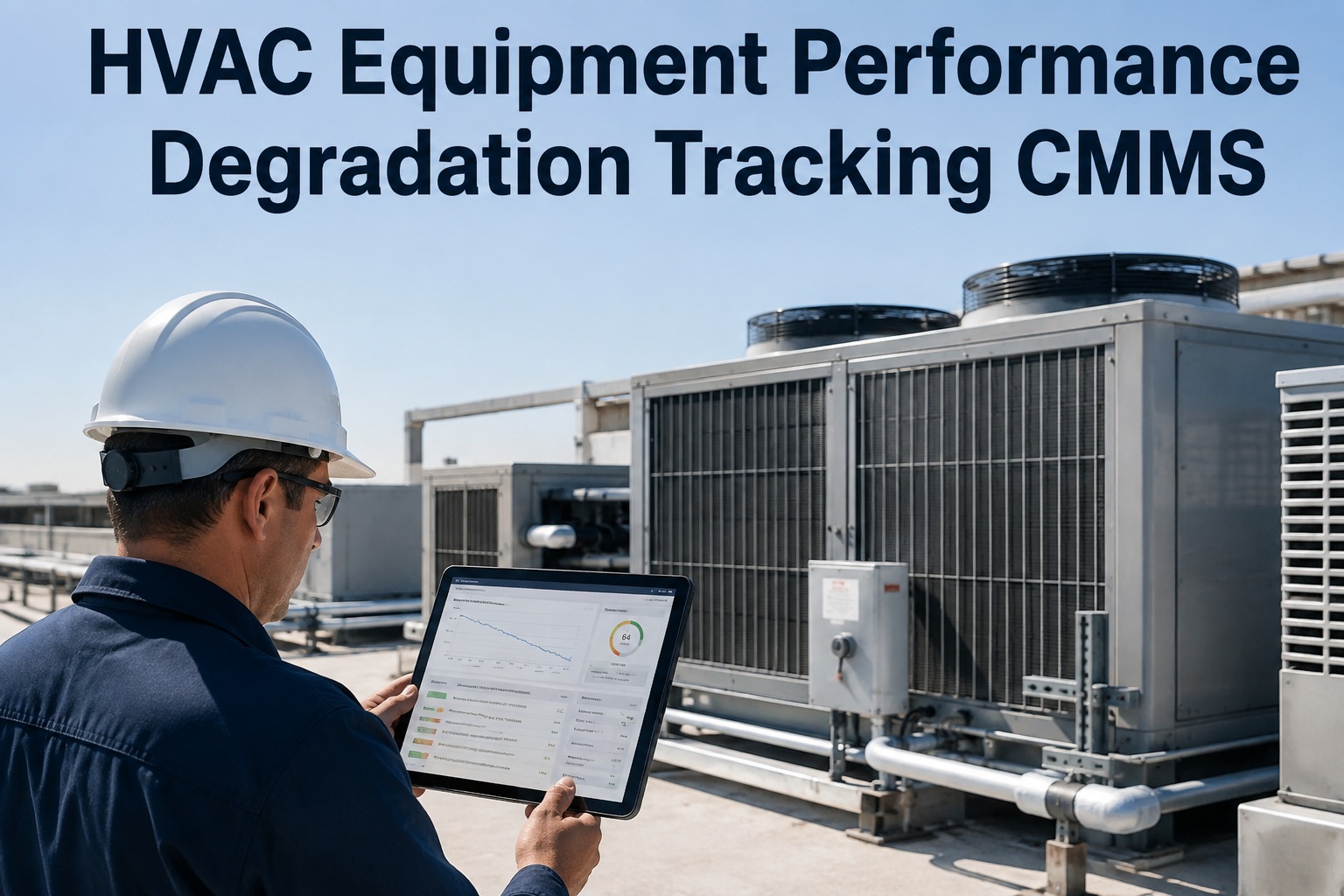
Compare actual performance to baseline—flag degradation trends
Adjust maintenance intervals based on real condition data
Stage 4
Repair vs. Replace Decision Point
Analyze total cost of ownership vs. replacement cost + projected savings
Use Facility Condition Index (FCI) to prioritize capital planning
Stage 5
Decommissioning and Replacement
Schedule replacement during planned downtime—not during emergencies
Reclaim refrigerants and recycle metals per regulatory requirements
Transfer warranty and performance data to new asset record
The most expensive decisions in HVAC management happen at Stage 4—but organizations without lifecycle data reach that stage blind. They can't calculate total cost of ownership because the data is scattered across filing cabinets, old emails, and the memories of technicians who may have already left. Facilities that schedule a walkthrough of lifecycle tracking in action often discover they've been spending replacement-level money on repairs for units that should have been retired years ago.
How a CMMS Transforms HVAC Asset Management
Brightly Software's 2026 Asset Lifecycle Report found that 88% of organizations believe preventive maintenance reduces costs compared to reactive methods, and 87% express confidence in their asset maintenance strategy to avoid unplanned downtime. But here's the catch: that confidence comes from data, and data comes from systems that capture it automatically. A CMMS centralizes your entire HVAC asset universe—every unit, every work order, every dollar spent, every failure, every part consumed—into a single platform that calculates the metrics you need to make good decisions.
What a CMMS Does for Every HVAC Asset
Asset Registry
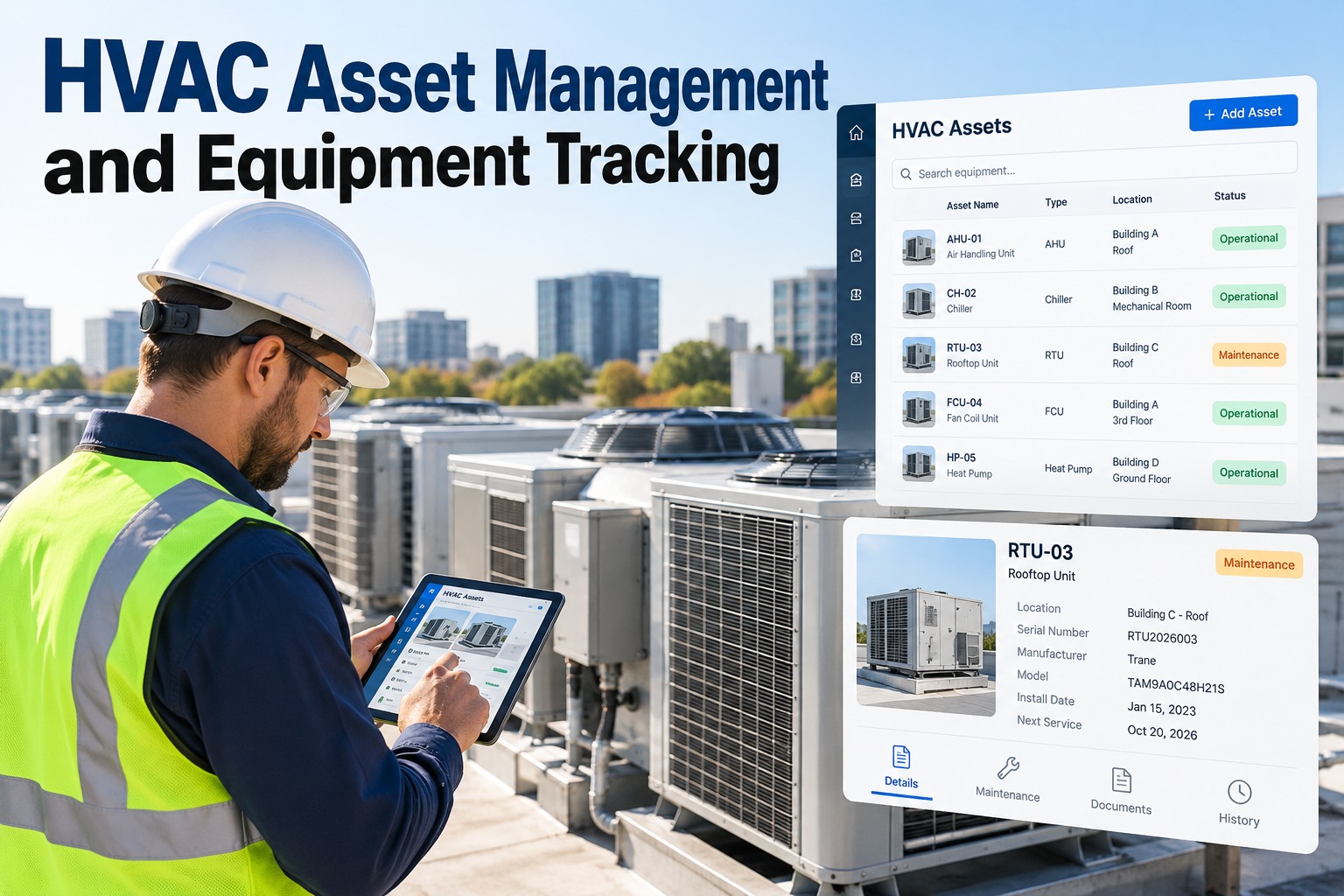
Full equipment profiles with specs, manuals, warranties, photos, and parent-child relationships in a searchable hierarchy
PM Scheduling
Auto-generated preventive tasks based on time intervals, runtime hours, or sensor triggers—never miss another PM window
Cost Tracking
Every labor hour, part, and contractor invoice linked to the specific asset—total cost of ownership calculated automatically
Failure Analysis
Pattern recognition across failures—which components fail, how often, and why—feeding smarter maintenance strategies
Parts Inventory
Real-time stock levels with auto-reorder alerts, linked directly to the assets and work orders that consume them
KPI Dashboards
MTBF, MTTR, PM compliance, energy metrics, and cost trends—updated automatically from every work order completed
The organizations that adopt a centralized HVAC asset management platform don't just improve their maintenance—they fundamentally change how leadership views the maintenance function. When you can show that PM compliance is at 94%, that MTTR dropped 35% over six months, and that three units are flagged for replacement based on cost-of-ownership data, maintenance stops being a cost center and starts being a strategic function.
Take Control of Your HVAC Asset Lifecycle
See how a centralized asset registry, automated PM scheduling, and real-time cost tracking work together to extend equipment life and cut maintenance spend.
Expert Review: Why the Best Facilities Treat Assets as Investments, Not Expenses
The shift happening in facility management right now is fundamental. In 2024, over half of organizations reported that a quarter to half of their work orders were reactive. By 2025, that number dropped to 22%. That isn't a gradual improvement—it's a structural change driven by asset management systems that give teams the visibility to act before failures occur. The 88% of organizations now reporting confidence that preventive maintenance reduces costs aren't guessing—they have the data to prove it. And the 51% that are ready to move toward predictive capabilities understand that the next competitive advantage comes from knowing what will fail, not just preventing what might.
Data Replaces Guesswork at Every Decision Point
Repair or replace? Extend PM intervals or tighten them? Add redundancy or accept risk? With lifecycle cost data, these become calculations—not debates.
Compliance Pressure Is Only Increasing
The R-410A phase-out, EPA Section 608, ASHRAE standards—regulatory compliance requires documented asset histories that only structured systems can provide reliably.
Asset Management Is Now a Leadership Conversation
When facility teams can present FCI scores, total cost of ownership trends, and projected replacement timelines, they earn capital budgets instead of fighting for them.
The common thread across high-performing facilities: they've connected their asset data to a system that automates the calculations. Technicians log work, the system does the math, and managers see the trends. If your team is still running HVAC asset management through spreadsheets or paper logs, explore what automated asset lifecycle tracking looks like in practice—most teams are surprised by how quickly they see results.
Where to Start: Your First 30 Days
You don't need to overhaul everything at once. The fastest path to better HVAC asset management is establishing visibility first, then layering in analytics. Start with your highest-criticality assets, build the registry, connect it to your work order workflow, and let the data accumulate. Within 60-90 days, you'll have baselines that transform every subsequent decision. Organizations that want a guided path can book a consultation to map which assets should be digitized first and how quickly the platform delivers actionable insights.
Your HVAC Assets Deserve Better Than Spreadsheets
Join facility teams using OXmaint to track every asset from installation to replacement—with automated cost tracking, PM scheduling, and lifecycle analytics built in.
What is HVAC asset management and why does it matter?
HVAC asset management is the systematic process of tracking, maintaining, and optimizing every HVAC unit throughout its entire lifecycle—from installation through operation, maintenance, and eventual replacement. It matters because HVAC systems consume approximately 40% of commercial building energy and represent one of the largest controllable operating expenses. Without structured asset management, organizations can't make informed repair-vs-replace decisions, can't accurately forecast capital budgets, and typically spend 20-60% more on maintenance than necessary due to reactive approaches and lack of visibility.
How long do commercial HVAC systems actually last?
According to ASHRAE data, commercial HVAC lifespans vary by component: central air conditioners average 15 years, heat pumps 14 years, gas furnaces 18 years, and boilers 20-25 years. However, these are properly maintained averages. Systems without structured maintenance programs typically fail 30-50% sooner, while well-managed assets with condition-based maintenance can exceed these lifespans by 20-40%. Climate, usage patterns, installation quality, and maintenance consistency all significantly impact actual service life.
What is asset criticality analysis and how do I apply it to HVAC?
Asset criticality analysis ranks each HVAC unit based on the consequence of its failure—considering factors like operational impact, safety risk, financial cost, and environmental exposure. High-criticality assets (like a chiller serving a data center or an air handler for a hospital operating suite) receive more frequent maintenance, tighter condition monitoring, and priority spare parts stocking. Lower-criticality units (like an HVAC unit serving a storage area) can follow a less intensive schedule. A CMMS integrates criticality ratings into work order prioritization, ensuring your team always focuses resources where failures carry the highest consequences.
When should I repair an HVAC unit versus replacing it?
The repair-vs-replace decision should be data-driven, not emotional. Key indicators for replacement include: annual maintenance costs exceeding 50% of replacement value, declining energy efficiency despite maintenance, increasing frequency and severity of breakdowns, regulatory compliance issues (particularly with the R-410A refrigerant phase-out), and FCI scores indicating end-of-useful-life. A CMMS that tracks total cost of ownership per asset gives you exact numbers for this calculation instead of relying on technician opinions or rough estimates.
How does a CMMS improve HVAC asset management?
A CMMS centralizes every piece of HVAC asset data into one platform: equipment profiles, maintenance histories, cost records, spare parts inventory, warranty tracking, and performance metrics. It automates PM scheduling based on time, runtime, or sensor data. It tracks total cost of ownership per asset automatically. It generates real-time dashboards showing MTBF, MTTR, PM compliance, and cost trends. And it provides the documented history needed for both regulatory compliance and capital budget justification. The 91% of organizations now using asset management systems for PM scheduling are doing so because manual tracking simply can't deliver the visibility and consistency required for modern HVAC asset management.