Why Multi-Site Portfolios Struggle With Consistent Carbon Data
Each site tends to track energy and refrigerant data its own way, which means portfolio-level emissions reporting often starts with reconciling formats before any actual accounting can happen. Book a Demo to see how Oxmaint standardizes HVAC asset and service records across sites so carbon data doesn't have to be rebuilt every reporting cycle.
Five Data Sources Every HVAC Carbon Accounting Workflow Needs
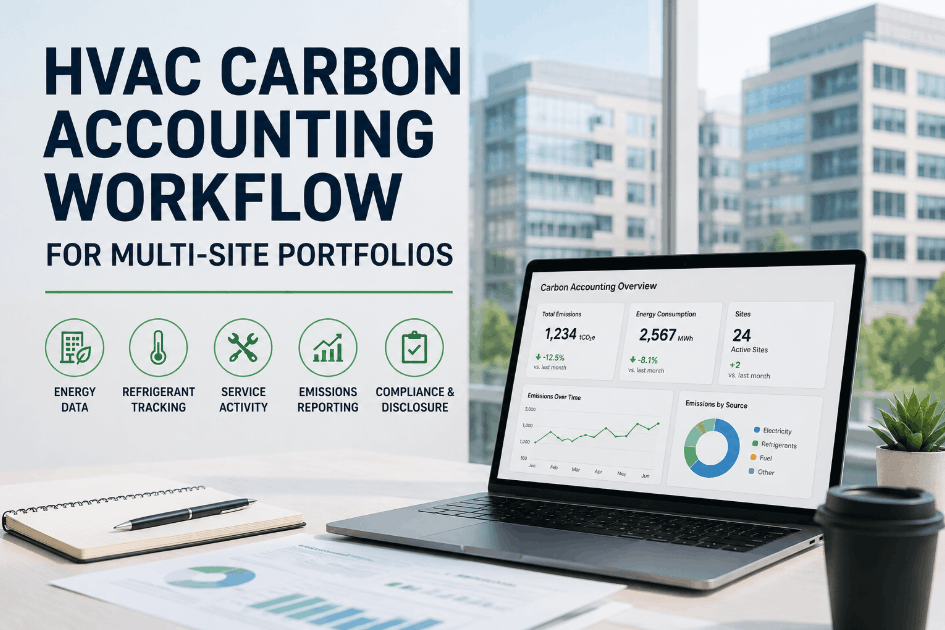
Reliable carbon accounting means pulling from the same data sources every reporting period, not chasing down site logs after the fact. Sign Up Free to start centralizing these data sources against your HVAC asset and site records in Oxmaint.
HVAC Asset Inventory and Equipment Specifications
Accurate carbon accounting starts with knowing exactly what equipment exists at each site, including capacity, refrigerant type, and age.
Energy Consumption by Site and System
Energy data tied to a specific asset or system, rather than a whole-building meter, gives portfolio teams a more defensible basis for emissions calculations.
Refrigerant Charge and Service Event Logging
Refrigerant top-offs and recoveries logged at the point of service are far more reliable than reconstructing leak history at year-end.
Maintenance and Repair Activity History
Repair frequency and equipment downtime patterns help explain energy and refrigerant anomalies that would otherwise look like reporting errors.
Site-Level Reporting Boundaries and Ownership
Owned, leased, and shared-system sites need clearly defined reporting boundaries so emissions aren't double-counted or missed across the portfolio.
Carbon Accounting Risk by Portfolio Site Type
Carbon accounting risk isn't uniform across a portfolio — owned manufacturing sites behave very differently from leased or multi-tenant space. Book a Demo to see how Oxmaint maps HVAC assets to site type so reporting effort goes where data gaps are largest.
| Site Type | Dominant Data Gap | Accounting Risk | Risk Level | Oxmaint Planning Lever |
|---|---|---|---|---|
| Owned Manufacturing Sites | Mixed metering granularity | Inconsistent energy baselines | High | Centralized asset and energy logging |
| Leased Office Portfolios | Limited refrigerant visibility | Untracked leak events | Critical | Refrigerant service work orders |
| Multi-Tenant Facilities | Shared system boundaries | Allocation ambiguity | Medium–High | Site-level asset tagging |
| Healthcare Campuses | Continuous-operation equipment | High service frequency, low logging | High | Service history trend reporting |
| Retail / Hospitality Chains | Decentralized site management | Format inconsistency across sites | Medium | Standardized multi-site templates |
How Inconsistent Carbon Data Drives Reporting and Compliance Costs
When HVAC carbon data isn't consistent across a portfolio, the costs show up well beyond the reporting deadline. Sign Up Free to connect HVAC asset, energy, and service data in Oxmaint and start closing the gap between site-level activity and portfolio-level reporting.
Using Oxmaint to Standardize HVAC Carbon Accounting Across Sites
Reporting accuracy improves once asset data, service history, and site records live in one workflow instead of separate site spreadsheets. Book a Demo to walk through how this roadmap fits your portfolio's reporting calendar.
Register HVAC Assets and Specifications Across Every Site
Create consistent asset records in Oxmaint for HVAC equipment at every site, including capacity, refrigerant type, and installation date.
Log Refrigerant Service Events on Standardized Work Orders
Capture refrigerant top-offs, recoveries, and charge data at the point of service so leak history is built from real records, not estimates.
Track Energy and Maintenance Activity by Site
Link energy and service data to specific assets and sites in Oxmaint so portfolio teams can see activity at the level emissions reporting requires.
Roll Up Site-Level Data Into a Portfolio Reporting View
Use Oxmaint to consolidate site-level HVAC records into a single portfolio view, reducing the manual reconciliation work each reporting cycle.
Generate Trend Reports to Support Annual Carbon Disclosures
Use Oxmaint reporting to track HVAC-related energy and refrigerant trends year over year, supporting disclosure and audit documentation.
Frequently Asked Questions: HVAC Carbon Accounting for Portfolios
What data does HVAC carbon accounting require across a multi-site portfolio?
Asset inventory, energy consumption, refrigerant service records, and maintenance history are the core data sources needed at every site.
Why does refrigerant tracking matter for HVAC carbon accounting?
Refrigerant leaks carry a significant emissions impact, and untracked service events leave gaps that surface during audits or disclosures.
How can multi-site teams avoid inconsistent emissions baselines?
Standardizing how asset, energy, and service data is logged across every site removes the format reconciliation work that creates baseline inconsistencies.
How does Oxmaint support HVAC carbon accounting workflows?
Oxmaint centralizes HVAC asset records, refrigerant service logging, and site-level activity tracking into one portfolio reporting view.
Can portfolio-level HVAC data support long-term sustainability reporting?
Yes — trend reports built from logged HVAC activity in Oxmaint give sustainability teams a consistent data foundation for recurring disclosures.