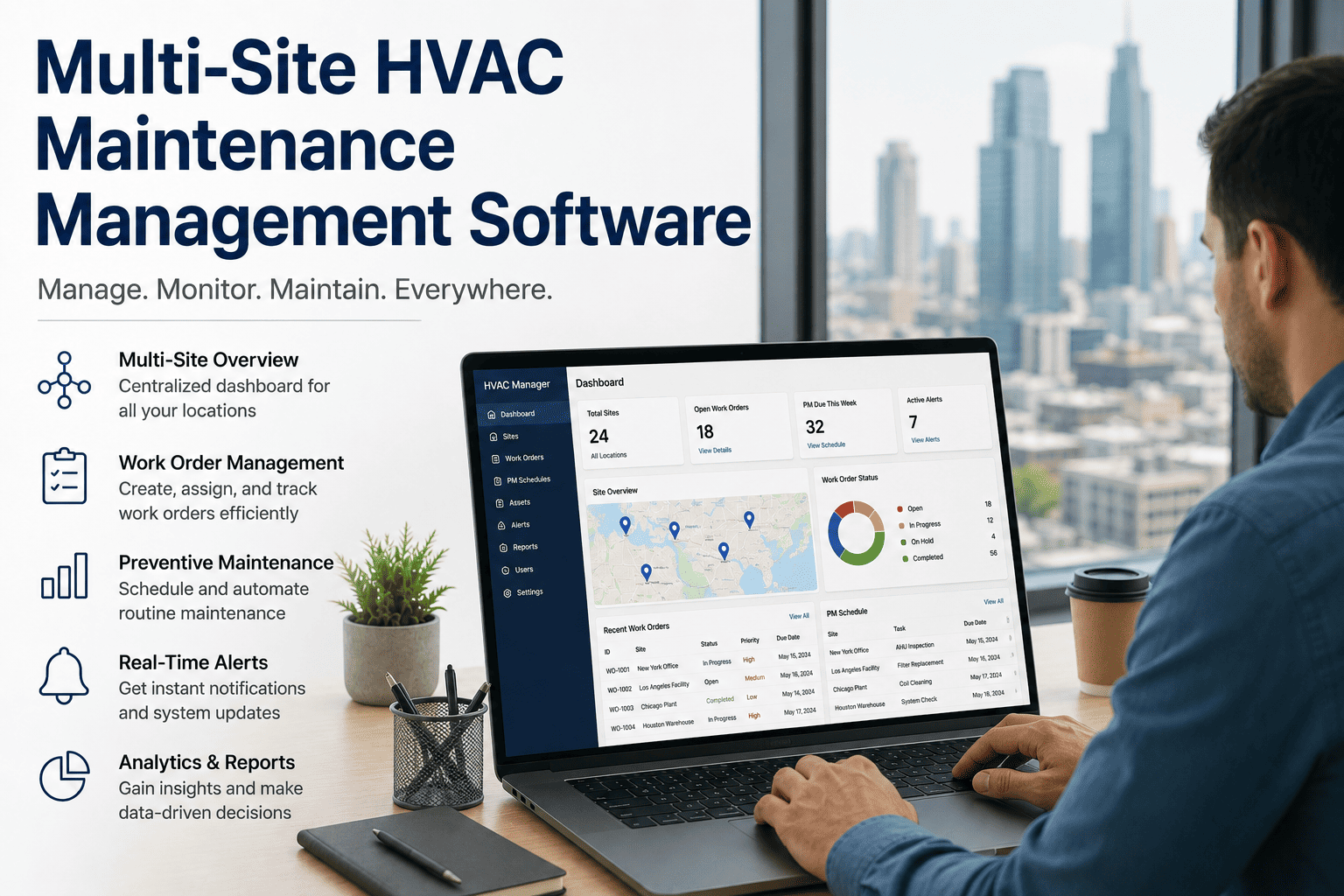
Managing HVAC systems across multiple buildings feels like conducting an orchestra where every musician plays from a different sheet of music. One facility team uses spreadsheets, another relies on whiteboards, and a third still takes phone calls for emergency repairs. The result? Inconsistent comfort levels, ballooning maintenance costs, and the constant anxiety of wondering which building will fail next. Whether you oversee ten locations or five hundred, the challenge isn't just maintaining equipment—it's creating visibility, standardization, and control across dispersed operations. Centralized multi-site HVAC maintenance management transforms fragmented chaos into a unified command center, delivering portfolio-wide insights that single-site managers can only dream of. The shift from reactive firefighting to predictive portfolio optimization isn't just operational efficiency; it's competitive advantage in an era where building performance directly impacts asset value and tenant retention.
Transform fragmented operations into centralized command and control
The Multi-Site HVAC Management Challenge
Portfolio managers face unique pressures that single-site operators never encounter. When you're responsible for HVAC performance across dozens or hundreds of locations, small inefficiencies multiply exponentially:
Operational Fragmentation: Each site develops its own maintenance rhythms, vendor relationships, and emergency protocols. What works in Phoenix fails in Minneapolis. Without standardization, you cannot benchmark performance or share best practices. Sign up to unify your portfolio under one digital platform.
Data Silos and Blind Spots: When work orders live in site-specific spreadsheets or local servers, portfolio-level patterns remain invisible. You cannot spot the systemic refrigerant leak trend affecting 15% of your buildings or identify which vendor consistently delivers poor value across multiple locations.
Resource Allocation Inequity: High-visibility buildings often receive disproportionate attention while remote locations suffer deferred maintenance. Without centralized oversight, critical needs go unaddressed while budgets bleed into unnecessary upgrades at flagship properties. Book a demo to see cross-site resource balancing in action.
The Fragmentation Tax
Centralized Command: The Digital Nervous System
True multi-site HVAC management requires more than just viewing separate building dashboards side by side. It demands a unified data architecture that normalizes information across different equipment ages, manufacturers, and building types:
Unified Work Order Ecosystem: Every service request, regardless of origin, flows into a single queue with automatic routing based on location, equipment type, and technician certification. A chiller failure at a medical facility triggers different protocols than the same failure at a warehouse, but both are visible on your portfolio dashboard instantly. Sign up to streamline work order routing across all locations.
Cross-Site Resource Pooling: When a specialist technician is idle at Site A and Site B faces a complex boiler issue 40 miles away, centralized dispatching optimizes labor utilization. Digital skill mapping and geolocation ensure the right expertise reaches the right problem without the overhead of maintaining full teams at every location.
Portfolio-Wide Inventory Intelligence: That critical VFD drive needed in Denver might be sitting unused in Dallas. Centralized spare parts visibility transforms emergency procurement into internal transfers, cutting both costs and downtime. Book a demo to explore intelligent inventory pooling.
Standardization Without Rigidity
The paradox of multi-site management: standardization drives efficiency, but local conditions demand flexibility. The solution lies in tiered standardization frameworks:
Universal PM Templates: Core maintenance tasks—filter changes, belt inspections, coil cleaning—follow identical schedules and procedures across the portfolio. This creates baseline performance expectations and simplifies training. However, frequencies adjust automatically based on local runtime hours, air quality indices, and equipment age.
Regional Protocol Variations: Coastal buildings follow corrosion-prevention protocols that desert locations ignore. Freeze protection procedures apply to northern sites only. Digital checklists dynamically generate location-appropriate tasks while maintaining consistent documentation standards. Sign up to deploy adaptive maintenance protocols.
Equipment-Specific Playbooks: While the process remains consistent, content varies by equipment type. A rooftop unit PM checklist differs from a chiller procedure, but both feed into the same compliance reporting and performance benchmarking systems.
Portfolio Analytics: From Data to Decisions
Centralized data aggregation transforms maintenance from cost center to strategic asset. When every work order, energy reading, and equipment status feeds into unified analytics, patterns emerge that drive capital decisions:
Cross-Site Benchmarking: Compare energy consumption per square foot across similar building types. Identify why Building A operates at $1.20/sqft while Building B hits $2.40. The answer often lies in maintenance quality rather than equipment age—insights that justify training investments or vendor changes. Book a demo to unlock portfolio benchmarking tools.
Predictive Failure Modeling: Analyze failure patterns across hundreds of similar units. If RTUs of a specific vintage show compressor failures clustering at 8-year marks, you can pre-emptively replace units at 7 years in remaining buildings, avoiding emergency costs and tenant disruptions.
Vendor Performance Scoring: Track response times, callback rates, and cost-per-work-order across all locations. That "great" local vendor might actually cost 40% more than the regional contractor when quality and warranty rework are factored in.
Quarterly cost-per-sqft trend across 47-building portfolio
Command Your Portfolio From Anywhere
Stop managing buildings in isolation. Centralize your HVAC operations and unlock portfolio-scale efficiency.
Vendor Consolidation and Master Service Agreements
Decentralized vendor management creates hidden costs: inconsistent pricing, quality variance, and administrative overhead. Centralized procurement transforms vendor relationships:
Regional Master Agreements: Negotiate single contracts covering all locations within geographic zones. Instead of 50 separate agreements with local HVAC contractors, three regional providers deliver standardized rates, shared parts inventories, and consistent service levels. Sign up to manage master service agreements digitally.
Performance-Based Contracts: Shift from time-and-materials to outcome-based agreements. Vendors guarantee uptime percentages or energy performance, with penalties for non-compliance and bonuses for exceeding benchmarks. Centralized tracking makes these complex arrangements administratively feasible.
Shared Risk Models: For critical equipment, consider equipment-as-a-service models where the vendor owns the asset and guarantees performance. Centralized portfolio data proves your reliability as a partner, securing better terms than individual locations could negotiate.
Implementation Without Disruption
Transitioning from siloed to centralized operations risks operational disruption if mishandled. Phased rollout minimizes risk while building organizational confidence:
Pilot Region Selection: Choose 3-5 geographically clustered buildings with varying equipment types. This tests integration without overwhelming support resources and creates local success stories that drive adoption elsewhere. Book a demo to design your pilot strategy.
Parallel Operations Period: Run new digital workflows alongside existing processes for 30 days. This validates data accuracy and builds user comfort before switching off legacy systems. Never go "cold turkey" on critical building systems.
Change Management Sequencing: Train regional managers first—they become local champions. Site technicians follow, with emphasis on how centralized tools reduce their administrative burden rather than increase oversight. Frame the shift as empowerment, not surveillance.
Pilot Selection
5 buildings, data migration, workflow design
Parallel Operations
Dual system validation, user training
Regional Rollout
25% of portfolio per month
Optimization
Analytics-driven improvements
Technology Integration: The Connected Portfolio
Modern multi-site HVAC management extends beyond maintenance software into building automation, energy management, and financial systems:
BMS Integration: Pull fault codes, runtime hours, and energy consumption directly from building automation systems. This eliminates manual meter reading and provides real-time performance visibility without site visits. Sign up to connect your BMS data streams.
IoT Sensor Networks: Low-cost wireless sensors monitor vibration, temperature, and power draw on critical equipment across all locations. Centralized dashboards alert to anomalies before they trigger BMS alarms, creating a predictive maintenance layer atop traditional automation.
ERP Synchronization: Maintenance costs flow automatically into capital planning and financial reporting. When the CFO asks for HVAC spend by region, the answer is available in minutes rather than weeks of spreadsheet consolidation.
FAQ: Multi-Site HVAC Management
How do I justify the investment in centralized HVAC management software?
Calculate current hidden costs: emergency repair premiums (typically 3x planned maintenance), administrative overhead for managing multiple vendor relationships (often 0.5 FTE per 20 buildings), and energy inefficiency from inconsistent maintenance (10-15% cost variance between best and worst performers). Most portfolios see 18-month ROI through reduced emergency work alone. Book a demo for a customized ROI analysis.
What is the ideal team structure for managing 50+ building HVAC portfolios?
Structure follows the three-layer model: Corporate/Portfolio level (1 director overseeing analytics and vendor management), Regional level (1 supervisor per 15-20 buildings handling quality assurance and escalations), and Site level (technicians executing work). Technology enables this lean structure by automating coordination that previously required extensive middle management.
How do I handle different equipment ages and manufacturers across my portfolio?
Standardize on maintenance processes, not equipment brands. Digital platforms accommodate any equipment type while enforcing consistent documentation and scheduling. Use analytics to identify which manufacturers deliver lowest total cost of ownership across your portfolio, informing future procurement decisions.
Can centralized management work with unionized workforces or contracted maintenance?
Absolutely. Centralized systems coordinate work allocation without changing employment status. Union shops gain transparency in work assignment fairness. Contractors receive digital work orders and performance feedback just like internal teams. The platform manages the workflow; labor relationships remain unchanged.
How quickly can we expect to see results after centralizing HVAC operations?
Immediate visibility improvements appear within 30 days as data aggregates. Cost reductions typically materialize in 90-120 days as preventive maintenance compliance improves and emergency work declines. Full optimization—including vendor consolidation benefits and predictive maintenance value—usually realizes within 12 months.
What data security considerations apply to centralized building management?
Enterprise-grade platforms offer role-based access controls, ensuring site teams see only their buildings while regional managers view appropriate scopes. All data transmission should be encrypted, with SOC 2 Type II compliance standard. For sensitive facilities (healthcare, government), on-premise deployment options maintain complete data sovereignty. Sign up to review enterprise security features.
Unify Your Portfolio. Optimize Your Operations.
Join leading property managers who have replaced fragmented chaos with centralized control. Your portfolio deserves enterprise-grade management.