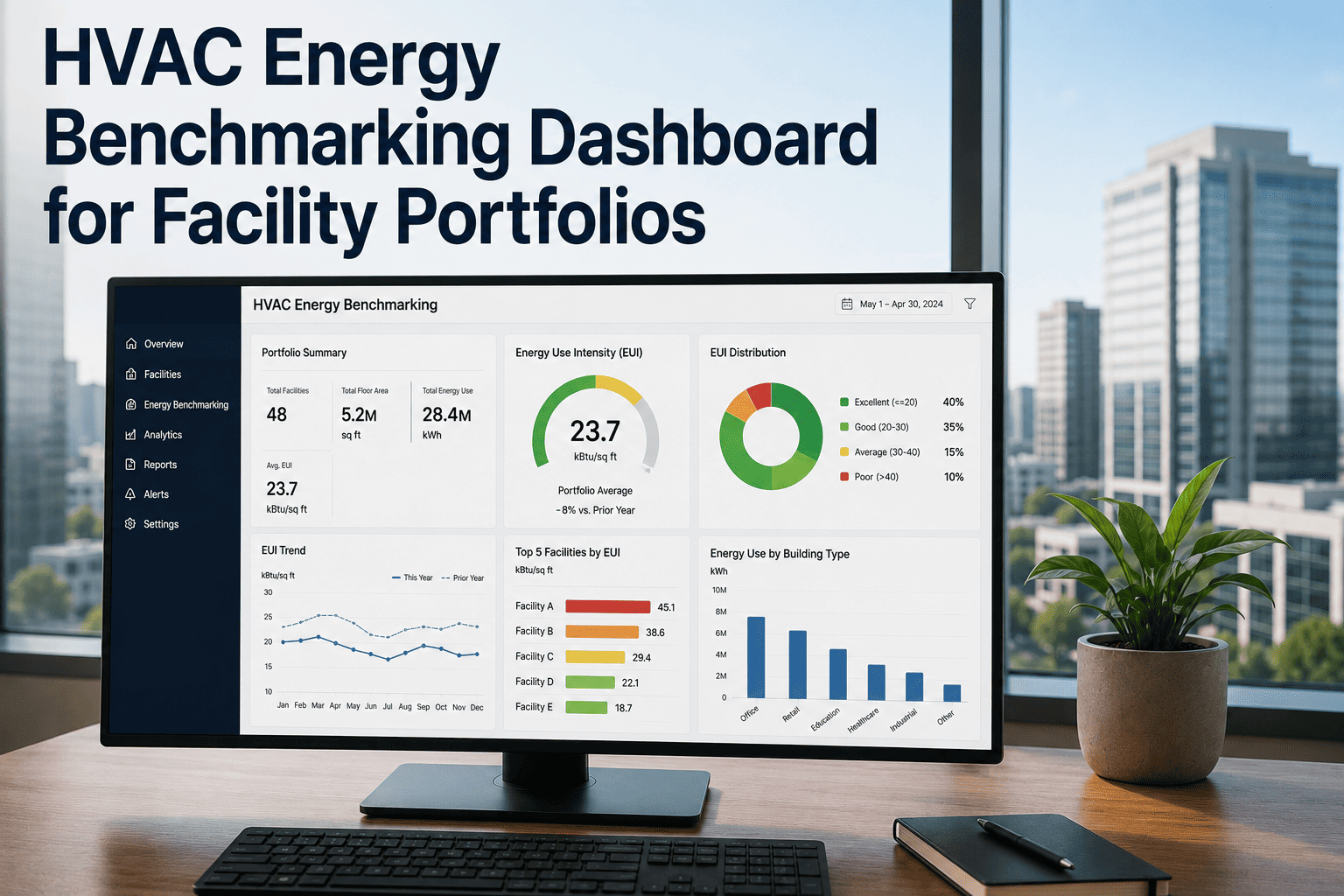
Portfolio owners managing HVAC systems across multiple facilities face a compounding data problem: scattered sensor feeds, disconnected work order systems, inconsistent maintenance records, and energy reports that don't correlate with asset condition. The result is a strategic blind spot that prevents effective capital planning, energy optimization, and maintenance prioritization at scale. Sign Up Free to consolidate your HVAC asset data into a single portfolio intelligence platform. A smart building HVAC data strategy doesn't require a rip-and-replace of existing systems — it requires a data architecture that aggregates maintenance history, energy consumption, fault frequency, and condition measurements into a unified view that drives decisions across every site. Book a Demo to see how Oxmaint structures multi-site HVAC data for portfolio-level decisions. When HVAC data is siloed by site, portfolio owners make capital decisions with incomplete information — and pay for it in deferred maintenance, reactive spend, and energy waste that a unified data model would have prevented.
Turn Scattered HVAC Data Into a Portfolio Strategy
Oxmaint unifies HVAC maintenance data, energy metrics, and asset condition across every site — giving portfolio owners the intelligence to plan comfort, maintenance, and capital at scale.
Why HVAC Data Stays Scattered: The Portfolio Owner's Structural Problem
The root cause of scattered HVAC data is architectural, not operational. Sites were built at different times, equipped with different BMS platforms, and maintained by different service contractors — each generating data in incompatible formats that never feed a unified portfolio view. When a portfolio owner asks "which sites have the highest HVAC failure rate?" or "which assets are within 18 months of end-of-life?", the answer requires manually aggregating reports from 4–8 different systems. Oxmaint's multi-site CMMS architecture solves this by standardizing asset data entry, work order structure, and maintenance KPIs across every site — generating portfolio-level reporting from day one without requiring BMS replacement. Sign Up Free to unify your multi-site HVAC maintenance data in Oxmaint.
The Four HVAC Data Layers Every Portfolio Owner Needs
A complete smart building HVAC data strategy requires four data layers working in concert: asset inventory data (what equipment exists and where), maintenance event data (what happened and when), condition measurement data (current asset health state), and performance outcome data (energy, comfort, uptime). Most portfolio owners have partial coverage of layers 1 and 2, and almost none of layers 3 and 4. Oxmaint provides a structured framework for building all four layers from existing maintenance operations — no new sensor hardware required for layers 1 and 2, and a clear sensor integration path for layers 3 and 4. Book a Demo to map your current HVAC data coverage against the four-layer model.
Capital Planning with HVAC Data: From Estimation to Evidence
Capital planning for HVAC replacement in a multi-site portfolio typically operates on two inputs: equipment age and manufacturer lifecycle estimates. Both are unreliable — age ignores operating intensity and maintenance quality, and manufacturer lifecycles assume conditions that rarely match real-world installation. A data-driven capital model uses actual maintenance cost trajectory, failure frequency trends, energy consumption deviation, and condition measurements to predict remaining useful life per asset — generating a replacement forecast that is 40–60% more accurate than age-based estimation. Oxmaint builds this model from work order history automatically, projecting capital requirements 12–36 months forward per site and across the portfolio. Sign Up Free to start building your data-driven HVAC capital forecast.
Energy Planning Through an HVAC Maintenance Lens
Energy consumption is the most visible HVAC performance metric — and the least connected to maintenance data in most portfolio operations. A degraded coil operating at 68% efficiency burns 32% more energy than a clean coil producing the same comfort output, but energy management systems typically flag the anomaly months after the maintenance trigger appears in asset condition data. Connecting energy performance to HVAC asset condition — through a CMMS that links maintenance events to energy deviation — allows portfolio owners to use maintenance data as an energy planning tool, identifying assets that require cleaning, refrigerant top-up, or replacement based on energy performance alone. Book a Demo to see how Oxmaint correlates maintenance events with energy consumption data.
Build Your HVAC Data Strategy Across Every Site
Oxmaint standardizes HVAC data collection, work order structure, and asset condition tracking across your portfolio — generating the unified intelligence that drives comfort, maintenance, energy, and capital decisions at scale.
Frequently Asked Questions
Improve Decisions on Comfort, Maintenance, Energy, and Capital Planning Across Every Site.
Oxmaint's smart building HVAC data platform unifies asset inventory, maintenance events, condition measurements, and portfolio performance analytics — giving portfolio owners the operational intelligence that scattered systems can never provide.