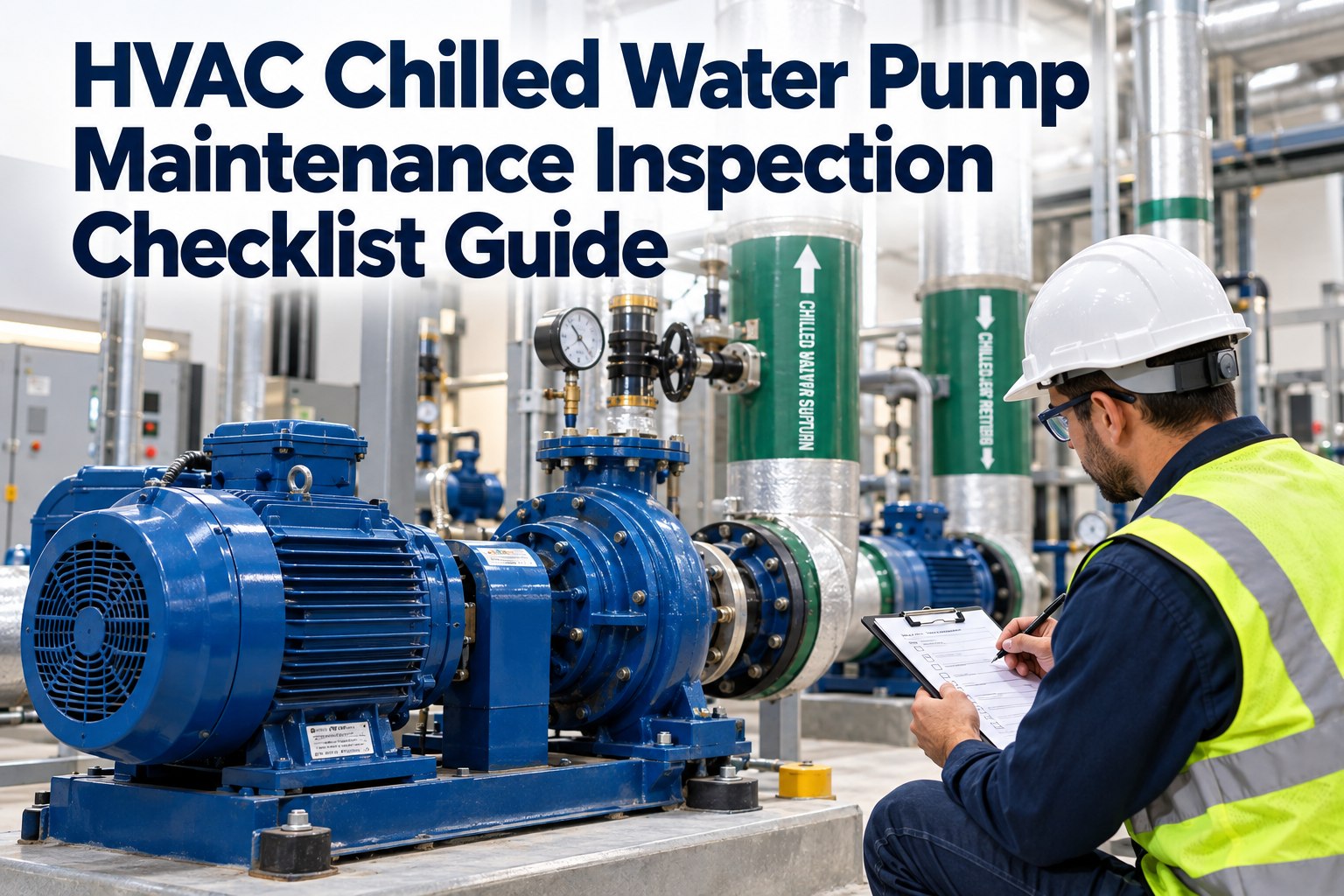
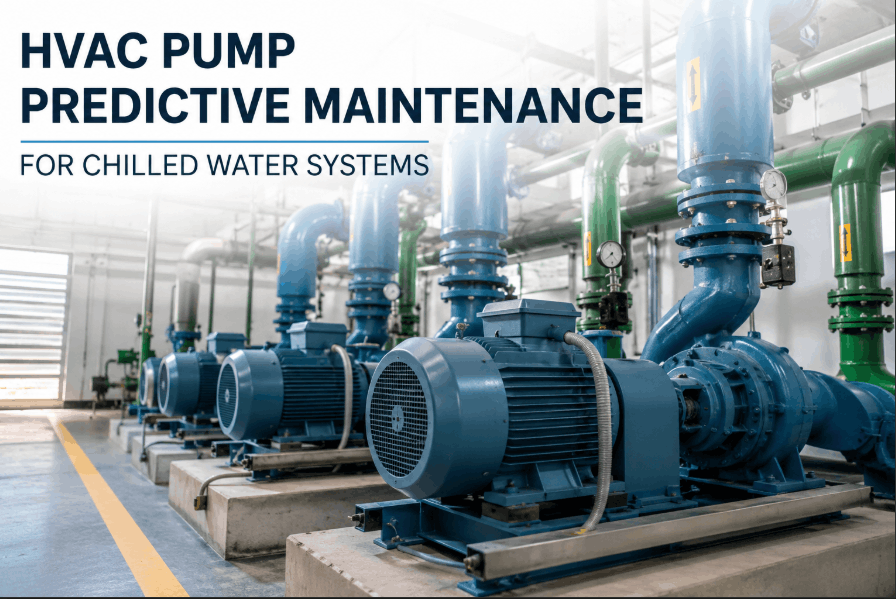
The chilled water pump is the quiet workhorse of the whole HVAC plant — and the one most likely to be running on borrowed time until the morning it isn't. A worn seal weeps for weeks before it floods a pump room; a bearing runs hot for a month before it seizes and takes the coupling with it; vibration climbs a little each week until something cracks. Every one of those failures announces itself early, in a reading, if someone is looking. A standardized inspection checklist is what makes sure someone always is — the same points, the same limits, on every pump, every cycle. OxMaint AI maintenance management software turns that checklist into scheduled work, captures each reading against the pump, and raises a work order the moment one crosses its limit.
Facility Management · HVAC · Chilled Water Pump · Maintenance Checklist · 2026
The Chilled Water Pump Checklist That Catches Failures Before They Flood the Room
Seals, bearings, vibration, alignment, motor draw — a chilled water pump gives weeks of warning before it fails, but only to a program that checks the same points every cycle and knows the limits. A standardized checklist turns inspection from "walk by and listen" into a repeatable record. OxMaint AI schedules every check, logs each reading to the pump, and flags any value out of range as a work order — so the warning becomes an action, not a note nobody read.
1Run the checklist
→
2Log the reading
→
3Flag out-of-range
→
4Work order & verify
4.5 mm/s
vibration warning limit · 7.1 is alarm (ISO 10816)
6 areas
bearings · seals · vibration · hydraulics · electrical · structure
5%+
efficiency drop warrants inspection
1 record
every reading logged to the pump, on schedule
Why a Standardized Checklist Beats a Walk-By
"Give it a look" catches nothing consistently — a checklist catches the same things every time, on every pump, no matter who's on shift. Start free and standardize every pump inspection in OxMaint AI.
Every Pump, Same Points
The primary and the standby get the identical inspection — no pump gets skipped because it "seemed fine."
Readings, Not Impressions
A logged bearing temperature beats "felt warm." A number can be trended; a memory can't.
Limits Built In
The checklist carries the threshold, so the technician knows on the spot whether a reading is a problem.
Nothing Depends on Memory
The schedule raises the check; the record proves it happened. Neither rides on someone remembering.
The 6-Point Chilled Water Pump Inspection Checklist
A complete pump inspection covers six systems. Here is each one with its checkpoints and the limits that separate normal from action. Book a demo to load this checklist into OxMaint AI.
1Lubrication & BearingsMonthly
Check bearing temperature with an IR or contact thermometer against baseline
Lubricate to OEM spec — correct grease type, volume, and interval
Inspect bearing housing for grease leakage or discolouration
Listen for grinding, rumbling, or high-pitched squeal
2Mechanical Seals & PackingMonthly
Inspect seal faces for leakage; log drops per minute against baseline
Check packing: slight seeping is acceptable, streaming is not
Inspect flush lines and quench connections for blockage
Record seal-chamber temperature and compare to baseline
3Vibration & AlignmentMonthly
Measure vibration at the bearing housing — horizontal, vertical, axial
Compare to ISO 10816: above 4.5 mm/s RMS is warning, above 7.1 is alarm
Check pump-to-motor alignment
Inspect the coupling for wear, looseness, or insert deterioration
4Hydraulic PerformanceQuarterly
Record suction and discharge pressure; compare to the pump curve
Measure flow rate against design specification
Flag efficiency degradation of 5% or more for inspection
Check for cavitation: noise, vibration, or impeller pitting
5Electrical & DriveQuarterly / Annual
Check motor current draw against nameplate rating
Megger the motor winding insulation resistance annually
Verify VFD settings and check for fault codes
Tighten terminals; check contactors for overheating
6Structural & GeneralMonthly
Inspect baseplate for cracks, corrosion, or loose anchor bolts
Check bolted connections and pump-casing integrity
Inspect the suction strainer; clean if differential pressure is high
Update pump run-hours in the CMMS for the next PM
A Checklist in a Binder Has Never Stopped a Pump From Seizing.
The value isn't the list — it's what happens when a reading crosses a limit. On paper, that's a note somebody has to notice, chase, and act on. In OxMaint AI, an out-of-range reading becomes a work order the instant it's entered, routed to the right technician with the pump's history attached.
The Readings That Signal Trouble
A checklist is only as sharp as the limits behind it. These are the readings to watch and the values that turn a routine check into a work order. Start free and log every reading against its limit in OxMaint AI.
| Reading | Watch for | Action point |
|---|
| Vibration (bearing housing) | Rising trend | > 4.5 mm/s warning · > 7.1 alarm (ISO 10816) |
| Bearing temperature | Above baseline | Rising trend or OEM limit exceeded |
| Seal / packing leakage | Streaming, not seeping | Steady stream or rising drip rate |
| Pump efficiency | Off the pump curve | Degradation of 5% or more |
| Motor current draw | Above nameplate | Sustained over-current |
| Insulation resistance | Falling megger reading | Below OEM/annual threshold |
| Suction strainer ΔP | Elevated differential | High ΔP — clean the strainer |
These are common commercial limits — your OEM manuals set the exact thresholds for your pumps. Book a demo to configure your own limits in OxMaint AI.
How OxMaint AI Runs the Pump Checklist
A checklist is a starting point; a system is what makes it happen every cycle and act on what it finds. OxMaint AI builds the checklist into the pump's maintenance program. Start free and turn the checklist into a running program.
Scheduled Inspection Tasks
Monthly, quarterly, and annual checks raised automatically per pump — no cycle depends on memory.
Mobile Checklist Capture
The technician logs each reading at the pump — the record is built where the work happens.
Out-of-Limit Work Orders
A reading past its threshold becomes a corrective work order the moment it's entered.
Reading Trends per Pump
Vibration, temperature, and efficiency trended over time, so a slow decline is visible early.
Run-Hours & PM Triggers
Pump run-hours tracked to trigger the next PM on usage, not just the calendar.
Full Pump History
Every inspection, reading, and repair on one timeline — the record behind every decision.
Frequently Asked Questions
What should a chilled water pump checklist cover?
Six areas: bearings and lubrication, seals and packing, vibration and alignment, hydraulic performance, electrical and drive, and structural checks — each with logged readings.
Start free and build all six in OxMaint AI.
What vibration level means trouble?
By ISO 10816, overall velocity above about 4.5 mm/s RMS is a warning and above 7.1 mm/s is an alarm — but the rising trend matters as much as the number.
Book a demo of vibration trending.
How often should chilled water pumps be inspected?
Bearings, seals, vibration, and structure monthly; hydraulic performance quarterly; insulation and drive checks quarterly to annually — tuned to run-hours.
Sign up free and schedule each cadence.
When is seal leakage a problem?
Slight seeping on packing is acceptable; a steady stream or a rising drip rate on a mechanical seal is not, and warrants a work order.
Book a demo of reading limits.
How does a CMMS improve pump maintenance?
OxMaint AI schedules every check, logs each reading to the pump, turns out-of-limit values into work orders, and trends the data — so warnings are caught and acted on.
Start free and see it work.
Make Every Pump Reading an Action, Not a Note.
A chilled water pump rarely fails without warning — it fails without anyone acting on the warning. A standardized checklist, run every cycle with the limits built in and the readings logged to the pump, turns those early signals into scheduled work before they become a flooded room or a dead plant. OxMaint AI runs the checklist, catches the reading that drifts, and raises the work order — so the pump keeps running and the surprise never comes.