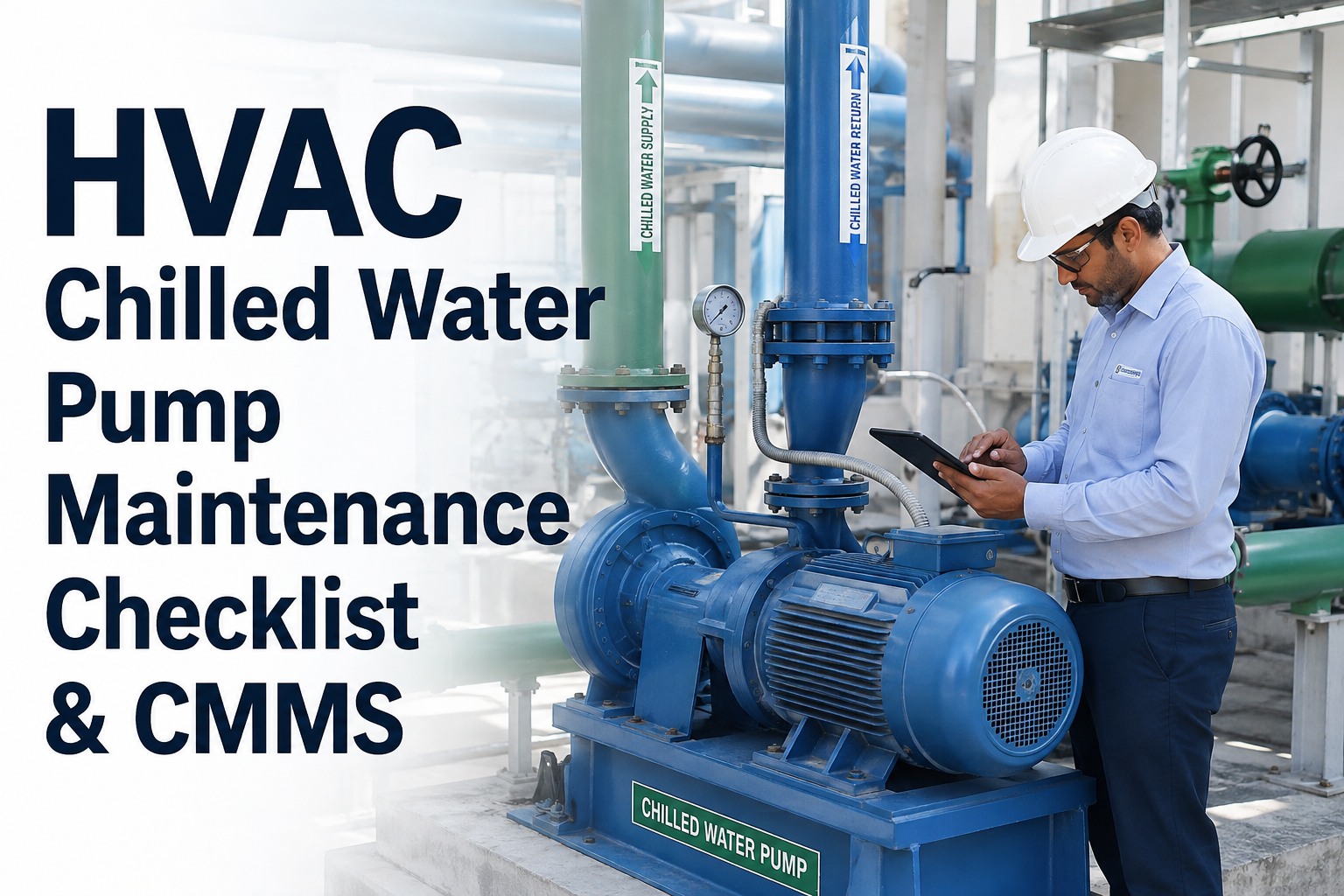
HVAC chilled water pump maintenance is the single highest-leverage activity for keeping central plant cooling capacity online, yet most facilities still rely on clipboard checklists and calendar-based service intervals that miss 40–60% of developing failures. A structured pump maintenance checklist — covering mechanical seal inspection, impeller wear monitoring, bearing lubrication, and runtime-triggered preventive tasks — can cut unplanned pump downtime by 30–50% and extend mean time between failures well beyond the typical 3-year mark. This HVAC pump maintenance guide walks through every inspection point, service interval, and failure mode, then shows how a chilled water pump CMMS like OxMaint automates the entire program using real runtime data instead of guesswork. Ready to stop reacting to pump failures? Start Free Trial and digitize your pump maintenance program today.
CHILLED WATER PUMP MAINTENANCE GUIDE 2026
Cut unplanned pump downtime up to 50% with a runtime-triggered maintenance program
Reactive maintenance on HVAC chilled water pumps costs 3–5× more than a planned, CMMS-driven program. This guide delivers the complete inspection checklist, failure-mode benchmarks, and service schedule your reliability team needs — then shows how OxMaint automates every task using actual pump runtime hours.
DAILY & WEEKLY INSPECTION CHECKLIST
HVAC Chilled Water Pump Maintenance Checklist — Daily, Weekly & Monthly Tasks
A single undetected seal leak on a 50 HP chilled water pump can waste $4,000–$8,000 in make-up water and chemical treatment annually. These tiered checklists cover every inspection point reliability technicians should perform, from walk-around visual checks to monthly vibration benchmarking.
Walk-Around & Visual Inspection
- Inspect mechanical seal for visible leakage — allowable weep ≤3 drops/minute on packed glands; zero drips on cartridge seals
- Check pump casing for sweating, corrosion, or flange gasket seepage at suction and discharge
- Read discharge and suction pressure gauges — verify differential matches design curve within ±10%
- Listen for cavitation (gravel sound), bearing whine, or rub noise — log any anomaly immediately
- Confirm motor amperage is within nameplate FLA rating at operating load
Bearing & Lubrication Check
- Grease pump bearings per OEM spec — typically 0.5–1 oz of NLGI #2 lithium grease per bearing per 2,000 runtime hours
- Check bearing housing temperature with infrared gun — alarm if >80°C (176°F) or >20°C above ambient
- Inspect coupling guard for vibration looseness; verify alignment hasn't drifted (target ≤0.002 in TIR)
- Verify oil-mist or oil-bath lubrication level on sleeve-bearing pumps; top off with ISO VG 32 oil if low
Vibration & Performance Benchmarking
- Measure vibration at drive and non-drive-end bearings — Hydraulic Institute limit: ≤0.15 in/s peak velocity for good, >0.31 in/s = alarm
- Record pump head, flow, and kW input — calculate wire-to-water efficiency and trend month-over-month
- Inspect impeller wear rings — measure clearance; replace if exceeds OEM max (typically 0.015–0.020 in for 6 in pumps)
- Trend motor winding resistance and megger test annually (target ≥100 MΩ for 460V motors)
PUMP SERVICE SCHEDULE
Chilled Water Pump Service Schedule — Annual & Runtime-Based Intervals
Industry data from ASHRAE and the Hydraulic Institute shows that 70% of pump failures follow predictable wear patterns tied to runtime hours, not calendar dates. This service schedule blends both triggers — and a CMMS like OxMaint auto-generates the work order the moment a runtime threshold is crossed.
| Service Task | Interval | Runtime Trigger | Typical Labor Hours |
|---|---|---|---|
| Mechanical seal inspection & flush | Quarterly | 2,000 hours | 0.5 |
| Bearing re-grease (anti-friction) | Monthly | 500 hours | 0.25 |
| Coupling alignment verification (laser) | Semi-annual | 4,000 hours | 1.5 |
| Impeller & wear-ring inspection | Annual | 8,000 hours | 4.0 |
| Bearing replacement (preventive) | Every 3 years | 25,000 hours | 6.0 |
| Complete pump overhaul & re-bowl | Every 5 years | 40,000 hours | 16.0 |
REAL-WORLD SCENARIO
A 280,000 sq ft commercial office building in Dallas operated four 60 HP primary chilled water pumps on calendar-based PMs. After two emergency seal failures in one summer cost $18,400 in emergency labor, expedited seals, and tenant comfort complaints, the facility team implemented OxMaint CMMS with runtime-hour triggers from the BMS. Over the next 18 months, zero unplanned pump failures occurred — and the team caught a worn impeller on Pump #3 during a CMMS-generated inspection before it destroyed the wear ring, saving an estimated $6,200 in rebuild costs.
FAILURE MODES & COST OF INACTION
Top 4 Chilled Water Pump Failure Modes — and What They Cost You
The average cost of an unplanned pump failure in a commercial HVAC system is $9,200 per event when you factor emergency labor, expedited parts, and downtime impact on occupied spaces. Here are the four modes responsible for over 80% of failures.
Mechanical seal failure — caused by dry running, misalignment, or cavitation. A single failed seal on a 75 HP pump averages $3,800 in parts and emergency labor.
Bearing failure — almost always lubrication-related. Over-greasing is as damaging as under-greasing; both destroy bearings within 1,500–3,000 hours if unchecked.
Impeller wear & cavitation damage — erodes vane tips over 2–4 years, dropping efficiency 15–25% before total failure. Often missed without performance trending.
Coupling & alignment drift — thermal cycling and pipe strain shift alignment beyond 0.005 in, accelerating seal and bearing wear simultaneously.
HOW OXMAINT HELPS
How OxMaint CMMS Automates Your Chilled Water Pump Maintenance Program
OxMaint replaces spreadsheet PM logs and clipboard checklists with an AI-powered CMMS that triggers preventive maintenance on actual pump runtime, predicts failures from vibration and temperature trends, and keeps every work order, spare part, and inspection record audit-ready.
Runtime-Triggered Preventive Maintenance
OxMaint ingests runtime hours directly from your BMS or pump controller via BACnet, Modbus, or OPC-UA — and auto-generates seal inspections, bearing greasing, and alignment checks at the exact hour threshold, not a guessed calendar date.
Predictive Analytics on Vibration & Temperature
OxMaint's AI engine trends vibration velocity, bearing temperature, and motor amperage over time — flagging the transition from "good" to "alarm" zone up to 30–60 days before failure, so you plan the repair instead of reacting to it.
Digital Work Orders & Mobile Inspection Checklists
Technicians receive pump-specific checklists on their mobile device — every gauge reading, leak observation, and grease quantity is captured digitally with timestamps, photos, and e-signatures. No more lost paper rounds.
Spare-Parts Inventory with Auto-Reorder
OxMaint tracks mechanical seals, bearings, and wear rings by pump asset — and auto-generates purchase requisitions when stock drops below your minimum. The right part is always on the shelf before the work order opens.
CMMS PUMP PROGRAM ROI
What a CMMS-Driven Pump Maintenance Program Saves — ROI Breakdown
For a typical commercial facility running 8–12 chilled water pumps, switching from reactive maintenance to an OxMaint CMMS pump program pays back in 4–7 months. Here is the math.
| Savings Category | Baseline (Reactive) | With OxMaint CMMS | Annual Savings |
|---|---|---|---|
| Unplanned pump failures (10-pump fleet) | 4–5 per year | 1–2 per year | $18,400–$27,600 |
| Energy waste from degraded efficiency | 15–25% over-spec kWh | 3–5% over-spec kWh | $6,200–$11,800 |
| Emergency labor (overtime + expedited) | 120 hrs/year | 30 hrs/year | $8,550 |
| Extended pump asset life (deferred capital) | Replace at 7 years | Replace at 11 years | $4,500/yr amortized |
| Total Annual Savings (10-pump fleet) | $37,650–$52,450 | ||
See OxMaint on your chilled water pumps — book a 30-minute demo
We'll show you how runtime-triggered PMs, predictive vibration analytics, and mobile work orders replace your clipboard checklist — and how fast your team can go live.
FREQUENTLY ASKED QUESTIONS
HVAC Chilled Water Pump Maintenance — FAQs
How often should chilled water pumps be inspected?
Chilled water pumps should receive a daily visual walk-around (5–10 minutes per pump), a weekly bearing and lubrication check, and a monthly vibration and performance benchmarking session. More detailed inspections — impeller wear-ring measurement, laser alignment verification, and megger testing — should occur quarterly to annually. OxMaint CMMS auto-generates each work order based on actual runtime hours, so no inspection is missed or performed prematurely.
What is the acceptable mechanical seal leak rate for an HVAC pump?
For packed-gland seals, a weep rate of up to 3 drops per minute is normal and actually required for lubrication. For cartridge mechanical seals, zero visible leakage is the standard — any drip indicates a failing seal face, contaminated barrier fluid, or misalignment that needs immediate attention. If left unchecked, a leaking cartridge seal will fail completely within 30–90 days. Book a demo to see how OxMaint tracks seal leak observations across every pump in your fleet.
What vibration level indicates a pump bearing problem?
Per the Hydraulic Institute standard, peak vibration velocity below 0.15 in/s (3.8 mm/s) is considered good for a pump running at 1,800–3,600 RPM. Readings between 0.15–0.31 in/s warrant monitoring; anything above 0.31 in/s is an alarm condition requiring immediate investigation. A sudden 2× increase in vibration at the bearing housing is the earliest predictor of bearing failure — typically 30–60 days before catastrophic seizure.
Can a CMMS prevent chilled water pump cavitation?
A CMMS cannot change the hydraulic conditions that cause cavitation (low suction pressure, air entrainment, or restricted intake), but it can detect the symptoms early. OxMaint trends suction pressure, motor amperage, and vibration signature over time — and flags the cavitation signature (high 1× and vane-pass frequency vibration with rising motor load) before it erodes the impeller. This gives your team 2–4 weeks to correct the system issue before permanent damage occurs.
How long does it take to implement OxMaint for a pump maintenance program?
Most facilities are live in 2–4 weeks. You import your pump asset register (or we help you build one), define PM templates from the built-in HVAC pump library, connect runtime data from your BMS, and assign technicians. Your team can Start Free Trial in minutes — and our onboarding team handles BACnet/Modbus integration as part of your plan. No on-premise servers or IT project required.
Stop reacting to pump failures — start preventing them
Join the maintenance & reliability teams using OxMaint to cut unplanned pump downtime up to 50%, extend asset life, and keep every inspection record audit-ready. Your chilled water pump program goes live in weeks — not months.
Free 14-day trial · No credit card