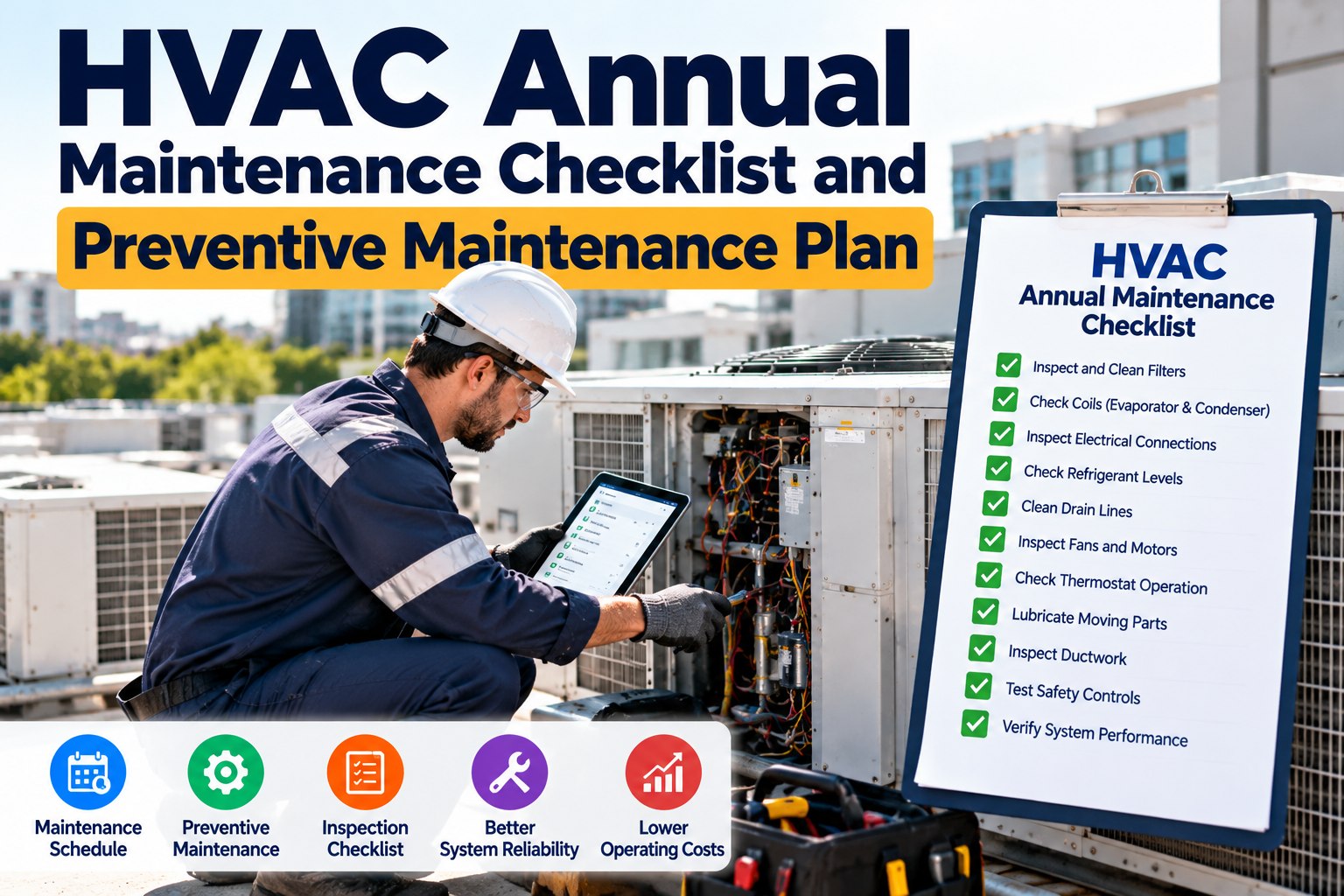
HVAC Preventive Maintenance Program: Step by Step Plan, Checklist and Schedule"
By Mark Strong on March 25, 2026
Every $1 spent on preventive HVAC maintenance saves $4 in repair costs. Equipment under a structured PM program lasts 5 to 10 years longer than neglected systems, and 95% of HVAC failures are preventable through systematic care. But most facilities do not have a PM program — they have a reaction plan. This article walks through how to build a complete HVAC preventive maintenance program from scratch: the right tasks, at the right frequencies, for the right equipment, tracked the right way. Sign up free on OxMaint to run every step below as automated work orders, or book a demo to see a live PM program on your system type.
$4
Saved per $1 spent
EPA benchmark
95%
Of HVAC failures
preventable with PM
+10 yr
Equipment life gained
vs. no PM program
20%
Annual energy saved
from proper maintenance
44%
Less downtime
with CMMS-managed PM
OxMaint turns this entire program into automated, tracked, photo-verified work orders.
Every step in this guide runs automatically — right technician, right task, right time. No spreadsheets. No missed intervals. Audit-ready documentation built into every completion.
Before any schedule can be built, every HVAC asset must be registered with the data that drives PM decisions. Missing a single chiller from your inventory means its PM intervals are also missing — and the next failure is already untracked.
Required Fields for Every HVAC Asset Record
Make, model, serial number
Installation date and age
Replacement asset value (RAV)
Location and zone served
Refrigerant type and charge
Criticality tier (1 / 2 / 3)
Warranty expiry and service contract
Last service date and technician
02
Step Two
Assign PM Frequencies to Every Task
Not all tasks need the same interval — here is the evidence-based matrix
The most common PM failure is applying one interval to all tasks. Filters need monthly attention. Coils need quarterly cleaning. Heat exchangers need annual inspection. Applying annual intervals to filters or monthly intervals to compressors both waste money.
Task
Monthly
Quarterly
Semi-Annual
Annual
Air filter inspection / replacement
Condensate drain inspection
Thermostat calibration check
Coil cleaning (evaporator + condenser)
Electrical connections and amperage check
Belt tension and condition
Blower motor lubrication
Safety controls function test
Seasonal system transition (heating / cooling)
Full refrigerant charge verification
Heat exchanger crack inspection
Combustion analysis (gas systems)
Monthly
Quarterly
Semi-Annual
Annual
03
Step Three
Map Your Annual PM Calendar
Visualize the full year — every task, every month, across all equipment
A PM program without a calendar is just a list. The calendar below shows how a structured program distributes tasks across 12 months — clustering seasonal transitions in spring and fall, spreading routine tasks evenly to avoid technician overload.
Jan
Feb
Mar
Apr
May
Jun
Jul
Aug
Sep
Oct
Nov
Dec
Filter Change
Coil Cleaning
Electrical Check
Belt Inspection
Cooling Startup
Heating Startup
Refrigerant Check
Heat Exchanger
Monthly
Quarterly
Seasonal
Annual
04
Step Four
Write Standardized Task Procedures
Every task needs a procedure — not just a task name
A work order that says "check coils" is not a procedure. A procedure tells the technician exactly what to do, what to measure, what threshold triggers action, and what to document. Without this, PM quality varies by individual — and that variance is invisible until it produces a failure.
Example: Quarterly Coil Cleaning Procedure
1Lock out/tag out electrical supply before accessing coil panels
2Photograph coil condition before cleaning — attach photo to work order
3Apply approved coil cleaner, allow 5-minute dwell time
4Rinse thoroughly — confirm no cleaning residue remains in drain pan
5Restore power, measure supply/return ΔT — record actual vs design (target 15–20°F)
6Photograph coil after cleaning — note condition rating: Good / Fair / Needs Replacement
7Close work order with readings, photos, and any corrective action required
This procedure produces an auditable, photo-documented record every time — not just "coils cleaned" on a paper log.
Every PM Procedure Must Capture These Four Things
Quantitative Readings
Actual numbers — temperatures, pressures, amps — not pass/fail alone
Before and After Photos
Visual proof of condition — required for warranty and audit compliance
Timestamp and Technician ID
Who did what and when — the accountability layer that paper logs cannot provide
Corrective Action Flags
Issues found trigger a new work order immediately — not a note on a clipboard
05
Step Five
Assign Technicians and Skill Requirements
Not every task can be done by every technician
A PM program that assigns refrigerant work to an uncertified technician creates EPA liability. One that sends your highest-paid engineer to change filters wastes payroll. Skill-matched assignment is how PM programs run efficiently without compliance exposure.
Facility / Internal Staff
Filter replacement and inspection
Condensate drain flushing
Outdoor unit perimeter clearance
Thermostat setting and battery check
Visual inspection of accessible components
Vent and register obstruction check
Certified HVAC Technician
Coil cleaning and treatment
Belt inspection and replacement
Electrical connection tightening and amp checks
Safety controls testing
Seasonal startup and shutdown
Combustion analysis (gas systems)
EPA 608 Certified Technician
Refrigerant charge verification
Leak detection and repair
Refrigerant recovery and recharge
Refrigerant handling documentation
Service log compliance records
06
Step Six
Set KPIs to Measure Program Health
A PM program without metrics is just a schedule — not a managed program
Tracking these four KPIs weekly tells you whether your PM program is actually working — and surfaces the gaps before they turn into emergency calls. Facilities using CMMS to track these metrics report 87% fewer equipment defects.
PM Completion Rate
Target: 90%+
Percentage of scheduled PM tasks completed on time. Below 80% means tasks are drifting — start of the reactive spiral
Planned-to-Reactive Ratio
Target: 75–80% planned
If reactive work exceeds 30–40% of total maintenance hours, the PM program is under-resourced or under-enforced
Mean Time Between Failures
Trend: increasing over time
Hours of operation between unplanned failures per asset. Well-maintained systems show MTBF increasing 90–175 hours vs. reactive baseline
Emergency Call Frequency
Target: declining month-over-month
Count of unplanned service calls per month. A healthy PM program reduces this 25–35% within 90 days and 50%+ within 12 months
07
Step Seven
Automate the Program with a CMMS
Manual scheduling is where PM programs die — automation is where they succeed
Every step in this guide can be built on paper. But paper-based PM programs have one structural weakness: they depend on someone remembering to initiate every task, every cycle. A CMMS removes that dependency — work orders generate automatically, assign themselves to the right technician, and escalate if not completed on time.
Manual PM Tracking
Tasks missed when person who manages schedule is out
No automatic escalation when PM passes due date
Compliance documentation assembled manually before audits
No pattern detection — recurring failures invisible until costly
OxMaint CMMS
PM work orders auto-generate on schedule — no human trigger needed
Overdue tasks escalate automatically to supervisor
Every completion timestamped and photo-documented — audit-ready always
Repeat work orders on same asset flagged as chronic failure pattern
Frequently Asked Questions
Most commercial HVAC programs use 2–4 professional service visits per year — quarterly for standard equipment, twice yearly for lighter-use systems. Internal facility staff handle monthly tasks (filter changes, drain checks) between professional visits. Critical facilities like hospitals and data centers often require monthly professional inspections on primary equipment.
Commercial PM programs typically run $0.90–$1.40 per square foot annually — significantly below the $1.80–$2.50 per square foot that reactive-dominant facilities spend. Residential annual plans range $150–$500. The PM budget pays for itself via avoided emergency repairs, energy savings of 5–20%, and deferred capital replacement.
The most immediate result — 25–35% fewer emergency calls — typically appears within 90 days of launching for Tier 1 and Tier 2 assets. Energy savings show up in the first billing cycle after the initial PM round. Full 50% cost reduction vs reactive maintenance compounds over a full year as the program matures and asset history accumulates.
You can run a basic PM program on spreadsheets — but facilities that do report significantly higher task-miss rates, especially during staff changes. A CMMS eliminates the human dependency by auto-generating work orders on schedule regardless of who is managing the calendar. Facilities using CMMS platforms report 44% less downtime and 87% fewer defects vs manual tracking. OxMaint deploys in 72 hours with your first automated PM schedule running from day one.
Live in 72 Hours — No IT Project Required
Your 7-step PM program is built. Now let OxMaint run it automatically.
OxMaint's Preventive Maintenance platform automates every schedule, task, and interval in this guide — auto-generating work orders, assigning the right technician, capturing photo-verified completions, and building audit-ready documentation on every service event. Deploy across your full HVAC asset portfolio in 72 hours.