Your HVAC technician finished a rooftop unit repair last Thursday. It took 90 minutes — 25 minutes diagnosing the issue, 35 minutes doing the actual work, and 30 minutes figuring out what was done to this unit last time. That last 30 minutes is pure waste, repeated across every service call, every day, across every building you manage. Now multiply that by the 5.6 million commercial buildings in the United States that depend on HVAC systems consuming roughly 35% of their total energy. Americans spend $14 billion annually on HVAC services and repairs, and facility teams still running on spreadsheets, paper work orders, and tribal knowledge are losing time, money, and equipment life on every single interaction. HVAC CMMS software eliminates that waste by giving every technician, every asset, and every work order a connected digital backbone. The CMMS market hit $1.29 billion in 2024 and is projected to reach $2.41 billion by 2030 — because organizations that adopt these systems see results that are impossible to ignore: 50% lower maintenance costs compared to reactive approaches, 5-20% annual energy savings, and up to 95% reduction in equipment failures.
The HVAC Maintenance Problem by the Numbers
$14B
spent annually on HVAC services and repairs in the U.S.
35%
of commercial building energy consumed by HVAC systems
$50B
annual cost of unplanned downtime across U.S. companies
3-10x
higher cost of run-to-failure vs. planned maintenance
What HVAC CMMS Software Actually Does
HVAC CMMS software is a centralized digital platform that connects every piece of your HVAC infrastructure — rooftop units, air handlers, chillers, boilers, VAV boxes, exhaust fans, split systems — to a single system that plans, tracks, and optimizes all maintenance activity. It replaces the scattered combination of spreadsheets, sticky notes, paper logs, and memory that most facility teams still rely on. Teams ready to see how this works for HVAC operations can book a live walkthrough of HVAC maintenance automation.
Core HVAC CMMS Capabilities
Preventive Scheduling
Auto-generate PM work orders based on time, meter readings, or condition triggers for every HVAC asset
Work Order Management
Create, assign, prioritize, and track work orders from request to completion with full mobile access
Asset Registry
Complete profiles for every HVAC unit — specs, install dates, warranty, service history, and linked documents
Maintenance Analytics
Track MTBF, MTTR, cost per asset, failure trends, and technician performance across your portfolio
Inventory Control
Track spare parts, filters, belts, and refrigerant with auto-reorder thresholds and vendor management
Compliance Tracking
Automated audit trails for EPA refrigerant logs, filter changes, safety inspections, and regulatory requirements
Seven Benefits That Change How Your Team Works
The difference between facilities that struggle with HVAC reliability and those that run smoothly almost always comes down to one thing: whether maintenance is managed reactively or systematically. CMMS doesn't just digitize your existing process — it fundamentally shifts the maintenance model from "fix when broken" to "maintain for performance." Here's what that shift delivers.
01
Preventive Maintenance That Actually Happens
CMMS auto-generates work orders based on schedules, runtime hours, or condition triggers — so PM tasks don't depend on someone remembering. Filter changes, belt inspections, coil cleaning, and refrigerant checks all happen on time, every time. The result: systems run as designed, not as degraded.
50% lower total maintenance costs vs. reactive approaches — U.S. Dept. of Energy
02
Dramatically Reduced Equipment Downtime
When every asset has a service history and upcoming PM schedule, failures become rare rather than routine. Technicians catch worn belts, failing capacitors, and refrigerant leaks during scheduled inspections — not during a tenant complaint at 2 AM. Predictive maintenance achieves up to 30% downtime reduction in facilities that implement it.
95% reduction in equipment failures achievable with comprehensive PM programs
03
One Source of Truth for Every HVAC Asset
Every rooftop unit, air handler, chiller, boiler, and split system lives in one searchable registry — with make, model, serial number, install date, warranty status, linked manuals, and complete service history. No more hunting through filing cabinets or calling the last tech who worked on the unit.
30 min saved per service call when technicians have instant asset history access
04
Work Orders That Move at the Speed of Mobile
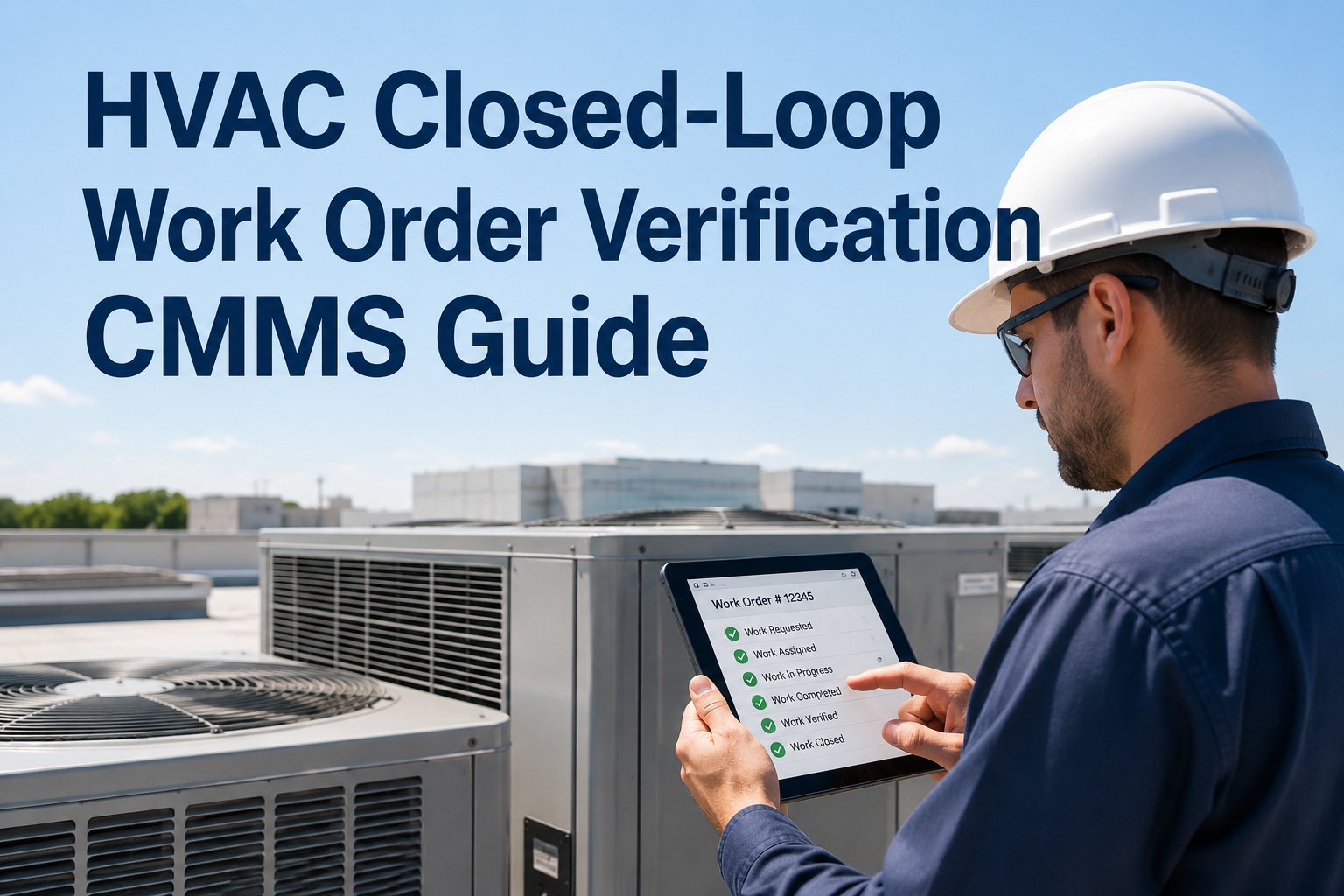
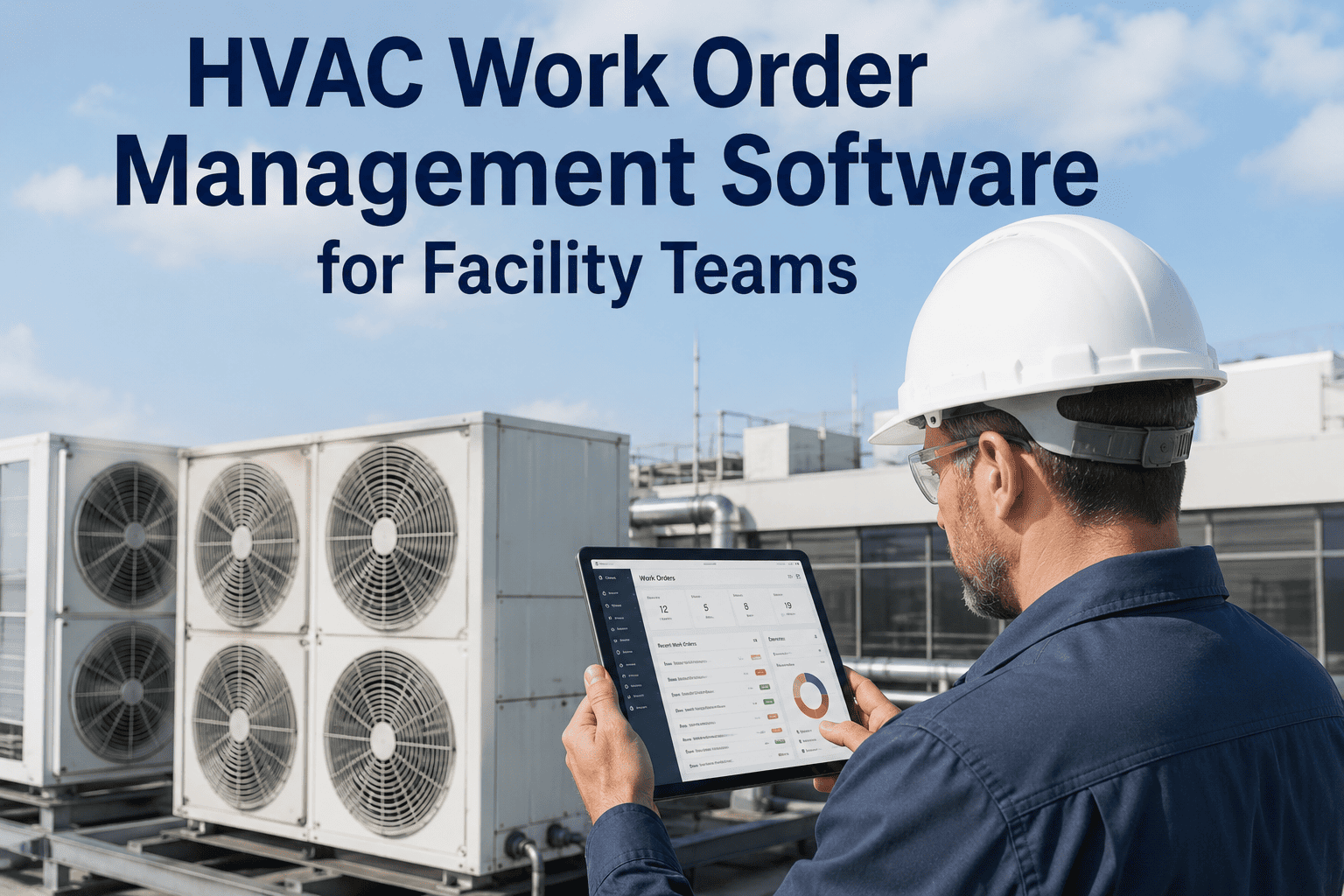
Digital work orders are created, assigned, prioritized, and completed from any device. Technicians receive push notifications, access checklists on-site, attach photos of completed work, and close tasks in real time. Managers see live status dashboards instead of chasing updates.
36% faster task completion with mobile CMMS tools
05
Compliance Documentation on Autopilot
EPA refrigerant tracking, filter change records, safety inspection logs, and equipment certifications are captured automatically as technicians complete work. When an auditor arrives, the documentation is already organized, time-stamped, and exportable — not scattered across binders and inboxes.
100% audit-ready documentation without manual record-keeping
06
Energy Savings from Systems Running as Designed
HVAC systems with clogged filters, dirty coils, and low refrigerant charge consume significantly more energy. Regular filter changes alone reduce utility bills by 5-15%. CMMS ensures these tasks happen consistently, keeping systems at peak efficiency across every building in your portfolio.
5-20% annual energy savings through proper HVAC maintenance — U.S. DOE
07
Data That Tells You Where to Invest Next
When every work order, parts purchase, and labor hour is captured, your CMMS reveals which assets cost the most to maintain, which buildings consume the most service hours, and which equipment is approaching end-of-life. That intelligence drives capital planning decisions with data instead of guesswork.
82% of asset failures preventable with effective maintenance management
Facility teams already seeing these benefits started by connecting their most critical HVAC assets to a CMMS platform. If you're managing maintenance with spreadsheets or paper, signing up for HVAC CMMS software is the single highest-impact change you can make this quarter.
See These Benefits Working in Real Time
OXmaint shows you exactly how CMMS automates PM scheduling, work orders, and compliance tracking for HVAC teams. One demo. Thirty minutes. Complete clarity on what changes.
Before vs. After: What CMMS Changes in Practice
The Transformation at a Glance
Swipe to see full comparison
The comparison isn't subtle. Organizations using CMMS spend less, break down less, and operate more efficiently across every measurable dimension. For multi-site teams managing hundreds of HVAC assets, the gap between managed and unmanaged maintenance widens with every building added. Get started with HVAC CMMS today and start closing that gap.
Expert Perspective: Why HVAC Teams Are Moving to CMMS Now
The shift from reactive to planned HVAC maintenance isn't a luxury — it's basic operational math. Emergency repairs cost 50-100% more than standard service calls. Running equipment to failure costs 3-10 times more than maintaining it properly. And every dollar of deferred maintenance creates four dollars of capital renewal cost down the line. CMMS doesn't just organize your work orders — it fundamentally changes the economics of your maintenance operation by making preventive and predictive strategies executable at scale.
Shift the Spending Ratio
Move from 70% reactive / 30% planned to the inverse. CMMS makes this shift possible by automating PM scheduling and holding teams accountable to completion rates.
Replace Tribal Knowledge
When your senior tech retires, everything they know about your systems goes with them. CMMS captures that knowledge in asset records and work order history permanently.
Scale Without Adding Headcount
As your portfolio grows, CMMS handles the complexity that would otherwise require additional coordinators. Standardized processes deploy across new buildings instantly.
The facilities achieving the strongest results are those that connect CMMS analytics to capital planning decisions — using failure data and cost-per-asset trends to determine when equipment should be repaired, refurbished, or replaced. Schedule a demo to see HVAC analytics in action and learn how maintenance data drives smarter investment decisions.
Scaling HVAC CMMS Across Your Entire Portfolio
HVAC CMMS software is designed to scale. Whether you manage five buildings or five hundred, the platform standardizes maintenance processes, inspection checklists, and reporting across every site. Technicians at any location follow the same PM protocols. Managers see portfolio-wide dashboards that highlight which buildings need attention, which assets are approaching end-of-life, and where maintenance spending is trending upward. That standardization is what transforms maintenance from a building-by-building firefight into a portfolio-level strategy. Facilities that start with a free HVAC maintenance platform often expand to full portfolio management within months once the time savings and cost reductions become undeniable.
Your HVAC Systems Deserve Better Maintenance
OXmaint gives facility teams the CMMS platform built for HVAC — preventive scheduling, mobile work orders, asset tracking, and compliance documentation in one system.
Frequently Asked Questions
What makes CMMS different from a regular maintenance spreadsheet for HVAC?
Spreadsheets track what happened — CMMS drives what needs to happen next. A CMMS auto-generates preventive maintenance work orders based on schedules or equipment runtime, assigns them to technicians with push notifications, tracks completion in real time, and builds a searchable history for every asset. Spreadsheets require someone to remember, update, and distribute information manually. The result: CMMS achieves 90%+ PM completion rates compared to 40-60% with manual tracking, because the system enforces accountability rather than depending on memory.
How quickly will we see ROI from HVAC CMMS software?
Most facility teams see measurable returns within 3-6 months. The first savings typically come from avoided emergency repairs — a single prevented compressor failure or after-hours service call can offset months of software investment. Ongoing returns accumulate from reduced downtime, lower energy costs (5-20% savings from properly maintained systems), extended equipment life (20-40% longer with consistent PM), and reduced labor waste from eliminating paper processes and information searching.
Can HVAC CMMS software handle compliance and audit requirements?
Yes — compliance documentation is one of the strongest CMMS advantages. EPA refrigerant tracking (Section 608), filter change records, safety inspection logs, and equipment certification dates are all captured automatically as technicians complete work orders. Every entry is time-stamped and linked to the specific asset. When an auditor requests documentation, reports are generated in minutes rather than assembled from filing cabinets over days.
Is HVAC CMMS software practical for small maintenance teams?
Small teams benefit the most from CMMS because they can't afford the inefficiency of reactive maintenance. When you have three technicians managing 200 HVAC assets, every minute spent searching for manuals, recreating work history, or forgetting a PM task multiplies rapidly. CMMS gives small teams the organizational capacity of much larger operations — automated scheduling, mobile work orders, and instant asset information — without adding headcount.
How does HVAC CMMS improve energy efficiency?
HVAC systems degrade silently. Dirty coils, clogged filters, low refrigerant, and worn belts all force systems to work harder — consuming more energy to deliver the same output. The U.S. DOE estimates that improper maintenance increases HVAC energy use by 30% or more. CMMS ensures the maintenance tasks that preserve efficiency (filter changes, coil cleaning, refrigerant checks, belt replacements) happen consistently and on schedule, preventing the gradual energy waste that accumulates in unmaintained systems.