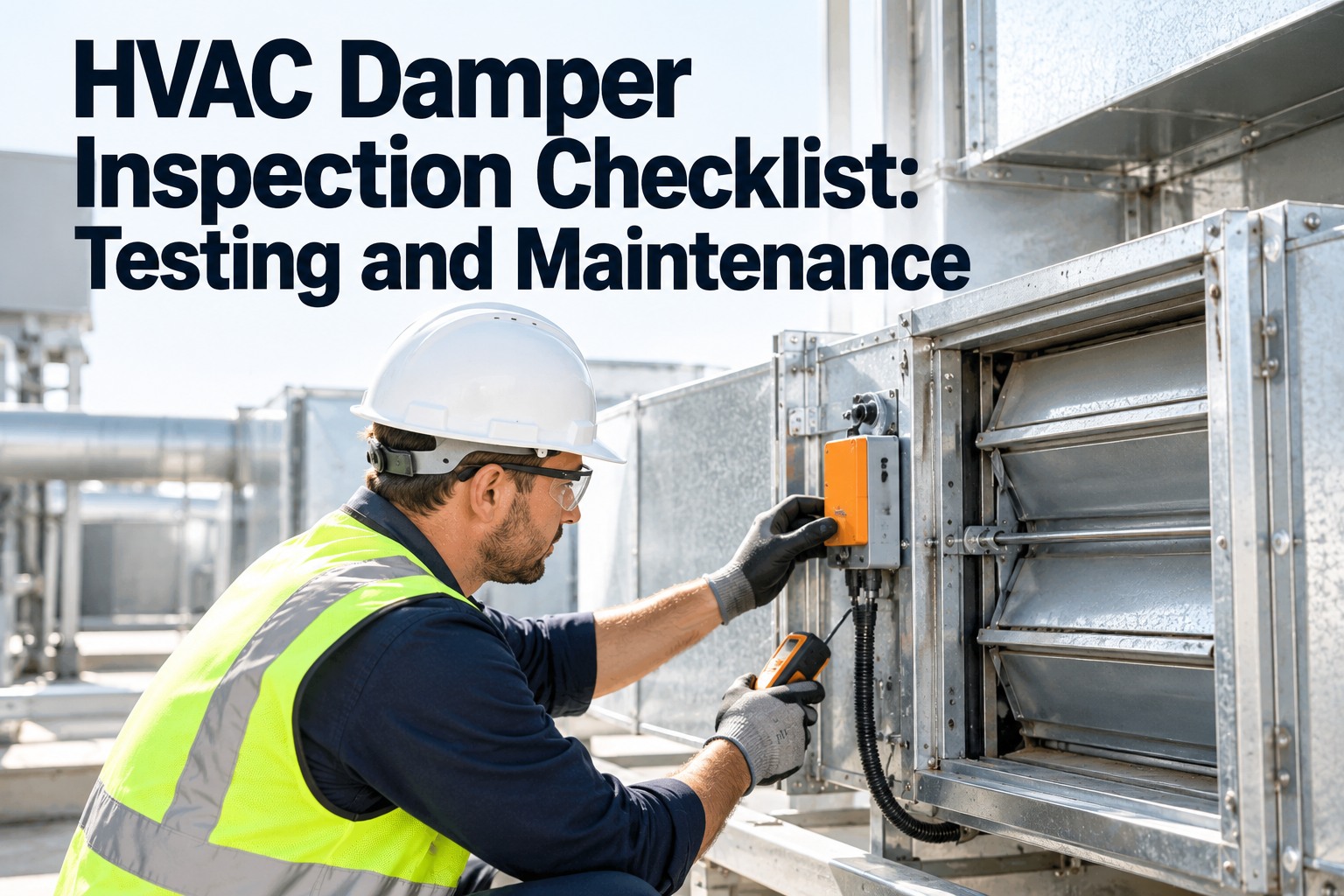
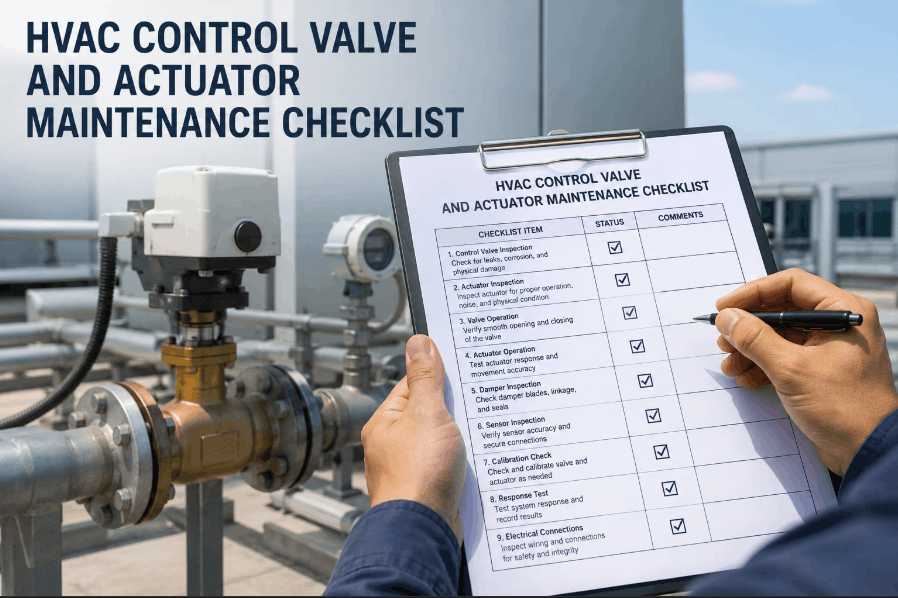
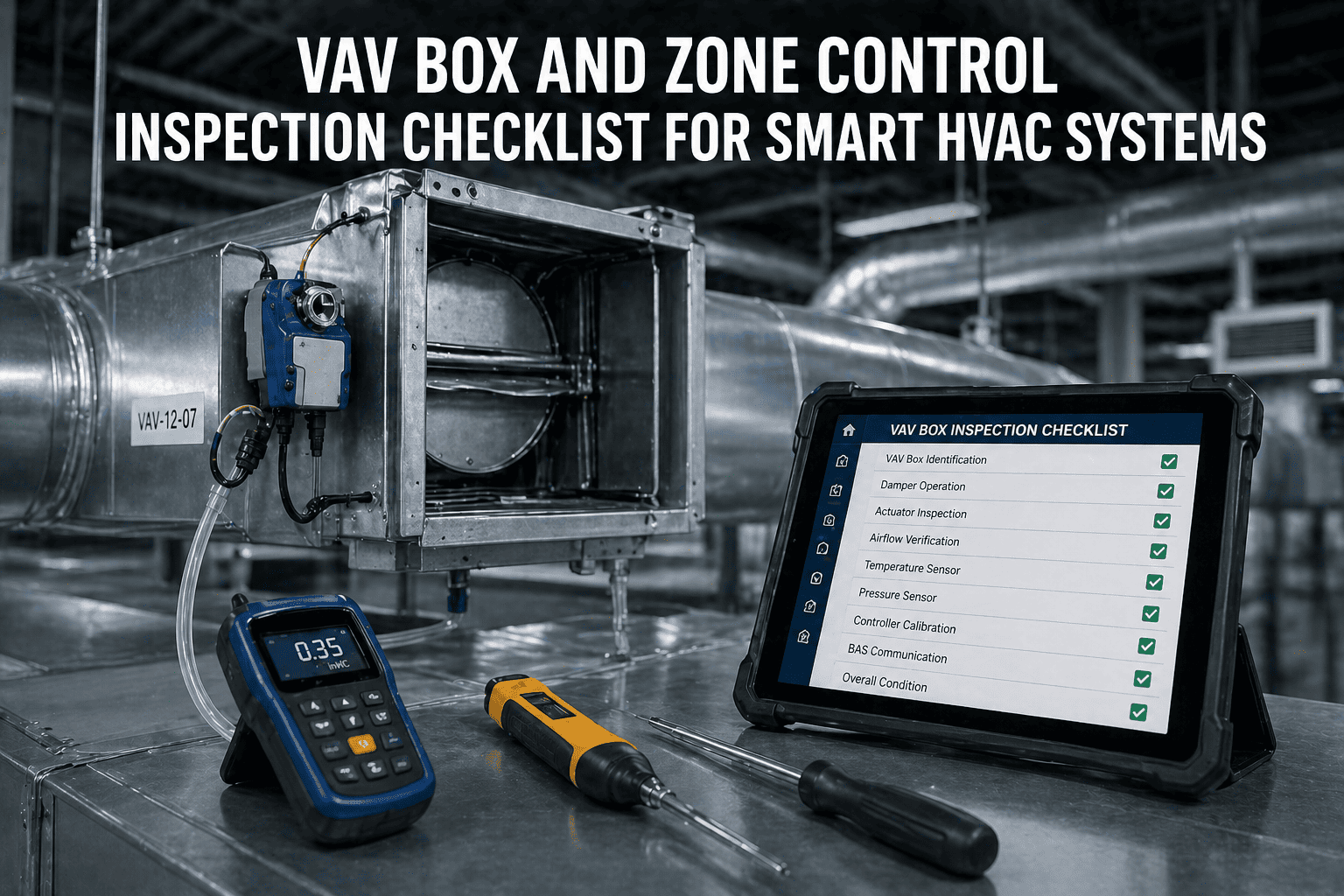
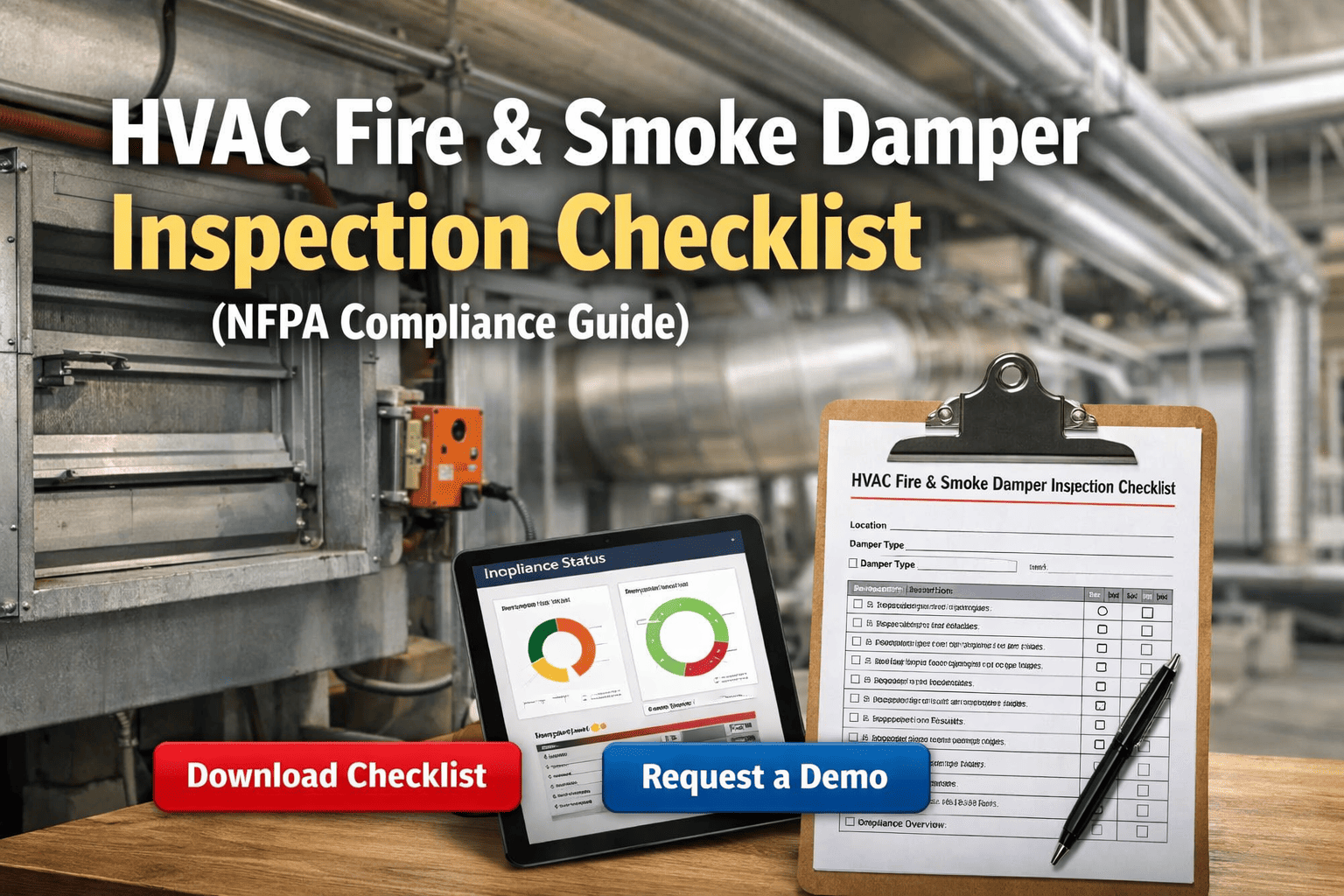
Dampers are small parts doing big jobs. They set how much outside air a building takes in, how much conditioned air each zone receives and, for fire and smoke dampers, whether a building stays compartmented in an emergency. They are also hidden above ceilings, inside ducts and behind panels, so they often go years without a proper test. A damper inspection checklist makes the invisible visible: command it, watch it move, compare it with what the controls say and record the result. This guide covers damper types, the five parts worth checking, a command-and-observe test and a symptom guide, using OXMAINT AI, the AI-powered CMMS for facility and HVAC maintenance teams.
HVAC Dampers · Inspection & Testing · Commercial Buildings
HVAC Damper Inspection Checklist: Testing and Maintenance.
When damper checks live on paper or in memory, a stuck blade or a failed actuator can hide for months behind a healthy-looking screen. OXMAINT AI connects the workflow in one CMMS: inspection rounds and comfort requests raise issues, issues become work orders on the right damper, repairs are recorded in its history, and preventive maintenance keeps the next test scheduled.
1Inspection or Request
→
2Issue Logged
→
3Work Order
→
4Repair Recorded
→
5PM Scheduled
Asset Register
Inspection Management
Work Order Management
Preventive Maintenance
Know What You Are Testing: Six Damper Types
The test depends on the job the damper does. Label each damper by type in your register so the right checklist appears at the right unit. Sign up free and tag each damper by type.
VOLUME / BALANCING
Set once to balance airflow in a branch. Check that it is still in its marked position and locked.
CONTROL / MODULATING
Moves continuously on a signal from the controls. Check full travel and response.
OUTSIDE AIR / ECONOMISER
Admits fresh air and uses cool outdoor air. Check position, seal and sensor agreement.
BACKDRAFT
Opens with airflow, closes when it stops. Check free swing and a clean seat.
FIRE DAMPER
Closes in a fire to hold compartments. Life-safety device with regulated testing.
SMOKE / COMBINATION
Closes on a smoke signal, and combination types also respond to heat. Life-safety device.
!
Life-safety dampers: fire, smoke and combination dampers are tested at intervals and by methods set by local codes and the manufacturer, and by suitably qualified people. Use this page for general maintenance and record-keeping, and follow your site's procedures, lockout/tagout and fall protection when working at height or in ceiling spaces.
Anatomy: Five Parts That Decide Whether a Damper Works
Most damper faults come from one of five places. Walk the damper from the outside in and check each part before you test the whole assembly. Book a demo to see these as inspection items.
1
Blades
Bent, corroded, dirty or coated blades can bind or fail to close fully. Look for damage and build-up.
2
Seals & edges
Worn blade or jamb seals allow leakage when the damper is closed. Check for gaps, tears and loose seals.
3
Linkage & shaft
Loose set screws, worn bushings or slipped linkages let the actuator move while the blades do not.
4
Actuator
Check mounting, travel, direction, noise and end stops. A strong actuator on a loose linkage still fails.
5
Frame & access
Check duct connections, supports and a clear, labelled access panel. A damper nobody can reach does not get tested.
The Command-and-Observe Test
The simplest damper test is also the most revealing: tell it to move, then confirm that it did. This works for control and outside air dampers where the controls can command a position. Start free and run the test from a mobile checklist.
1
Note the starting state
Record the controller position and the visible blade position before any change.
→
2
Command a change
Drive it toward open, then toward closed, following your site's override procedure.
→
3
Watch the blades
Confirm full travel, smooth movement and a firm close, not just actuator motion.
→
4
Return & record
Release the override, restore normal control and log the result with a photo.
Turn "I Think It Moves" Into a Dated Record.
Give every damper an ID, a checklist and a history in OXMAINT AI, so each test leaves evidence behind.
The Damper Inspection Checklist by Type
Use these as a template and adapt to your equipment and manufacturer guidance. Book a demo to load them as reusable checklists.
CONTROL & OUTSIDE AIRModulating Dampers
Damper has a unique ID and the access panel is labelled
Blades move through full travel with no binding
Actuator position matches the visible blade position
Linkage and set screws are tight, with no slippage
Closed position seals well, with no visible gaps
Sensor and controller readings agree with reality
VOLUME & BACKDRAFTManual and Passive Dampers
Balancing damper is at its marked position and locked
Quadrant, handle and lock are intact and readable
Backdraft blades swing freely and return to rest
No debris or build-up on blades or seating surfaces
Duct connections are sealed and well supported
Any change from the balanced setting is reported
FIRE & SMOKELife-Safety Dampers (Qualified Staff)
Access panel is present, labelled and unobstructed
Damper type, location and rating are on the register
Blades, fusible links and actuators inspected per manufacturer
Operation tested to the method your local code requires
Damper is reset and confirmed in its normal position
Any failure is reported at once and tracked to repair
Symptom Guide: What a Misbehaving Damper Is Telling You
Use this to decide where to look first. It points to likely causes and is not a diagnosis. Sign up free and log symptoms against each damper.
Symptom
Likely causes to check
First action
Actuator moves, blades do not
Slipped linkage, loose set screw, broken shaft
Inspect the linkage and shaft connection
Blades stick or move roughly
Corrosion, dirt, bent blades, dry bushings
Inspect, clean and lubricate where specified
Zone too hot or too cold
Stuck position, failed actuator, wrong signal
Run the command-and-observe test
Fresh air reading looks wrong
Outside air damper stuck, sensor drift, leaky seal
Compare blade position with controller reading
Rattle or whistle at the damper
Loose blade, partly open position, high velocity
Check blade fixings and operating position
Damper will not fully close
Worn seals, misaligned blades, actuator end stop set wrong
Inspect seals and check the actuator end stops
A Damper Test Register at a Glance
A register turns scattered checks into one picture: what passed, what failed and what was never reached. The "not accessible" status is often the most important one. Book a demo to see register views.
Illustrative Damper Test Register
OA-01
Outside air damper · full travel confirmed
PASS
VAV-12
Actuator moves, linkage slipping · work order raised
FAIL
BAL-07
Position differs from marked setting · recheck planned
REVIEW
FD-23
Access panel blocked · access to be cleared
NO ACCESS
Sample data for illustration only
What to Record for Every Damper
Good records make the next inspection faster and show what was done. Hidden dampers are easier to find again when the access panel carries a label or QR code linked to the record. Start free and generate QR labels for access panels.
How OXMAINT AI Supports Damper Inspection and Maintenance
OXMAINT AI is a mobile-first CMMS, so inspectors can test and record at the damper while the manager sees the results across the building. Start free and add your first dampers.
Asset Register
Hold every damper's ID, type, location, access notes and history in one record.
QR Code Labels
Generate labels for access panels so a scan opens the right damper record.
Inspection Management
Run digital checklists on a phone, with photos and notes on each damper.
Work Order Management
Turn a failed test into an assigned repair and track it to completion.
Preventive Maintenance
Schedule recurring damper checks so the next test is already planned.
Analytics & Reporting
See failed, overdue and inaccessible dampers and spot repeat faults.
Frequently Asked Questions
What should an HVAC damper inspection checklist include?
Blades, seals, linkage and shaft, actuator, frame and access, plus a command-and-observe test for modulating dampers and a record of the result with photos.
Sign up free and build your checklist.
How often should dampers be inspected?
It depends on the damper type, the building and local requirements. Control dampers are often checked within regular HVAC PM, while fire and smoke dampers follow code-set intervals.
Book a demo to plan your schedule.
Who should test fire and smoke dampers?
Suitably qualified people, using the methods and intervals required by local codes and the manufacturer. Use your CMMS to schedule, record and follow up on the results.
Start free and track life-safety checks.
How do we find dampers hidden above ceilings?
Record each damper's location and access panel in the register, label the panel and link a QR code to the record so the next inspector can find it quickly.
Book a demo to see QR labelling.
How does a CMMS help with damper maintenance?
Command It. Watch It. Record It.
Bring damper registers, inspections, work orders and PM scheduling together in OXMAINT AI, and give every damper a clear next test.