HVAC Fire & Smoke Damper Inspection Checklist (NFPA Compliance Guide)
By James smith on April 17, 2026
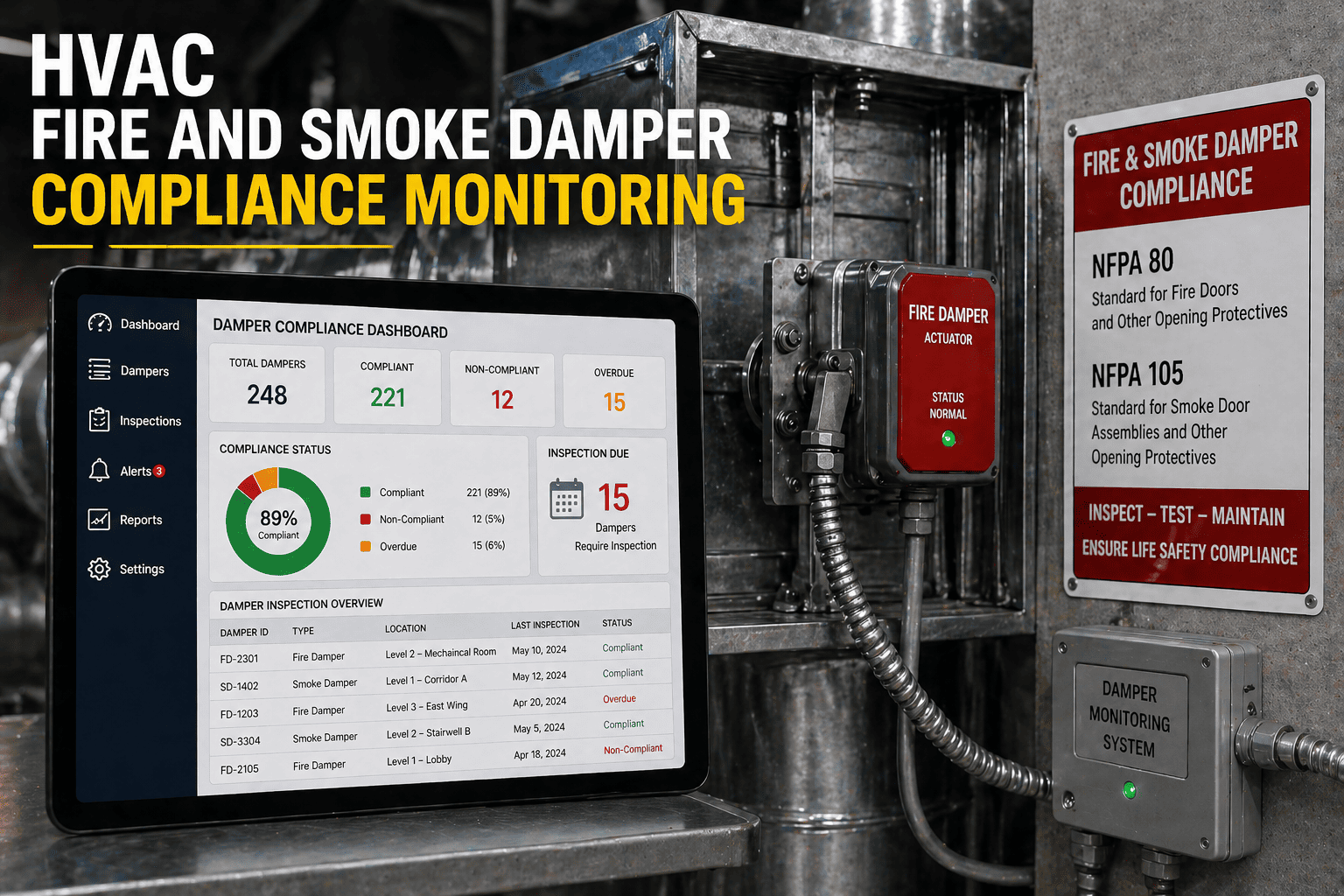
Fire and smoke dampers are passive fire protection devices installed at every point where an HVAC duct penetrates a fire-rated barrier — and in most commercial buildings, they are among the least maintained life safety systems in the portfolio. NFPA 80 and NFPA 105 require periodic inspection and testing of every fire damper, smoke damper, and combination fire/smoke damper: once at one year after installation, then every four years for standard occupancies and every six years for hospitals. A 2024 FM Global study found that well-maintained damper systems achieve 98% closure reliability compared to just 57% in neglected installations. The gap between those two numbers is the gap between a contained fire and a whole-floor event. When a damper fails during a fire because paint immobilised the fusible link, corrosion seized the blade, or the actuator lost its return spring years ago, no inspection certificate reverses that outcome. OxMaint’s compliance tracking and inspection management platform schedules, documents, and archives every damper inspection by unit ID, test date, technician credential, and deficiency status — producing the AHJ-ready records that NFPA 80 Section 19.4.9 and NFPA 105 Section 7.6.4 specifically require.
01 — Damper Types: What You Are Inspecting and Why It Matters
Each damper type operates under different trigger mechanisms and serves a distinct fire or life safety function. The inspection procedures, test methods, and NFPA references differ by type. Applying the wrong checklist to the wrong damper produces incomplete compliance records and leaves real deficiencies undocumented.
Fire Damper
StandardNFPA 80, Section 19 · UL 555
TriggerFusible link melts at rated temperature (typically 165°F / 74°C or 212°F / 100°C)
Rating1.5-hour (barriers <3 hr rated) or 3-hour (barriers ≥3 hr rated) — per NFPA 90A
FunctionCloses automatically on heat detection to restrict passage of flame through duct penetration
TypesCurtain blade (spring/gravity) or multi-blade (motorised or fusible link)
Frequency1 year after install, then every 4 years (standard) / 6 years (hospital)
Smoke Damper
StandardNFPA 105, Section 7 · UL 555S · NFPA 92 (smoke control systems)
TriggerActuator receives signal from smoke detector (no fusible link) — motorised, spring-return
RatingLeakage Class I, II, or III per UL 555S — Class I is lowest leakage (highest performance)
FunctionControls smoke migration through HVAC openings; does NOT provide fire-resistance rating
Test methodRemove power/air pressure from actuator; confirm full closure; restore and confirm full open
FrequencySame as fire damper; dedicated smoke control systems require semiannual testing
TriggerDual: fusible link/thermostat (heat) AND actuator/smoke detector signal (smoke)
RatingMust meet fire damper fire-resistance AND smoke damper leakage class simultaneously
FunctionProvides both flame restriction and smoke migration control — common in healthcare and high-rise
Test methodBoth thermal activation test AND electrical/pneumatic actuator test required at each inspection
FrequencySame as fire damper (every 4/6 years) — both test protocols completed at each visit
02 — Inspection Frequency: NFPA 80 and NFPA 105 Requirements by Occupancy
NFPA 80 Section 19.4.1 and NFPA 105 Section 7.6.2 establish the same inspection frequency requirements for both fire and smoke dampers. The Authority Having Jurisdiction (AHJ) — typically the local fire marshal or building official — may impose more frequent requirements based on occupancy classification, environmental conditions, or prior inspection failures. Records must be retained for a minimum of three full inspection cycles.
Inspection Type
When Required
Occupancy
NFPA Reference
OxMaint Scheduling
Operational (Initial)
Prior to building occupancy
All occupancies
NFPA 90A Sec. 7.2 · NFPA 105 Sec. 6.4.1
Acceptance test work order linked to asset
Acceptance (Year 1)
1 year after installation — under normal HVAC airflow conditions
All occupancies
NFPA 80 Sec. 19.4.1 · NFPA 105 Sec. 7.6.2.1
Auto-scheduled 12 months from asset install date
Periodic (Standard)
Every 4 years after Year-1 acceptance test
All except hospitals
NFPA 80 Sec. 19.4.1.1 · NFPA 105 Sec. 7.6.2.2
4-year calendar trigger per damper ID
Periodic (Hospital)
Every 6 years after Year-1 acceptance test
Healthcare (CMS-accredited)
NFPA 80 Sec. 19.4.1.1 (exception) · NFPA 105 Sec. 7.6.2.2
6-year calendar trigger, configurable per occupancy type
Semiannual (Smoke Control)
Twice per year — dedicated smoke control systems only
Buildings with engineered smoke control
NFPA 92 · IFC Section 909.12
6-month recurring PM separate from fire damper cycle
Post-Repair
Immediately following any repair or adjustment to a damper
All occupancies
NFPA 80 Sec. 19.5.4 · NFPA 105 Sec. 7.6.4
Post-repair test work order auto-linked to repair WO
03 — Fire Damper Inspection Checklist (NFPA 80 Section 19)
Each inspection must be documented with damper location, asset ID, inspection date, technician name and qualification, test results (pass/fail per item), and a description of any deficiencies with required corrective action. All PPE requirements must be confirmed before accessing any damper through an access door. The HVAC system airflow conditions at test time must be recorded per NFPA 80 Section 19.4.3.
Pre-Inspection: Access and Documentation
Confirm access door or removable duct section is present, unobstructed, and minimum 12 in² per NFPA 80 Sec. 19.2.3Record: Access confirmation · Ref: NFPA 80 Sec. 19.2.3, NFPA 90A Sec. 4.3.5.1
Verify damper label is legible and correctly identifies type (FIRE DAMPER) in letters ≥½ inch high per IFC Sec. 717.4Record: Label photo · Ref: IFC Section 717.4, NFPA 90A Sec. 4.3.5.2
Record damper asset ID, building location (floor, zone, barrier type), installation date, and last inspection dateRecord: Inspection log · Ref: NFPA 80 Sec. 19.4.9
Confirm HVAC airflow conditions at time of test — test must be conducted under normal operating airflow per NFPA 80 Sec. 19.4.3Record: Airflow status at test time · Ref: NFPA 80 Sec. 19.4.3
Visual Inspection: Blades, Frame, and Seals
Inspect blades for rust, corrosion, warping, bent or misaligned condition — any defect that could prevent full closure is an immediate failRecord: Blade condition rating · Ref: NFPA 80 Sec. 19.4.5, NFPA 105 Sec. 7.5.7
Inspect damper frame — no penetrations by foreign objects, no deformation that could obstruct blade travel or compromise fire-barrier integrityRecord: Frame condition · Ref: NFPA 80 Sec. 19.4.5.1
Inspect sleeve and fire-rated barrier penetration for gaps or unsealed openings — all gaps must be sealed with fire-rated caulk or intumescent materialRecord: Seal condition · Ref: NFPA 80 Sec. 19.2.2
Inspect all exposed moving parts (hinges, springs, pivot pins) — verify freedom of movement and absence of obstruction in blade travel pathRecord: Moving parts condition · Ref: NFPA 80 Sec. 19.5.2
Fusible Link Inspection and Operational Test
Inspect fusible link — check for corrosion, damage, or paint coating. If temperature rating is unclear or link shows damage, replace with identical size, temperature, and load ratingRecord: Fusible link condition / replacement · Ref: NFPA 80 Sec. 19.4.6, ANSI/UL 33
Confirm fusible link temperature rating matches NFPA 90A and ANSI/UL 33 classifications for the application — standard is 165°F (74°C) or 212°F (100°C)Record: Link temperature rating verified · Ref: NFPA 80 Sec. 19.3.1.7
Remove fusible link to allow operational test — confirm blades travel from fully open to fully closed and latch or lock in closed position where equippedRecord: Full closure confirmed (pass/fail) · Ref: NFPA 80 Sec. 19.4.5
Check blade alignment in closed position — gaps between adjacent blades must not exceed 1/8 inch. Any gap indicates blade damage or misalignment requiring repair before return to serviceRecord: Blade gap measurement · Max gap: 1/8 inch (3.2mm)
Post-Test: Lubrication, Reset, and Documentation
Dry lubricate all exposed moving parts per manufacturer specification — do not use oil-based lubricants unless specifically recommended (oil attracts dust and causes binding)Record: Lubrication completed · Ref: NFPA 80 Sec. 19.5.2
Reinstall fusible link — confirm correct link installed, properly seated, and damper reset to fully open position before closing access panelRecord: Link reinstalled and damper reset to open · Ref: NFPA 80 Sec. 19.4.6
Verify all position indication devices report correctly to BAS or control panel (where installed) and test switch confirms open/closed statusRecord: Position indication verified · Ref: NFPA 80 Sec. 19.4.8
Document all findings: location, asset ID, date, technician name and qualification, pass/fail per item, deficiencies noted, corrective action required and completion dateRecord: Inspection report · Ref: NFPA 80 Sec. 19.4.9 & 19.4.10 · Retain 3 inspection cycles minimum
Smoke dampers operate on actuators receiving a signal from the smoke detection system — there is no fusible link. The inspection verifies the entire signal chain from detector through control panel to actuator, and confirms the damper achieves full closure within 10 seconds of signal receipt. Per NFPA 105 Section 7.6.2, smoke dampers in dedicated smoke control systems require semiannual testing in addition to the standard 4-year periodic inspection.
Pre-Inspection: Access and Signal Chain Confirmation
Confirm access panel is present, unobstructed, and labelled “SMOKE DAMPER” in letters ≥½ inch per NFPA 105 Sec. 7.3.2.2Record: Access and label confirmed · Ref: NFPA 105 Sec. 7.3.2
Verify smoke detector(s) serving this damper are functional and correctly spaced per NFPA 72 — confirm detector-to-damper control wiring continuityRecord: Detector status · Ref: NFPA 105 Sec. 7.3.1.4, NFPA 72
Confirm power supply to actuator is active and secondary/backup power source (where required) is available and testedRecord: Power supply status · Ref: NFPA 105 Sec. 7.3.1.2
Visual Inspection: Actuator, Blades, and Barrier
Inspect actuator mounting — secure, free from corrosion, wiring connections intact with no exposed conductors or degraded insulationRecord: Actuator condition · Ref: NFPA 105 Sec. 7.5.7
Inspect linkage between actuator and damper blades — moves freely without binding, no corrosion, pins and clevis connections intactRecord: Linkage condition · Ref: NFPA 105 Sec. 7.5.7
Inspect blade condition — no rust, warping, or damage. Check for ductwork modifications near damper that could obstruct blade travelRecord: Blade condition · Ref: NFPA 105 Sec. 6.5.7
Inspect smoke barrier penetration around sleeve — seal any gaps with fire-rated caulk. Smoke damper sleeves must maintain smoke barrier integrity per NFPA 105Record: Barrier seal condition · Ref: NFPA 105 Sec. 6.3.2
Operational Test and Reset
Activate smoke detector signal (via test switch or disconnect power/air pressure from actuator) — damper must begin closing immediately on signal receiptRecord: Response to signal (pass/fail) · Ref: NFPA 105 Sec. 7.5.4 & 7.6.3
Time damper from signal receipt to full closure — must reach fully closed position within 10 seconds. Delay exceeding this is a failure requiring immediate repairRecord: Closure time in seconds · Max: 10 seconds · Ref: NFPA 105
Restore power/air pressure to actuator and confirm damper returns to full-open position — must open fully without obstruction per NFPA 105 Sec. 7.5.5Record: Full open confirmed on reset · Ref: NFPA 105 Sec. 7.5.5
Verify position indication signal reports correctly to fire alarm panel or BAS — green (open) and red (closed) indicator states confirmed at remote panelRecord: Position indication verified at panel · Ref: NFPA 105 Sec. 7.5.5
Combination fire/smoke dampers must pass both the thermal activation test (fire damper protocol per NFPA 80 Section 19) and the actuator/signal-chain test (smoke damper protocol per NFPA 105 Chapter 6). Both tests must be completed and documented at every inspection. A combination damper that passes only one protocol is not compliant. These units are most common in healthcare facilities, high-rise commercial buildings, and corridor/stairwell enclosures where both hazards require control.
Combined Pre-Inspection and Visual Checks
Confirm access door labelled for combination unit — verify label identifies damper as “FIRE/SMOKE DAMPER” per applicable code requirementsRecord: Label type confirmed · Ref: IFC Sec. 717.4, NFPA 105 Sec. 7.3.2.2
Inspect all fusible link or thermostat heat-responsive components for damage, paint, or corrosion. Thermostats must be confirmed at correct rated temperature per NFPA 80 Sec. 19.3.1.7Record: Thermal device condition · Ref: NFPA 80 Sec. 19.3.1.7
Inspect actuator mounting, linkage, and wiring — same smoke damper visual checks as Section 04 above. Confirm both thermal and electrical trigger mechanisms are unobstructedRecord: Dual-trigger condition assessment · Ref: NFPA 80 Sec. 19.1.3, NFPA 105 Sec. 6.3.2.4
Thermal Activation Test (Fire Damper Protocol)
Remove fusible link or isolate thermostat to simulate heat trigger — confirm damper blades travel to full closed position and latch. Test conducted under normal HVAC airflow per NFPA 105 Sec. 6.5.6Record: Thermal closure test result · Ref: NFPA 80 Sec. 19.4.5, NFPA 105 Sec. 6.5.5
Verify damper meets fire-resistance rating (1.5-hour or 3-hour) — no gaps exceeding 1/8 inch in closed position; frame and sleeve integrity intactRecord: Fire-resistance verification · Ref: NFPA 90A, NFPA 80 Sec. 19.4.5.1
Smoke Actuator Test (Smoke Damper Protocol)
After thermal test reset: test smoke damper actuator independently via smoke detector signal or control panel test switch — confirm closure within 10 seconds, full open on resetRecord: Actuator closure and reset result · Ref: NFPA 105 Sec. 6.5.1 & 6.4.1.6
Verify smoke leakage class performance is maintained — inspect blade seals and perimeter gaskets for deterioration that could compromise the UL 555S leakage class ratingRecord: Smoke leakage seal condition · Ref: UL 555S, NFPA 105 Sec. 6.5.7
Document both tests as separate pass/fail entries in the inspection record — NFPA requires both thermal and actuator results independently documented for combination unitsRecord: Separate pass/fail for each protocol · Ref: NFPA 80 Sec. 19.4.11, NFPA 105 Chapter 6
Replace Paper Logs with Digital Inspection Records Linked to Every Damper Asset
OxMaint assigns inspection work orders by damper ID, tracks technician credentials, captures photo evidence, auto-schedules the next cycle, and generates AHJ-ready reports — eliminating the 40% manual tracking error rate and making every inspection audit-ready within minutes.
06 — Documentation Requirements: What NFPA Requires You to Retain
NFPA 80 Section 19.4.9 and NFPA 105 Section 7.6.4 define the minimum documentation content for every damper inspection. Records must be retained for a minimum of three full inspection cycles — which at a 4-year frequency means a minimum 12-year retention period. An up-to-date record book is the standard of evidence during AHJ inspection, fire marshal review, and insurance audits.
Name and qualification of inspector performing the test
Deficiencies discovered during inspection — each item described
When and how each deficiency was corrected (with date)
Best Practice (OxMaint Standard)
Additional Documentation for AHJ Defence
Photo of damper label (legibility confirmation)
Photo of access door location and condition
Photo of blade closed position (gap measurement evidence)
Fusible link rating and replacement record (where applicable)
Actuator response time in seconds (smoke dampers)
Technician digital signature and credential number
Deficiency Management
When a Damper Fails Inspection
Tag damper out of service immediately — document tag date and technician
Notify building management and fire authorities within 24 hours per AHJ requirements
Repairs must begin without delay per NFPA 80 Sec. 19.5.3
Post-repair: retest per NFPA 80 Sec. 19.5.4 before return to service
Document repair completion date and re-test pass result
All records retained minimum 3 full inspection cycles
Frequently Asked Questions
Who is qualified to inspect and test fire and smoke dampers under NFPA 80 and NFPA 105?
NFPA 80 Section 19.4.1 and NFPA 105 Section 7.6.1 require that inspections and testing be performed by a qualified person with knowledge and understanding of the operating components of the type of assembly being tested. In practice, this means a licensed HVAC technician, fire protection contractor, or certified life safety inspector with documented training on the specific damper types in the building. Some jurisdictions — and all CMS-accredited healthcare facilities — require inspectors to hold specific certifications such as NICET Fire Protection Engineering or equivalent. The building owner is ultimately responsible for ensuring the inspecting person meets the qualification standard, and technician credentials must appear in the inspection record. OxMaint stores technician credentials per inspection record — start your free trial to configure your qualified inspector roster.
Can the HVAC system remain operational during damper testing?
Yes — and it must be. NFPA 80 Section 19.4.3 and NFPA 105 Section 6.5.6 require that tests be conducted with normal HVAC airflow operating. This is because the damper’s ability to close against airflow resistance is a critical performance variable — a damper that closes easily under static conditions may fail to close against an active air pressure differential. For dynamic-rated combination fire/smoke dampers, the test specifically verifies closure under airflow. Shutdown of the HVAC system during testing produces a result that does not reflect actual fire conditions and may mask a blade or actuator weakness that would fail under operating pressure.
What happens if a damper is found to be inaccessible or has no access door?
NFPA 90A Section 4.3.5.1 requires that service openings be provided in air ducts adjacent to each fire or smoke damper, sized to allow maintenance and resetting of the device. If a damper is found without an access door — a common finding in older buildings or after duct modifications — this is a code violation that must be corrected before the periodic inspection can be completed. The deficiency should be documented in the inspection record, and access must be provided before the damper is tested. Installing retrofit access panels or removable duct sections is the standard remediation. A damper that cannot be accessed cannot be tested and is therefore non-compliant regardless of its actual condition. Book a demo to see how OxMaint tracks inaccessible dampers as open deficiencies until access is confirmed.
How does OxMaint track inspection frequency for mixed-portfolio buildings with different occupancy types?
OxMaint assigns inspection cycle configuration at the individual damper asset level — not at the building level — allowing a single building to have different inspection frequencies for different units. A hospital-wing damper can be configured for the 6-year cycle while a commercial office wing in the same structure uses the 4-year cycle. The installation date is the trigger anchor, and OxMaint auto-schedules the Year-1 acceptance inspection and all subsequent periodic inspections from that date. When a post-repair retest is completed, it does not reset the periodic cycle — the next periodic inspection fires on its original schedule. All inspection records are stored per damper asset ID with the full documentation trail retrievable for AHJ audit at any time.
Stop Tracking Damper Inspections in Spreadsheets. Start Generating AHJ-Ready Records Automatically.
OxMaint schedules every fire damper, smoke damper, and combination unit inspection by asset ID and installation date, routes work orders to qualified technicians, captures digital checklists with photo evidence, and archives the complete NFPA-required documentation record per unit — across your entire HVAC life safety portfolio.