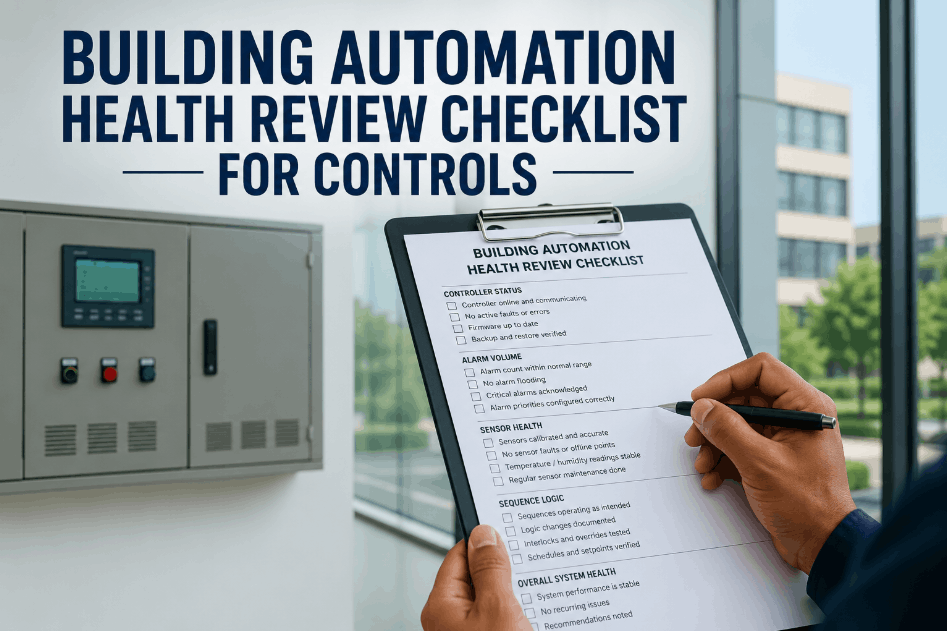
Retrofit projects fail quietly — not at contract signing, but during commissioning, when the installed system no longer matches the original design intent. Misaligned controls logic, field deviations from drawings, and undocumented substitutions create performance gaps that never appear until occupants complain or utility bills spike. Sign Up Free to log field verification tasks, track commissioning results, and link every retrofit inspection record to your HVAC asset register in OxMaint. Design intent verification is a maintenance workflow, not a one-time engineering review — and when it lives inside your CMMS, deviations get corrected before the building owner takes handover.
Facility Engineering · Blog · HVAC & Building Systems
HVAC Design Intent Verification for Retrofit Projects
Field condition checks, controls logic validation, commissioning result tracking, and CMMS-linked work orders — practical design intent verification for commercial HVAC retrofit delivery.
68%Of retrofit project deficiencies are discovered post-handover, not during commissioning
±12%Typical energy performance gap when design intent is not verified against actual installation
−51%Reduction in post-handover warranty calls when field verification is CMMS-tracked per asset
2.4×Faster deficiency resolution when commissioning results are linked to the asset work order
Design Intent Verification Components — What Every Retrofit Needs on Record
A complete verification record logs field conditions, controls logic, and commissioning results against the specific HVAC asset — not in a project binder that gets filed after handover. Book a Demo to see how OxMaint structures retrofit verification tasks against each building system asset for traceable project delivery.
Step 1
Design Basis Review
Original design intent documented per system — setpoints, sequences of operation, and equipment specifications recorded as the verification baseline.
Foundation
Step 2
Field Condition Check
Installed equipment, ductwork routing, and sensor locations verified against construction documents before controls commissioning begins.
Core Metric
Step 3
Controls Logic Validation
BAS sequences, setpoint programming, and override logic tested against the design specification under representative load conditions.
Diagnostic
Step 4
Commissioning Result Log
Functional test results recorded per asset with pass/fail status, deviation notes, and assigned corrective actions — all linked to the CMMS work order.
Critical Gate
Step 5
Deficiency Work Order
Any field deviation from design intent auto-generates a work order with the asset record, test data, and responsible party attached for resolution tracking.
Action
Step 6
Operational Readiness Sign-Off
Post-correction verification confirms all systems operate to design intent before the asset transitions to the ongoing maintenance programme.
Closure
The Retrofit Deviation Cascade — How One Unverified Field Change Grows
Retrofit deviations compound silently — a substituted sensor, an undocumented damper adjustment, or a controls sequence left at factory default. Sign Up Free to track every field condition check and commissioning result per HVAC asset, so deviations are caught during delivery, not after tenant complaints.
Retrofit Deviation Cascade — 5 Stages from Field Change to Performance Failure
Stage 1
Undocumented Substitution
Contractor substitutes a component without design team sign-off. No field verification task exists to capture the change.
$0
Cost if caught at field check
↓
Stage 2
Controls Logic Mismatch
BAS sequence programmed for original equipment spec, not the substitute. System runs but not to design intent.
$380
Controls reprogramming, planned
↓
Stage 3
Performance Gap Emerges
Zone temperatures drift. Occupant complaints begin. Facility team investigates comfort, not the original field deviation.
$1,600
Misdirected investigation cost
↓
Stage 4
Warranty Dispute Opens
Contractor claims installation is correct. Design team disputes performance. No shared commissioning record exists to resolve it.
$6,200
Legal and engineering review
↓
Stage 5
Retrofit Remediation Required
System must be partially reinstalled to meet original design intent. Full re-commissioning required at building owner's cost.
$21,000+
Remediation and re-commissioning
Retrofit Verification Maturity Score — Where Does Your Project Stand?
Use the scoring framework below to assess your current HVAC retrofit design intent verification process.
HVAC Retrofit Verification Maturity Score
Score 5 = full verification control · Score 1 = active handover risk · Assess per project or per system
5
Fully Controlled — Asset-Linked Verification Records
Field checks, controls validation, and commissioning results logged per asset in CMMS with automated deficiency work orders.
Action: Maintain verification cadence. Transition records to ongoing PM schedule at handover.
4
Mostly Controlled — Inconsistent Asset Linkage
Commissioning results captured but stored in project files, not linked to the CMMS asset record for ongoing reference.
Action: Import project commissioning data into asset records within 30 days of handover.
3
Partially Managed — Verification Completed, Not Tracked
Field checks performed verbally or on paper. Deficiencies not formally tracked against assets or assigned with deadlines.
Action: Digitise outstanding deficiency list. Assign each item to an asset work order this week.
2
Reactive — Verified After Occupant Complaint
Design intent only checked when performance complaints surface post-handover. No pre-handover verification programme in place.
Action: Establish a field verification checklist. Apply to current project before practical completion.
1
No Programme — Active Handover Risk
No field verification or commissioning record exists. Design intent assumed to be met with no documented evidence.
Action: Build a verification asset register immediately. Assign field check ownership before handover.
Technology Integration: CMMS Commissioning Data and Deficiency Tracking
Design intent verification depends on connected project data, not a commissioning binder shelved after handover. Book a Demo to see how OxMaint links field verification tasks, commissioning results, and deficiency work orders to each HVAC asset for traceable retrofit project delivery.
Asset-Linked Verification
100%
Commissioning history visible per HVAC asset via QR scan
Every field check and controls test result logged against the asset record, accessible from the plant room floor.
Deficiency Alerts
−51%
Reduction in post-handover warranty calls with tracked deficiencies
Field deviations from design intent trigger an automatic status change and work order before the project closes.
Work Order Automation
2.4×
Faster deficiency resolution with asset-linked work orders
Commissioning failures auto-generate corrective work orders with the full asset history and assigned contractor attached.
Mobile Field Access
Offline
Verification tasks logged from the field without connectivity
Commissioning engineers log test results on mobile; data queues offline and syncs when reconnected on-site.
"
On our last AHU retrofit we had a controls sequence deviation that didn't show up until three months after handover. Now every commissioning result is logged in OxMaint against the asset before practical completion — the first deviation triggered a work order automatically and the contractor corrected it the same week.
Facilities Engineer — Commercial office retrofit project
Root Causes of Retrofit Design Intent Failures
HVAC retrofit verification failures in commercial projects cluster into six recurring root causes. Sign Up Free to address all six with structured commissioning workflows in OxMaint.
Retrofit Design Intent Failure — Root Cause Distribution (%)
No field condition check against design drawings
72%
Controls logic not validated against design sequence
65%
Commissioning results not linked to CMMS asset
58%
Substitutions made without design team approval
49%
Deficiencies closed verbally, not on record
42%
No operational readiness sign-off before handover
35%
Verify Design Intent Before Handover, Not After Complaints.
OxMaint logs field checks, commissioning results, and deficiency work orders per HVAC asset — so retrofit projects close with a complete verification record, not an open punch list.
Frequently Asked Questions
What is HVAC design intent verification in retrofit projects?
It is the process of confirming that installed equipment, controls logic, and commissioning results match the original design specification before the building is handed over to the owner.
Why do retrofit projects fail to meet design intent?
Field substitutions, undocumented changes, and controls sequences left at factory defaults are the most common causes — all preventable with a structured asset-linked verification workflow.
How does a CMMS support retrofit commissioning?
A CMMS links commissioning results directly to the asset record, auto-generates deficiency work orders, and gives every party a shared audit trail from field check to sign-off.
Can OxMaint be used during active construction and commissioning?
Yes — field teams log verification tasks and test results on mobile, even offline, and data syncs automatically when connectivity is restored on-site.
Does design intent verification reduce post-handover warranty disputes?
Documented commissioning records linked to each asset provide a clear reference for warranty claims and reduce resolution time significantly.
Build Your Retrofit Verification Programme in OxMaint Today.
Track field conditions, controls logic, and commissioning results per HVAC asset — free to start, mobile-ready, and built for project delivery teams.