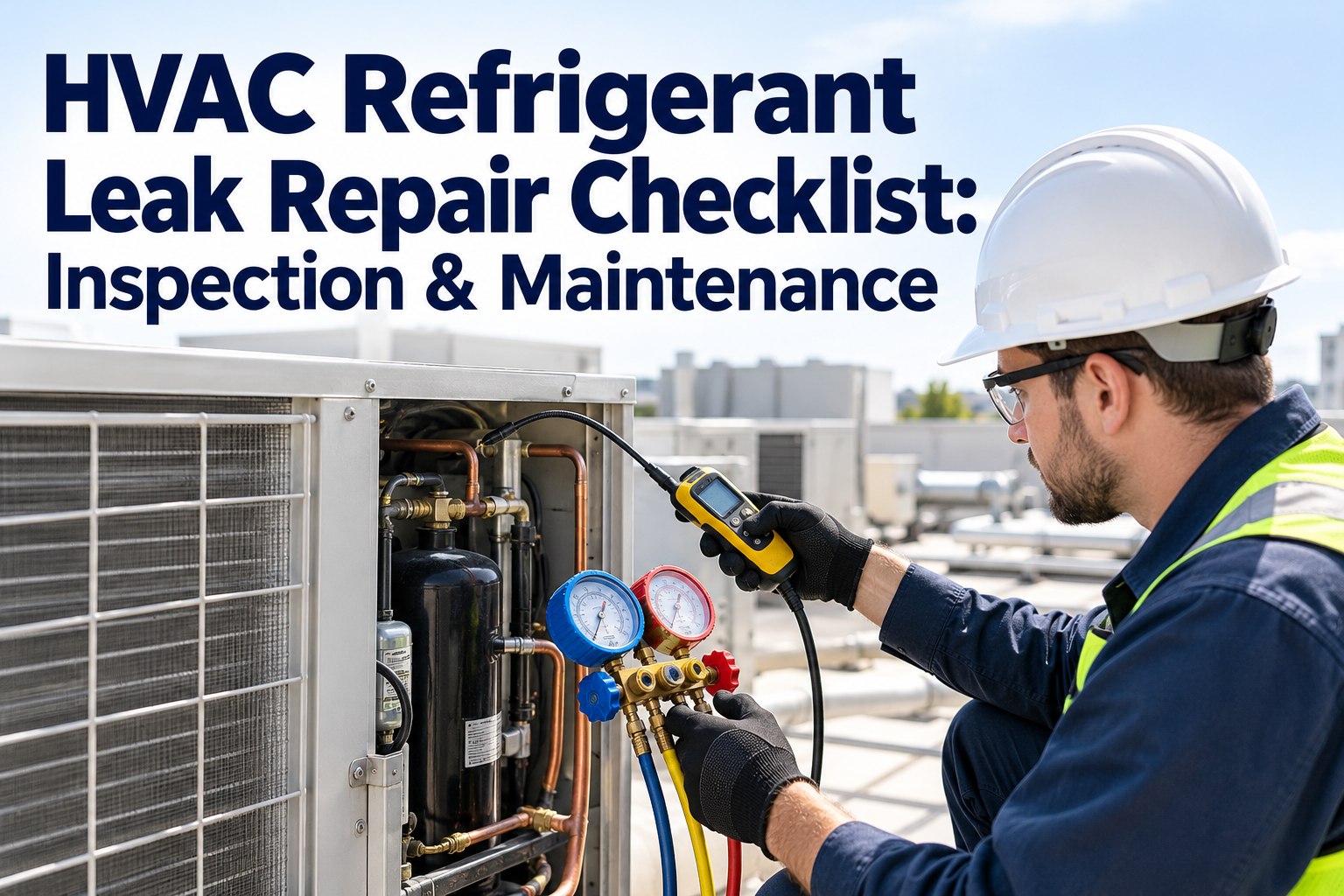
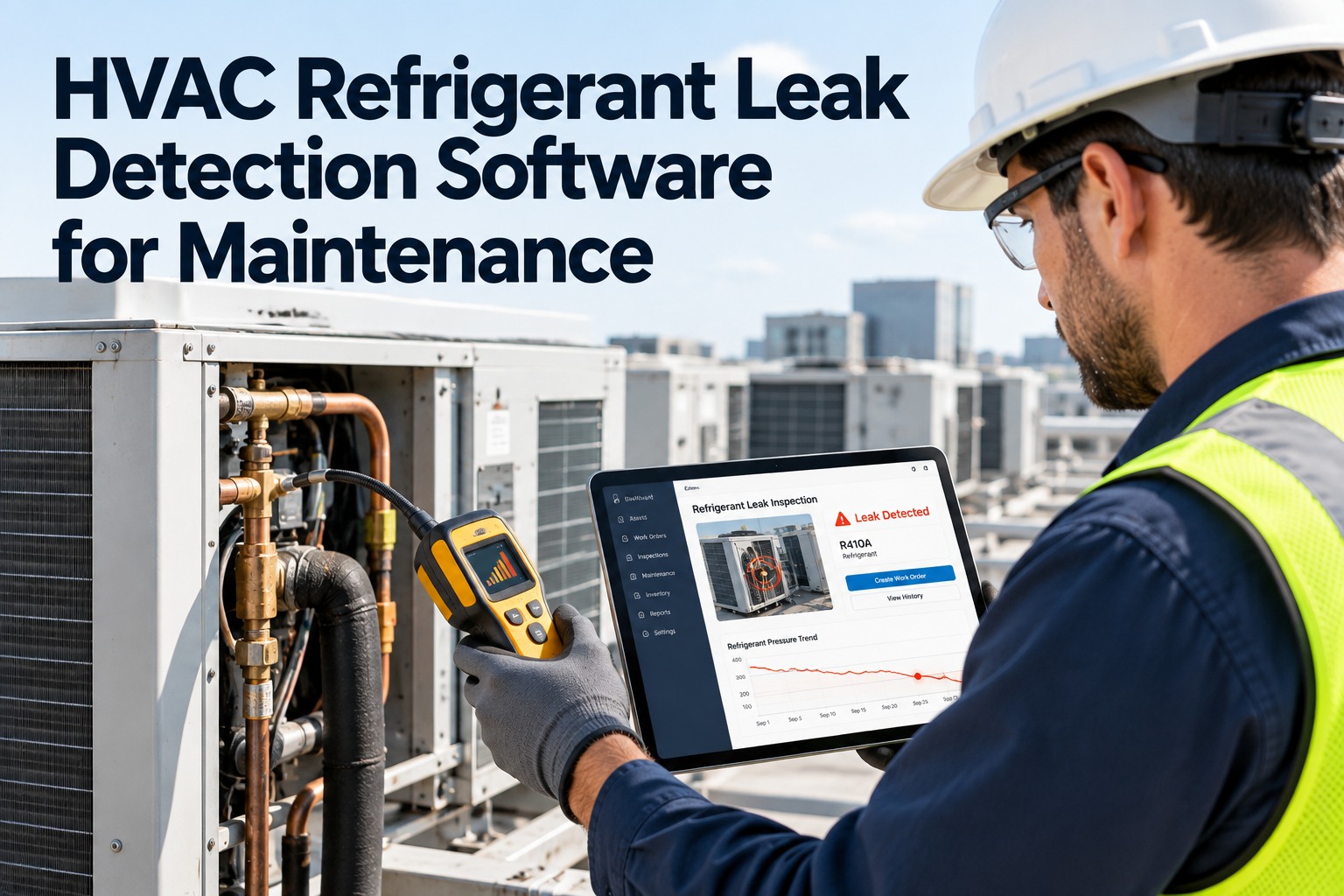
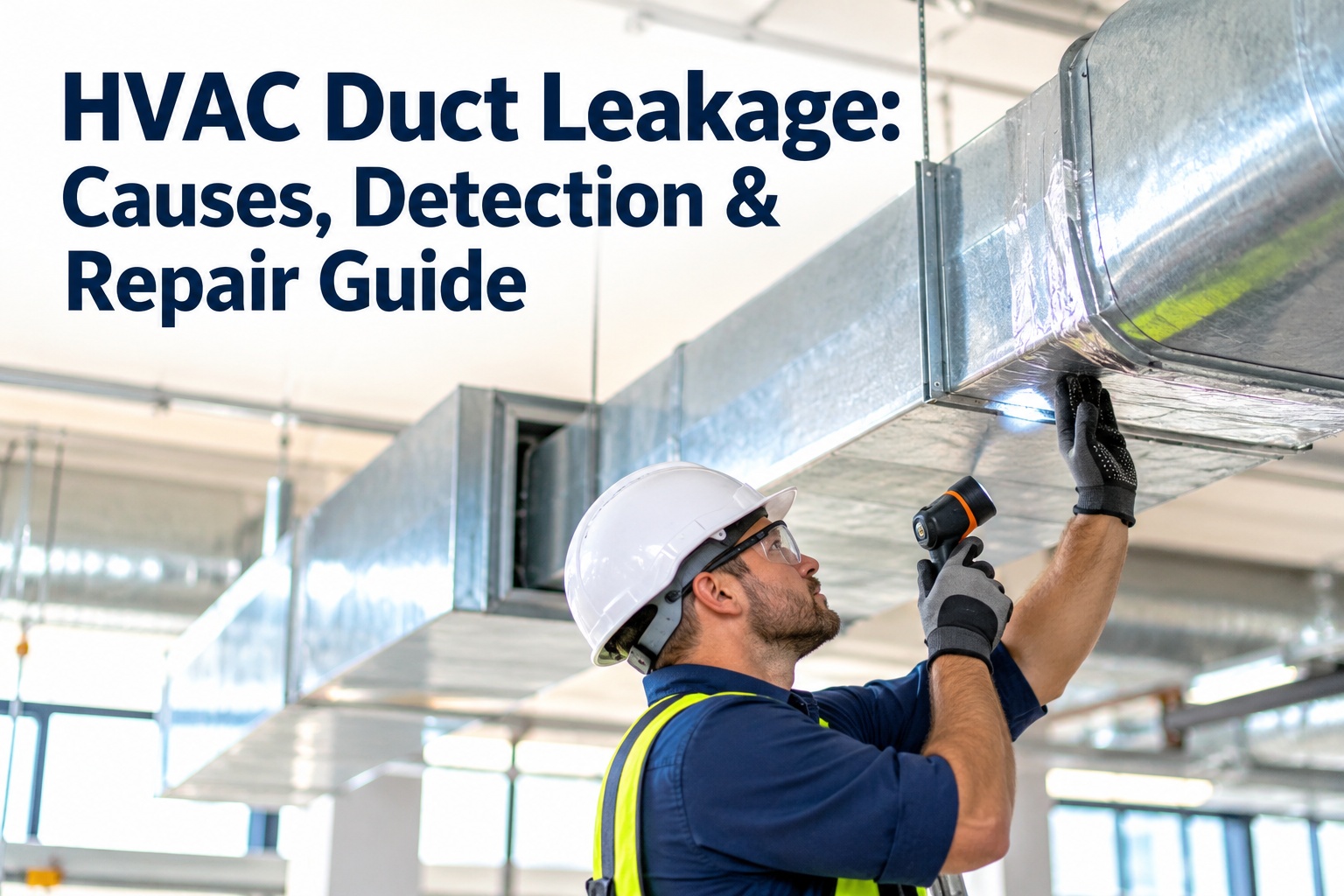
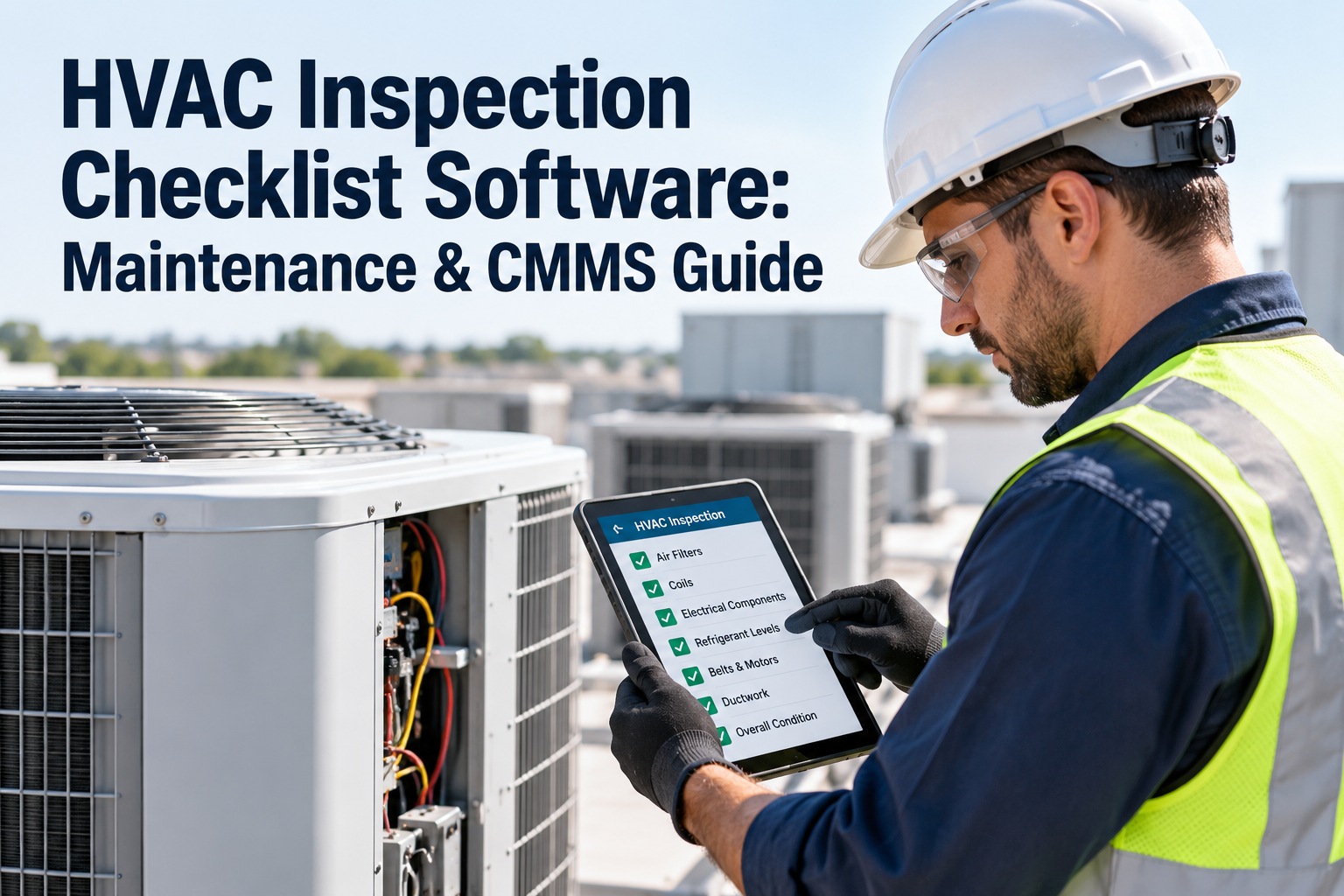
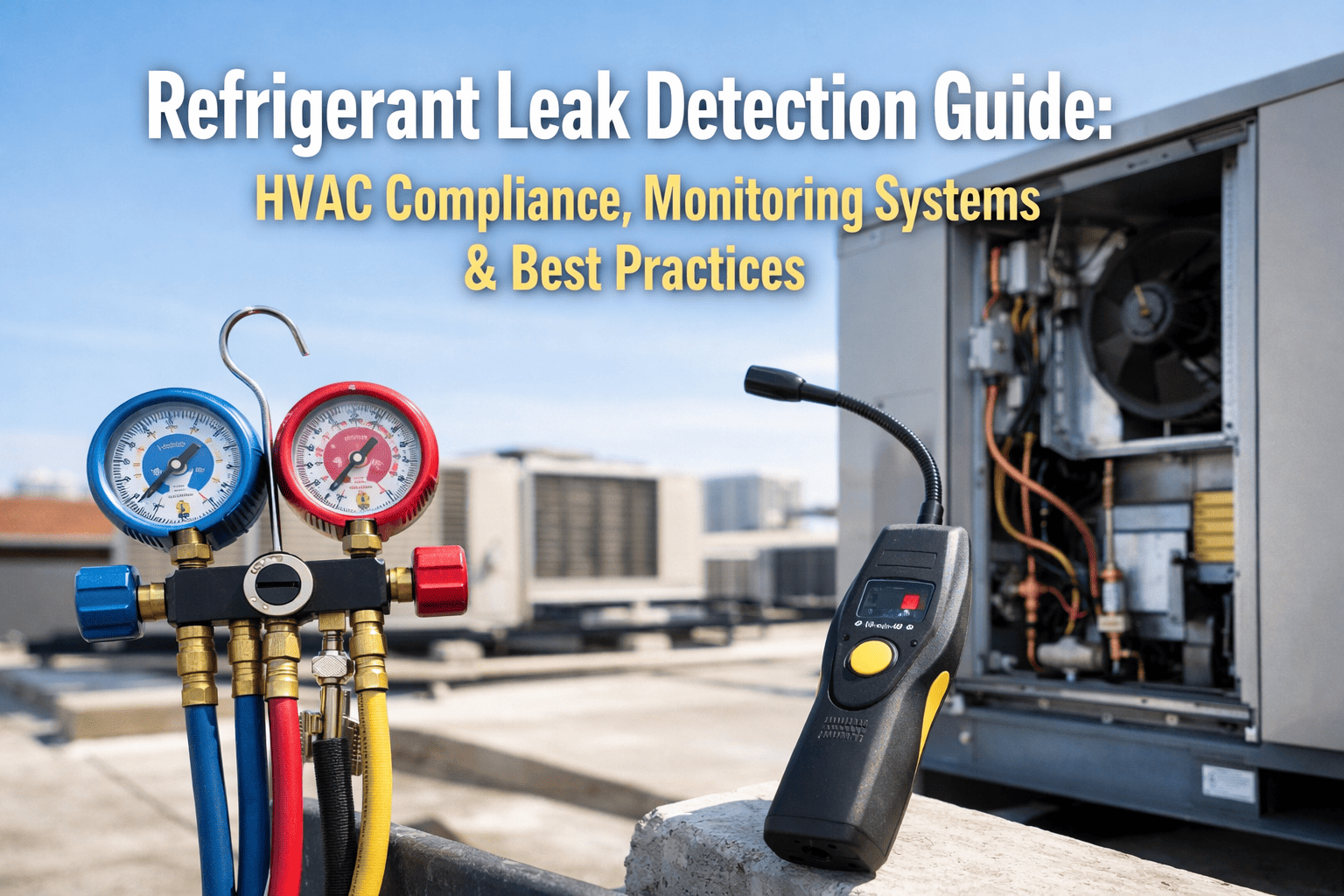
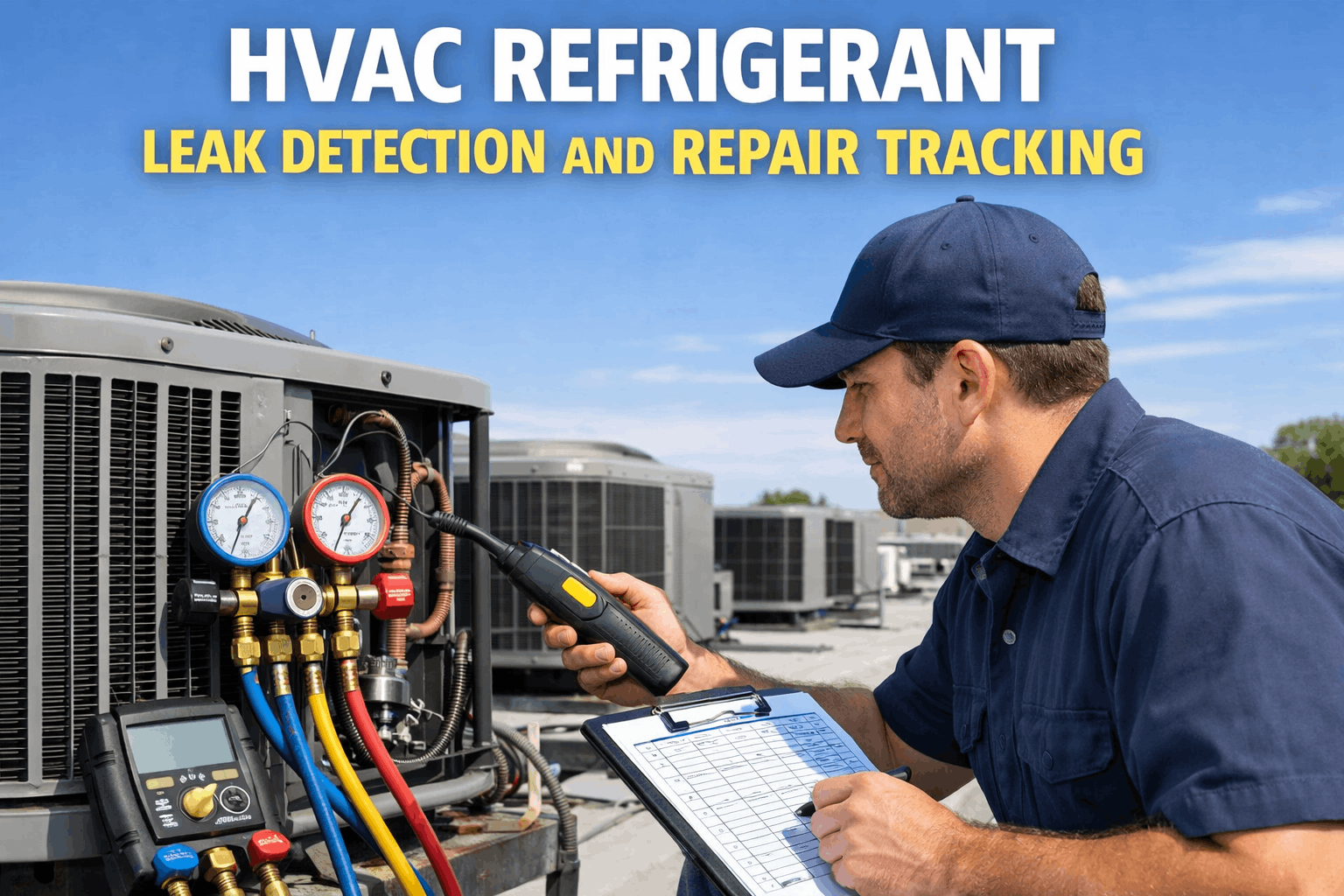
A refrigerant leak rarely announces itself. The system just runs longer, cools less, ices up, and trips on pressure — while the charge quietly escapes, the energy bill climbs, and a regulated greenhouse gas vents to the air. Finding the leak, fixing it properly, verifying the repair held, and documenting the whole thing is what separates a real fix from a top-up that leaks again next month. This HVAC refrigerant leak repair checklist walks the full detect-to-document workflow and logs each step as a tracked work order in OXMAINT AI — or book a demo of refrigerant compliance tracking in OXMAINT AI.
HVAC REFRIGERANT LEAK REPAIR · DETECTION · VERIFICATION · CHECKLIST · 2026
HVAC Refrigerant Leak Repair Checklist: Inspection & Maintenance
A slow leak costs capacity, energy and refrigerant long before anyone calls it in — and for larger systems it carries an EPA repair clock. OXMAINT AI is the AI-powered CMMS that schedules the leak inspections, logs the detection and repair results, and tracks the required verification tests to closure — so a leak becomes a documented, verified repair, not a recurring top-up.
1 · Detect
2 · Repair
3 · Verify
4 · Document
50 lb
EPA 608 leak-repair rules apply to appliances over 50 lbs of refrigerant
10/20/30%
annual leak-rate triggers — comfort cooling, commercial, industrial process
30 days
to repair a leak once the threshold is exceeded
2 tests
an initial and a follow-up verification test to prove the repair held
How to Find the Leak: Detection Methods
No single method catches every leak — a good technician layers them, from a quick electronic sweep to a sealed pressure test. These are the tools and when each earns its place. Start free and log detection results by asset in OXMAINT AI.
Electronic Detector
A heated-diode or infrared sniffer swept along the circuit — fast first pass to find the general area.
UV Dye & Lamp
Fluorescent dye circulated in the system shows the exact weep point under UV light, days later if needed.
Bubble / Soap Test
Solution brushed on a suspect joint — simple, cheap confirmation of an active, accessible leak.
Nitrogen Pressure Test
The circuit pressurised with dry nitrogen to reveal leaks the operating charge was too low to show.
Standing Vacuum / Decay
A pulled vacuum watched for a pressure rise — proves the sealed system is tight before recharging.
Visual & Oil Trace
Oily residue marks a leak point — refrigerant carries oil, so a stain is a map to the breach.
Where Refrigerant Leaks Hide
Leaks concentrate at a handful of points — joints that flex, coils that corrode, valves that wear. Knowing the usual suspects is half the search.
Evaporator Coil
Formicary (ant-nest) corrosion pits the tubing from inside — a leading cause of indoor-coil leaks.
Condenser Coil
Impact damage, vibration fatigue and outdoor corrosion open slow leaks in the outdoor coil.
Flare & Brazed Joints
Poorly made or vibration-fatigued connections are the classic field-leak location.
Schrader & Service Valves
Worn valve cores and unseated caps weep slowly — cheap to fix, easy to miss.
Metering Device / TXV
Connections at the expansion valve and distributor are common weep points.
Line-Set Rub Points
Where tubing rubs a bracket or wall, vibration wears a hole over time.
The EPA Section 608 Leak-Repair Clock
For appliances over 50 lbs of refrigerant, exceeding the annual leak rate for the appliance type starts a regulated repair timeline — and two verification tests to prove it worked. These are the reference thresholds; confirm the current rule and any updates for your situation.
Appliance type
Annual leak-rate trigger
Repair window
Verification
Comfort Cooling
10%
30 days
Initial + follow-up
Commercial Refrigeration
20%
30 days
Initial + follow-up
Industrial Process Refrigeration
30%
30 days (120 if shutdown)
Initial + follow-up
The initial verification test follows the repair; the follow-up test comes within about 10 days of the initial. Service records for 50+ lb appliances are typically kept for three years.
The Refrigerant Leak Repair Checklist
Work the five stages in order — detect, confirm, repair, verify, document. The verification stage is the one most often skipped and the one the rules care most about. Tick each item as you go; the whole row toggles. Book a demo and run this checklist from a phone in OXMAINT AI.
Signature RuleA Repair Isn't Done Until Two Tests Say So
The step that gets skipped is verification — and it's the one that proves the fix held. A repair is only complete after an initial verification test, then a follow-up test a short time later confirms the system is still tight. One passing reading isn't proof; two are.
✓
Initial test — run after the repair, before the system goes back to normal service.
✓
Follow-up test — a short time after the initial, to confirm the repair is still holding.
✓
Both recorded — each test logged with its date and result against the asset.
✓
Re-plan if it fails — a failed test reopens the repair, it doesn't close the job.
How OXMAINT AI Closes the Loop on Every Leak
OXMAINT AI is the AI-powered maintenance management software that carries a refrigerant leak from detection to the verified, documented repair — the asset register, the inspection schedule, the detection and repair results, and the verification-test clock on one platform. Put your refrigerant appliances on it when you start free and schedule leak inspections in OXMAINT AI.
Refrigerant Asset Register
Every appliance with its refrigerant type, full charge and leak history on file.
Scheduled Inspections
Recurring leak checks generated on cadence so a developing leak is found on a route, not on a breakdown.
Leak → Work Order
A detected leak raises a prioritised repair with the location, method and reading attached.
Verification Clock
The initial and follow-up tests tracked as tasks so neither is missed and both are on record.
Service & Charge Log
Every gram added and recovered logged by date and technician for the retention record.
Leak-Rate Trending
Refrigerant added trended per appliance so a chronic leaker gets a real fix, not another top-up.
A Top-Up Is Not a Repair.
Adding refrigerant to a leaking system buys weeks and vents gas the whole time. Found, fixed and verified, a leak is closed for good — with the records to prove it. OXMAINT AI makes the inspection repeatable, the repair accountable and the verification impossible to forget.
EXPERT REVIEW
Written for HVAC-R, facilities and building-operations teams. Handling refrigerant is regulated work — under the US Clean Air Act Section 608, only EPA-certified technicians may service, recover or dispose of refrigerant, and leak-repair rules, thresholds and verification timelines apply to appliances above the charge threshold. The figures cited here are reference values that have changed across rulemakings and carry exceptions — confirm the current requirements against the EPA regulations and your authority having jurisdiction before relying on them. OXMAINT AI is a maintenance management platform that schedules the inspections, logs the results and tracks the verification tests and records — it is not a leak detector, a refrigerant-handling certification, or a substitute for a qualified technician's judgement.
Frequently Asked Questions
How do I know my HVAC system has a refrigerant leak?
The signs are indirect — reduced cooling, longer run times, ice on the evaporator or line, hissing or bubbling sounds, and pressures below normal. Because refrigerant carries oil, an oily residue near a joint or coil is a strong clue. Confirm with an electronic detector, dye or a bubble test before opening the system.
Start free and log leak inspections in OXMAINT AI.
Why isn't adding refrigerant enough?
Topping up a leaking system only masks the problem — the charge escapes again, capacity drops, and for regulated appliances the leak remains a compliance issue. The refrigerant that leaks is also a greenhouse gas. A proper repair finds and fixes the breach, then verifies the system is tight before recharging to the correct weight.
What are the EPA leak-rate thresholds?
For appliances with more than 50 lbs of refrigerant, the annual leak rate that triggers repair is commonly cited as 10% for comfort cooling, 20% for commercial refrigeration and 30% for industrial process refrigeration, with repair generally required within 30 days. These are reference values with exceptions — confirm the current rule for your appliance and jurisdiction.
What are the two verification tests?
After a repair, an initial verification test confirms the leak is fixed; a follow-up test a short time later confirms the repair is still holding under operating conditions. Both are recorded. The two-test discipline is what proves a repair worked rather than just appeared to on the day.
How long must refrigerant records be kept?
For appliances at or above the charge threshold, service records — the date, refrigerant type and quantity added or recovered — are typically retained for three years, with additional reporting if a repair will take longer than a year. Keeping these against each asset is what makes a facility audit-ready.
Book a demo of refrigerant recordkeeping in OXMAINT AI.
Find It, Fix It, Prove It — Every Time.
Run refrigerant leak repair on OXMAINT AI: a register of every refrigerant appliance, scheduled leak inspections, a work order that carries detection and repair results, the initial and follow-up verification tests tracked to closure, and a service-and-charge log that keeps the facility audit-ready.