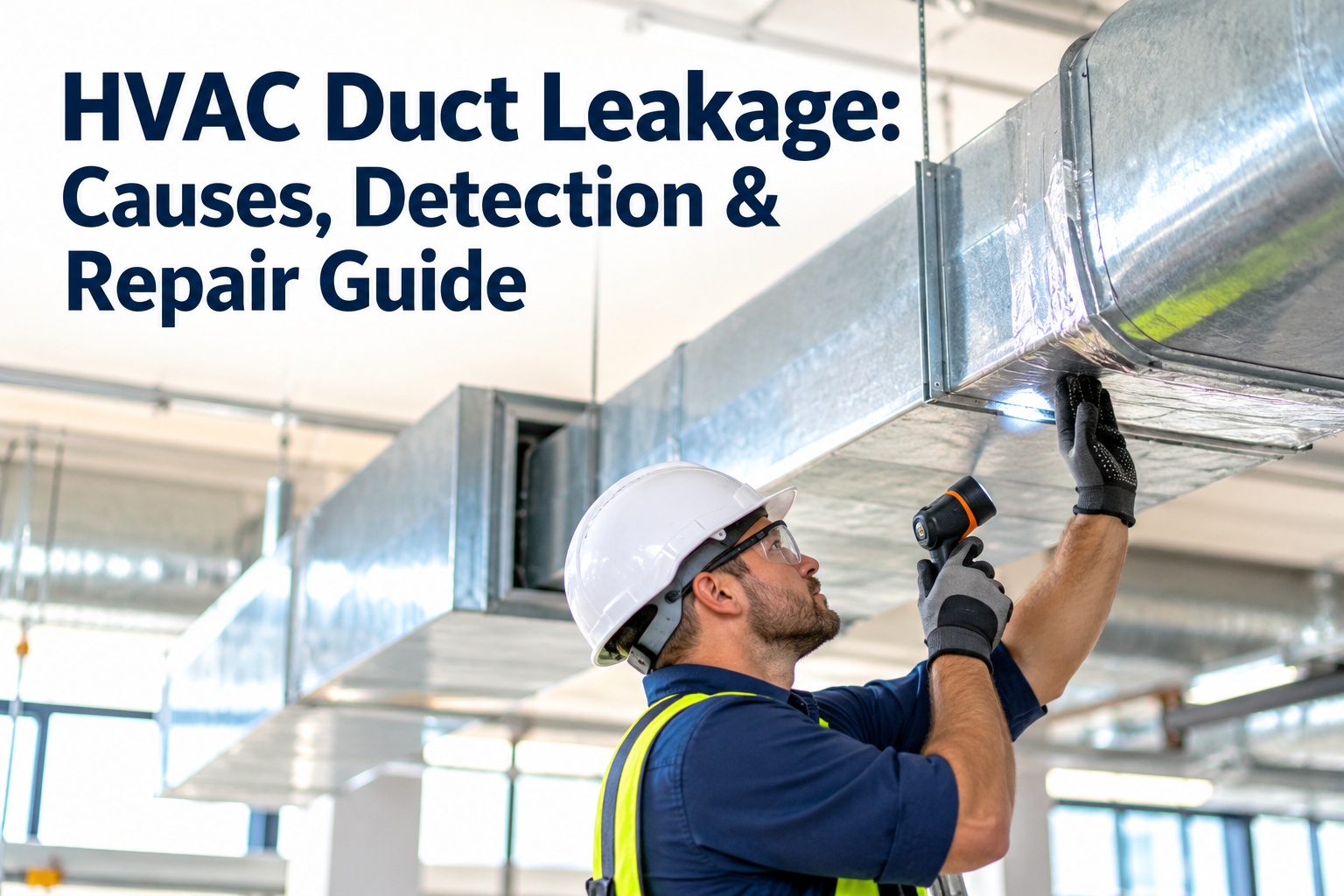
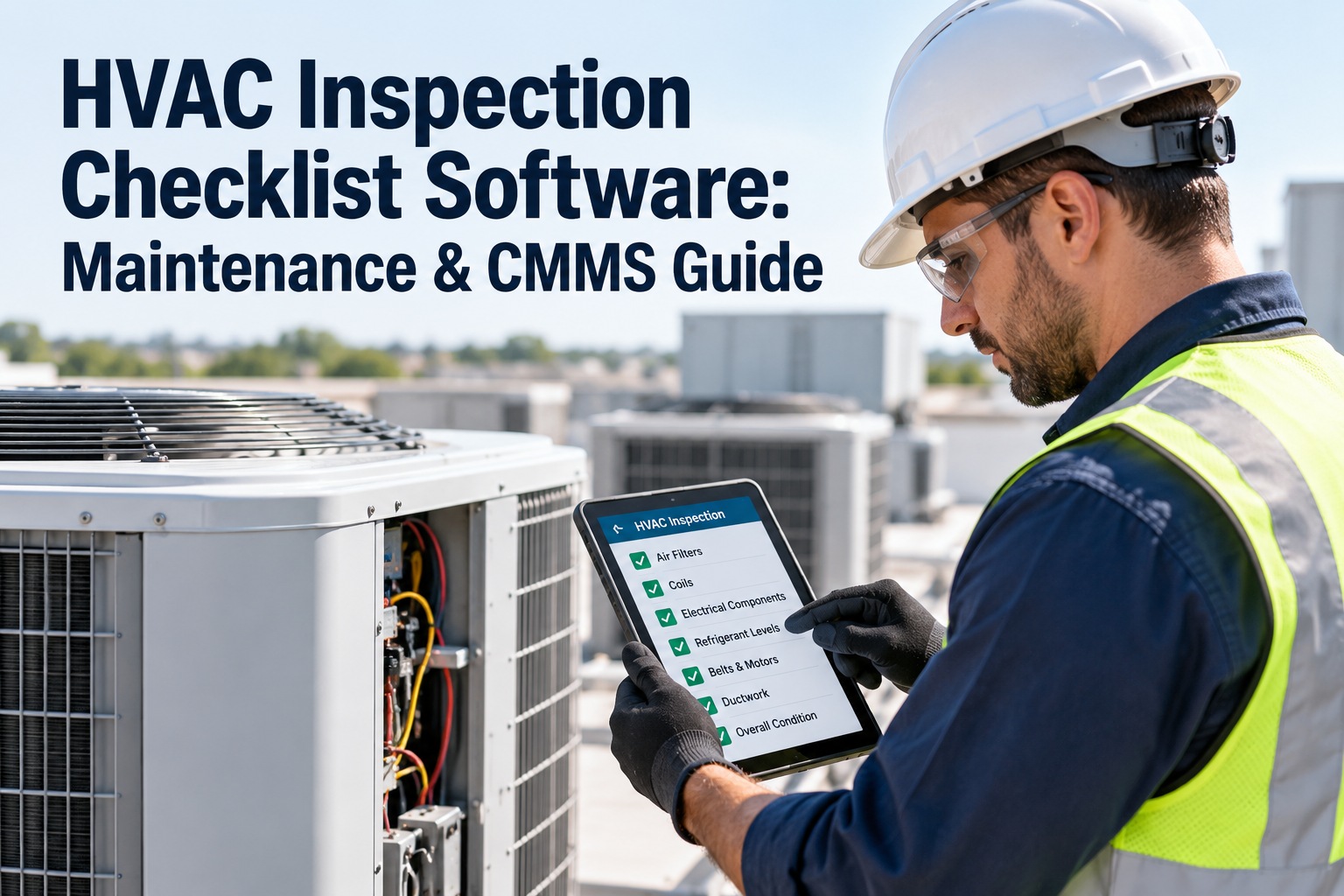
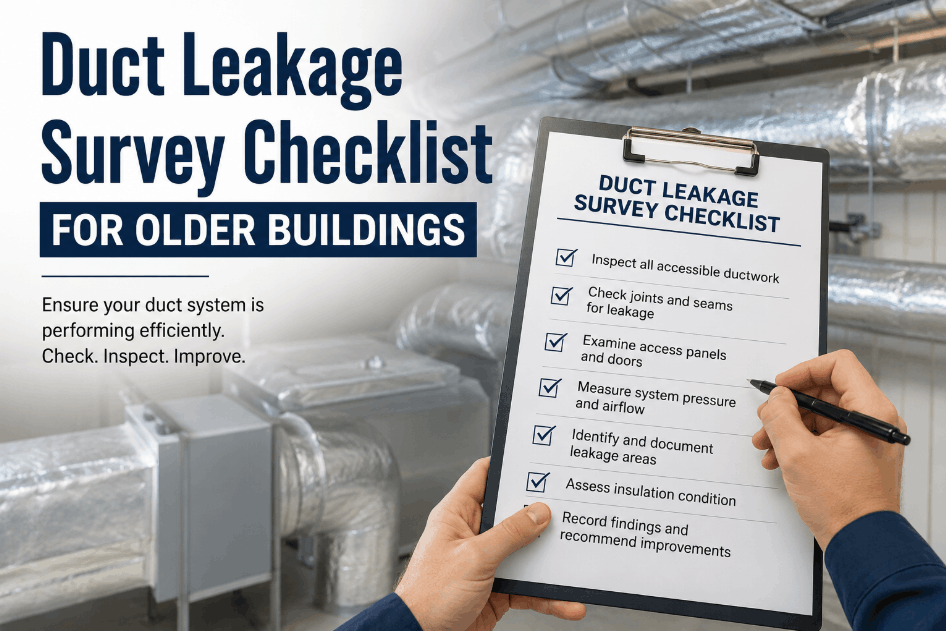
Air you paid to cool or heat escapes through a seam before it ever reaches the room and leaky ductwork can bleed away a large share of a system's delivered air, starving far rooms and loading the fan. The fix is a cycle: find the leaks, seal them to a class, verify by test. This guide covers HVAC duct leakage — causes, detection and repair — and how OXMAINT AI, the AI-powered HVAC maintenance CMMS, turns duct inspection into a tracked maintenance program.
Controls & Airside · HVAC · Duct Leakage Guide · 2026
HVAC Duct Leakage: Causes, Detection & Repair Guide
Conditioned air lost through unsealed seams, far rooms that never cool, a fan working harder for less delivered airflow — that's what duct leakage costs. OXMAINT AI, the AI-powered CMMS and maintenance management software, schedules duct inspections, logs leakage-test results against each system, and turns every failed section into a tracked sealing work order.
1Find
→
2Seal to class
→
3Test & verify
→
4Log & retest
WHAT LEAKAGE COSTS
⚠Conditioned air lost before it reaches the room
⚠Far rooms starved — uneven comfort
⚠Fan runs harder for less delivered airflow
⚠Return leaks pull in dust, humidity, fumes
⚠Pressure imbalance across the system
3 classes
SMACNA seal classes A / B / C by pressure
CL
leakage class — CFM/100 ft² at 1 in. w.g.
F = CL×Pⁿ
allowable leakage equation (n = 0.65)
Test
pressurize, hold, compare to the limit
Where Ducts Actually Leak
Leaks aren't spread evenly — they cluster at the joints, connections and transitions where sections meet and where the duct meets everything else. Knowing the usual suspects is half the inspection, and you can book a demo to see duct inspection tracking in OXMAINT AI.
1
Transverse jointsWhere duct sections connect end to end — the most common leak path.
2
Longitudinal seamsThe lengthwise seam of the duct itself, especially on rectangular runs.
3
AHU connectionsJoints where ducts meet the air handler and plenums — high pressure, high loss.
4
Register & grille bootsWhere the duct meets the diffuser at wall, floor or ceiling.
5
Return plenumsReturn paths are often barely sealed and pull from unconditioned space.
6
Flex runsDisconnected, crushed or kinked flexible duct in ceilings and chases.
Leakage Classes: The Target You Seal To
SMACNA defines how tight a duct must be by its leakage class (CL) — the allowable leakage in CFM per 100 ft² of duct surface at 1 in. w.g. — and sets it by seal class, which depends on the system's pressure. Round duct is inherently tighter than rectangular. The chart below is the target an inspection measures against, and you can start free and record leakage targets in OXMAINT AI.
| Duct type | Seal Class Cjoints only | Seal Class Bjoints + seams | Seal Class Ajoints, seams, penetrations |
| Rectangular metal |
CL 24 |
CL 12 |
CL 6 |
| Round metal |
CL 12 |
CL 6 |
CL 3 |
| Typical pressure |
½–2 in. w.g. |
3 in. w.g. |
4–10 in. w.g. |
CL = CFM/100 ft² at 1 in. w.g. (lower is tighter). Scroll sideways on mobile to see every column.
F = CL × P0.65
F maximum allowable leakage, CFM/100 ft²CL leakage class from the chartP duct pressure, in. w.g.
Measured leakage at or below F for the section means the duct passes.
A Duct Either Meets Its Class, Or It Doesn't.
Leakage isn't a feeling — it's a number you pressurize the duct to find and compare against a calculated limit. Schedule the test, log the result against the system, and a failed section becomes a sealing work order, not a note someone forgets.
How To Detect The Leaks
Detection ranges from a quick hand-and-eye pass to an instrumented pressurization test that puts a number on the whole system. The right method depends on whether you're hunting a specific leak or certifying the duct, and you can book a demo to schedule leakage tests in OXMAINT AI.
Pressurization test
Seal all openings but one, pressurize the section to its class with a calibrated fan, and measure the flow needed to hold it — the quantified result (per ANSI/RESNET/ICC 380 and SMACNA method).
Visual & tactile
Walk the accessible runs feeling for escaping air at joints, seams and boots — fast for finding obvious leaks, poor for quantifying them.
Smoke & airflow
Introduce visible smoke or check airflow at registers to locate where air is escaping or where delivery has dropped off.
Instrument check
Pressure and flow instruments, calibrated within 12 months with NIST-traceable certificates, make the test result defensible.
How To Seal & Repair
Once located, the fix is matched to the joint and the access. The one rule that never bends: ordinary cloth duct tape fails — it dries out and peels. Use rated materials and let them cure before retesting.
Duct mastic
Brushed over joints and seams; durable and handles irregular gaps — the workhorse sealant for most connections.
UL 181 foil tape
For clean, smooth metal joints. Rated and long-lasting — unlike cloth duct tape, which dries out and lets go.
Aerosol sealing
Sealant particles blown through the system from inside, reaching hidden and inaccessible ducts a brush can't.
Boot & penetration seal
Caulk or mastic between boots and the building, plus wall penetrations for higher seal classes.
Section replacement
For crushed, disconnected or badly deteriorated duct — sealing a failed section is false economy.
Insulate after sealing
Re-insulate ducts in unconditioned spaces once sealed, so the gain isn't lost to conduction.
Build A Duct Maintenance Program
One-off sealing degrades again; a program keeps the system tight. OXMAINT AI schedules recurring duct inspections and leakage tests, logs results against each air system, and closes the loop from failed test to sealing work order to retest, and you can start free and build the duct program in OXMAINT AI.
◉
Scheduled Duct Inspections
Recurring inspection and leakage-test PMs per air system, so tightness is checked on a cadence, not after a complaint.
◉
Leakage-Test Records
CFM results, pressure class and pass/fail against the calculated limit logged against each system over time.
◉
Failed-Section Work Orders
A section over its limit raises a sealing work order with the location and method, routed to a technician.
◉
Seal-and-Retest Loop
The seal-cure-retest sequence is tracked so a repair isn't closed until the section passes.
◉
Photo & Document Capture
Leak photos and test reports kept on the asset record for the energy, commissioning or code file.
◉
Airside History
Duct work sits alongside filter, coil and fan PMs on one air-system record, so airside issues connect.
“
We kept chasing comfort complaints on the top floor with balancing tweaks that never held — the real problem was leakage at the plenum connections dumping conditioned air into the ceiling. Once we scheduled leakage tests, logged the CFM against each system and let a failed section raise a sealing order, the duct work became measurable. We seal to a class and verify it now, instead of guessing from the registers.
Facilities Engineer · Commercial Office Portfolio
Frequently Asked Questions
What causes HVAC duct leakage?
Mostly unsealed or failed connections: transverse joints between duct sections, longitudinal seams, connections at the air handler and plenums, register and grille boots, barely-sealed return plenums, and disconnected or crushed flex runs. Leaks concentrate at joints and transitions, not along solid duct wall.
Book a demo to see duct inspection tracking in OXMAINT AI.
What are SMACNA leakage and seal classes?
The leakage class (CL) is the allowable leakage in CFM per 100 ft² of duct at 1 in. w.g. — lower is tighter, and round duct is tighter than rectangular. Seal class sets what you seal by pressure: Class C seals transverse joints only (low pressure), Class B adds seams, and Class A adds all wall penetrations (high pressure).
How is a duct leakage test done?
Choose a section and calculate its surface area, seal all openings but one, connect a calibrated fan with flow and pressure instruments, pressurize to the duct's class, and measure the airflow needed to hold that pressure. Compare the measured leakage to the maximum allowable F = CL × P^0.65 for the section — at or below passes.
What's the best way to seal ducts?
Mastic brushed over joints and seams for most connections, UL 181 foil tape on clean metal joints, and aerosol sealing for hidden runs a brush can't reach. Never use ordinary cloth duct tape — it dries out and peels. Crushed or disconnected duct is replaced, not sealed, and ducts in unconditioned space are re-insulated afterward.
How does a CMMS help with duct leakage?
It makes sealing a program instead of a one-off: schedule recurring duct inspections and leakage tests, log CFM results and pass/fail against each air system, raise a sealing work order for any section over its limit, and track the seal-cure-retest loop until it passes — with photos and test reports kept on the asset.
Start free and build a duct maintenance program in OXMAINT AI.
Stop Paying To Condition The Ceiling Void.
Run duct leakage control on the OXMAINT AI maintenance management software — scheduled inspections and leakage tests, results logged to the seal class, sealing work orders for every failed section, and a seal-and-retest loop that proves the duct is tight. Find the leaks, seal to the class, verify by test — on a cadence.