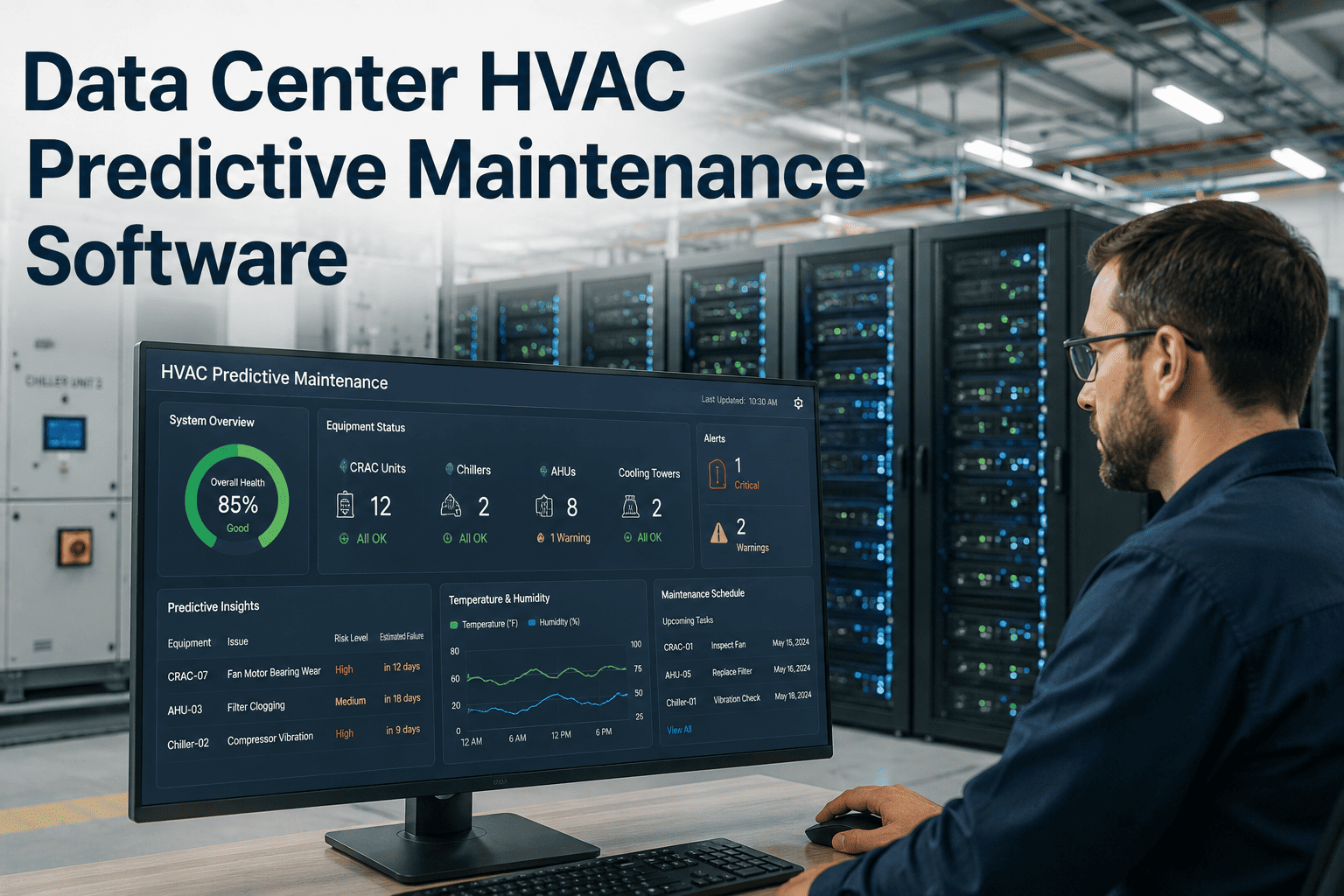
A data center operations manager watches the thermal dashboard spike — a CRAH unit on Row 14 has drifted 6°F above setpoint, and the nearest technician is 40 minutes away responding to a separate chiller alarm. By the time they arrive, three adjacent racks have throttled CPUs to prevent thermal shutdown, cutting compute capacity by 22% during a peak workload window. The post-incident review reveals what everyone already knew: the coil fouling that caused the failure was visible two weeks ago, but nobody had bandwidth to inspect 340 air handling units across 180,000 square feet of whitespace. Data centers deploying robotic HVAC inspection and maintenance systems monitor cooling infrastructure continuously, detect coil degradation 3–6 weeks before performance impact, and reduce thermal-related compute throttling events by 72%. A hyperscale operator running 48 MW of critical IT load across three facilities deployed autonomous inspection robots across 2,400+ cooling units — linking every thermal anomaly, coil condition score, and refrigerant reading directly to Oxmaint CMMS for predictive work order generation and cooling asset lifecycle management. This guide explains exactly how HVAC robots work for data center cooling maintenance and how CMMS integration turns robotic inspection data into cooling reliability intelligence.
29%
Downtime from Cooling
Percentage of unplanned data center outages where cooling system failure is a primary or contributing cause (Uptime Institute)
$8,660/min
Average Outage Cost
Average cost per minute of unplanned data center downtime including SLA penalties, lost revenue, and emergency response (Ponemon Institute)
40–60%
Energy for Cooling
Proportion of total data center energy consumption devoted to cooling — making HVAC efficiency the single largest controllable operating cost
Operations teams ready to
Sign Up connect robotic inspection data to structured maintenance workflows — linking every cooling unit's thermal performance, coil condition, and refrigerant status to predictive work orders and lifecycle tracking in a single platform.
What HVAC Robots for Data Centers Actually Do
HVAC robots for data centers aren't general-purpose cleaning machines. They are purpose-built autonomous inspection and maintenance platforms designed to operate in the unique environment of raised-floor and hard-floor whitespace — navigating hot aisle/cold aisle configurations, accessing underfloor plenums, and performing continuous thermal and mechanical assessment of cooling infrastructure that human technicians only inspect periodically. The real value emerges when robotic inspection data connects to operational systems. Data centers implementing Sign Up for Oxmaint establish the critical link — connecting every robotic inspection finding to the cooling unit's maintenance history, PM schedule, and performance baseline so that condition data drives predictive work orders automatically.
5
Predictive Cooling Optimization Layer
Historical inspection data, failure patterns, and seasonal load profiles feed machine learning models that predict cooling unit degradation curves. Maintenance shifts from calendar-based PM to condition-driven intervention timed to actual asset health.
Outputs: Predictive failure alerts, optimal coil cleaning schedules, refrigerant charge trending, capacity planning reports, PUE optimization recommendations
4
CMMS Integration Layer
Each inspected cooling unit maps to a unique Oxmaint asset record via API. Robotic findings auto-generate work orders with severity classification, thermal imagery attachments, and recommended actions. PM schedules adjust dynamically based on inspection results.
Technologies: Oxmaint CMMS, REST APIs, automated work order generation, condition-based PM triggers, asset hierarchy mapping
3
Analytics & Anomaly Detection Layer
Inspection data processed through thermal analysis algorithms, vibration signature comparison, and coil condition scoring models. Anomalies flagged against baseline performance envelopes established per unit. Delta-T trending identifies degradation weeks before threshold breach.
Technologies: Thermal analytics engines, FFT vibration analysis, AI coil condition scoring, CFD model correlation, statistical process control
2
Data Collection & Sensor Fusion Layer
Robots capture synchronized multi-sensor data at each cooling unit: thermal imagery (coil face, discharge air, motor housing), acoustic signatures (bearing, compressor, fan), vibration profiles, airflow velocity, and ambient temperature/humidity mapping.
Technologies: FLIR thermal cameras, MEMS microphone arrays, tri-axis accelerometers, hot-wire anemometers, BME680 environmental sensors
1
Autonomous Navigation & Access Layer
Robots navigate hot/cold aisle configurations autonomously using LiDAR SLAM, avoid active cabling and personnel, access underfloor plenums via ramp or lift, and execute inspection routes during off-peak hours without disrupting operations or requiring escorts.
Technologies: LiDAR SLAM navigation, obstacle avoidance, fleet management software, underfloor-rated platforms, autonomous charging docks
Critical Integration Point: Oxmaint operates at Layer 4, connecting every robotic inspection finding to the cooling unit's complete maintenance record — so thermal anomalies, coil condition scores, and vibration alerts drive predictive work orders automatically.
Robotic HVAC Platforms: Technology Comparison for Data Centers
Selecting the right robotic platform depends on facility layout, cooling architecture, inspection scope, and whether the priority is continuous monitoring or periodic deep inspection. Most large data centers deploy a combination — autonomous mobile robots for continuous whitespace patrol, underfloor crawlers for plenum inspection, and aerial drones for overhead ductwork and ceiling plenum access. Operations leaders evaluating robotic programs can Book a Demo to see how Oxmaint connects robotic inspection data to cooling maintenance workflows regardless of robot platform.
Most data centers combine 2–3 approaches: autonomous mobile robots for continuous CRAH/CRAC inspection, underfloor crawlers for plenum health, and coil cleaning robots for automated maintenance execution. Regardless of platform, all inspection data flows into the same CMMS asset structure through
Sign Up for Oxmaint.
Connect Robotic Inspection Data to Cooling Maintenance Intelligence
Oxmaint links every robotic thermal scan, vibration reading, and coil condition score to structured work orders, PM schedules, and asset lifecycle tracking — so every cooling unit becomes a continuously monitored, predictively maintained asset.
What Robotic Inspection Actually Detects: Cooling Failure Modes
The value of robotic HVAC inspection is measured by what it catches before failure cascades into compute impact. Each failure mode has a detection window — the time between when degradation becomes robotically detectable and when it causes a thermal event. Understanding these detection windows is what transforms robotic inspection from a monitoring novelty into a reliability program with measurable uptime impact.
Coil Fouling & Degradation
Thermal imaging detects uneven coil face temperatures indicating fouling zones. Progressive delta-T degradation tracked across inspection cycles. AI scoring quantifies fouling severity from 0–100 and predicts cleaning urgency based on degradation rate and current thermal headroom.
Detection Window: 3–6 weeks before performance impact — enough time for planned coil cleaning during maintenance windows
Fan Bearing Degradation
Acoustic and vibration signatures identify bearing wear patterns — inner race defects, outer race faults, cage deterioration, and lubrication breakdown. Frequency-domain analysis separates bearing faults from normal operational signatures with high confidence even in noisy whitespace environments.
Detection Window: 4–8 weeks before failure — preventing catastrophic fan failure and secondary compressor damage
Refrigerant Charge Loss
Superheat and subcooling deviation detected through supply/return temperature differential analysis. Gradual charge loss shows as progressive delta-T reduction before reaching alarm thresholds. Robotic trending catches 5–10% charge deviation that BMS setpoint alarms miss entirely.
Detection Window: 2–4 weeks before capacity loss — enabling scheduled refrigerant service instead of emergency calls
Airflow Obstruction & Bypass
Anemometer and thermal mapping identify hot air recirculation, blanking panel gaps, cable obstructions under raised floors, and misaligned perforated tiles. Underfloor crawlers map plenum obstructions that reduce cooling delivery to specific rack rows without triggering unit-level alarms.
Detection Window: Immediate identification — eliminating phantom hot spots that waste cooling capacity
Condensate & Water Leak Detection
Thermal imaging and moisture sensors detect active leaks, condensate pan overflow, and drain line blockages. Underfloor crawlers identify standing water, dripping from overhead piping, and sub-slab moisture migration before water reaches IT equipment or causes structural damage to raised floor systems.
Detection Window: Hours to days before water reaches equipment — preventing the #2 cause of data center physical damage
Electrical & Motor Anomalies
Thermal imaging of motor housings, VFD enclosures, and electrical connections detects hot spots indicating loose connections, insulation breakdown, or phase imbalance. Acoustic analysis identifies motor winding faults and VFD switching anomalies that precede drive failure.
Detection Window: 2–6 weeks before motor or drive failure — preventing complete unit loss and cascading thermal events
Deployment Strategy: Phased Robotic Program Implementation
The deployment approach determines how quickly robotic inspection delivers reliability improvements. Data centers that attempt to instrument every cooling unit simultaneously face integration complexity, alert fatigue, and delayed value realization. Phased deployment focused on highest-density cooling zones first delivers measurable thermal reliability improvements within weeks — building operational confidence and baseline data for facility-wide expansion.
Single-Hall Pilot
Best for: Proving concept to operations leadership
Timeline: 4–8 weeks to first actionable findings
Advantages
- Contained scope — one robot, one data hall, focused integration
- Produces thermal reliability data within first inspection cycle
- Low-risk validation of robot navigation in live environment
- Baseline data quality established before scaling
Considerations
- Limited ROI scope — single hall may not represent facility diversity
- Robot utilization low if only one hall is in scope
- Cross-hall thermal interactions not captured
- May miss interconnected cooling system dependencies
Recommended
Phased Multi-Hall Rollout
Best for: Enterprise and hyperscale operators
Timeline: 3–6 months for full facility coverage
Advantages
- Start with highest-density / highest-risk cooling zones
- Each phase builds integration maturity and alert tuning
- Fleet scales as operational team builds robotic workflow competency
- CMMS integration refined progressively — fewer false positive work orders
Considerations
- Requires clear phase gates and expansion criteria
- Temporary coverage gaps in non-deployed halls
- Robot fleet management complexity increases with each phase
- Cross-facility coordination needed for multi-site operators
Full Facility Deployment
Best for: New builds or major cooling retrofits
Timeline: 6–12 weeks intensive deployment
Advantages
- Complete facility thermal visibility from day one
- Full cooling system interdependency mapping
- Uniform baseline across all halls simultaneously
- Maximum PUE impact in shortest total timeline
Considerations
- Highest initial alert volume — requires tuned escalation logic
- Larger robot fleet requires dedicated fleet management
- All-at-once CMMS integration may overwhelm maintenance teams
- Larger upfront investment before baseline data validates ROI
Most data centers begin with a phased rollout: deploy to the highest-density data hall with the most cooling units and tightest thermal margins first, expand to adjacent halls in phase two, then complete coverage with utility plant and exterior condenser inspection in phase three. All data — regardless of deployment phase — feeds into the same Oxmaint asset structure for unified cooling reliability reporting.
The Maintenance Connection: Why CMMS Is the Backbone
A robot that generates thermal alerts without connecting to maintenance workflows is a notification system, not a reliability program. A CMMS without robotic condition data schedules coil cleaning on calendar intervals regardless of actual fouling state — wasting labor on clean units while neglected units degrade toward failure. The integration of robotic inspection data with CMMS maintenance records transforms both — giving condition data operational structure and giving maintenance workflows predictive intelligence. This is where robotic inspection investment compounds in value across every cooling unit and every maintenance cycle.
1
Autonomous Inspection
Robot completes scheduled patrol — thermal, acoustic, vibration, and environmental data captured for every cooling unit
→
2
Anomaly Detection
Analytics engine compares readings against unit-specific baselines — deviations classified by severity and failure mode type
→
3
Predictive Work Orders
Oxmaint auto-generates work orders with thermal images, condition scores, recommended actions, and priority based on thermal headroom
→
4
Planned Intervention
Technicians execute targeted maintenance during scheduled windows — coil cleaning, bearing replacement, or refrigerant service on confirmed-degraded units only
→
5
Verification & Trending
Post-maintenance robotic scan confirms performance restoration — trending data updates asset lifecycle models and optimizes future PM intervals
Example Scenario 1: Coil Fouling Prevention at Scale
A 20 MW colocation facility with 280 CRAH units across four data halls deployed two autonomous inspection robots on continuous patrol. Within the first 30 days, robotic thermal analysis identified 34 units with coil fouling scores above 60 (on a 0–100 scale) — none of which had triggered BMS alarms because delta-T remained within normal range. Targeted coil cleaning on these 34 units recovered 8.2°F average supply air temperature improvement, reducing compressor runtime across the facility by 11%. Annualized energy savings: $340,000. More critically, the robotic program identified 6 units with fouling progression rates indicating they would have breached thermal margins within 3 weeks — preventing an estimated 4 thermal throttling events affecting 180+ racks. Each event historically cost $45,000–$120,000 in SLA penalties and emergency response.
Example Scenario 2: Bearing Failure Prediction Across Fleet
Robotic acoustic analysis across 420 CRAH/CRAC units in a hyperscale facility identified 12 units with bearing degradation signatures — 8 with inner race defects and 4 with lubrication breakdown patterns. Maintenance history in Oxmaint showed all 12 units were within their calendar-based PM window (no work due for 6–10 weeks). Without robotic detection, these bearings would have progressed to failure during the PM gap. Three of the 12 units had degradation rates indicating failure within 14 days. Planned bearing replacement during a scheduled maintenance window cost $1,800 per unit. The historical average cost of an unplanned CRAH fan bearing failure at this facility — including emergency parts, overtime labor, temporary cooling deployment, and compute capacity impact — was $78,000 per event. Cost avoidance for the 12 detected units: $912,000.
Robotic Inspection Finds the Problem. Oxmaint Fixes It Before It Matters.
Connect every robotic thermal scan, vibration alert, and coil condition score to structured work orders, predictive PM schedules, and cooling asset lifecycle tracking — all in one platform built for data center operations managing mission-critical cooling infrastructure.
Expert Perspective: HVAC Robots for Data Center Cooling
We were cleaning every CRAH coil on a 90-day calendar cycle — 280 units, four times a year. That's 1,120 coil cleanings annually at $180 each, and we still had thermal events because some coils fouled in 45 days while others were clean at 120 days. The calendar approach was both too frequent and not frequent enough at the same time. The robots changed the equation completely. Within two months, we had fouling rate curves for every unit in the facility. Some coils near loading docks fouled three times faster than units in interior rows. The CMMS now schedules coil cleaning based on actual condition scores — not calendar dates. We cut total cleanings by 40% while eliminating thermal events caused by fouled coils entirely. The PUE improvement alone — from optimized coil condition across the fleet — saved us $280,000 per year in energy costs. But the real win was the bearing prediction. Six months in, the robots flagged a fan motor on a CRAH unit that showed no BMS alarm, no temperature deviation, nothing visible. The acoustic signature said inner race bearing defect, 14–21 days to failure. We replaced it during a planned window for $1,800. That unit was the sole cooling source for a high-density row running $4 million in customer SLA commitments.
Tune Alerts Before You Scale
Run the first 30 days in observation mode — collect data, establish baselines, and tune anomaly thresholds before enabling automatic work order generation. Untethered robots generating hundreds of untuned alerts will overwhelm your maintenance team and destroy program credibility before it starts.
Baseline Every Unit Individually
No two CRAH units perform identically, even same-model units in the same row. Age, load, position, and airflow path create unique performance envelopes. Robot baselines must be per-unit, not fleet-average — otherwise you'll miss degradation in high-performing units and false-alarm on naturally lower-performing positions.
Close the Loop with Post-Maintenance Scans
Every maintenance action — coil cleaning, bearing replacement, refrigerant charge — should be followed by a robotic verification scan within 24 hours. This confirms performance restoration, updates the unit's baseline, and creates a maintenance-effectiveness record that optimizes future interventions across the fleet.
Frequently Asked Questions
Can HVAC inspection robots operate safely in live data center environments?
Yes — purpose-built data center inspection robots are designed specifically for live production environments. They operate at walking speed or slower, use LiDAR-based obstacle avoidance to navigate around personnel and active cabling, produce noise levels below 45 dB (quieter than a typical CRAH unit), and generate no electromagnetic interference that could affect IT equipment. Robots are typically scheduled for primary inspection routes during low-traffic periods but can operate safely alongside active maintenance teams during all hours. Most platforms include emergency stop capabilities accessible from fleet management software and physical buttons. The robots do not contact or physically interact with cooling equipment during inspection — all measurements are non-contact thermal, acoustic, and environmental sensing.
Book a Demo to discuss safety integration for your facility configuration.
How does robotic inspection compare to BMS monitoring for detecting cooling issues?
BMS monitoring and robotic inspection are complementary, not competing. BMS sensors monitor unit-level setpoints and alarm thresholds — they tell you when a unit has already deviated from normal operation. Robotic inspection detects the degradation patterns that precede those deviations, typically 3–8 weeks earlier. A CRAH unit losing refrigerant charge gradually will maintain its setpoint by increasing compressor runtime — the BMS shows normal operation while energy consumption rises and capacity margin shrinks. Robotic thermal analysis catches the supply air temperature shift and delta-T reduction that indicates charge loss weeks before the unit can no longer hold setpoint. Similarly, coil fouling that reduces capacity by 15% may not trigger a BMS alarm if the unit compensates with increased fan speed — the robot sees the fouling thermally and scores it for maintenance priority. Oxmaint integrates both data streams — BMS alarms for real-time response and robotic condition data for predictive maintenance.
What is the ROI of deploying HVAC robots in a data center?
ROI comes from four primary sources: avoided thermal events (the largest single contributor — one prevented thermal throttling event typically saves $45,000–$250,000 in SLA penalties and emergency costs), energy optimization from maintained coil efficiency (typically 5–15% cooling energy reduction, worth $100K–$500K annually per megawatt of IT load), labor reallocation from calendar-based to condition-based maintenance (30–50% fewer coil cleanings with zero thermal events), and extended equipment life through early intervention (15–25% bearing and compressor life extension). For a typical 10 MW facility with 200+ cooling units, total annual ROI ranges from $400K–$1.2M against a robotic program cost of $150K–$400K per year. Payback period is typically 4–8 months.
Sign Up to start building the cooling asset data foundation for ROI measurement.
How does robotic inspection data connect to Oxmaint CMMS?
Robotic platforms transmit inspection data via REST API to Oxmaint after each patrol cycle. Each cooling unit in the facility maps to a unique Oxmaint asset record using the unit's physical identifier (nameplate, QR code, or location ID). When the analytics engine detects an anomaly exceeding configured thresholds, Oxmaint automatically generates a work order containing the thermal image, condition score, anomaly classification, recommended maintenance action, and priority level based on thermal headroom remaining. Technicians receive the work order on mobile devices with the unit's complete maintenance history visible in context. After completing maintenance, the technician closes the work order in Oxmaint, and the next robotic inspection verifies performance restoration — closing the predictive maintenance loop. All historical inspection data is retained in the asset record for lifecycle trending and capital planning.
How many robots does a typical data center need?
Fleet size depends on facility square footage, number of cooling units, desired inspection frequency, and hall layout complexity. A general guideline: one autonomous mobile inspection robot covers 100,000–200,000 square feet of whitespace on a daily inspection cycle, or 150–400 cooling units. A 20 MW facility with four data halls and 300 CRAH units typically deploys 2–3 mobile inspection robots plus one underfloor crawler for plenum inspection. Hyperscale campuses with multiple buildings may deploy 5–10 robots managed through centralized fleet software. Coil cleaning robots are typically deployed at 1 per 200–300 units and shared across halls on a rotating schedule. Most operators start with a single inspection robot in their highest-risk hall and expand fleet size as the program matures and ROI is validated.
Book a Demo to model fleet sizing for your facility.